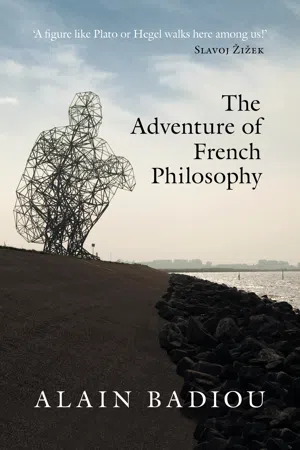
The Adventure of French Philosophy is essential reading for anyone interested in what Badiou calls the "French moment" in contemporary thought.
Badiou explores the exceptionally rich and varied world of French philosophy in a number of groundbreaking essays, published here for the first time in English or in a revised translation. Included are the often-quoted review of Louis Althusser's canonical works For Marx and Reading Capital and the scathing critique of "potato fascism" in Gilles Deleuze and F?lix Guattari's A Thousand Plateaus. There are also talks on Michel Foucault and Jean-Luc Nancy, and reviews of the work of Jean-Fran?ois Lyotard and Barbara Cassin, notable points of interest on an expansive tour of modern French thought.
Guided by a small set of fundamental questions concerning the nature of being, the event, the subject, and truth, Badiou pushes to an extreme the polemical force of his thinking. Against the formless continuum of life, he posits the need for radical discontinuity; against the false modesty of finitude, he pleads for the mathematical infinity of everyday situations; against the various returns to Kant, he argues for the persistence of the Hegelian dialectic; and against the lure of ultraleftism, his texts from the 1970s vindicate the role of Maoism as a driving force behind the communist Idea.
- 432 pages
- English
- ePUB (mobile friendly)
- Available on iOS & Android
eBook - ePub
The Adventure of French Philosophy
About this book
Information
Topic
FilosofíaSubtopic
Teoría críticaPART I. ESSAYS AND TALKS
1
The Current Situation
on the Philosophical Front
I. SO MANY MOTLEY SOLDIERS ON ONE FRONT
Philosophy as partisanship. Philosophy as concentration of antagonism, in terms of worldview. Philosophy thoroughly summoned by history. The servant not of the sciences but of weaponry. Not the reign of the eternal, much less of wisdom, but the trenchant figure of the actual, of the divided, of class. Not heaven and air, the place of contemplative transparency. Not at all the nocturnal waters of reconciliation. But the resilient earth of production, the weight of interestedness, the fire of the historical ordeal.
Here we are going to place a few names, three notable names on the whole apparent surface: Lacan, Deleuze and Althusser. Does this not say it all? No, because our philosophical time, since the revolt spread, no longer finds an emblem in a name. Every list of notables is foreclosed. We will explain why these names are at best masking and misleading the philosophical novelty that is at stake. What they tell us about the forces of the real is foreign to these names themselves.
There is only one great philosopher of our time: Mao Zedong. And this is not a name, nor even a body of work, but time itself, which essentially has the current form of war: revolution and counter-revolution. There is nothing else to say, philosophically speaking, than the anteriority of this division with regard to any philosophy. Which is why what matters is the line drawn at the front.
When our Chinese comrades talk about ‘struggles of principle’ that take place on the ‘philosophical front’, they have in mind the stages of revolutionary politics. Philosophical attacks and counterattacks accompany the historical periodization. The philosophical preparation of two camps aims at drawing up a balance sheet of one stage and concentrating the forces for the new stage that is just opening up. Philosophy possesses no more permanence than does the revolution. It enters the scene at the great turning points of history.
For three or four years now, philosophy enters the scene by way of a practical question that occupies all philosophers, whether avowedly or not: what has been the significance of May 1968? We will show that everything that is said about Power and Desire, about the Master and the Rebel, about the Paranoiac and the Schizophrenic, about the One and the Multiple, takes a stance and resonates with regard to this question – what has happened in May 1968? What has happened to us? And, within this national variant, the universality of this particularity, still only one question: what happened in the USSR after the October Revolution? What happened during the Great Proletarian Cultural Revolution in China? What happened to Marxism? There lies the front line where everyone battles, rallies, mobilizes or wavers.
There are so many ‘philosophers’ today! You have the dealers in nihilism, the inflationists of petty and personal misery, the flute-players of capital and nomadic subversion, the Nietzschean undermen and the proclaimers of Sex. You have the anthill of laborious epistemologists. In the heavens, the procession of Angels, Virtues, Thrones, Dominations and Seraphim; on earth, the resignation to the Master and the Law. The exegetes of Discourses, and the eulogists of textuality. Those who, in Le Nouvel Observateur, solemnly declare that God is not as dead as He looks. Those who, in stupor at the exit from the latest Seminar, tie together the obscure threads of the Borromean knot. Those who with their own eyes have seen that the seventy-fourth burial of Marx, or of Lenin, was undeniably the good one. Those who hate: thought, Marxism and the proletariat (but do they even possess the force of hatred?). Those who love: their ego, their sex and their voice (but do they even possess the force of love?). And the apostles of bad faith: those who amass their clientele by baptizing ‘Marxist’ the antiquated bourgeois conclusions about Stalin or about the Lysenko affair. Those who offer the friendly advice to the PCF that its window dressers better keep the dictatorship of the proletariat in the jars on the shelves, just in case. Those who rely upon the forgotten sciences, the crushed revolts, the falsified texts, in order to represent the tenor voice in the operetta chorus in honour of ‘Eurocommunism’.
But all these speculative fortune-tellers, charlatans or honest retirees meet in the place assigned to them by history: where do we stand today with regard to the revolution? And even those who, together with their soul, sell to the bourgeoisie the pompous formulae of vulgar defeatism, must be seen as standing on the front line, such as it seems to become fixed between two storms.
Marxists have always said that the decomposition of a revolutionary impulse causes the two faces of selfish reinvestment to flourish among the exalted petty-bourgeois who have fallen from on high: pornography and mysticism. Today we can see both: Desire and the Angel. However, history is never a simple story of forms, it deforms and splits even that which it repeats.
II. POINT OF DEPARTURE: A SILENT THUNDER
May 1968, and even 1969, 1970, 1971: the masses front stage, the omnipresent Maoist ideology, albeit with Linbiaoist inflections – this was the silence of the garrulous philosopher, of separated philosophy. There is nothing more surprising than to compare this strong and violent uprising, this real and simple philosophy, which is everywhere at work in the substance of the movement in revolt, that is, the retreat and vacuity of academic discourse, with the logorrhea of the confessional in which everyone today spills their misery and their apocalypse. What then has happened?
In the end, the years 1968–1971 lent themselves only to the most real philosophy, the one that forms a single body with the practical questions of the revolution. In the heat of the moment people worked on ‘One divides into two’ in order to analyze the revolts; they called upon the class origin of ideas to bring down the reign of the mandarins. ‘Antagonism’ and ‘non-antagonism’ were distinguished in order to push to the end the workers’ struggle against the PCF and against the unions. ‘Identity’ and ‘difference’ referred back immediately to the place of the organized Maoists in the movement and to the inventive force of the popular masses.
The historical breadth of the phenomena simplified the task of formal thought, barred speculation, and by force led back to the practice of masses and classes. The idealist deviations, which did not fail to appear, especially among the ‘Maos’, remained powerfully subservient to the immediate density of their contents.
Mao’s philosophical writings themselves were inexhaustible, since they were supported by the inexhaustible force and capacity for rupture of the real movement. All the rest disappeared into futility. Roused out of itself through the relaying of the student revolt by the working masses, the so-called revolutionary intelligentsia of the petty bourgeoisie continued to feel exalted, on top of history. With enthusiasm it gave up its ordinary sophistication, because it imagined itself at the heart of the storm, with nothing more to do than to fuse its ideological and moral virulence with the harsh battalions of the factory revolt, in order to reach its victory.
III. THE REVERSALS OF 1972
This great and violent era sees its cycle come to an end around 1972. The mass of petty-bourgeois intellectuals understood little by little that, appearances notwithstanding, it was not the paladin of history. The fury of its ideological tumult, its exalted passion for ‘struggles’, its devastating impatience, if they were not organically linked to the people’s revolutionary politics – at the heart of which stands the proletariat as the only antagonistic class of the bourgeoisie, and its avant-garde as the leading nucleus of the people in their entirety – became inverted into their opposite under the recovered weight of the fundamental clash, that of classes and their programmatic interests. The discovery of the masses was an anti-revisionist impact force of the first order; and the discovery of Maoism, a cultural revolution without precedent. But Maoism is not solely the apologia of revolt, it is the Marxism of our time, it is the thought and practice of proletarian revolution in the space opened up, on a worldwide scale, by the Great Proletarian Cultural Revolution. Maoism, too, puts the petty-bourgeois intellectuals in their place, just as starting in January 1967 the Chinese revolutionary proletariat, taking control of the storm, gave both its strength and its limitation to the spirit of revolt among the young red guards.
If one did not hold onto this historical and theoretical truth and translate it into the facts – as is the path of Marxism-Leninism-Maoism – what did one see? The ideologico-moral tumult turned into hollow terrorism, or flipped over into shapeless decadence; the passion for ‘struggles’ washed out into cautious conformism behind the bourgeois unions; the impatience slipped into defeatism.
These reversals were accelerated by the fact that the bourgeois counter-offensive, via the Union of the Left and the Programme Commun,1 in the end left our ideologues completely disarmed. The adversaries, who up to this point had been on the defensive in the face of the revolts and the ideological rapid fire, finally started talking politics (that is, programmes and power), which is something of which the petty-bourgeois would-be revolutionaries are congenitally unable, being only the bearers of a principled, and thus abstract, vision of politics. For them, the strong antagonistic patience of the programme of the revolution is nothing more than popular materialism. They dream of a formal antagonism, of a world broken in two, with no sword other than ideology. They love revolt, proclaimed in its universality, but they are secondary in terms of politics, which is the real transformation of the world in its historical particularity.
The programmatic return to the proletariat and to the people, inevitable to keep steady in the face of the two bourgeoisies – which after the storm, and then in the form of the economic crisis, reconstituted their political space, their plans and their combats – was for the ‘leftists’ an unbearable test. They had believed in the blinding coincidence of their newfound morality and the historical aspirations of the people. Now they discovered that once more, in order to be the fortune-tellers of the revolution, they had to submit themselves to the internal process by which the proletariat appropriates its new historical dimension, formulates its programme, and strengthens the nuclei of its future party. To suppress oneself as a bourgeois intellectual was not some parousia but a labour.
The majority, it must be said, threw in the towel and returned to their sheep. Which is when they discovered the avenging virtues of philosophy.
IV. REVANCHISTS OF THE IDEA
Chased away from the front stage, our ‘Maos’ from the night before, and most notably their petty chiefs now gone astray, swore to take their revenge in philosophy for the trick that history had played on them. Since no one still wanted them to take the leading role, they were going to show that the play was bad and its principal actor (the proletariat) would henceforth be responsible for a vile fiasco.
Since it was established that, not being a true political class, a state-bound class, the petty-bourgeois intelligentsia had no chance of ever exerting power, well then, they were going to show that Power is Evil. In this way they would remain the heroes of the whole affair, ideally changing the defeat of their vain ambition into the noble disapproval of its stakes.
Since they had been carried away by the ideological exaltation over the revolt of the masses, but now it seemed that without class structure, or without the antagonistic proletarian framework, the revolt does not carry the revolutionary politics for very long, they were going to say: the Masses are good, but the Proletariat is bad. The revolt is good, but politics is bad. The spokesperson is good, but the militant is scary.
Since Marxism was the means for the proletariat to exert its theoretical hegemony in the camp of the revolution, they would not hesitate to reveal a great secret: Marxism is bad.
The ‘philosophers’ of the moment, with their brilliant paraphernalia, have no other function than to organize the following three theses:
a)the masses (revolts) are good;
b)the proletariat (Marxism) is bad;
c)power (the State, in whatever form) is Evil.
All these discourses filter their dismal balance sheet of May ’68 and its aftermath through the political matrix of mass/class/State, for which they propose singular universalizations. The political essence of these ‘philosophies’ is captured in the following principle, a principle of bitter resentment against the entire history of the twentieth century: ‘In order for the revolt of the masses against the State to be good, it is necessary to reject the class direction of the proletariat, to stamp out Marxism, to hate the very idea of the class party.’
Everywhere to substitute the couple masses/State for the class struggle (that is, everywhere to substitute ideology for politics): that is all there is to it. And this is because the petty-bourgeois intelligentsia can parade around in the ineffective revolt, but it is in agony in the prolonged proletarian class struggle.
It does not like the dictatorship of the proletariat, it does not seek the dictatorship of the proletariat, as long as imperialism nourishes it to satisfaction. Nothing else exists in politics? Then, at its lowest, it will say: long live the Nothing! In the vicinity of the retreat after 1972 roams the nihilist sarcasm, the profound apoliticism, the pre-fascist aestheticism of these petty old men of history.
So that is the soil where our ‘philosophies’ grow. We will see through all these ‘balance sheets’ of May 1968, of October 1917, even if instead of the Masses, we obtain: the body, or desire, or the multiple. Instead of Class and Marxism: Discourse, or the Signifier, or the Code. Instead of the State: Power, or the Law, or the One.
Indeed, it is from the point of view of the reconstitution of their vacillating identity and from the restoration of their social practices that our intellectuals transmit their memory and their vengeful verdict. Everyone, including the Maoists, is after all called upon today, after the Cultural Revolution and May ’68, to take a stance, to discern the new with regard to the meaning of politics in its complex articulation, its constitutive trilogy: mass movement, class perspective, and State. Such is clearly the question of any possible philosophy today, wherein we can read the primacy of politics (of antagonism) in its actuality. The difference is that the Maoists practice this question under the sign of the revolutionary politics of the people, the core of which is the antagonism bourgeoisie/proletariat. And our philosophers do so in the denial of antagonism, through their newly shared disengagement and their vindicated ignorance of the popular political realities. At a time when what counts is the question of the programme of the revolution, the petty-bourgeois intelligentsia finds itself largely out of place, cut off from politics, bound to a clear class choice from which its entire being desperately turns it away. And yet, politics is what makes it talk, it is the balance sheet of the storm that has it all worked up. So there it is forced to manipulate the poor, miserable content of its immediate social life (I read a little, I talk, I teach, I publish, I make love), to stage it in the place and stead of that which makes up the true backbone of their own history. The impoverishment, the abstract sophistication of the contents, the exaltation of the most individualistic and rarefied ‘lived’ experience: all this is what refracts, in the recuperation of social uses, the muffled thunder of the shaking up of history, whose features the petty-bourgeois intelligentsia no longer recognizes, even if it continues to carry along the question they pose.
We could propose a figure for the thread of this progressive misrecognition, in which the following contradiction can be read:
a)What forces the petty-bourgeois intelligentsia to think is the massive nature of the historical interpellation since 1968, the core of which is po...
Table of contents
- Cover Page
- Halftitle Page
- Title Page
- Copyright Page
- Contents
- Translator’s Introduction
- Preface: The Adventure of French Philosophy
- Part I. Essays and Talks
- Part II. Book Reviews
- Part III. Notices
- A Note on the Texts
- Notes
- Index
Trusted by 375,005 students
Access to over 1.5 million titles for a fair monthly price.
Study more efficiently using our study tools.
Frequently asked questions
Yes, you can cancel anytime from the Subscription tab in your account settings on the Perlego website. Your subscription will stay active until the end of your current billing period. Learn how to cancel your subscription
No, books cannot be downloaded as external files, such as PDFs, for use outside of Perlego. However, you can download books within the Perlego app for offline reading on mobile or tablet. Learn how to download books offline
Perlego offers two plans: Essential and Complete
- Essential is ideal for learners and professionals who enjoy exploring a wide range of subjects. Access the Essential Library with 800,000+ trusted titles and best-sellers across business, personal growth, and the humanities. Includes unlimited reading time and Standard Read Aloud voice.
- Complete: Perfect for advanced learners and researchers needing full, unrestricted access. Unlock 1.5M+ books across hundreds of subjects, including academic and specialized titles. The Complete Plan also includes advanced features like Premium Read Aloud and Research Assistant.
We are an online textbook subscription service, where you can get access to an entire online library for less than the price of a single book per month. With over 1.5 million books across 990+ topics, we’ve got you covered! Learn about our mission
Look out for the read-aloud symbol on your next book to see if you can listen to it. The read-aloud tool reads text aloud for you, highlighting the text as it is being read. You can pause it, speed it up and slow it down. Learn more about Read Aloud
Yes! You can use the Perlego app on both iOS and Android devices to read anytime, anywhere — even offline. Perfect for commutes or when you’re on the go.
Please note we cannot support devices running on iOS 13 and Android 7 or earlier. Learn more about using the app
Please note we cannot support devices running on iOS 13 and Android 7 or earlier. Learn more about using the app
Yes, you can access The Adventure of French Philosophy by Alain Badiou, Bruno Bosteels in PDF and/or ePUB format, as well as other popular books in Filosofía & Teoría crítica. We have over 1.5 million books available in our catalogue for you to explore.