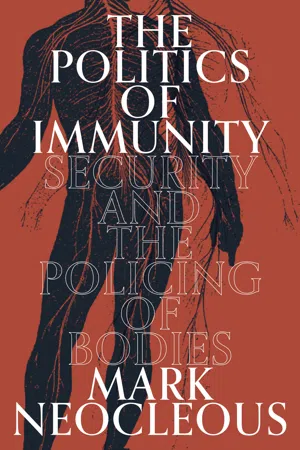
Our contemporary political condition is obsessed with immunity. The immunity of bodies and the body politic; personal immunity and herd immunity; how to immunize the social system against breakdown. The obsession intensifies with every new crisis and the mobilization of yet more powers of war and police, from quarantine to border closures and from vaccination certificates to immunological surveillance.
Engaging four key concepts with enormous cultural weight - Cell, Self, System and Sovereignty - Politics of Immunity moves from philosophical biology to intellectual history and from critical theory to psychoanalysis to expose the politics underpinning the way immunity is imagined. At the heart of this imagination is the way security has come to dominate the whole realm of human experience. From biological cell to political subject, and from physiological system to the social body, immunity folds into security, just as security folds into immunity. The book thus opens into a critique of the violence of security and spells out immunity's tendency towards self-destruction and death: immunity, like security, can turn its aggression inwards, into the autoimmune disorder.
Wide-ranging and polemical, Politics of Immunity lays down a major challenge to the ways in which the immunity of the self and the social are imagined.
- 368 pages
- English
- ePUB (mobile friendly)
- Available on iOS & Android
eBook - ePub
About this book
Information
1
War Power, Police Power, Cell Power
Why is it so difficult to imagine that I am cared about, that something takes an interest in what I do, that I am perhaps protected, maybe even kept alive not altogether by my own will and doing? Why do I prefer insurance to the invisible guarantees of existence? For it sure is easy to die. A split second of inattention and the best-laid plans of a strong ego spill out on the sidewalk. Something saves me every day from falling down the stairs, tripping at the curb, being blindsided. How is it possible to race down the highway, tape deck singing, thoughts far away, and stay alive? What is this ‘immune system’ that watches over my days, my food sprinkled with viruses, toxins, bacteria?
James Hillman, The Soul’s Code (1996)
‘Our country is at war.’ ‘The world is at war.’ ‘We are under attack from an invisible enemy.’ ‘Ours is now a wartime government.’ ‘Wartime President.’ ‘Medical personnel are frontline workers.’ ‘In this fight we can be in no doubt that each and every one of us is directly enlisted.’ ‘We are at war, and this is our draft.’ ‘Raising an army of the infected.’ ‘A war economy.’ As if to prove the truth of all these claims, measures of total war were announced for the whole of society: emergency laws, new police powers, quarantine, troops mobilized, new behaviour instilled in the population. All to conduct a war against … a virus.
Such was life during the Covid pandemic that started in early 2020. A total war against a virus capable of destroying millions of lives and therefore a war that we were told was necessary to defend the state, protect the system and secure the social order from collapse. The front-line of nurses, doctors, and the medical police was to be supported by the sturdy trench system of modern warfare formed of the institutions of civil society. It was a war fought through the people’s bodies and the body of the people. It was a war of immunity: the immunity of each and every single body was integral to the defence of the realm, and the immunity of the body politic was integral to the protection of each and every one of us. Body and body politic were as one in their search for mutual security. We were encouraged to imagine the sovereign nation as a body and our body as a sovereign nation.
‘Imagine That Your Body Is a Sovereign Nation’
In June 1986, an article by Peter Jaret appeared in National Geographic, accompanied by a series of images, called ‘Our Immune System: The Wars Within’. The article was circulated widely and discussed by many. It received the most commendations of any article that year, was reprinted many times, and spawned many other journal articles along the same lines in popular publications such as Time and Reader’s Digest.1 Jaret’s article contained material from his book co-authored with Steven Mizel, called In Self-Defense, but the text was illustrated with images from a book called The Body Victorious, published in Swedish in 1985 and then in English translation in 1987. That book, which also received a lot of publicity and became an international bestseller, is credited largely to Lennart Nilsson, one of the world’s leading medical photographers, and it is impossible to open the book and not be stunned by the array of shapes and colours in the images. For what is laid bare is the range of processes through which the body ‘victoriously’ defends itself against all the forces which oppose it or threaten it. Like Jaret’s 1986 article, the book suggests that the body’s defence system is the site of ‘life-and-death struggles between attackers and defenders, waged with a ruthlessness found only in total war’. The site of an injury is ‘a battlefield on which the body’s armed forces, hurling themselves repeatedly at the encroaching microorganisms, crush and annihilate them’.
No one is pardoned, no prisoners are taken – although fragments of the invading bacteria, viruses, rickettsias, parasites, and fungal micro-organisms are conveyed to the lymph nodes for the rapid training of the defence system’s true bloodhounds, the ‘killer cells’. These cells learn in detail, molecule by molecule, how to recognise the adversary, whereupon they launch their offensive.
They go on:
A cell whose identification is faulty is immediately destroyed by the armed force which is constantly on patrol … The human body’s police corps is programmed to distinguish between bona fide residents and illegal aliens – an ability fundamental to the body’s powers of self-defence.
What then follows is a series of diagrams illustrating the way the body deals with ‘the foreign invader’. Light-blue paths represent ‘older defences’, which work in tandem with ‘the newer, special defence force’ (in green). Elsewhere, in the lymphoid tissue, special ‘B-lymphocytes are trained’, which are ‘the precursors of the large plasma cells … which produce the body’s sniper ammunition, the antibodies’. The different types of T-lymphocytes include ‘aggressive killer cells, helper cells, and suppressive cells’, all of which ‘have specialised tasks to perform when the immune system launches a counterattack’. Despite the book’s title, The Body Victorious, the victory is never fully won. Rather, the body is the site of perpetual war, or perhaps is even the war itself. The body is a battlefield, from cradle to grave.
At the heart of this war is the immune system:
The organisation of the human immune system is reminiscent of military defence, with regard to both weapon technology and strategy. Our internal army has at its disposal swift, highly mobile regiments, shock troops, snipers, and tanks. We have soldier cells which, on contact with the enemy, at once start producing homing missiles whose accuracy is overwhelming. Our defence system also boasts ammunition which pierces and bursts bacteria, reconnaissance squads, an intelligence service, and a defence staff unit which determines the location and strength of troops to be deployed.
The war goes on:
One type of white blood cell is the granulocyte. Granulocytes are small, fast-moving, and dynamic feeding cells in the blood, kept permanently at the ready for a blitzkrieg against the microorganisms or foreign particles. They constitute the infantry of the immune system. Multitudes fall in battle, and together with their vanquished foes, they form the pus which collects in wounds.Another type is the considerably larger macrophage (large feeding cell), the armoured unit of the defence system … tracking down their victims.
This ‘giant army of granulocytes and macrophages is, of course, a fearsome opponent for the invading microorganisms’, and so some enemy-bacteria seek other methods of invasion and destruction.
One refined method employed by many bacteria and all viruses is to hide inside the body’s own cells. They disguise themselves, as it were, in a uniform which the immune system’s soldiers have learned to overlook. In this situation, the defence system deploys its special commandos or frontline troops, the B- and T-lymphocytes.
Lymphocytes ‘kill their opponents differently: by using homing projectiles (antibodies), and with some form of poisoning (killer cells). The ability to do so requires training at technical colleges’. They continue:
The lymphocytes which attend the technical college of the thymus are helper, suppressor, and killer cells called T-lymphocytes (or T-cells). They are among the most indispensable armed forces of the immune system.Helper cells constitute the defence staff unit, directing troop operations … Killer cells are formed in the thymus to kill those of the body’s own cells which contain foreign antigens.
The defence mechanisms also include the skin, ‘the first line of defence’, and a form of ‘chemical warfare’ in the form of sweat and sebum.2
The Body Victorious was a bestseller, the images alone being a fascinating guide to the immune system, despite (or perhaps because of) the fact that the images show acts of violence after violence. The power of the images also no doubt helps explain why Jaret’s National Geographic article was so widely circulated. Jaret’s article tells the same story of incessant battles within, of combatants too tiny to see, of legions of specialist defence forces, of the body’s munitions factories, and of chemical weapons such as antibodies. The article presents the process in diagrammatic form: ‘The Battle Begins’, ‘The Forces Multiply’, ‘Conquering the Infection’, ‘Calling a Truce’.
These war stories will come as no surprise to anyone who has ever read a magazine article or popular book on immunity, as the same ideas run through the medical and popular literature in the field. This much has been pointed out many times before and has been subject to sustained critique for its ‘militarization’ of medical language and excessive use of war images. I want to briefly give an indication of the extent of these ideas and images, however, partly to show just how wide and deep their use is, but also because I want to point to some of the limitations of the critical comments made about them. Most importantly, I want to use these observations to then expand the argument beyond the narrow frame of ‘war metaphors’ and the militarization of medical discourse. The politics of immunity requires more than just an argument against the language of war.
‘Imagine that your body is a sovereign nation’, suggests Michael Weiner in his popular text Maximum Immunity.
What prevents your body, the host country, from becoming a Petri dish for every kind of bacterium and virus? That is the job of your immune system. It is the immune system that protects you from attack by foreign and internal agents, that plans defensive actions, and that provides the necessary personnel and equipment.3
Text after text takes up the theme. John Dwyer’s book The Body at War is organized around immunity as ‘the programming of cells to recognise the enemy’ and includes chapters on ‘War and the Warriors’, ‘Taming the Warriors’, and ‘Defeat of the Warriors’.4 The War within Us by Cedric Mims is organized around the idea of an ‘ancient war between the invader and the defender’ in which ‘the defences of the host have called forth answering strategies by the parasite, which have led in turn to counterstrategies on the part of the host’.5 Even if you think you are at peace, you are in fact at war:
Outwardly you may be a gentle, peaceful person, a loving parent, a churchgoer, even a pacifist. Inside of you, however, whether you will it or not, an awesome fighting force is on the alert. The human immune system is an efficient war machine that never negotiates a treaty. It strikes no bargains with the enemy. It takes no prisoners.6
These tropes from popular health and medicine books are not simplifications for a popular audience, since the language is lifted from scientific texts within immunology. Developing the clonal selection theory in the late 1950s, Macfarlane Burnet would put it that ‘when foreign and hence potentially dangerous material enters the body – classically as an invading micro-organism – it requires to be recognized as foreign … Any defence force must know how to distinguish friend from enemy’.7 Stewart Sell’s Immunology, Immunopathology and Immunity, a leading textbook in medical biology that has run into several editions, opens as follows:
Immunology is the study of the system through which we identify infectious agents as different from ourselves and defend or protect ourselves against their damaging effects. From the time of conception, the human organism faces attack from a wide variety of infectious agents and must have ways to identify and react to them … The immune system provides us with highly specialized ways to defend ourselves against invasion and colonization by foreign organisms. This defensive ability is called immunity.8
Likewise, Edward Golub and Douglas Green’s Immunology: A Synthesis, an equally important reference point in the field, offers a ‘Machiavellian view’ on how to protect the body politic from internal and external invaders. For Golub and Green, the immune system is part of the body’s armamentarium, and they add that ‘the use of the term armamentarium shows that this process has been visualized as a battle between two opposing forces, one good and one very bad’. Other major textbooks such as David Wilson’s Science of Self: A Report of the New Immunology (1971) and Jan Klein’s Immunology: The Science of Self-Nonself Discrimination (1982) follow suit.9 The two popular books by one of the authors of Killer Lymphocytes (2005), William R. Clark, carry the theme over: on the one hand, immunity is In Defense of Self (2008); on the other hand, we are A t War Within (1995). Such imagery and language, it should be noted, functions in the more detailed discussions of both innate and acquired immunity. Innate immunity consists of general reactions such as inflammation and fever and operates through the phagocytes and macrophages, while acquired immunity involves the work of ‘killer lymphocytes’.10
The same theme permeates children’s books on the subject, with cartoon images of military forces fighting invasions, patrolling the body, mustering specialist troops whenever the threat of invasion looms. This began with a book by renowned physicist George Gamow and microbiologist Martynas Yčas, Mr. Tompkins Inside Himself (1968), a biology book for children which presented white blood cells fighting off and killing invaders, and continues with more recent literature such as Cell Wars (1990), by Fran Balkwill and Mic Rolph, which won the Children’s Science Book Prize in 1991. For slightly older children there is the more recent comic Immunity Warriors: Invasion of the Alien Zombies, launched in January 2017 to encourage children in Canada to undergo immunization. The comic presents an attack on the body, ‘made of billions of cities called cells’, under assault, with comic figures organizing the defence: ‘Commander, we’re under attack. Sector 12 is down … The enemy has somehow infiltrated the city’s defenses … The enemy are taking over the City’s command center … They’ve turned the citizens into zombies.’ As always with the zombie narrative, and as I discuss at length in The Universal Adversary (2016), the emergency war powers are mobilised:
Send out the NKC [Natural Killer Cells] and the Macro Squad. Now! … Call in the elite forces … B-Team, steady your aim and target the enemy for the Macro Squad … There must be some sacrifices. T-squad, you know what you must do.
In the end, the battle is won, the body defended, and the project continues with a nice recognition of the role the police power might play in such wars: a ‘Wanted’ poster appears for the influenza virus, complete with a picture of the microscopic invader-intruder.
From popular science books to immunology textbooks, from scientific research to children’s literature, a common sense about the body’s immunity has emerged that runs through our imagination and the way we are expected to care for the Self. Protect, defend, and preserve one’s body through the correct regimen: the care of the Self involves thinking about and operating on the Self as a body under siege in need of a general defence policy to repel invaders, fortify itself, wage campaigns, block entry points, and identify the Self as a killing machine. The care of the self leaves one at war with the world. The message is clear: You are by nature a war machine.
Now, this image of the body has been criticized from many quarters. Unravelling the ways in which the controlling images in accounts of diseases are drawn from the language of warfare, pa...
Table of contents
- Cover Page
- Halftitle Page
- Title Page
- Copyright Page
- Contents
- Acknowledgements
- Introduction
- 1. War Power, Police Power, Cell Power
- 2. Imagining an Immune Self
- 3. Imagining an Immune System: Politics of Systems I
- 4. Order, Energy, Entropy, Bodies: Politics of Systems II
- 5. Nervous States: Politics of Systems III
- 6. Immunity’s Fiction
- Notes
- Index
Trusted by 375,005 students
Access to over 1.5 million titles for a fair monthly price.
Study more efficiently using our study tools.
Frequently asked questions
Yes, you can cancel anytime from the Subscription tab in your account settings on the Perlego website. Your subscription will stay active until the end of your current billing period. Learn how to cancel your subscription
No, books cannot be downloaded as external files, such as PDFs, for use outside of Perlego. However, you can download books within the Perlego app for offline reading on mobile or tablet. Learn how to download books offline
Perlego offers two plans: Essential and Complete
- Essential is ideal for learners and professionals who enjoy exploring a wide range of subjects. Access the Essential Library with 800,000+ trusted titles and best-sellers across business, personal growth, and the humanities. Includes unlimited reading time and Standard Read Aloud voice.
- Complete: Perfect for advanced learners and researchers needing full, unrestricted access. Unlock 1.5M+ books across hundreds of subjects, including academic and specialized titles. The Complete Plan also includes advanced features like Premium Read Aloud and Research Assistant.
We are an online textbook subscription service, where you can get access to an entire online library for less than the price of a single book per month. With over 1.5 million books across 990+ topics, we’ve got you covered! Learn about our mission
Look out for the read-aloud symbol on your next book to see if you can listen to it. The read-aloud tool reads text aloud for you, highlighting the text as it is being read. You can pause it, speed it up and slow it down. Learn more about Read Aloud
Yes! You can use the Perlego app on both iOS and Android devices to read anytime, anywhere — even offline. Perfect for commutes or when you’re on the go.
Please note we cannot support devices running on iOS 13 and Android 7 or earlier. Learn more about using the app
Please note we cannot support devices running on iOS 13 and Android 7 or earlier. Learn more about using the app
Yes, you can access The Politics of Immunity by Mark Neocleous in PDF and/or ePUB format, as well as other popular books in Social Sciences & Critical Theory. We have over 1.5 million books available in our catalogue for you to explore.