- 234 pages
- English
- ePUB (mobile friendly)
- Available on iOS & Android
eBook - ePub
About this book
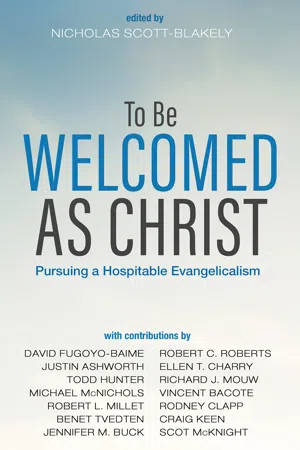
Mainstream American evangelicalism is facing an identity crisis. Many wonder whether or not evangelical communities can become safe spaces that better enable people to enjoy, love, and know God and all that God cares about. This book, in honor of Dennis Okholm's decades of leadership in the academy and the church, commends the ways in which he has attempted to help his own communities flourish. His goal of filling the pews with theologically and biblically literate Christians is a much-needed example of steadiness and wisdom to an otherwise turbulent reality facing those who wish to maintain some association with the evangelical label. The emphases that appear in the contributions to this book represent Okholm's passion for the life of the church, his desire for evangelicalism to be a more hospitable home for all within its fold and in relation to other communities, and his desire for friendship and community to have a more prominent role in theological and biblical reflection. To Be Welcomed as Christ offers an example for engaging one's own community and the communities of others with the hospitality of Christ.
Table of Contents
1. Theology as a Healing Art
Ellen T. Charry
2. To Be Welcomed as Christ--Into the Church
Todd Hunter
3. Participating in God's Mission: A Proposal at the Boundaries of Evangelicalism
Justin Ashworth
4. Evangelicalism: A Home for All of Us
Vincent Bacote
5. Herstory:
Reclaiming Women's Voices for the Evangelical Tradition
Jennifer Buck
6. Thinking Theologically about Interfaith Dialogue
Richard J. Mouw
7. Talking with Evangelicals: The Latter-day Saint-Evangelical Dialogue in Retrospect
Robert Millet
8. The Monkhood of All Believers: On Monasticism Old and New
Rodney Clapp
9. When Friends Become Siblings: A Pauline Theology of Friendship
Scot McKnight
10. Wiri Nina in the Body of Christ: Considering Friendship from an African Perspective
David Fugoyo-Baime
11. Of All These Friends and Lovers: Remembering the Body and the Blood
Craig Keen
12. Is it OK to be Proud of Your Humility?
Robert Roberts
13. Dennis Okholm
Michael McNichols
Epilogue: At the Advice of a Sister: The Benedictine Way for the Unexpected
Benet Tvedten, OSB
Information
Topic
Theology & ReligionSubtopic
Christian Ministry1
Theology as a Healing Art
Dennis Okholm repairs damaged bridges. Task-oriented, future-directed Americans are particularly prone to neglecting the past, relinquishing custom, and seeking novelty, ignoring the need for healing. Perhaps trained by the advertising industry selling products based on planned obsolescence cultivates craving novelty interested in keeping pocketbooks open and the economy afloat. To this, Okholm says, wait a minute. As one of my own teachers taught me, just because they didn’t have computers, doesn’t mean that you are smarter than those who’ve come before. Perhaps the contrary dependent as we are on machines to do our thinking for us. We speak of “the wisdom of the ages” for a reason. Indeed. At bottom, Okholm is inviting us to consider just that wisdom. He is calming underlying Protestant anger at the corruption of the medieval church that took on a life of its own yet is now anachronistic. His reconsideration of monasticism is a humble penitential move for Protestant doctrine and practice. Sometimes looking back enables moving forward. While the Catholic instinct is to repair what has gone awry, the Protestant instinct has been to get rid of it. Enough time has now elapsed since righteous indignation drove the Protestant Reformation that evangelicals may see that in running to fresh ground they discarded valuable treasures. Indignation may by now have run its course unless we indoctrinate students into the sixteenth century’s theological problems as their own at the expense of current theological needs. Indeed, penitential humility became the chief virtue of western monasticism. Okholm’s work exemplifies it.
Damaged bridges are not only between the Great Church and Protestantism that Okholm’s retrieval of Benedictine spirituality and patristic psychology addresses.8 Other bridges were damaged between church and culture with modernity—perhaps itself born of Protestant rejectionism—that also charted a fresh way forward. So, for example, Okholm is offering a way to get from the modern evangelical notion of faith as assent to intellectual propositions to faith as the cultivation of “the law of the Spirit of life in Christ Jesus” as Paul understood the purpose of following Christ according to Romans 8:2: “For the law of the Spirit of life in Christ Jesus has set you free from the law of sin and of death.”9 In this particular case, Okholm is reclaiming the ancient notion that following the Anointed Savior is not assenting to a set of ideas that enable one to live forever or escape eternal punishment but to a beautiful life. He is healing theology of its rationalist cognitive obsession back into beauty.
The point of this reflection on theology is not to besmirch or regret modernity but to recognize that every strength has its weakness. In creating modern science, medicine, and technology, some valuable things fell by the wayside—beauty, truth, and goodness chief among them. We do not have to, indeed, cannot choose sides between modern science and the value of goodness and beauty as true wisdom of God because embracing science and technology does not preclude admitting that we do not need the wisdom of God. In this we are no different from the pre-moderns. This essay hopes to contribute to the bridge-repairing effort, particularly repairing the break within theology itself between the ancient spiritual and modern academic understandings of what it is and does.
What Is Theology?
Theology is a notoriously slippery word. Assuming that the world is intelligible, it became reasoned thought seeking the truth about god and the things of god. I use the lower case “g” here to indicate that theology is larger than reflection on the God of Israel whom Jews, Christians, and Muslims worship. Plato, Aristotle, Zeno, and Epicurus were theologians, although they did not know of the biblical God. As reasoned thought, theology aims at human flourishing through an intentional life based on the orderliness of the world grounded in god. Theology’s chief task is to help society flourish by enabling individuals to flourish. Christian theology assumes that that is not going too well and aims to heal the fault.
As conversation, theology is a human word, one hopes a lucid word, a vulnerable word. And as a vulnerable human word about god and the things of god it invites discussion, correction, and repair. Theology is thus a conversation across the ages, gathering up the wisdom of each, known primarily by assessing and (re)interpreting its honored texts, that the wisdom of the ages may refresh and guide each generation.
Working within a classical theistic heritage that keeps God at its center, Christian theology itself became a tradition that abides by certain conventions that both preserve the heritage and give each generation fresh access to it. Christian theological convention adopted Greek philosophical categories that describe the ancient notion of perfection as divine attributes rather than the biblical ones listed at Exodus 34:6 (paraphrased at Jonah 4:2): “The LORD passed before [Moses], and proclaimed, ‘The Lord, the Lord, a God merciful and gracious, slow to anger, and abounding in steadfast love and faithfulness.’” Christian insistence on divine perfection removed God from history making it difficult for theology to make sense of God entering history as a Judean carpenter.
Leaving that logical conundrum aside for now, theology has other work to do. Since it is undertaken to help people, heal people so that they understand themselves and the world salutarily, it requires interpretation of the culture in which it resides. So, theology looks in two directions simultaneously, seeking to interpret the culture to the tradition and the tradition to the culture. To do this well, theology esteems the literature, stories, and practices of its particular heritage and puts these in conversation with contemporary needs and society’s circumstances.
From this perspective, theology is a helping profession like auto mechanics, pharmacy, social work, dietetics, medicine, and law—before the last two became business ventures. They all seek or sought to keep people safe and functioning well in order to secure societal well-being. Theology seeks to heal society that individuals may flourish and to heal individuals that society may flourish. This is a mutually enhancing cycle. Morally and economically healthy societies foster individual flourishing and flourishing individuals enable morally, spiritually, and socially flourishing societies. To this end, theology is the self-observing physician of religious communities, correcting and repairing them when criticisms from outside the community or current in the general culture are sufficiently persuasive for insiders to recognize that certain beliefs or practices are or have become corporately or individually harmful. The task here is self-reflection unto self-repair, not polemic to bolster itself against an alternative interpretation of the texts that constitute the tradition.
The medicinal function of theology is not to adapt the tradition to current tastes but to examine its doctrines and practices to enable the heritage to be its best self so that it will form people for excellent lives. One current example is the secular ecology movement that enables Christians to understand the biblical doctrine of creation better. Genesis 1:28: “God blessed them, and God said to them, ‘Be fruitful and multiply, and fill the earth and subdue it; and have dominion over the fish of the sea and over the birds of the air and over every living thing that moves upon the earth.’” The blessing has an ugly underside for it seems to permit the exploitation of animals and perhaps of the earth itself. Once ecological awareness is raised however, ecologically attuned biblical texts make a stronger impression. Deuteronomy 20:19 on the conduct of war is one: “If you besiege a town for a long time, making war against it in order to take it, you must not destroy its trees by wielding an ax against them. Although you may take food from them, you must not cut them down. Are trees in the field human beings that they should come under siege from you?” Another ecologically attuned text is Deuteronomy 22:6–7: “If you come on a bird’s nest, in any tree or on the ground, with fledglings or eggs, with the mother sitting on the fledglings or on the eggs, you shall not take the mother with the young. Let the mother go, taking only the young for yourself, in order that it may go well with you and you may live long.”
At the same time, secular culture is capable of deforming or harming people. When this happens, the theologian becomes the attorney for the heritage, interpreting its salient teaching to those outside the community in terms that they can grasp, as well as to insiders who entertain similar questions or experiences. An example is the question of whether Christians may participate in war. The question was first discussed by Augustine of Hippo who coined the term “just war.”10 He judged that Christians may be soldiers under certain conditions. “Christians could serve in the army as long as it was for just reasons such as obeying the commands of God, the righting of wrongs or in pursuit of a better state of peace. In addition, soldiers were required to obey the legitimate orders of their superiors.”11 Augustine’s concern for just conditions for war reverberates unto our own day. Aspects of it remain controversial but that too has been a helpful stimulus for wider consideration of how a general culture receives theological reflection.
Following the master bishop, Aquinas the monk discussed the notion of just war at Summa Theologiae 2.2.40.12 He sustained the master’s judgment that Christians may soldier but developed three criteria to judge a war to be just: It must be formally, legally declared. It...
Table of contents
- Title Page
- Contributors
- Introduction
- Chapter 1: Theology as a Healing Art
- Chapter 2: To Be Welcomed as Christ—Into the Church
- Chapter 3: Participating in God’s Mission
- Chapter 4: Evangelicalism
- Chapter 5: Herstory
- Chapter 6: Thinking Theologically about Interfaith Dialogue
- Chapter 7: Talking with Evangelicals
- Chapter 8: The Monkhood of All Believers
- Chapter 9: When Friends Become Siblings
- Chapter 10: Wiri Nina in the Body of Christ
- Chapter 11: Of All These Friends and Lovers
- Chapter 12: Is It OK to Be Proud of Your Humility?
- Chapter 13: Dennis Okholm
- Epilogue
Trusted by 375,005 students
Access to over 1.5 million titles for a fair monthly price.
Study more efficiently using our study tools.
Frequently asked questions
Yes, you can cancel anytime from the Subscription tab in your account settings on the Perlego website. Your subscription will stay active until the end of your current billing period. Learn how to cancel your subscription
No, books cannot be downloaded as external files, such as PDFs, for use outside of Perlego. However, you can download books within the Perlego app for offline reading on mobile or tablet. Learn how to download books offline
Perlego offers two plans: Essential and Complete
- Essential is ideal for learners and professionals who enjoy exploring a wide range of subjects. Access the Essential Library with 800,000+ trusted titles and best-sellers across business, personal growth, and the humanities. Includes unlimited reading time and Standard Read Aloud voice.
- Complete: Perfect for advanced learners and researchers needing full, unrestricted access. Unlock 1.5M+ books across hundreds of subjects, including academic and specialized titles. The Complete Plan also includes advanced features like Premium Read Aloud and Research Assistant.
We are an online textbook subscription service, where you can get access to an entire online library for less than the price of a single book per month. With over 1.5 million books across 990+ topics, we’ve got you covered! Learn about our mission
Look out for the read-aloud symbol on your next book to see if you can listen to it. The read-aloud tool reads text aloud for you, highlighting the text as it is being read. You can pause it, speed it up and slow it down. Learn more about Read Aloud
Yes! You can use the Perlego app on both iOS and Android devices to read anytime, anywhere — even offline. Perfect for commutes or when you’re on the go.
Please note we cannot support devices running on iOS 13 and Android 7 or earlier. Learn more about using the app
Please note we cannot support devices running on iOS 13 and Android 7 or earlier. Learn more about using the app
Yes, you can access To Be Welcomed as Christ by Nicholas Scott-Blakely in PDF and/or ePUB format, as well as other popular books in Theology & Religion & Christian Ministry. We have over 1.5 million books available in our catalogue for you to explore.