The times in which we live are often described as “unprecedented.” The word might be overused, yet the last few years have seen exceptional healthcare challenges, loss of human life, economic disruption, and political turmoil. We are now in the second year of novel coronavirus and its global impact. Most people either know someone who died from the virus or have experienced its nefarious effects in other ways—illness, unemployment, school and border closures, shortages, confinement, addiction, fear, anxiety. Families were separated from loved ones who died alone in hospitals and nursing homes. We wait for a return to normal or a new normal and live with the lingering suspicion that life will never be the same. Where do we look for hope? As Christians, our ultimate hope is in God and his promises. Christians have dual citizenship, earthly and heavenly. On earth they want what most people want—security, satisfaction, and significance—and desire a better world. Christians also assert that this world order will pass away and every person will live somewhere forever. These messages from God’s word seek to point Christians and non-Christians to Jesus Christ as the only one who provides genuine, eternal hope.
eBook - ePub
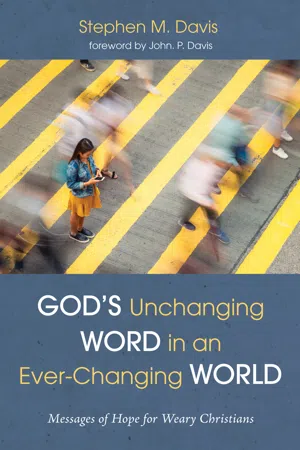
God’s Unchanging Word in an Ever-Changing World
Messages of Hope for Weary Christians
- 152 pages
- English
- ePUB (mobile friendly)
- Available on iOS & Android
eBook - ePub
God’s Unchanging Word in an Ever-Changing World
Messages of Hope for Weary Christians
About this book
Information
Topic
Theology & ReligionSubtopic
Religion1
Seeking a Homeland
Hebrews 11:8–16
8 By faith Abraham obeyed when he was called to go out to a place that he was to receive as an inheritance. And he went out, not knowing where he was going. 9 By faith he went to live in the land of promise, as in a foreign land, living in tents with Isaac and Jacob, heirs with him of the same promise. 10 For he was looking forward to the city that has foundations, whose designer and builder is God. 11 By faith Sarah herself received power to conceive, even when she was past the age, since she considered him faithful who had promised. 12 Therefore from one man, and him as good as dead, were born descendants as many as the stars of heaven and as many as the innumerable grains of sand by the seashore. 13 These all died in faith, not having received the things promised, but having seen them and greeted them from afar, and having acknowledged that they were strangers and exiles on the earth. 14 For people who speak thus make it clear that they are seeking a homeland. 15 If they had been thinking of that land from which they had gone out, they would have had opportunity to return. 16 But as it is, they desire a better country, that is, a heavenly one. Therefore God is not ashamed to be called their God, for he has prepared for them a city.
The opening of the Tokyo Olympics featured the well-known song by John Lennon, “Imagine.” The song has a beautiful melody and arrangement. Its lyrics, however, are among the worst you will find in popular songs. We are presented a utopian vision, asked to imagine that there's no heaven or hell, and to live for today in brotherhood. People can imagine whatever they want, but it is not reality. They can even wish for a brotherhood of man, a noble sentiment in itself, but impossible if there is no heaven, no hell, everyone living for today, and no religion. You can live by your imagination or by faith. You can imagine reality as you would like it to be or live by faith in the promises of God. You can die and enter the great unknown either hoping there is nothing beyond, that you will be okay if it turns out that there is a God, or you can die in faith trusting that God has prepared an eternal dwelling place. Consider these words from C. S. Lewis:
Christianity asserts that every individual human being is going to live forever, and this must be either true or false. Now there are a good many things which would not be worth bothering about if I were going to live only seventy years, but which I had better bother about very seriously if I am going to live forever.1
You will live forever, either in God’s presence or far from it. Our text speaks about people who were strangers and exiles in the land where they dwelled. They looked past their short earthly existence to the future beyond the grave. The first eleven verses of chapter 11 speak of Old Testament people who lived by faith and end with Abraham and Sarah. Verse 1 tells us that faith is a present and continuing reality. This faith believes that God has done what the Bible tells us he has done and will do what he has promised to do. Those we find in this passage died as they lived. They lived by faith. They died in faith. It is interesting that their failures are not mentioned. These people were faithful but not perfect. Their lives were characterized by faith and they believed what seemed impossible from a human perspective. The phrase “by faith” provides many examples of what it means to live by faith.
When we speak of faith we understand it as “substance” or foundation that in some sense inaugurates in us those things of which we are assured, future realities and the fulfillment of the promises of God (vv. 1–2). Verse 6 tells us that without faith it is impossible to please God. There are realities for which we have no material evidence. We have no hard proof about spiritual realties that everyone would find irrefutable and convincing. Faith enables us to know that these realities exist, and while we might not have any assurance of these things apart from faith, faith does give us genuine certainty. None of us were there at creation. None of us had personal contact with any of the people mentioned here. We believe these truths by faith. Faith is not unreasonable but is not founded on human reason. According to Blaise Pascal, “What is essential is invisible to the eye . . . The heart has its reasons which reason does not know.”2
Verses 8–12 speak about faithful Abraham and his wife. Verses 13–16 are an explanation, a parenthesis, followed by Abraham again in verse 17. Verse 13 tells us that “these died in faith, not having received the things promised.” Only by faith can we see and grasp these unseen realities and remain steadfast when alternate man-made realities are advanced. Often, we must decide whether to believe God, whom we’ve not seen, or believe the voices and talking heads of our day, who seem to speak with so much authority and assurance. Many of you are familiar with movies which portray people living in a computer simulation without knowing it. There are several, but the only one I recall watching was The Truman Show. As entertaining and unrealistic as that seemed at the time, there are now philosophers who propose that we are living in a simulated reality, that we are self-aware software trapped inside virtual reality. As you know, many people find it laughable to think that there is a personal Creator God who made all things and before whom we will stand one day. So they create alternate realities, often using religious language that speaks of transcendence, something or someone out there that is beyond us.
I think most people are seekers: seekers of pleasure, of truth, or reality, happiness, or seekers of purpose. Of course, there are some who believe everything is random, that life has no meaning and personal gratification is the goal of life. God’s people are distinguished by what they are seeking. In verse 14 we find people who make it clear that they are seeking a homeland. What kind of people are clearly seeking a homeland? Are we that kind of people? Is it clear in your life today, in your priorities, in your relationship with God’s people, in your witness, that you really are a stranger passing through this world? If you’re a Christian, this is the kind of person you want to be.
A person who anticipates the fulfillment of God’s promises (v. 13–14)
Those who lived by faith also died in faith without experiencing all that God promised. They lived and died looking for the fulfillment of a promise they never fully experienced on earth. Yet it was so real it enabled them to press on against the current of their surroundings and the pressures of their societies. Compare verses 39–40 which repeat this truth: “And all these, though commended through their faith, did not receive what was promised, since God had provided something better for us and that apart from us they should not be made perfect.” Yet their lives were ordered by the firm conviction that God would fulfill his promises. Even in death they looked forward to the fulfillment of God’s promises and passed them on to their descendants. “By faith Isaac invoked future blessings on Jacob and Esau. By faith Jacob, when dying, blessed each of the sons of Joseph, bowing in worship over the head of his staff” (11:20–30). For us as well in our present condition, in our mortal bodies, and with our inability to fully contemplate the glory of God, we cannot experience or rightly perceive all that God has promised. We can know that we are saved, that we are forgiven, that we have the promise of eternal life, but we only grasp what is possible to know with our present limitations. This promise has now been fulfilled in Christ. A new age dawned at his coming. We are fellow citizens of the heavenly Jerusalem with all the saints of the past (Phil 3:20; Heb 12: 22). This “something better” (v. 40) embraces the better hope, better promises, better covenant, better sacrifices, better and abiding possessions, and better resurrection which we now share as our heritage.
The “seeing” and “greeting” (v. 13) the promises of God is not insignificant. It is an expectation that changes our perspective in life and of our life. We see and greet them “from afar.” This not only refers to time and distance but experience. We embrace these realities; we keep them in mind as we live our daily lives. Yet we do not live in a dreamland so focused on the future that we neglect the present. We need to learn the difference between the things which are important and that which is ultimate. That’s our challenge. That’s your challenge when God provides you a good job, but it’s so good a job that it almost becomes your new religion. God provides you a nice place to live and your priority is more comfort at the expense of caring about others. God gives you a husband or wife and you are so in love that you neglect other relationships and begin to live in a little sweetheart bubble.
Notice how “not having received” and “having acknowledged” are contrasted. How do people “acknowledge" that they are strangers and exiles? By believing and acting on the promises of God, as Abraham did, even when there is nothing to indicate that they will be fulfilled in the near term. When we read that they died “not having received the promises” we understand this refers to the full realization. Hebrews 6:17 tells us that Abraham “obtained the promise” in the birth of Isaac and later his restoration when offered as a sacrifice (11:19). Verse 33 tells us that some “obtained promises.” They did not receive the promise in the sense of its complete fulfillment in Christ and at his coming. F. F. Bruce explains that “they lived and died in prospect of a fulfillment which none of them experienced on earth; yet so real was that fulfillment to them that it gave them power to pass upstream, against the current of the environment, and to live on earth as citizens of that commonwealth whose foundations are firmly laid in the unseen and eternal order.”3
In Christ and through the gospel we have another identity as strangers and exiles on earth. This life isn’t all there is. Now, if you are not a child of God, then it’s not surprising that your focus is only earthward. It’s also not surprising that you invest so much time and energy in things that have some earthly importa...
Table of contents
- Title Page
- Foreword
- Preface
- Introduction
- Chapter 1: Seeking a Homeland
- Chapter 2: Great Joy of the Gospel
- Chapter 3: Radical Discipleship
- Chapter 4: The Gospel and Religion
- Chapter 5: When Evil Encounters Jesus
- Chapter 6: The Sower and the Seed
- Chapter 7: If Jesus Cares About My Troubles, Why Doesn't He Do Something?
- Chapter 8: What Does God Want Most From Me?
- Chapter 9: Don’t Drift Away
- Chapter 10: Surviving Another Year
- Chapter 11: Joy to the Nations
- Chapter 12: Supremacy of Christ in All Things
- Chapter 13: Living in Love and Truth in a World of Hate and Distortion
- Chapter 14: For His Name’s Sake
- Chapter 15: Present Glimpse of Future Glory
- Chapter 16: Is the End of the World Near?
- Chapter 17: Living in the Last Days
- Chapter 18: Faithful Living in Times of Struggle
- Chapter 19: Forgiven and Restored: Time to Follow Jesus!
- Bibliography
Trusted by 375,005 students
Access to over 1.5 million titles for a fair monthly price.
Study more efficiently using our study tools.
Frequently asked questions
Yes, you can cancel anytime from the Subscription tab in your account settings on the Perlego website. Your subscription will stay active until the end of your current billing period. Learn how to cancel your subscription
No, books cannot be downloaded as external files, such as PDFs, for use outside of Perlego. However, you can download books within the Perlego app for offline reading on mobile or tablet. Learn how to download books offline
Perlego offers two plans: Essential and Complete
- Essential is ideal for learners and professionals who enjoy exploring a wide range of subjects. Access the Essential Library with 800,000+ trusted titles and best-sellers across business, personal growth, and the humanities. Includes unlimited reading time and Standard Read Aloud voice.
- Complete: Perfect for advanced learners and researchers needing full, unrestricted access. Unlock 1.5M+ books across hundreds of subjects, including academic and specialized titles. The Complete Plan also includes advanced features like Premium Read Aloud and Research Assistant.
We are an online textbook subscription service, where you can get access to an entire online library for less than the price of a single book per month. With over 1.5 million books across 990+ topics, we’ve got you covered! Learn about our mission
Look out for the read-aloud symbol on your next book to see if you can listen to it. The read-aloud tool reads text aloud for you, highlighting the text as it is being read. You can pause it, speed it up and slow it down. Learn more about Read Aloud
Yes! You can use the Perlego app on both iOS and Android devices to read anytime, anywhere — even offline. Perfect for commutes or when you’re on the go.
Please note we cannot support devices running on iOS 13 and Android 7 or earlier. Learn more about using the app
Please note we cannot support devices running on iOS 13 and Android 7 or earlier. Learn more about using the app
Yes, you can access God’s Unchanging Word in an Ever-Changing World by Stephen M. Davis in PDF and/or ePUB format, as well as other popular books in Theology & Religion & Religion. We have over 1.5 million books available in our catalogue for you to explore.