- 232 pages
- English
- ePUB (mobile friendly)
- Available on iOS & Android
eBook - ePub
About this book
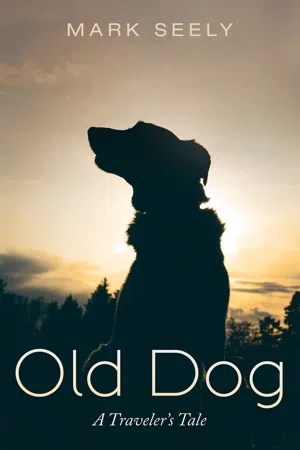
Old Dog is an elderly rescue dog with extraordinary insight, and an urgent message for humankind.
As his current caretaker works on various writing projects, Old Dog reminisces about his own past: his joyful youth, bleak years chained to a porch rail, a heartrending abandonment on a remote highway, life among the homeless, a formal education by a woman struggling with mental illness, his time with a pack of feral dogs, his capture and confinement in a pound, and his eleventh-hour rescue by the writer. While recounting these events, Old Dog reflects on what it means to be a dog--and, along the way, what it means for humans to be entangled in the web of an all-consuming civilization.
Old Dog takes us on a journey into the very heart of the human condition, highlighting the mismatch between modern life and our evolved expectations as a foraging species. Destruction of the natural world, loss of authentic connection with each other, crushing dependence on technology, the outsourcing of morality--these problems are all consequences of a civilized lifestyle that we were never meant to live.
And the answers, according to Old Dog, are staring us right in the face.
Information
Print ISBN
9781666736922
9781666795806
Ecotones
12
The liminal spaces between are spaces themselves: the bent tidal grasses of an estuary, the thick band of cattails along a lazy lowland river, the bush-adorned alluvium at the base of a rocky cliffside, the fading echo of birdcall, the powdery patchwork of gray that precedes dawn.
Each surface sustains a universe at its margins.
Too often what beckons from the other side of the doorway overshadows the threshold itself. Too often the transition is dismissed as mere passage. But this surely has things wrong side out. There is no destination without first a path. There is no arrival without first the journey. And the rocky summit is a barren place with little to offer, while the slope that leads to it breathes green with living abundance.
And the impossibly short distance between past and future takes an entire lifetime to traverse.
13
The linear nature of civilized consumption provides a stark contrast to the embedded cycles of rebirth, the perpetual repurposing and regeneration, the renewal of life upon death upon life found everywhere else in nature. Cities become one-way resource conveyors, inescapable gravity wells that drain the lifeforce from all that is drawn into their event horizons, fragmenting living communities and sterilizing the land. Humans raised inside civilization’s ever-expanding impact zone learn to internalize this extractive orientation to the world. They are called consumers because that is their life, that is the role they practice and prepare for as children, that is the only message they hear from commercial media—the ubiquity of which overwhelms all other possible messages. Social status is arrayed on a continuum of potential to consume. And all consumable things serve their designated temporary functions and are then cast aside, discarded without a second thought.
Humans are consumers by civilized mandate. But they are also proximal thinkers by evolutionary design. They possess a powerful psychological bias to inflate the importance of the local in both space and time. Things that are affecting them right now, or due to arrive soon, things that are close by, in their neighborhood, affecting their family or their close friends, take precedence over things that are distant, happening to strangers, or due to occur in the far-off future. There is nothing inherently wrong with this. From a survival standpoint, it makes sense to be more concerned with the small bear standing right in front of you than with the large one on the other side of the hill.
Humans are consumers by civilized mandate and proximal thinkers by evolutionary design. But they are also mammals, and in possession of a deeply embedded set of mammalian responses to potentially threatening situations, the most generally useful of which is active avoidance. Out of sight, out of mind is among the simplest of avoidance strategies. If an image is causing you fear or distress, simply close your eyes, or turn your head and look away. If there is an object in your life that is causing you some discomfort, simply get rid of it, throw it away, leave it behind and think nothing more about it.
These three things, the mandate to consume, the tendency to emphasize the proximal and deemphasize the distal, and out-of-sight-out-of-mind avoidance, fold into each other seamlessly: flush the toilet, toss it in the garbage to be hauled to some distant invisible landfill, poison the weeds growing on the parking strip, buy a new car, build a taller fence, get a divorce, block the annoying relative from your social media feed.
Leave the unwanted dog on the side of the road and drive away.
The road radiated heat. Old Dog watched the family’s van slowly fade into the distance, finally vanishing in a visual analog to an audible pop inside a wavy asphalt mirage. He didn’t know what to do. For all of his insight, for all of his unusual intelligence, his dog-genius, he was at a loss—both about why the family had left him there, and what he should do about it. Would they come back for him? Surely, they would come back for him! They wouldn’t just leave him to die on the side of the road, in the middle of nowhere.
So, for a while, he simply did nothing. He stood there and waited for something to happen, squinting into the distance with his ears folded forward for any sign of their return. But nothing happened. Finally, a car sped past from behind, blaring its horn as it did. The sound shook Old Dog from his trance. He stepped over to the partial shade of some gray rabbitbrush growing along the shoulder, and curled up in a ball on the sharp, small-grained gravel. It was approaching midday. It was July. There was not a cloud in the sky, very little breeze, and the temperature had already passed ninety degrees.
After a time, he decided that he needed to move. He couldn’t stay where he was, and he was getting thirsty. He stood up and looked around. On every side was feral pasture and fallow farmland, flat and brown from a months-long dry spell. There was nothing in any direction that suggested that it would be better than any other, so he started walking toward the spot on the horizon where the family’s van had disappeared. Bits of broken glass along the side of the road winked and glittered, a colorful counterpoint to the steady high-pitched static of insects in the fields. The sun’s heat made the fur around his leg joints feel like wax melting against his skin, with each step the wick burning closer and closer to the bone. By late afternoon, the highway crossed a shallow river. He limped down the bank and waded in until he was shoulder-deep. The water had a slightly sour taste, but he drank until he could hold no more. Then, back up to the highway.
His fur was dry before he made it to the other side of the bridge. Once there, he could see clusters of houses off in the distance, their windows reflecting the sun that was angling behind him. In all the time he had been walking, only a half-dozen cars had passed, but now there was actual traffic. Large trucks kicked up dust and gravel that forced him to duck his head sideways. By early evening he had made his way to the center of a small town. As the streetlights overhead flickered and hummed into luminescence, he slipped down the alley between two darkly stained brick buildings, crawled behind a small dumpster, and slept until late morning the next day.
He was awakened by the crash of a heavy bag of garbage landing in the dumpster just above his head. He peered out of his hiding spot and met the eyes of a short, thin man in a food-spattered apron. The man stepped back, startled, and then relaxed as Old Dog shuffled out into the daylight.
“Hey, pup,” the man offered gently, leaning steeply forward with his hands against his knees. “Looks like you’ve had a rough time of things lately. You look like warmed-over shit. Wait right there, I’ll get something for you. Stay. I’ll be right back.”
The man disappeared through an unframed rust-stained metal door in the wall of the building across the alley, and reappeared a few moments later carrying a small pile of cooked ground meat in a Styrofoam bowl in one hand, and another bowl filled with water in the other. He set the two bowls along the side of the dumpster, stepped back, and said, “that should help.” Then he disappeared back through the door.
Old Dog approached the food cautiously. In all of the recent trauma, he hadn’t noticed how hungry he was. He ate the meat in one large bite and washed it down with water, continuing to lick the bottom of the water bowl long after it was empty.
What did he say about how I look? Old Dog thought. He twisted his neck back and inspected his side. His ribs were clearly visible. He hadn’t noticed how much he had changed physically since the early days with the family. His hips were sharp. His muscles were atrophied but obvious—he pushed his snout up against the muscles in his thigh, and they rolled and twitched while he tried to hold his contorted position.
Old Dog felt gratitude toward the man. What would lead a stranger to be so kind to an animal that he had no connection with? He had seen this before with humans, an empathetic response that seemed completely out of context. Dogs are more tit-for-tat in their dealings with strangers—especially on first meeting them. Any sign of friendliness or playfulness is immediately reciprocated, as is any sign of aggression. Dogs, in both their wild and domestic form, coyotes and wolves and jackals and poodles, are willing to fight and risk injury or even death for friends and family; but none would lift a paw to help a stranger. The needs of a strange dog are of little or no concern. Humans, likewise, are preferential to their friends and family. But they can also be callous and even purposely hurtful to friends and family, allowing those close to them to suffer while they tend to the needs of complete strangers. He had a lot to learn about the contours of the human empathy response, he decided. But he would let those thoughts rest for now. He was a dog, and he could feel his instinctual drive for reciprocity tugging at him. Or maybe it wasn’t instinct, exactly, but something to do with the compulsion to bond with humans that had been bred into his kind. He thought momentarily of waiting by the door for the man’s return, but something told him that he needed to keep moving. By noon, he was once again making his way down the shoulder of the highway, with the small town shrinking smaller behind him.
The traffic became heavier the farther he went. And there was more variety. Trucks and cars and pickups and delivery vans and motorcycles, all in an increasingly frenetic stream, and a bus tossing diesel exhaust over him in a thick, unbreathable, ephemeral blanket that burned his eyes and left a bitter taste in his throat. Intersections occurred at more frequent intervals. He stuck to the far edge of the shoulder when he could, but there were places where he had to skirt out into the road, onto the hot asphalt, pushing himself along rusty metal guardrails and concrete barriers to avoid being hit. Many of the cars honked at him as they passed. By evening, the traffic had reached a crescendo, and the land ahead gave way to a large sprawling valley that twinkled with lights of every size and color, like the sunlit glass on the side of the road but burning with an internal fire. He had reached the edge of the city.
14
It’s called transverse orientation, navigation at night by keeping a fixed angle of orientation to a distant light source. In the natural world, prominent nighttime light sources are invariably celestial and indeed distant, the moon, Venus or Jupiter, the waxing or waning glow on the horizon that precedes and follows the sun. The trigonometry changes dramatically with light from a nearby terrestrial source, a streetlamp, a porchlight, a campfire, and the resulting path of travel becomes an inescapable circular vortex, a nocturnal Charybdis. Moths aren’t attracted to light from the window, they are just unable to fly away from it because all plottable courses lead them right back to where they started.
Transverse orientation. People aren’t drawn to the city so much as they become trapped by their own navigational trigonometry, caught in a vortex created by the city’s consumptive commotion, failing to recognize its source of luminescence is the spark of life being violently extinguished; its siren’s song, a fading scream; its beguiling pulse, a death rattle. All plottable courses lead them right back to where they started.
Old Dog stood along the highway, at a point just before it started its three-mile-long downward trajectory into the valley below, into the heart of the city. He was mesmerized by the lights. Many of them were in motion: headlights of vehicles. But even the stationary ones seemed to bob and weave, disappearing briefly behind a wind-stirred tree branch, or shimmering in the asphalt’s heat-mirage. He had been paying very little attention to the kaleidoscope of scents arrayed along the side of the road, and at this point, his sense of smell was more-or-less off-line, overwhelmed by traffic exhaust. But the lights. And the sounds as well, a complex and persistent drone riding the warm breeze rising up from the valley, filling in the punctate gaps between the passing cars. Not entirely mechanical. The raspy irregular breathing of an impossibly massive beast, a metal and flesh hybrid. He could feel it vibrating his bones.
But the lights. He had never seen a city like this. He had never seen a city at all. The small town where the family lived had buildings and streetlights and rush-hour traffic, all the accoutrements of a city. But nothing like this. The city followed the somewhat jagged contours of a mid-sized river, and sprawled lazily across the valley floor like a bloated jewel-scaled serpent. As Old Dog began his descent toward the lights, and as the city’s not-entirely-mechanical drone passed into his marrow, he could feel himself crossing a liminal space of transition, an incorporeal boundary. He was not sure exactly where, but at some point, he had emerged on the other side of an unnatural, invisible border—he was now inside the city.
To be civilized is to be contained, to inhabit spaces defined by external borders—many of which are intangible fictions. The civilized live inside walled houses and apartments and work inside sealed buildings and commute inside weather-insulated vehicles. These things have solid enough edges. But they also reside inside towns, cities, counties, and states or provinces encased within nations. The borders of each of these artificial, arbitrary, imaginary regions serve as vessels of aggregation, sheaths of containment, and, above all, tools of separation: that which is on the far side of the border is external, outside, other.
This is a wholly unnatural thing. Externally-defined boundaries are inventions of civilization. They are technologies of control that have no true counterpart in the natural world. Nature simply will not abide a boundary. In nature, what looks to civilized eyes as a distinct border shows the very opposite of a boundary with only a slight increase in resolution: the wa...
Table of contents
- Title Page
- Prolog
- Symbolic Worlds
- Invisible Chains
- Ecotones
- Things of Power
- Relics
- The Abundance of Now
- Epilog
Trusted by 375,005 students
Access to over 1.5 million titles for a fair monthly price.
Study more efficiently using our study tools.