The Disciple Dilemma explains the realities and limitations of using classic business logic and strategy within the Christian community and makes the case that Christian leaders must restructure their organizations to conform to Christ's mission.
eBook - ePub
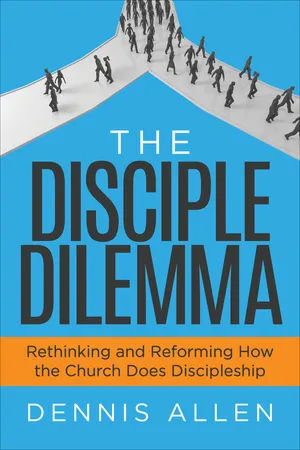
The Disciple Dilemma
Rethinking and Reforming How the Church Does Discipleship
- English
- ePUB (mobile friendly)
- Available on iOS & Android
eBook - ePub
About this book
Information
Topic
Theology & ReligionSubtopic
Christian ChurchPart One
What Is the Dilemma?

Ironically, the conditions that caused the demise of disciple building and lay ministry in those times [second and third centuries] are recurring in the modern church and pose the same threats.
The problem isn’t that we don’t have enough Christians. The problem is Christ doesn’t have enough disciples.
1
Is Something Amiss?
Statistically speaking, your community of believers is probably infected. Most everyone in your small groups, teams, committees, youth groups, worship gatherings, mission trips and ministry operations. Odds are 99 to 1 that they’re infected. But not with a virus. It’s a dilemma. You might be one of the fortunate communities where the ancients, contemporary society and organizational culture exempted you from the dilemma, but you would be a rarity to be without any of the consequences. Let’s set up the problem and get this dilemma out into the light.
Here are four different situations posing a common question:
- There’s a “Check Engine” light flashing when you drive your car, and a bizarre noise under the hood.
- Your young children and their friends have been upstairs, quiet for far too long.
- Your boss says she wants to meet with you and the HR director on Friday about your career.
- The doctor tells you the heart scan needs to be run again, right away.
The common question would be: “Is something amiss?”
Take a look at the bullet points in this chapter. After you skim them, if I were to ask you that same question “Is something amiss?” you would be justified to reply: “It’s the disciples, stupid!”2 So let’s talk about the symptoms that drive that common question looking at Christian communities—churches, small groups, ministries, mission agencies and parachurch organizations. People have been telling us for a long time there’s a discipleship problem. For example, “Ironically, the conditions that caused the demise of disciple building and lay ministry in those times [second and third centuries] are recurring in the modern church and pose the same threats.” was the jolt for me from Carl Smith in his seminal book With Christ in the School of Disciple Building.3 And Tony Evans: “The problem isn’t that we don’t have enough Christians. The problem is Christ doesn’t have enough disciples.”4
Some symptoms surrounding disciples are good. But others indicate that something’s badly amiss, and these symptoms center on disciples. Not all disciples. But even if, as a leader, you’re sure your own people are ok, you still might have nagging doubts about those other Christians out there, looking around your part of the world. Facts to back up that nagging sense of unease are not hard to find. Just as an opener, consider these Pew Research Center findings:5
- Eternal life is not exclusive to Christianity, according to six out of ten Christians.
- Absolute truth does not exist for 40 percent of Christians.
- Talking about faith is “not my job” for 35 percent of Christians.
And toss in a few findings from some other credible research houses:
- 92 percent of Christians do not believe sharing faith is important6
- 65 percent of Christians say living out faith is better than talking about it7
- The average tithe today is 2.5 percent and declining. It was 3.3 percent during the Great Depression.8
Pew Research’s “Religious Landscape Study” tells us that the Protestant census breaks into two-thirds conservative evangelical and one-third liberal/mainline. In other words, evangelicals—the ones who should be the most likely to ascribe to a high view of Scripture and a high view of the person and work of Christ—account for 66 percent of the people in Protestant Christianity. The minority, the 34 percent frequently hew toward looser/lesser views on the reality and resurrection of Jesus, skepticism toward biblical accuracy and inspiration, tending to see truth as an unknowable, and that salvation cannot simply be exclusively in Christ. Yet it’s a majority of Protestants who claim that God would not make Jesus the only way to heaven, and that truth, in the classic sense of the biblical narrative, does not exist.
How does a Frankensteinian worldview like this get sewn together in a society? It may be, we think, those Republican right-wingers holding us back, or the social justice lefty progressives. Some say it’s due to our academies, that they’re the ones polluting minds. Bad politicians are another scapegoat, wrecking morals and principles, or perhaps it’s the olders, or the youngers, or movies, music, morals, conservatives, liberals, racists, cis-genders, nationalism, marxism and the beat goes on. Whatever it might be, the symptoms flourish right here amongst us, the believers, in the minds, hearts and social media of the so-called faithful, who are otherwise known as disciples.9
What symptoms should we expect of disciples raised with an anemic, spiritually speaking, framework to take to college, or off to the workplace, off to the military, the media, or the universities? (Off may in fact be the operative word to use.) What we should expect is a fragile disciple. The New Testament says disciples must be readied with a living and active personal faith, not a bequeathed tradition, lest they become fair game “taken captive by philosophy and empty deceit, according to human tradition, according to the elemental spirits of the world, and not according to Christ.” Colossians 2:8 [ESV]
Now it would be one thing to take one or two numbers in a few research studies to force a dire conclusion about discipleship. But there’s more to discuss. Let’s read on. What do these numbers suggest to you?
- 65 percent of the US population identify as Christian, which suggests there are around 200 million believers. Less than a quarter of those Christians—about 50 million—attend a church.10
- In Great Britain, 60 percent of the UK’s 60 million people (about 38 million) claim Christianity. Of those 38 million Christians, 8 percent—about three and a half million—actually attend a church somewhere.11
- 82 percent of US Christians surveyed say they have no Bible study, no faith community, no mentor.12
- 80 percent of Christians say they lack the skills or relationships to feel okay to talk about their faith.13
This means that eight of every ten Christians have, at best, little or no association with a community of believers, no developmental life in Christ aside from an occasional sermon. These followers run stealthy about their life in Christ outside their churches, first because most claim not to know how to discuss their belief, or alternatively, believe that to talk about their beliefs is not ethical. And a great many, in increasing numbers are walking off the grid altogether, having been abandoned in their questions, life and belief system. This is anemic discipleship for anybody else watching and listening.
Are these discipling problems being solved by the traditional methods common to modern Christian community—small groups, discipling classes, mission trips and top-notch facilities? Well, there are studies for all that too, with consistently somber findings like these, from the Barna Research Group:14
- 41 percent of believers attending church say spiritual growth is an entirely private matter.
- 33 percent of believers say going it alone in spiritual growth is right for them.
- 52 percent of Protestant church leaders say small groups are the key to discipleship.
- 74 percent of Christians say that they’re satisfied, or almost where they want to be, spiritually.
- 65 percent of congregants think discipling at their church is good
- Yet only 1 percent of pastors believe discipleship is good in their churches.
Who’s right? These trends paint a very Western portrait about disciples: the lone wolf, needin’ nothin’ from nobody.
People abandoning their faith is not a new thing, but it is uniquely on the rise today. Youthful departures from church have been a problem for centuries. Especially so in the US since the World Wars. But the academics tell us that as the pre-1980’s parents raised children of their own, they typically came back to church. Not so any longer.
- 59 percent of millennials drop out of church, and having kids does not bring them back.15
- From 1990 to 2016, “Nones” (no religious affiliation) quadrupled from 4 percent to 17 percent.16
- “Nones” are 17 percent of the boomer generation (born 1946-1964), but for millennials (born 1981-1994) the rate more than doubles to 36 percent.17
- US church membership is down 17 percent from 1999 to 2016. Protestant headcount trends are down 8 percent from 2007 to 2019, and accelerating downward. And for the Roman Catholic Church, for every person who comes in, six leave.18
- Beginning with the Gen Xr’s (born 1965-1976) most church groups have begun to shrink, a new trend compared to the two hundred preceding years.19
If discipling is going well, what gives with these studies? William Wilberforce, the great British politician and emancipator, warned in 1797 about the risk of traditions versus religious commitment. In the opening pages of his book A Practical View of Christianity, he discussed traditions ensnaring the typical child growing up at that time:
He was born in a Christian country, of course he is a Christian; His father was a member of the Church of England, so is he. When such is the hereditary religion handed down from generation to generation, it cannot surprise us to observe young men of sense and spirit beginning to doubt altogether the truth of the system in which they have been brought up, ready to abandon a station which they are unable to defend. Knowing Christianity chiefly in the difficulties which it contains, and in the impossibilities which are falsely imputed to it, they fall perhaps into the company of infidels; and, as might be expected, are shaken by frivolous objections and profane cavil’s, which, had they been grounded and bottomed in reason and argument, passed by them, as “the idle wind,” and scarcely have seemed worthy of serious notice.20
In other words, being brought up in a religion—or simply associating with groups of people involved in it—does not make for enduring disciples.
A lot of people are writing thoughtfully about the whys underlying the challenges in Christianity and in Western society generally. Some, like Rod Dreher say families and sexuality have been wrecked—and if we can get that sorted, we’ll be heading in a better way.21 Others, like R.R. Reno, point to populism, politics, and nationalism as the real problem.22 Here in the populists, they say, are the roots of the problems in Christian community and society. From another angle, Jonathan Wilson Hartgrove’s work strongly suggests the problems of racism, slavery, and the tragedies of oppression in the Western world are the root cause.23 Or we can look to authors like Sherry Weddell, a Southern Baptist-turned-Catholic scholar, who has published a number of books on discipleship’s trends, problems, and better traits, her most famous book being Forming Intentional Disciples, where she thoughtfully lays out her case of cause and effect, and a program to set things to rights.24 Is any of that getting at the problem? Are those things together the problem? Sexuality, politics, racism, program deficiencies? We should consider the possibility that those kinds of issues, rightly describing real impacts on disciples are in fact more societal symptoms of a much larger dilemma infesting the community and the individual people of Christ. Each of these excellent authors’ works are well-researched, valid descriptors and superb background. Yet they are the symptoms, not the cause of the disciple dilemma. This means we must find a way to locate the real cause, and then bridge the obvious question of “what someone ought to do” and “what the Church should do,” nationally, locally, personally. There must be a beginning to a national, perhaps a global reset for Christian community. A beginning to get us all back to the centerline of what we each do in addressing the disciple dilemma. And that personal first responder must be you. As leaders.
If you’ve been in a leadership role in the Christian community, you’ve probably had the feeling that something in the spiritual DNA of many believers isn’t quite right. Like a spring winding down in an old clock, a slowing tempo in what we were intended to be. We know that agape, surrender, commitment, and endurance were supposed to be prime strands of our new DNA in Christ. Nowadays that DNA seems kind of scarce. But the symptoms are there, evident to almost everyone.
These facts and figures point to corrosive trends that are accelerating among Christian believers of all stripes and types. Usually when this subject comes up with people a common question is “What’s the answer to it all?” The problem is, the problem isn’t even on the table yet.
Then and Now
Os Guinness has a helpful phrase he uses in seeing the bigger picture: “Contrast is the mother of clarity.”25 Let’s lean on that wisdom here. Consider these contrasts between modern-day discipleship and what we can observe from the New Testament period:
- In today’s world, the modern thinks of disciples as Christians who upgrade—the premium version, so to speak, of a believer. The New Testament believer knew that every Christian was a disciple.
- The modern sees discipling as possible only if one is a believer. In contrast, New Testament discipling began with people as skeptics or scoffers.
- The modern may, occasionally, be inclined to try to “save” people, but prefers operating from within the safety of groups—such as mission trips and inviting people to church.
- If someone does come to Christ, the modern is inclined to get a convert to sign on, to join somewhere, then the modern can move on to the next prospect. In contrast, the disciples of the New Testament period were inviting people—often relatives, neighbors or recent acquaintances—to “come and see” (and evaluate) Jesus the Christ.
- The modern thinks about discipling as group activity (>3) gatherings, memberships and programs because that’s what Christians do—if the cause is right, and the friendships are interesting. The New Testament disciple was mentored, teamed in close proximity to a very few others, and to live with one another as disciples.
- The modern sees lordship as a cost-capped option, if at all. That Jesus will not ask for more than one is willing to give and he will not be unhappy if we opt out of the lord part. For New Testament Christians, it was full and unconditional surrender.
- For the modern, Christianity often is about improving a quality of life, pursuing world causes and right thinking to validate discipleship. For the New Testament disciple, it meant literally setting their life aside and pursuing their Master.
- Moderns embrace identity, uniqueness and individualism. New Testament disciples sought to lose their identity and devote their life, skills and energy in service to God and the people around them.
- The modern seeks solutions with recurring challenges such as sex, money, career or meaning. For New Testament disciples—to fall short is human and grace would prevail.
- The modern disciple is self-made, autonomous, independent. For the New Testament believer, it was never a solo act.
- The modern has an exit ramp, a mission accomplished milestone—it might mean being a good example until the kids have grown up, or taking that big mission trip, or maybe hitting age sixty-five when somebody else ought to step in. Yet, for the New Testament disciple, it never ended. Continuous improvement—sanctification—discipleship was lifelong. There was never any retiring as a disciple.
- For the modern, failure to live up to biblical standards means that something’s wrong with the biblical standards. For the New Testament disciple, such failures simply confirmed what was already known: something’s wrong with us as huma...
Table of contents
- Cover
- Title
- Copyright
- Contents
- Introduction
- Part One What Is the Dilemma?
- Part Two The Dilemma’s Effects
- Part Three Moving Forward—a Better Path
- Conclusion
- About The Author
- Endnotes
Trusted by 375,005 students
Access to over 1.5 million titles for a fair monthly price.
Study more efficiently using our study tools.
Frequently asked questions
Yes, you can cancel anytime from the Subscription tab in your account settings on the Perlego website. Your subscription will stay active until the end of your current billing period. Learn how to cancel your subscription
No, books cannot be downloaded as external files, such as PDFs, for use outside of Perlego. However, you can download books within the Perlego app for offline reading on mobile or tablet. Learn how to download books offline
Perlego offers two plans: Essential and Complete
- Essential is ideal for learners and professionals who enjoy exploring a wide range of subjects. Access the Essential Library with 800,000+ trusted titles and best-sellers across business, personal growth, and the humanities. Includes unlimited reading time and Standard Read Aloud voice.
- Complete: Perfect for advanced learners and researchers needing full, unrestricted access. Unlock 1.5M+ books across hundreds of subjects, including academic and specialized titles. The Complete Plan also includes advanced features like Premium Read Aloud and Research Assistant.
We are an online textbook subscription service, where you can get access to an entire online library for less than the price of a single book per month. With over 1.5 million books across 990+ topics, we’ve got you covered! Learn about our mission
Look out for the read-aloud symbol on your next book to see if you can listen to it. The read-aloud tool reads text aloud for you, highlighting the text as it is being read. You can pause it, speed it up and slow it down. Learn more about Read Aloud
Yes! You can use the Perlego app on both iOS and Android devices to read anytime, anywhere — even offline. Perfect for commutes or when you’re on the go.
Please note we cannot support devices running on iOS 13 and Android 7 or earlier. Learn more about using the app
Please note we cannot support devices running on iOS 13 and Android 7 or earlier. Learn more about using the app
Yes, you can access The Disciple Dilemma by Dennis Allen in PDF and/or ePUB format, as well as other popular books in Theology & Religion & Christian Church. We have over 1.5 million books available in our catalogue for you to explore.