Extraordinary growth of the financial relative to the nonfinancial sector has marked the development of mature capitalism during the last four decades. The changing balance between the two sectors has altered the outlook of the economy and facilitated the spread of financial concerns, practices, and outlooks across society. The result has been the gradual transformation of contemporary capitalism – namely, its financialization since the late 1970s.
There are similarities between the Marxian, the Post-Keynesian and other heterodox approaches to analyzing the profound changes in money and finance in the global economy since the 1980s. Prominent among them is a common focus on financialization but also on the limits of monetary policy, the transformation of banking, the tendency to crisis related to financial excess, and the problematic role of neoliberalism in finance. Furthermore, the complexity of the interrelationship between finance and the rest of the economy has increased since the great crisis of 2007-9. This book tackles several of these developments as well as engaging in debate among different currents of heterodox economics.
The chapters in this book were originally published in The Japanese Political Economy.
Profitability trends in the era of financialization: Notes on the U.S. economy
Costas Lapavitsas and Ivan Mendieta-Muñoz
ABSTRACT
This article considers the evolution of financialization in the U.S. economy by examining the profitability and the volume of profits of the financial sector relative to general profitability and total profits in the economy. It is shown that financial profitability rose strongly from the early 1980s to the early 2000s. Similarly, the volume of financial profits reached extraordinary levels in the early 2000s. These phenomena occurred while interest rates and the net interest margin of banks were on a downward trend and, broadly speaking, reflect financial expropriation in the U.S. economy. The great crisis of 2007–2009 has acted as a threshold point beyond which both the profitability and the volume of profits of the financial sector have not recovered to previous levels. It is possible, but not certain, that a rebalancing of the productive and the financial sectors is under way in the financialized U.S. economy.
Introduction: Profitability trends in the course of financialization
Extraordinary growth of the financial relative to the nonfinancial sector has marked the development of mature capitalism during the last four decades. The changing balance between the two sectors has altered the outlook of the economy and facilitated the spread of financial concerns, practices, and outlook across society. The result has been the gradual transformation of contemporary capitalism—namely, its financialization since the late 1970s.1
Within the framework of Marxist political economy, and following Lapavitsas (2013), financialization can be characterized as the outcome of three underlying tendencies: first, reduced reliance of nonfinancial enterprises on borrowed funds for investment; second, turning of banks toward transacting in open markets and household lending; and, third, increasing involvement of households in formal finance. These tendencies are summed up in the extraction of financial profit by various agents within the economy. It follows that an important analytical approach to characterizing financialization as a historical period is to examine the trajectory of the relevant profitability measures during the last several decades. After all, capitalism rests on the making of profit, and thus the trajectory and fluctuations of financial profit are crucial to the analysis of financialization, as is also the relationship between financial and total profit over time.
It is reasonable to expect, a priori, that during the period of financialization both financial profitability and the proportion of financial profit have increased relative to general profitability and total profit. With this expectation in mind, the relationship between financial and total profit in the U.S. economy is discussed in the rest of the article by considering various measures of aggregate profitability during the period 1955–2015. The analysis deploys publicly available data obtained from Duménil and Lévy (2016), the Federal Deposit Insurance Corporation (FDIC), the Federal Reserve Bank of St. Louis (FRED), and the National Income and Product Accounts (NIPA) published by U.S. Bureau of Economic Analysis (BEA).
A major difficulty in this respect is that financial profit is a difficult concept to define theoretically. Broadly speaking, it can be taken to refer to profit made through financial transactions by a range of economic agents, and not only by capitalists (Lapavitsas 2013). Furthermore, in line with standard Marxist political economy, financial profit can be considered to derive principally as a share of the flow of total profit (surplus value) generated by the nonfinancial sector. It has become apparent in the years of financialization, however, that financial profit can also derive out of the flows of personal income as well as from the redivision of money holdings across society (mostly as various forms of capital gains). Precisely for this reason, financial profit has given rise to the concept of “financial expropriation,” that is, profit deriving via expropriating methods from the income and wealth of others. In short, financial expropriation is characteristic of financialization and captures profits arising out of transfers of household income but also of money wealth, chiefly in the form of capital gains (Lapavitsas 2009, 2013).
Unfortunately, it is extremely difficult to measure financial profit by deploying national income accounts or other publicly available macroeconomic statistics, when such profit is defined in the appropriate “envelope” terms outlined above. For one thing, there is no clearly established way of measuring financial profit that arises out of capital gains. Given this difficulty, and despite the undoubted importance of capital gains and other forms of financial expropriation in the course of financialization, the best way of empirically approximating financial profit is simply to measure the profits of financial institutions, above all, of commercial banks.
After measuring financial profit, the main problem is to establish its relationship to total profit. There are two methods of pursuing this task, both of which are standard in Marxist political economy. The first is to compare the rate of financial profit to the general rate of profit; the second is to compare the volume (or mass) of financial relative to total profit. Each method could cast a different light on the path and the direction of financialized mature capitalism in the United States. The comparisons, furthermore, would broadly reflect the balance between the financial and the nonfinancial sections of the U.S. capitalist class.
Empirical analysis in the following sections examines the relationship between financial and total profit in the U.S. economy during the period 1955–2015 by deploying both methods. On this basis, conclusions are drawn about the trajectory of the U.S. financialization. The fundamental reason for focusing exclusively on the United States is the availability of data, which is by far the best among developed countries. At the same time, the United States is the paradigmatic country of financialization, and thus the conclusions reached about the U.S. economy may have a broader significance for financialization elsewhere. Nonetheless, it is vital to acknowledge at the outset the data limitations in tackling the complex research question of this article. The results presented below should be taken cum grano salis.
Comparing the general rate of profit to the rate of profit of commercial banks
The main purpose of this section is to compare the rate of financial profit to the general rate of profit. To the best of our knowledge, this is the first time such a comparison has been attempted for the U.S. economy, and the evidence presented is new. The results offer a fresh and penetrating insight into the trajectory of U.S. financialization that could also facilitate further analysis for other countries.
Estimating the relevant profit rates is a complex task. There is an enormous Marxist literature on the general rate of profit, including its trajectory in the long and the short term. We have deployed a simple measure of the general rate of profit for the U.S. economy obtained from the dataset provided by Duménil and Lévy (2016). Moreover, there are tremendous conceptual difficulties with regard to financial profit arising from its inchoate and “envelope” character. Put simply, there cannot be a general rate of return that reflects at once the profitability of banks, the rate of financial profits made by nonfinancial enterprises, the profitability of pension funds, the rate of profit made by individuals derived from financial assets, and so on. The fundamental reason is that such rates cannot achieve uniformity, as they are not all earned by competing capitals, and thus do not reflect the movement of resources across different areas of the economy. There is no general rate of financial profit that is formed in a manner analogous to the general rate of profit. In this light, a useful proxy for financial profits is the net operating income of commercial banks, which are the pivot of the financial system. Data for that is available from the FDIC online database.
Given this proxy for financial profit, the first step is to establish an initial proportionate relation between financial and total profit in the U.S. economy. A simple way of doing that is to standardize both forms of profit with regard to gross domestic product (GDP). The ratios would obviously not reflect pure measures of profitability but nonetheless offer insight into the relative weight of each form of profit in the U.S. economy in the course of financialization. Furthermore, note that Duménil and Lévy (2016) have sought the broadest definition of profitability by calculating the annual volume of total profits in relation to net domestic product (NDP). It is expedient to follow the same path using NDP to standardize profit measures.
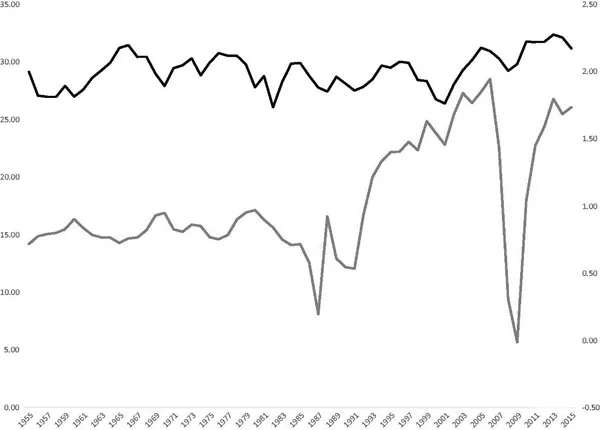
Figure 1 plots the respective ratios of financial and nonfinancial (total) profit to NDP in the U.S. economy. Several important points are apparent from visual inspection alone:
Figure1.United States, 1955–2015 (annual data). Total profits as percentage of net domestic product (black line, left axis) and net operating income of commercial banks as a percentage of net domestic product (red line, right axis). Source: Our own elaboration using data obtained from Duménil and Lévy (DL; 2016) and the Federal Deposit Insurance Corporation (FDIC). (Total profits: net domestic product minus wages, DL; net domestic product: DL; financial profits: pretax net operating income for commercial banks, FDIC, Table CB04. Net income for all insured commercial banks.)
Nonfinancial profits have exhibited a slight upward trend relative to NDP during the period following the Second World War.
Financial profits began to rise steadily relative to NDP after the middle of the 1980s, and peaked in 2006.
Financial profits collapsed relative to NDP in the course of the great crisis of 2007–2009, but rebounded strongly soon afterward, although they have not regained an upward trend.
In sum, the relative weight of financial profit in the U.S. economy rose steadily in the course of financialization. However, the balance between the two forms of profit appears to have shifted since the great crisis of 2007–2009. The preliminary evidence seems to suggest that the crisis has acted as a threshold point dampening the historic upward trajectory of financial profits.
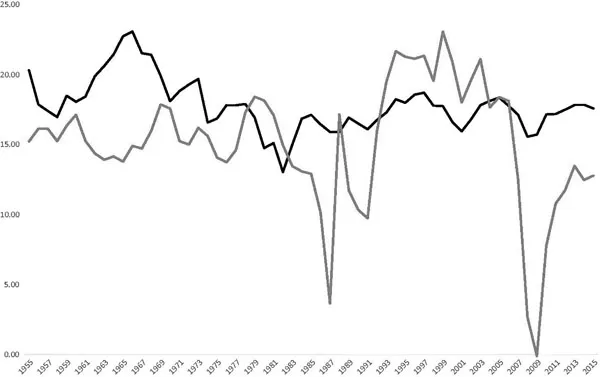
The ratios of profit volumes relative to NDP are informative, but a far a more accurate view of the balance between the two sectors of the economy can be obtained by establishing the relevant rates of profit. The general rate of profit can be extracted from the dataset provided by Duménil and Lévy (2016). For the financial sector, on the other hand, suffice it to measure the rate of profit of commercial banks, which can be approximated by estimating the net operating income of banks as a percentage of their total equity capital. Thus, Figure 2 shows the general rate of profit compared to the rate of profit of commercial banks for the U.S. economy. Comparing the two rates is not common in the literature on financialization, but is revealing about the characteristics of the period.
Introduction: Money, finance, and capitalist crisis
1 Profitability trends in the era of financialization: Notes on the U.S. economy
2 The comparative advantage of the U.S. shadow banking system and the role of the U.S. dollar
3 Building blocks for the macroeconomics and political economy of housing
4 Marx’s Financial Capitalism
5 Financialization and the impasse of capitalism
6 State involvement in cryptocurrencies: A potential world money?
Index
Trusted by 375,005 students
Access to over 1.5 million titles for a fair monthly price.
Study more efficiently using our study tools.
Frequently asked questions
Yes, you can cancel anytime from the Subscription tab in your account settings on the Perlego website. Your subscription will stay active until the end of your current billing period. Learn how to cancel your subscription
No, books cannot be downloaded as external files, such as PDFs, for use outside of Perlego. However, you can download books within the Perlego app for offline reading on mobile or tablet. Learn how to download books offline
Perlego offers two plans: Essential and Complete
Essential is ideal for learners and professionals who enjoy exploring a wide range of subjects. Access the Essential Library with 800,000+ trusted titles and best-sellers across business, personal growth, and the humanities. Includes unlimited reading time and Standard Read Aloud voice.
Complete: Perfect for advanced learners and researchers needing full, unrestricted access. Unlock 1.5M+ books across hundreds of subjects, including academic and specialized titles. The Complete Plan also includes advanced features like Premium Read Aloud and Research Assistant.
Both plans are available with monthly, semester, or annual billing cycles.
We are an online textbook subscription service, where you can get access to an entire online library for less than the price of a single book per month. With over 1.5 million books across 990+ topics, we’ve got you covered! Learn about our mission
Look out for the read-aloud symbol on your next book to see if you can listen to it. The read-aloud tool reads text aloud for you, highlighting the text as it is being read. You can pause it, speed it up and slow it down. Learn more about Read Aloud
Yes! You can use the Perlego app on both iOS and Android devices to read anytime, anywhere — even offline. Perfect for commutes or when you’re on the go. Please note we cannot support devices running on iOS 13 and Android 7 or earlier. Learn more about using the app
Yes, you can access Money, Finance, and Capitalist Crisis by Nobuharu Yokokawa, Costas Lapavitsas, Nobuharu Yokokawa,Costas Lapavitsas in PDF and/or ePUB format, as well as other popular books in Economics & Economic Theory. We have over 1.5 million books available in our catalogue for you to explore.