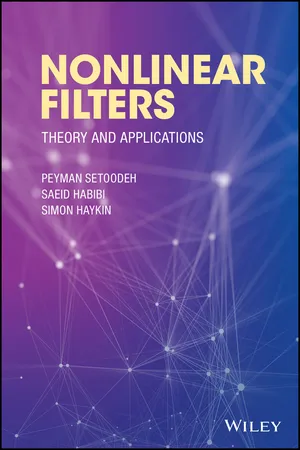
Nonlinear Filters
eBook - ePub

Nonlinear Filters

Theory and Applications

  1. English
  2. ePUB (mobile friendly)
  3. Available on iOS & Android
eBook - ePub

Nonlinear Filters

Theory and Applications

About this book

NONLINEAR FILTERS

Discover the utility of using deep learning and (deep) reinforcement learning in deriving filtering algorithms with this insightful and powerful new resource

Nonlinear Filters: Theory and Applications delivers an insightful view on state and parameter estimation by merging ideas from control theory, statistical signal processing, and machine learning. Taking an algorithmic approach, the book covers both classic and machine learning-based filtering algorithms.

Readers of Nonlinear Filters will greatly benefit from the wide spectrum of presented topics including stability, robustness, computability, and algorithmic sufficiency. Readers will also enjoy:

  • Organization that allows the book to act as a stand-alone, self-contained reference
  • A thorough exploration of the notion of observability, nonlinear observers, and the theory of optimal nonlinear filtering that bridges the gap between different science and engineering disciplines
  • A profound account of Bayesian filters including Kalman filter and its variants as well as particle filter
  • A rigorous derivation of the smooth variable structure filter as a predictor-corrector estimator formulated based on a stability theorem, used to confine the estimated states within a neighborhood of their true values
  • A concise tutorial on deep learning and reinforcement learning
  • A detailed presentation of the expectation maximization algorithm and its machine learning-based variants, used for joint state and parameter estimation
  • Guidelines for constructing nonparametric Bayesian models from parametric ones

Perfect for researchers, professors, and graduate students in engineering, computer science, applied mathematics, and artificial intelligence, Nonlinear Filters: Theory and Applications will also earn a place in the libraries of those studying or practicing in fields involving pandemic diseases, cybersecurity, information fusion, augmented reality, autonomous driving, urban traffic network, navigation and tracking, robotics, power systems, hybrid technologies, and finance.

Information

Publisher
Wiley
Year
2022
Print ISBN
9781118835814
Edition
1
eBook ISBN
9781119078159

1
Introduction

1.1 State of a Dynamic System

In many branches of science and engineering, deriving a probabilistic model for sequential data plays a key role. System theory provides guidelines for studying the underlying dynamics of sequential data (time series). In describing a dynamic system, the notion of state is a key concept [1]:
Definition 1.1 State of a dynamic system is the smallest collection of variables that must be specified at a time instant
k 0
in order to be able to predict the behavior of the system for any time instant
k greater-than-or-equal-to k 0
. To be more precise, the state is the minimal record of the past history, which is required to predict the future behavior.
According to the principle of causality, any dynamic system may be described from the state perspective. Deploying a state‐transition model allows for determining the future state of a system,
bold x Subscript k Baseline element-of double-struck upper R Superscript n Super Subscript x
, at any time instant
k greater-than-or-equal-to k 0
, given its initial state,
bold x Subscript k 0
, at time instant
k 0
as well as the inputs to the system,
bold u Subscript k Baseline element-of double-struck upper R Superscript n Super Subscript u
, for
k greater-than-or-equal-to k 0
. The output of the system,
bold y Subscript k Baseline element-of double-struck upper R Superscript n Super Subscript y
, is a function of the state, which can be computed using a measurement model. In this regard, state‐space models are powerful tools for analysis and control of dynamic systems.

1.2 State Estimation

Observability is a key concept in system theory, which refers to the ability to reconstruct the hidden or latent state variables that cannot be directly measured, from the measured variables in the minimum possible length of time [1]. In building state‐space models, two key questions deserve special attention [2]:
  1. (i) Is it possible to identify the governing dynamics from data?
  2. (ii) Is it possible to perform inference from observables to the latent state variables?
At time instant
k
, the inference problem to be solved is to find the estimate of
bold x Subscript k plus alpha
in the presence of noise, which is denoted by
ModifyingAbove bold x With ĆŒā€š Subscript k plus alpha
. Depending of the value of
alpha
, estimation algorithms are categorized into three groups [3]:
  1. (i) Prediction:
    alpha greater-than 0
    ,
  2. (ii) Filtering:
    alpha equals 0
    ,
  3. (iii) Smoothing:
    alpha less-than 0
    .
Regarding the mentioned two challenging questions, in order to improve performance, sophisticated representations can be deployed for the system under study. However, the corresponding inference algorithms may become computationally demanding. Hence, for designing efficient data‐driven inference algorithms, the following points must be taken into account [2]:
  1. (i) The underlying assumptions for building a state‐space model must allow for reliable system identification and plausible long‐term prediction of the system behavior.
  2. (ii) The inference mechanism must be able to capture rich dependencies.
  3. (iii) The algorithm must be able to inherit the merit of learning machines to be trainable on raw data such as sensory inputs in a control system.
  4. (iv) The algorithm must be scalable to big data regarding the optimization of model parameters based on the stochastic gradient descent method.
Regarding the important role of computation in inference problems, Section 1.3 provides a brief account of the foundations of computing.

1.3 Construals of Computing

According to [4], a comprehensive theory of computing must meet three criteria:
  1. (i) Empirical criterion: Doing justice to practice by keeping the analysis grounded in real‐world examples.
  2. (ii) Conceptual criterion: Being understandable in terms of what it says, where it comes from, and what it costs.
  3. (iii) Cognitive criterion: Providing an intelligible foundation for the computational theory of mind that underlies both artificial intelligence and cognitive science.
Following this line of th...

Table of contents

  1. Cover
  2. Table of Contents
  3. Title Page
  4. Copyright
  5. Dedication
  6. List of Figures
  7. List of Table
  8. Preface
  9. Acknowledgments
  10. Acronyms
  11. 1 Introduction
  12. 2 Observability
  13. 3 Observers
  14. 4 Bayesian Paradigm and Optimal Nonlinear Filtering
  15. 5 Kalman Filter
  16. 6 Particle Filter
  17. 7 Smooth Variable‐Structure Filter
  18. 8 Deep Learning
  19. 9 Deep Learning‐Based Filters
  20. 10 Expectation Maximization
  21. 11 Reinforcement Learning‐Based Filter
  22. 12 Nonparametric Bayesian Models
  23. References
  24. Index
  25. Wiley End User License Agreement

Trusted byĀ 375,005 students

Access to over 1.5 million titles for a fair monthly price.

Study more efficiently using our study tools.

Frequently asked questions

Yes, you can cancel anytime from the Subscription tab in your account settings on the Perlego website. Your subscription will stay active until the end of your current billing period. Learn how to cancel your subscription
No, books cannot be downloaded as external files, such as PDFs, for use outside of Perlego. However, you can download books within the Perlego app for offline reading on mobile or tablet. Learn how to download books offline
Perlego offers two plans: Essential and Complete
  • Essential is ideal for learners and professionals who enjoy exploring a wide range of subjects. Access the Essential Library with 800,000+ trusted titles and best-sellers across business, personal growth, and the humanities. Includes unlimited reading time and Standard Read Aloud voice.
  • Complete: Perfect for advanced learners and researchers needing full, unrestricted access. Unlock 1.5M+ books across hundreds of subjects, including academic and specialized titles. The Complete Plan also includes advanced features like Premium Read Aloud and Research Assistant.
Both plans are available with monthly, semester, or annual billing cycles.
We are an online textbook subscription service, where you can get access to an entire online library for less than the price of a single book per month. With over 1.5 million books across 990+ topics, we’ve got you covered! Learn about our mission
Look out for the read-aloud symbol on your next book to see if you can listen to it. The read-aloud tool reads text aloud for you, highlighting the text as it is being read. You can pause it, speed it up and slow it down. Learn more about Read Aloud
Yes! You can use the Perlego app on both iOS and Android devices to read anytime, anywhere — even offline. Perfect for commutes or when you’re on the go.
Please note we cannot support devices running on iOS 13 and Android 7 or earlier. Learn more about using the app
Yes, you can access Nonlinear Filters by Peyman Setoodeh,Saeid Habibi,Simon Haykin in PDF and/or ePUB format, as well as other popular books in Technology & Engineering & Electrical Engineering & Telecommunications. We have over 1.5 million books available in our catalogue for you to explore.