This volume highlights the variety of forms comedy took in England, with reference to developments in Europe, particularly France, during the European Enlightenment. It argues that comedy in this period is characterized by wit, satire, and humor, provoking both laughter and sympathetic tears. Comic expression in the Enlightenment reflects continuities and engagements with the comedy of previous eras; it is also noted for new forms and preoccupations engendered by the cultural, philosophical, and political concerns of the time, including democratizing revolutions, increasing secularization, and growing emphasis on individualism.
Discussions emphasize the period's stage comedy and acknowledge comic expression in various forms of print media including the emerging literary form we now know as the novel. Contributions from scholars reflect a wide variety of interests in the field of 18th-century studies, and the inclusion of a generous number of illustrations throughout demonstrates that the period's visual culture was also an important part of the Enlightenment comic landscape.
Each chapter takes a different theme as its focus: form, theory, praxis, identities, the body, politics and power, laughter and ethics. These eight different approaches to Enlightenment comedy add up to an extensive, synoptic coverage of the subject.
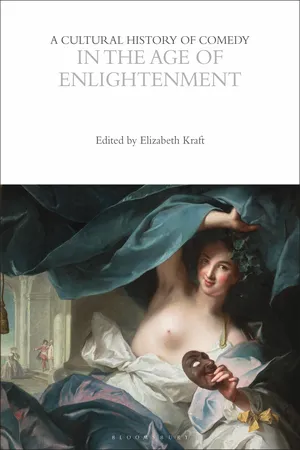
eBook - ePub
A Cultural History of Comedy in the Age of Enlightenment
- 272 pages
- English
- ePUB (mobile friendly)
- Available on iOS & Android
eBook - ePub
A Cultural History of Comedy in the Age of Enlightenment
About this book
CHAPTER ONE
Form
BRIAN CORMAN
By the time of the “Age of Enlightenment,” comedy already had a two-thousand-year history. Given this long history and the changes that occurred over time, it is not surprising that critics have failed to arrive at a precise, inclusive definition of the form.1 Most would agree that comedy usually ends happily, fulfilling audience desires and expectations for the protagonists. Most would also agree that there is usually a moral dimension to comedy. Consensus tends to end there. Attempts at formulating a more exact definition are misguided for a number of reasons. Forms are not tangible objects but rather intellectual constructs, heuristic devices that provide models for comprehension and interpretation to aid both authors and readers in a range of activities from the creation of new works to the understanding of both new and older works. Their value is in problem solving, not prescription or classification.2 Attribution is necessarily conjectural and subject to change over time in response to changing literary fashions and critical and cultural concerns.
Comedy has the longest continuous tradition in western literature, but it has developed in many different ways over time and in diverse cultures. Large synchronous generic terms like comedy thus have limited—but real—value. Such “institutional” forms are “externally defined” (Koelb 1975: 252); that is, membership is determined by inclusiveness and responsiveness to historical change. Thinking about comedy this way fosters an approach that recognizes that many of the characteristics of what we continue to recognize as comedy were in place by the time of Aristophanes and Menander. The differences between the “Old Comedy” of Aristophanes and the “New Comedy” of Menander made it impossible even then to capture a single, intrinsic genre. To reach that level of specificity, it became necessary to divide comedy into subgenres, a practice well-developed before the “Age of Enlightenment.” As Alastair Fowler points out, subgenres, often treated as freestanding genres, are formed “by distinguishing additional genre-linked motifs or topics,” and they can, in turn, be further subdivided “more and more minutely” (Fowler 1982: 112). In large genres like comedy, change occurs at the level of subgenre. It is here where innovation occurs. It is here where the conservative form of dramatic comedy was continually revitalized during the Enlightenment. It is here where historic change is best seen.
It is also important to recognize that comedy extends beyond genre and subgenre to what Fowler calls its modal or adjectival form, the “comic” (1982: 106–7). Many works that are not comedies contain parts or aspects that are comic; nevertheless, their overall form is not comedy. A familiar example is the “comic relief” found in many tragedies such as in the “Nicky-Nacky” scenes in Thomas Otway’s Venice Preserved (1682). Forms of drama other than comedy often contain parts that are comic; other literary forms such as the novel and satire do so at least as often. I differ with Fowler in one significant point about comedy. For him, comedy means dramatic comedy; outside of drama, all other occurrences of comedy are modal, that is, there are only comic novels, not prose fiction comedies. I would argue that with an institutional genre like comedy, the manner of representation does not determine its form. For me, there are comedies presented in narrative just as later forms of comedy appear in film or television. I consider a novel like Emma, to cite one of Fowler’s examples, a comedy, a point I return to below.
Comedy’s origin, at least as a critical concept, goes back to Aristotle; his thinking about comedy was largely about dramatic comedy. Since thinking about comedy in the Enlightenment continues to be based in dramatic comedy, I begin with the drama and propose to use it as a basis for exploring non-dramatic forms and modes of comedy. I focus largely on the literature of England and Great Britain to allow for sufficient detail to examine the range of comedy and its changes over time, but I do so with the conviction that very similar patterns are found in other European literatures, in part because of the common classical origins of comedy and in part because of the constant cross-fertilization of these literatures throughout the Enlightenment. Cultural tastes and needs determine the specifics, but comedy is recognizably comedy across cultures and languages.
When the London theaters reopened after the restoration of Charles II, they depended on earlier plays for a number of years while a new generation of playwrights established itself. The most popular playwrights were John Fletcher and Ben Jonson. (Shakespeare’s romantic comedies did not appeal to Restoration audiences. They preferred The Merry Wives of Windsor over A Midsummer Night’s Dream, Twelfth Night, and As You Like It.) Comedies by other pre-Restoration playwrights were also performed, often adapted to the tastes of the Restoration audiences. French and Spanish plays that had pleased Charles II and his court while they were in exile quickly became preferred sources for adaptation. Continental plays continued to provide playwrights with texts they made English/British throughout the period.
The popularity of the plays of Fletcher and Jonson demonstrates the ongoing appeal of both the “Old” and “New” comedies of the Greeks and Romans. Restoration and eighteenth-century playwrights continued to use these two basic streams of comedy to think about and construct their work. The dramatic criticism of the period is frequently based on the promotion of one of these streams over the other in arguments that are often self-promotional attempts to insure the success on stage of the playwright-critic. Such well-known disputes as those between John Dryden and Thomas Shadwell or John Dennis and Richard Steele show the centrality of Fletcher and Jonson to the thinking about comedy in the period.3
Plot elements from Fletcher and Jonson continued to dominate the theaters, though subject to frequent modification. Fletcher provided the model for what was to be known as “wit comedy” or “comedy of manners.” His is a comedy of action and intrigue; the plots derive from Greek “New Comedy” with its focus on courtship and the obstacles to that courtship, usually from parents, other relations, or rival suitors. Clever servants often aid the lovers. It frequently includes seduction or cuckolding plots or marital discord plots, and frequently combines more than one of these elements. Late seventeenth-century examples are dominated by highly sophisticated protagonists who emulate the polished, sophisticated values of the Restoration court. They excel at clever, witty dialogue (repartee) that distinguishes them from lesser characters, those unable to live up to the elite social standards of the protagonists. These inferior characters are subject to ridicule and victimization for their deficiencies. Resolution normally comes with the young lovers overcoming the obstacles to their desired union, the unhappy married couples restoring harmony in their households or finding ways to separate, and the cuckolding of foolish, older husbands by the younger lovers of their younger wives.
Jonson’s is more a comedy of character. The Jonsonian model derives from Greek “Old Comedy,” with its focus on political and social satire and the punishment and/or correction of characters guilty of venial sins. Jonson’s version often centered on “humours” characters, those suffering from an imbalance of the four humours that ancient medicine identified as the determinants of personality and behavior.4 For Jonson, humours characters were the object of ridicule, well-deserving of the punishments they suffered. By the Restoration, it became increasingly common for humours characters to be cured, though only after painful exposure. And not all humours could be cured.
These two formal models provided the restored theaters of the 1660s with the elements of dramatic comedy that would dominate the period—and beyond. Although playwrights and critics debated the relative value of each, often declaring their firm adherence to the model of their choice, Dryden for one recognized that theory rarely translated into practice without compromise. What he called “the mixt way of Comedy; that which is neither all wit, nor all humour, but the result of both” (Dryden 1970: 206) best describes the actual practice of most playwrights. The dominance of one of these models provides an aid for understanding a given play, but it is very rare for a comedy not to partake of elements of the other. An assumption that rigid walls can be built across the various comic subgenres, however defined, is likely to produce incomplete or distorted understandings.
Fletcher’s witty intrigue comedy and Jonson’s punitive humours comedy, then, are constructs for understanding the forms of comedies that appear and develop in the 140 years after the restoration of Charles II. Although tragedy remained the most prestigious form of drama, it was comedy that most pleased audiences. Hundreds of comedies were performed in this period and a significant subset entered—and left—the repertory of plays performed season after season. I have elsewhere identified a core repertory of eighty-one comedies for the first fifty years following the Restoration (Corman 1993: 12–13). It is not surprising that this group is highly diverse in both form and content. Additional subgenres come and go, though it is rare to find core elements of the models provided by Jonson and Fletcher absent. English audiences were notorious for their love of variety. They rejected the French models of neoclassical critics who demanded purity of form as well as adherence to the unities of time, place, and action. The one thing that virtually all of the comedies of the period share is the inclusion of formal elements from multiple subgenres. Since these subgenres, like all literary forms, change over time, sometimes mutating and other times dropping out of active production, even such relative constants as wit and humours evolve over the course of the period.
Subgenres of comedy proliferated over the course of the period; they remained easily recognizable throughout because the two streams of comedy represented by Fletcher and Jonson provided the models from which they developed. The wit comedy of Dryden and the humours comedy of Shadwell were joined by Spanish intrigue comedy, burlesque and farce, pantomime, ballad opera, sentimental comedy, and burletta to name some of the most prominent. The addition of new subgenres was accompanied by the constant development of existing subgenres, all to meet the ever-changi...
Table of contents
- Cover
- Half-Title Page
- Series
- Title Page
- Contents
- List of Illustrations
- Notes on Contributors
- Editor’s Acknowledgments
- Series Preface
- Introduction
- 1 Form
- 2 Theory
- 3 Praxis: The Practice of Comedy in the Restoration and Eighteenth Century
- 4 Identities: Deception, Discovery, and the Paradox of the Dark Lantern
- 5 The Body: Performing Comic Eighteenth-Century Embodiment
- 6 Politics and Power
- 7 Laughter: Enlightenment Philosophies of Laughter, from Superiority Theory to Incongruity Theory
- 8 Ethics
- Notes
- References
- Index
- Copyright
Trusted by 375,005 students
Access to over 1.5 million titles for a fair monthly price.
Study more efficiently using our study tools.
Information
Publisher
Bloomsbury AcademicEdition
1Year
2021Topic
HistoryPrint ISBN
9781350440715
Subtopic
Early Modern HistoryeBook ISBN
9781350187740
Index
HistoryFrequently asked questions
Yes, you can cancel anytime from the Subscription tab in your account settings on the Perlego website. Your subscription will stay active until the end of your current billing period. Learn how to cancel your subscription
No, books cannot be downloaded as external files, such as PDFs, for use outside of Perlego. However, you can download books within the Perlego app for offline reading on mobile or tablet. Learn how to download books offline
Perlego offers two plans: Essential and Complete
- Essential is ideal for learners and professionals who enjoy exploring a wide range of subjects. Access the Essential Library with 800,000+ trusted titles and best-sellers across business, personal growth, and the humanities. Includes unlimited reading time and Standard Read Aloud voice.
- Complete: Perfect for advanced learners and researchers needing full, unrestricted access. Unlock 1.5M+ books across hundreds of subjects, including academic and specialized titles. The Complete Plan also includes advanced features like Premium Read Aloud and Research Assistant.
We are an online textbook subscription service, where you can get access to an entire online library for less than the price of a single book per month. With over 1.5 million books across 990+ topics, we’ve got you covered! Learn about our mission
Look out for the read-aloud symbol on your next book to see if you can listen to it. The read-aloud tool reads text aloud for you, highlighting the text as it is being read. You can pause it, speed it up and slow it down. Learn more about Read Aloud
Yes! You can use the Perlego app on both iOS and Android devices to read anytime, anywhere — even offline. Perfect for commutes or when you’re on the go.
Please note we cannot support devices running on iOS 13 and Android 7 or earlier. Learn more about using the app
Please note we cannot support devices running on iOS 13 and Android 7 or earlier. Learn more about using the app
Yes, you can access A Cultural History of Comedy in the Age of Enlightenment by Elizabeth Kraft, Eric Weitz,Andrew McConnell Stott in PDF and/or ePUB format, as well as other popular books in History & Early Modern History. We have over 1.5 million books available in our catalogue for you to explore.