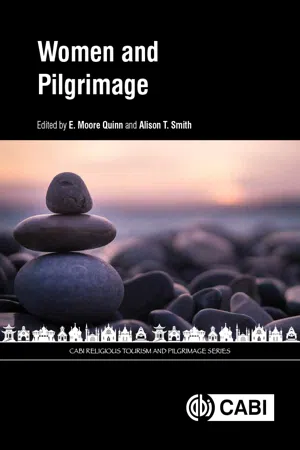
Women and Pilgrimage presents scholarly essays that address the lacunae in the literature on this topic. The content includes well-trodden domains of pilgrimage scholarship like sacred sites and holy places. In addition, the book addresses some of the less-well-known dimensions of pilgrimage, such as the performances that take place along pilgrims' paths; the ephemeral nature of identifying as a pilgrim, and the economic, social and cultural dimensions of migratory travel. Most importantly, the book's feminist lens encourages readers to consider questions of authenticity, essentialism, and even what is means to be a "woman pilgrim". The volume's six sections are entitled: Questions of Authenticity; Performances and Celebratory Reclamations; Walking Out: Women Forging Their Own Paths; Women Saints: Their Influence and Their Power; Sacred Sites: Their Lineages and Their Uses; and Different Migratory Paths. Each section will enrich readers' knowledge of the experiences of pilgrim women. Readers' understanding will be further enhanced by the book's: · interdisciplinary nature: The contributors hail from a wide range of disciplines, including Anthropology, Political Science, French, Spanish, Fine Art, and Religious Studies;· uniqueness: The text brings together previously scattered resources into one volume;· feminist perspective: Much of the subject matter utilizes feminist theories and methodologies and argues that further research will be welcome.The book will be of interest to scholars of pilgrimage studies in general as well as those interested in women, travel, tourism, and the variety of religious experiences.
- 192 pages
- English
- ePUB (mobile friendly)
- Available on iOS & Android
eBook - ePub
Women and Pilgrimage
About this book
Information
Part I
Questions of Authenticity

1First Class or Coach? Women as Tourists and Pilgrims, 1888–1928
Maryjane Dunn*
Henderson State University, Arkadelphia, Arkansas, USA
Abstract
The concept of touristic travel developed in the 19th century, when travel in general became more accessible to persons of varying socio-economic status. Travel to a pilgrimage destination could be conceived as both a religious and a touristic journey, but were persons who traveled comfortably to pilgrimage sites still considered pilgrims? At the turn of the 20th century, five well-to-do women authors—Emilia Pardo Bazán, Katherine Lee Bates, Catherine Gasquoine Hartley, Edith Wharton, and Georgiana Goddard King—wrote about their travels and their pilgrimages to Lourdes, Rome, and Santiago de Compostela. A detailed reading of their travel narratives and stories brings out their prejudice against “first-class” travelers being considered truly spiritual pilgrims; rather, they are viewed more as religious tourists. Although these authors do not eschew train and boat travel as modes of transportation for pilgrims, the holiness of a pilgrimage is linked to, if not suffering, at least to a more spartan and therefore what they considered to be a more spiritual journey. This idea, at least for Santiago de Compostela, continues today for modern pilgrims and visitors.
Key words: rail travel, 19th century, Pardo Bazán, Goddard King, Gasquoine Hartley, Lourdes, Santiago de Compostela, Rome
Introduction: the Advent of Touristic Pilgrimages
Simply defined, a tourist is a person traveling to a place for pleasure or interest, while a pilgrim travels to a place of special holy significance. The importance of pilgrimage as ritualized travel fluctuates across history and between different religions. In Western Europe, the great age of Christian pilgrimage spanned the 11th through 15th centuries, waning after the Reformation as the new Protestant sects discredited the importance of relics, the cult of saints, the veneration at traditional shrines, and the need for indulgences. Without a religious need to travel, fewer people could find the resources to make long journeys. The numbers of visitors to many minor shrines declined precipitously in the 18th and early 19th centuries, while journeys to distant places out of curiosity and a desire to see and learn about other worlds and peoples became a luxury for the wealthy and well educated.
The concept of tourism is a relatively new category that developed in the changing world of European travel in the 19th century. The advent of relatively inexpensive steam travel (both by rail and ship) opened a whole new world of travel possibilities. No longer was travel restricted to the wealthy or upper class making the slow, expensive, and lengthy Grand Tour of the great cities of Europe, nor was the religious excuse of pilgrimage needed as an acceptable reason to leave one’s home to make the long, dangerous, often solitary trip to Jerusalem, Rome, or Santiago de Compostela. By the mid-1800s, the introduction of round-trip train tickets, prepaid vouchers for hotels and meals, and travel guides summarizing things to see and do helped establish the early foundations of mass tourism. Entrepreneurs organized groups who traveled together to experience secular events such as fairs and rallies or to visit historical monuments, churches, or religious shrines. As travel became accessible to more persons of lower socio-economic status, families escaped their routine lives through vacations to the sea or the mountains.
First Class or Coach? Distinguishing between Tourism and Pilgrimage
For five intrepid women authors—Emilia Pardo Bazán, Katherine Lee Bates, Catherine Gasquoine Hartley, Edith Wharton, and Georgiana Goddard King—the simple question of how a person chooses to travel is pivotal in distinguishing whether a person is a tourist or pilgrim. Their classification of travelers to sacred places as either pilgrims or as tourists, however, is not mutually exclusive. The mindset of the traveler, the place visited, and the transportation used to arrive at the shrine must be considered. Traveling in the late 19th and early 20th centuries, even with religious intent, to a pilgrimage shrine did not necessarily cause a tourist to be considered a pilgrim. These authors masquerade as pilgrims themselves, and as such, they offer unique insights into expectations of tourists and pilgrims in their travel narratives. Their perception of pilgrimage is nuanced by destination, religious affiliation, transportation modes, and social class, but it is always viewed through the lenses of well-educated, upper-class travelers as they go to Rome, Lourdes, and Santiago de Compostela, three famous but vastly different Christian pilgrimage destinations.
What is the nature of those differences? Rome is the oldest of these three pilgrimages. As the center of the classical West, the birthplace of the Christian Church, and the residence of the pope, it offers something for everyone. With the rise of guided tourism, its multiple layers of culture and history attracted English and American travelers (both Protestant tourists and Catholic pilgrims) who toured both classical and early Christian archaeological sites and visited historic pilgrim churches such as St. Peter’s Basilica.
Lourdes, the newest of the three sites, was just a small town in the French Pyrenees prior to the apparitions of the Virgin Mary in the nearby grotto witnessed by 14-year-old Bernadette Soubirous in 1858. Only 4 years later, the local bishop proclaimed the veracity of these sightings and confirmed the healing properties of the grotto’s spring waters. As Kaufman (2005) reveals, the French Catholic Church encouraged a new religious-tourist experience by promoting commercial exhibits, mass-produced souvenirs, and guidebooks for both pilgrim activities and local excursions. By 1866, special trains with cars for the ill were arranged and advertised as weeklong national pilgrimages.
In contrast, Santiago de Compostela, the burial site of St. James the Apostle, the third of the “big three” of medieval pilgrimages (with Rome and Jerusalem),1 did not undergo the 19th-century revival of pilgrimage or tourism. While the Compostela cathedral was not empty of worshipers, it had faded to a local shrine for Galician and Portuguese pilgrims on romería.2 Its remoteness, once its strength as the shrine at the furthest reach of Christendom, was now its undoing. The missing element for its rebirth, whether as pilgrim shrine or tourist destination—easy, direct, mass transportation and sufficient tourist amenities, most notably hotels and other lodging—came late in comparison to Rome and Lourdes. Although a small spur rail line from Carril (in the Ría Arousa) to Santiago opened in 1873, a complete rail connection from the port of Vigo to Santiago was only established in 1899. No direct rail line to Compostela from outside of Galicia existed until 1944 (Pazos, 2020, p. 109). The first mass pilgrimage, sponsored by the Catholic Association of England via steamship to Vigo, only arrived in 1909, and then with just 50 members. Compostela’s relative isolation caused the town to be a relic of a bygone era. All three of these pilgrimage centers, especially Santiago de Compostela, however, held a fascination for our five women travel writers.
Five Turn-of-the-century First-class Women Pilgrims
Emilia Pardo Bazán (1851–1921) was an only child, born into an aristocratic Galician family. A precocious child and a devout Catholic, she married at 16, gave birth to three children, but separated from her husband in 1886. She introduced French naturalism to Spain via her most famous novel, Los Pazos de Ulloa (Pardo Bazán, 1886), published over 600 short stories and novellas, was an essayist for multiple periodicals, and became the first female professor of neo-Latin literature at the Central University of Madrid. Her works specifically devoted to pilgrimage are a travel narrative, Mi Romería (Pardo Bazán, 1888), two short stories, “El peregrino” (Pardo Bazán, 1891) and “La danza del peregrino” (Pardo Bazán, 1916), and two magazine articles about the Compostela Holy Year (Pardo Bazán, 1897a, b).
Katherine Lee Bates (1859–1929) is primarily known as the author of “America the Beautiful,” (Lewis, 2019) but this is only one of her many published works. Her father was a Congregationalist minister who died shortly after her birth; she was raised by her mother and her aunt. She was a member of the second graduating class at Wellesley College; she then became a high school teacher. After publishing her first young adult novel Rose and Thorn: a Story for the Young (Bates, 1889), she traveled to England and studied at Oxford. Upon her return, she became a professor of English literature at Wellesley, where she remained until her death. In February 1899, her travels through Spain originated in crossing the border at Biarritz, traveling south to Seville, then journeying back north to the Basque provinces from whence she and a friend followed the traditional pilgrimage route to Compostela. They arrived in time to attend the St. James’s Day celebrations (25 July), after which they set sail from Vigo to the USA. About these adventures, Bates wrote a travel narrative, Spanish Highways and Byways (Bates, 1900), and a young adult novel, In Sunny Spain with Pilarica and Rafael (Bates, 1913).
Catherine Gasquoine Hartley (1866 or 1867–1928) was born in Madagascar where her father, Reverend Richard Griffiths Hartley, was a missionary. When the family returned to England, she became a teacher. She was the second wife of journalist and writer Walter Gallichan. The couple traveled (primarily in Spain) and wrote about their lifestyle; together they wrote The Story of Seville (Gallichan and Hartley, 1903) for the Medieval Town series, which was published by J.M. Dent & Co. Hartley studied art and wrote several books about Spanish artists whose works hang in the Prado museum. Individually, she wrote another Medieval Town book, The Story of Santiago de Compostela (Hartley, 1912).3 Hartley had earlier written a more personal book, Spain Revisited: a Summer Holiday in Galicia (Hartley, 1911), about her 1910 voyage to Vigo and travels up the coast to Compostela.
Edith Wharton (1862–1937) is the most well-known literary figure of these five women. She was born into a socially prominent and wealthy New York family. After the American Civil War, the family traveled frequently to France, Italy, Germany, and Spain. She married Edward Wharton in 1885. The couple spent 4 months abroad each year in the early years of their marriage before divorcing. She remained in Paris during World War I, and ultimately died and was buried there in the Protestant cemetery. About her travels to Santiago de Compostela, we have only her unpublished “Spain Diary” (notes from 1925) and “Back to Compostela,” an undated, unpublished essay from c.1930 (edited and translated in 2011). She described her visit to Lourdes in A Motor-Flight Through France (Wharton, 1908).
Georgiana Goddard King (1871–1939) was born in Virginia. Her father worked with the railroad while her mother, who died when Georgiana was only 13, was active in literary clubs in Norfolk. She attended Bryn Mawr College, graduating with a Master of Arts in English literature as well as degrees in philosophy and political science. After graduation she continued her studies for 6 months in Paris. When she returned, she taught at the Graham School in New York City, where she met Archer Huntington, founder of the Hispanic Society of America. In 1906, she returned to Bryn Mawr as a professor of modern languages and later founder of the Art History Department. King’s three-volume work The Way of Saint James (King, 1920) began as a scholarly work about the sources of Romanesque and Gothic architecture, but it grew “from a mere pedantic exercise in architecture, to a very pilgrimage, to following ardently along the ancient way where all...
Table of contents
- Cover
- Title Page
- Copyright
- Contents
- Dedication
- Contributors
- Editors’ Acknowledgements
- Women and Pilgrimage: an Introduction to the Experiential and the Expressive
- Part I: Questions of Authenticity
- Part II: Performances and Celebratory Reclamations
- Part III: Walking Out: Women Forging Their Own Paths
- Part IV: Women Saints: Their Influence and Their Power
- Part V: Sacred Sites, Their Lineages and Their Uses
- Part VI: Different Migratory Paths
- Index
- Back Cover
Trusted by 375,005 students
Access to over 1.5 million titles for a fair monthly price.
Study more efficiently using our study tools.
Frequently asked questions
Yes, you can cancel anytime from the Subscription tab in your account settings on the Perlego website. Your subscription will stay active until the end of your current billing period. Learn how to cancel your subscription
No, books cannot be downloaded as external files, such as PDFs, for use outside of Perlego. However, you can download books within the Perlego app for offline reading on mobile or tablet. Learn how to download books offline
Perlego offers two plans: Essential and Complete
- Essential is ideal for learners and professionals who enjoy exploring a wide range of subjects. Access the Essential Library with 800,000+ trusted titles and best-sellers across business, personal growth, and the humanities. Includes unlimited reading time and Standard Read Aloud voice.
- Complete: Perfect for advanced learners and researchers needing full, unrestricted access. Unlock 1.5M+ books across hundreds of subjects, including academic and specialized titles. The Complete Plan also includes advanced features like Premium Read Aloud and Research Assistant.
We are an online textbook subscription service, where you can get access to an entire online library for less than the price of a single book per month. With over 1.5 million books across 990+ topics, we’ve got you covered! Learn about our mission
Look out for the read-aloud symbol on your next book to see if you can listen to it. The read-aloud tool reads text aloud for you, highlighting the text as it is being read. You can pause it, speed it up and slow it down. Learn more about Read Aloud
Yes! You can use the Perlego app on both iOS and Android devices to read anytime, anywhere — even offline. Perfect for commutes or when you’re on the go.
Please note we cannot support devices running on iOS 13 and Android 7 or earlier. Learn more about using the app
Please note we cannot support devices running on iOS 13 and Android 7 or earlier. Learn more about using the app
Yes, you can access Women and Pilgrimage by E. Moore Quinn, Alison T. Smith, E. Moore Quinn,Alison T. Smith in PDF and/or ePUB format, as well as other popular books in Business & Hospitality, Travel & Tourism Industry. We have over 1.5 million books available in our catalogue for you to explore.