Bayesian Reasoning and Gaussian Processes for Machine Learning Applications
eBook - ePub

Bayesian Reasoning and Gaussian Processes for Machine Learning Applications

  1. 133 pages
  2. English
  3. ePUB (mobile friendly)
  4. Available on iOS & Android
eBook - ePub

About this book

This book introduces Bayesian reasoning and Gaussian processes into machine learning applications. Bayesian methods are applied in many areas, such as game development, decision making, and drug discovery. It is very effective for machine learning algorithms in handling missing data and extracting information from small datasets. Bayesian Reasoning and Gaussian Processes for Machine Learning Applications uses a statistical background to understand continuous distributions and how learning can be viewed from a probabilistic framework. The chapters progress into such machine learning topics as belief network and Bayesian reinforcement learning, which is followed by Gaussian process introduction, classification, regression, covariance, and performance analysis of Gaussian processes with other models.

FEATURES


  • Contains recent advancements in machine learning


  • Highlights applications of machine learning algorithms


  • Offers both quantitative and qualitative research


  • Includes numerous case studies

This book is aimed at graduates, researchers, and professionals in the field of data science and machine learning.
Frequently asked questions

Yes, you can cancel anytime from the Subscription tab in your account settings on the Perlego website. Your subscription will stay active until the end of your current billing period. Learn how to cancel your subscription.
No, books cannot be downloaded as external files, such as PDFs, for use outside of Perlego. However, you can download books within the Perlego app for offline reading on mobile or tablet. Learn more here.
Perlego offers two plans: Essential and Complete
  • Essential is ideal for learners and professionals who enjoy exploring a wide range of subjects. Access the Essential Library with 800,000+ trusted titles and best-sellers across business, personal growth, and the humanities. Includes unlimited reading time and Standard Read Aloud voice.
  • Complete: Perfect for advanced learners and researchers needing full, unrestricted access. Unlock 1.4M+ books across hundreds of subjects, including academic and specialized titles. The Complete Plan also includes advanced features like Premium Read Aloud and Research Assistant.
Both plans are available with monthly, semester, or annual billing cycles.
We are an online textbook subscription service, where you can get access to an entire online library for less than the price of a single book per month. With over 1 million books across 1000+ topics, we’ve got you covered! Learn more here.
Look out for the read-aloud symbol on your next book to see if you can listen to it. The read-aloud tool reads text aloud for you, highlighting the text as it is being read. You can pause it, speed it up and slow it down. Learn more here.
Yes! You can use the Perlego app on both iOS or Android devices to read anytime, anywhere — even offline. Perfect for commutes or when you’re on the go.
Please note we cannot support devices running on iOS 13 and Android 7 or earlier. Learn more about using the app.
Yes, you can access Bayesian Reasoning and Gaussian Processes for Machine Learning Applications by Hemachandran K, Shubham Tayal, Preetha Mary George, Parveen Singla, Utku Kose, Hemachandran K,Shubham Tayal,Preetha Mary George,Parveen Singla,Utku Kose in PDF and/or ePUB format, as well as other popular books in Mathematics & Statistics for Business & Economics. We have over one million books available in our catalogue for you to explore.

1 Introduction to Naive Bayes and a Review on Its Subtypes with Applications

Eguturi Manjith Kumar Reddy, Akash Gurrala, and Vasireddy Bindu Hasitha
Woxsen University
Korupalli V Rajesh Kumar
Vellore Institute of Technology
DOI: 10.4324/9780367758479-1

CONTENTS

  • 1.1 Introduction
  • 1.2 Intuition behind the Naive Bayes Algorithm and Its Subtypes with Applications
    • 1.2.1 Why Is It Called Naive Bayes?
    • 1.2.2 Bayes Theorem – Intuition behind the Classification
      • 1.2.2.1 Bayes Theorem
      • 1.2.2.2 Bayes Theorem in Machine Learning
    • 1.2.3 Types of Naive Bayes Models
    • 1.2.4 Gaussian Naive Bayes
    • 1.2.5 Predictions Using Gaussian Naive Bayes Model
    • 1.2.6 Bernoulli Classification
      • 1.2.6.1 Bernoulli Statistics or Distribution
      • 1.2.6.2 Rule for Bernoulli Naive Bayes Classifier
      • 1.2.6.3 An Example for Bernoulli Naive Bayes
      • 1.2.6.4 Advantages
      • 1.2.6.5 Disadvantages
    • 1.2.7 Multinomial Naive Bayes Classifier
    • 1.2.8 Differences between Gaussian, Bernoulli, and Multinomial Distributions
    • 1.2.9 Advantages of Naive Bayes
    • 1.2.10 Disadvantages of Naive Bayes
  • 1.3 Real-Time Application: Human Activity Recognition Using Naive Bayes Algorithm
    • 1.3.1 Dataset Attributes
    • 1.3.2 Naive Bayes Algorithm–Based Result
  • 1.4 Conclusion
  • References

1.1 Introduction

AI – Artificial Intelligence – is taking over the industrial, educational, medical, entertainment, and almost all sectors. In this aspect, machine learning (ML), deep learning, reinforcement learning, and natural language processing techniques, methods, and technologies have become more popular. All such technologies created an impact on real-time applications. With regard to ML applications, there are numerous functionalities and applications are revolutionizing all sectors. Generally, ML algorithms are broadly categorized into two major types:
  1. Supervised learning algorithms
  2. Unsupervised learning algorithms
Supervised learning is a type of learning in which data is provided to the algorithm with both input and output with labels.
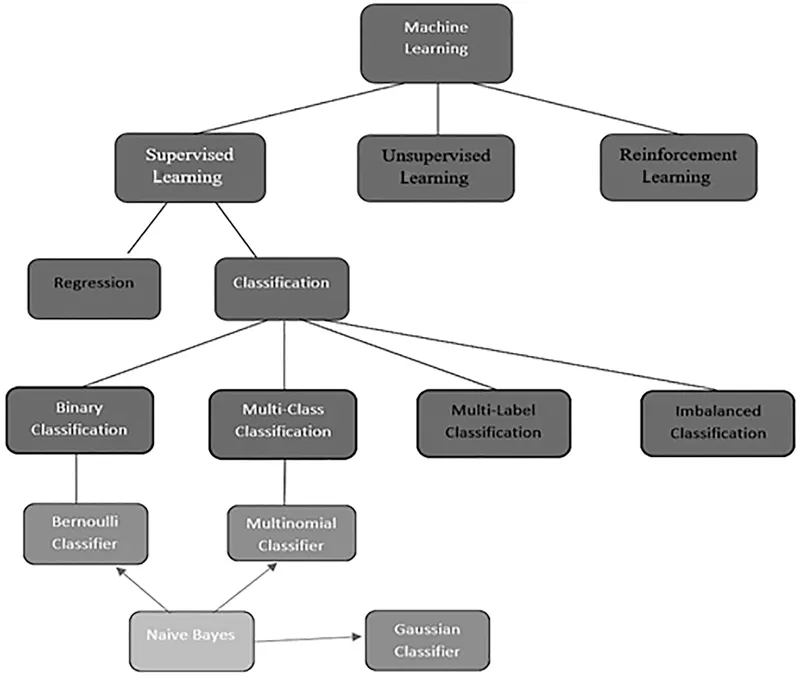
Figure 1.1, shows the flow of the ML algorithm. Our focus is on supervised learning algorithms, mainly on classification models using the naive Bayes flow.
FIGURE 1.1 Machine learning algorithms – supervised learning.
The ML algorithm learns the process by setting a target. The machine will predict the new outcome to a newly furnished input from experience of past data. Mainly, learning systems are categorized into two under supervised learning models (Bhogaraju and Korupalli, 2020; Kumar et al., 2020; Bhogaraju et al., 2021; Seeja et al., 2021).
  1. Regression modeling
  2. Classification modeling
Classification and prediction are essential aspects of ML. Classification is a part of supervised learning, which categorizes the given data into classes. The data may be structured or unstructured. The algorithms in ML used for classification are called classification algorithms. These algorithms use trained data to predict the probability of data falling into the respective class. One of the most commonly used applications of classification is the sorting of standard emails and spam emails. In classification, the output is discrete. There are many algorithms used for classification, among which Naive Bayes is one of the most widely used simple and effective algorithm for classification.

1.2 Intuition behind the Naive Bayes Algorithm and Its Subtypes with Applications

Naive Bayes is a supervised learning algorithm, which is used as a classifier for ML and is based on the Bayes theorem. Naive Bayes works on probability distribution. The naive Bayes algorithm is one of...

Table of contents

  1. Cover
  2. Half Title Page
  3. Title Page
  4. Copyright Page
  5. Table of Contents
  6. Preface
  7. Editors
  8. Contributors
  9. 1. Introduction to Naive Bayes and a Review on Its Subtypes with Applications
  10. 2. A Review on the Different Regression Analysis in Supervised Learning
  11. 3. Methods to Predict the Performance Analysis of Various Machine Learning Algorithms
  12. 4. A Viewpoint on Belief Networks and Their Applications
  13. 5. Reinforcement Learning Using Bayesian Algorithms with Applications
  14. 6. Alerting System for Gas Leakage in Pipelines
  15. 7. Two New Nonparametric Models for Biological Networks
  16. 8. Generating Various Types of Graphical Models via MARS
  17. 9. Financial Applications of Gaussian Processes and Bayesian Optimization
  18. 10. Bayesian Network Inference on Diabetes Risk Prediction Data
  19. Index