eBook - ePub
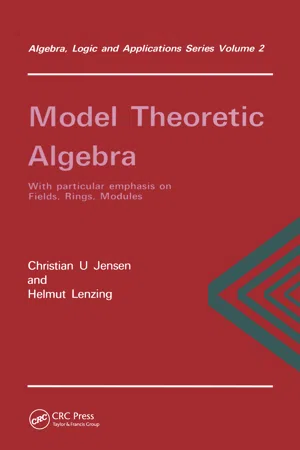
Model Theoretic Algebra With Particular Emphasis on Fields, Rings, Modules
- 464 pages
- English
- ePUB (mobile friendly)
- Available on iOS & Android
eBook - ePub
Model Theoretic Algebra With Particular Emphasis on Fields, Rings, Modules
About this book
This volume highlights the links between model theory and algebra. The work contains a definitive account of algebraically compact modules, a topic of central importance for both module and model theory. Using concrete examples, particular emphasis is given to model theoretic concepts, such as axiomizability. Pure mathematicians, especially algebraists, ring theorists, logicians, model theorists and representation theorists, should find this an absorbing and stimulating book.
Information
Chapter 1 Introduction. Ultraproducts. Definitions and examples
DOI: 10.4324/9780203746943-1
The aim of this introductory chapter is to illustrate the power of the most basic principles of model theory (ultraproducts, Ƚos’s principle, Löwenheim-Skolem’s theorem and Keisler-Shelah’s ultrapower theorem) in applying them to classical questions of algebra (Hilbert’s Nullstellensatz, Hilbert’s 17th problem, Noether-Ostrowski’s irreducibility theorem).
For a detailed treatment of the fundamental facts of model theory we refer the reader to the the books of Bell-Slomson [21], Chang-Keisler [33] or the Handbook of Mathematical Logic [12].
Ultrafilters
1.1 If I is an arbitrary set, we recall that a filter ℱ on I is a family of subsets of I satisfying the following conditions:
- A ∈ ℱ, A ⊆ B ⊆ I ⇒ B ∈ ℱ,
- A ∈ ℱ and B ∈ ℱ ⇒ A ∩ B ∈ ℱ,
- Ø ∉ ℱ.
The filters on I are partially ordered by set inclusion. Filters that are maximal with respect to this ordering are called ultrafilters. It is easy to see that ultrafilters can be characterized in the following way:
1.2 A filter ℱ on I is an ultrafilter if and only if for each subset A of I either A or the complement I – A belongs to ℱ.
For a fixed element α ∈ I the family of all subsets of I containing α is an ultrafilter on I, called the principal ultrafilter generated by a. By Zorn’s lemma any filter on I can be extended to an ultrafilter on I. This, in particular, implies that there exist non-principal ultrafilters on any infinite set I.
Ultraproducts and Ƚos’s principle
1.3 Let (Rα)α∈I be a family of algebraic structures which may be groups, rings or modules. To fix the attention on something specific let us assume that (Rα)α∈I is a family of rings. Further, let ℱ be an ultrafilter on I. In the direct (Cartesian) product Πα∈I Rα we introduce an equivalence relation by setting (rα) ~ (r’α) if the set {α∈I|rα = r′α} belongs to ℱ. This is expressed by saying that
if and only if rα = r′α holds for ℱ-almost all α.
The equivalence class represented by an element (rα) is denoted by [rα]. By obvious componentwise addition and multiplication these equivalence classes form a ring, called the ultraproduct of (Rα)α∈I with respect to ℱ, that is denoted Πα∈I Rα/ℱ. If Rα= R for all α ∈ I, the ultraproduct is denoted by RI/ℱ and is called the ultrapower of R with respect to ℱ. In the latter case there is a canonical (diagonal) mapping Δ: R →RI/ℱ defined by setting Δ(r) = [rα], where rα = r for all α ∈ I.
1.4 It is easily verified that Πα∈I Rα/ℱ is a field if each Rα is a field. It even suffices to assume that Rα is a field for all α ’s belonging to a subset J of I that belongs to ℱ. Conversely, if the ultraproduct Πα∈I Rα/ℱ is a field, the set {α ∈IRα is a field } belongs to ℱ. In other words: the ultraproduct Πα∈I Rα. is a field if and only if Rα is a field for ℱ-almost every α ∈ I.
The property R is a field can be expressed by saying
This is an example of a first order sentence in the language R of rings, that is, a formula in the language of rings, in which every variable is in the scope of a quantifier (∀ or ∃).
The above example is a special case of a metatheorem called Ƚos’s principle.
Theorem 1.5 (Ƚos’s principle) Let (Rα)α∈I be a family of rings, (resp. fields, modules, ... ) and ℱ an ultrafilter on I. A first order sentence σ in the language of rings (resp. fields, modules, ... )...
Table of contents
- Cover Page
- Half-Title Page
- Title Page
- Copyright Page
- Table of Contents
- Preface
- 1 Introduction. Ultraproducts. Definitions and examples
- 2 Elementary equivalence. Axiomatizable and finitely axiomatizable classes. Examples and results in field theory
- 3 Elementary definability. Applications to polynomial and power series rings and their quotient fields
- 4 Peano rings and Peano fields
- 5 Hilbertian fields and realizations of finite groups as Galois groups
- 6 The language of modules over a fixed ring
- 7 Algebraically compact modules
- 8 Decompositions and algebraic compactness
- 9 The two-sorted language of modules over unspecified rings
- 10 The first order theory of rings
- 11 Pure global dimension and algebraically compact rings
- 12 Representation theory of finite dimensional algebras
- 13 Problems
- Tables
- A Basic notions and definitions from homological algebra
- B Functor categories on finitely presented modules
- C Glossary of some basic notions in ring and module theory
- Bibliography
- Author Index
- Subject Index
Trusted by 375,005 students
Access to over 1.5 million titles for a fair monthly price.
Study more efficiently using our study tools.
Frequently asked questions
Yes, you can cancel anytime from the Subscription tab in your account settings on the Perlego website. Your subscription will stay active until the end of your current billing period. Learn how to cancel your subscription
No, books cannot be downloaded as external files, such as PDFs, for use outside of Perlego. However, you can download books within the Perlego app for offline reading on mobile or tablet. Learn how to download books offline
We are an online textbook subscription service, where you can get access to an entire online library for less than the price of a single book per month. With over 1.5 million books across 990+ topics, we’ve got you covered! Learn about our mission
Look out for the read-aloud symbol on your next book to see if you can listen to it. The read-aloud tool reads text aloud for you, highlighting the text as it is being read. You can pause it, speed it up and slow it down. Learn more about Read Aloud
Yes! You can use the Perlego app on both iOS and Android devices to read anytime, anywhere — even offline. Perfect for commutes or when you’re on the go.
Please note we cannot support devices running on iOS 13 and Android 7 or earlier. Learn more about using the app
Please note we cannot support devices running on iOS 13 and Android 7 or earlier. Learn more about using the app
Yes, you can access Model Theoretic Algebra With Particular Emphasis on Fields, Rings, Modules by Christian.U Jensen,Christian. U Jensen,Helmt Lenzing in PDF and/or ePUB format, as well as other popular books in Mathematics & Algebra. We have over 1.5 million books available in our catalogue for you to explore.