- 214 pages
- English
- ePUB (mobile friendly)
- Available on iOS & Android
About this book
This reference text introduces concepts of computer and Internet crime, ethics in information technology, and privacy techniques.
It comprehensively covers important topics including ethical consideration in decision making, security attacks, identification of theft, strategies for consumer profiling, types of intellectual property rights, issues related to intellectual property, process and product quality, software quality assurance techniques, elements of an ethical organization, telemedicine, and electronic health records.
This book will serve as a useful text for senior undergraduate and graduate students in interdisciplinary areas including computer science, information technology, electronics and communications engineering, and electrical engineering.
Frequently asked questions
- Essential is ideal for learners and professionals who enjoy exploring a wide range of subjects. Access the Essential Library with 800,000+ trusted titles and best-sellers across business, personal growth, and the humanities. Includes unlimited reading time and Standard Read Aloud voice.
- Complete: Perfect for advanced learners and researchers needing full, unrestricted access. Unlock 1.4M+ books across hundreds of subjects, including academic and specialized titles. The Complete Plan also includes advanced features like Premium Read Aloud and Research Assistant.
Please note we cannot support devices running on iOS 13 and Android 7 or earlier. Learn more about using the app.
Information
1 An Overview of Ethics
Learning Objectives
- To understand how different people see their own interests in business circumstances.
- To enable readers to form their own, well-considered opinions on corporate ethical problems.
- To encourage the readers to become more deliberate, disciplined thought while attempting to resolve ethical concerns in business.
- To introduce the notion of corporate social responsibility (CSR) and discuss how it relates to ethical business practices.
- To equip readers to contribute to the ethical considerations of organizations with which they may be associated in a positive way.
- To look at the ethical responsibilities and ideals that exist in the interaction between employers and workers.
1.1 Definition of Ethics
- Ethics based on axiology: an area of ethics concerned with the relative goodness or worth of the motivations and outcomes of any behavior.
- Deontological ethics: a subset of ethics concerned with right conduct and the essence of duties, regardless of the goodness or worth of motivations or the desirableness of the ends of every act.
1.2 Ethics in Business World

- Leadership for integrity
- The executive committee establishes the tone for how the business operates on a daily basis. When a company’s dominant management philosophy is focused on ethical values and behavior, leaders will set a precedent for their employees and encourage them to make decisions that favor both them and the company as a whole. Long-term advantages of establishing and maintaining a positive identity in society include the capacity to attract and retain highly qualified workers and the ability to create and maintain a good image in society. Running a business responsibly from the top down improves executive team ties, which contributes to the company’s overall stability.
- Employee integrity
- When it comes to managing a company ethically, employees follow in the footsteps of managers. With corporate principles as a driving philosophy, employees make more decisions with less time, which improves performance and morale. The whole organization wins as employees carry out their duties with integrity and honesty. Employees who work for a business that maintains a high level of organizational honesty in all areas of management are more likely to perform well and remain loyal.
- Ethics differ depending on the industry
- Business ethics differ from industry to industry, as well as from nation to country. The nature of a company’s operations has a significant effect on the regulatory issues it must address. When a customer’s best option and their money do not coincide, the brokerage pays the maximum charge, for example, an ethical dilemma occurs for the brokerage. A broadcasting organization that produces children’s television programming may have a moral imperative to uphold positive ideals and avoid using off-color material in its programming. Companies such as Amazon and Google, who perform the majority of their business online, are not subjected to environmental scrutiny. When it comes to protecting the identity and welfare of their clients, though, their ethics are scrutinized.
1.2.1 Corporate Social Responsibility
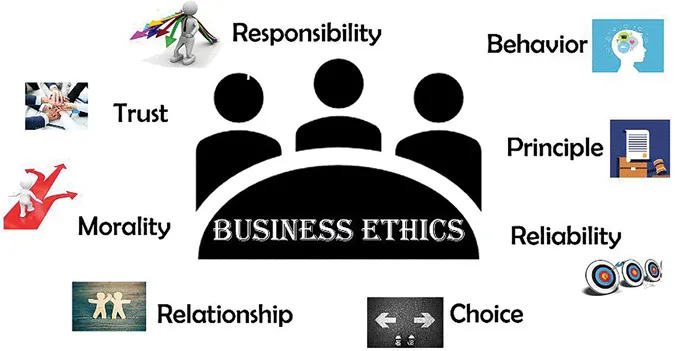
1.2.2 Reasons for Good Business Ethics
- Obtaining the community’s goodwill
- Establishing a dependable company
- Promoting ethical corporate practices
- Defending the company and its staff from legal prosecution
- Avoiding negative attention
- Obtaining the community’s goodwill
- Organizations have certain basic societal obligations. These obligations are sometimes stated in a written declaration of their company’s values or convictions. Many companies start or fund socially conscious program, such as donating to charitable causes and nonprofit organizations, giving incentives to staff who go beyond and above legal standards, and allocating money to initiatives that are more socially desirable than lucrative. As a result, many businesses start or endorse socially conscious initiatives, such as donating to charity organizations and nonprofit entities. In 2011, IBM workers in 120 countries volunteered 3.2 million hours of voluntary service.
- Creating an organization that operates consistently
- Values are developed and adhered to by organizations in order to establish a corporate ethos and identify a cohesive commitment to meeting the interests of their stakeholders, who include owners, staff, consumers, vendors, and the environment. Employees will realize what is required of them and will be able to use the organization’s principles to guide their decision-making. Despite the fact that each company’s belief structure is unique, all of them share the following principles:
- Operate with honesty and integrity, according to organizational values
- Operate in accordance with ethical conduct standards, both in words and deeds
- Treat colleagues, clients, and consumers with respect
- Strive to be the best at what matters most to the company
- Value diversity
- Foster good business practices
- Companies that provide excellent service retain their customers instead of losing them to competitors. Employee productivity and unemployment rates are lower in companies that establish and retain good employee relationships. Working with businesses that act in a fair and ethical way is also a concern for suppliers and other business partners. Bad ethics, on the other hand, will lead to poor business outcomes.
- Defend the company and its employees from legal action
- Establishing appropriate ethical and management systems is one way to discourage and detect workplace discrimination. Indeed, the Department of Justice published parole guidelines in 1991 that say that accused executives should be treated more leniently if their businesses have ethics policies. When an agency has developed an integrity compliance scheme that cooperates with police, fines for disciplinary offences will be reduced by up to 80%.
- Keep negative press at bay
- The valuation of a company’s stock, how investors perceive its goods and services, the level of regulatory scrutiny it enjoys, and the extent of funding and assistance it receives from its corporate partners are all influenced by its public image. As a result, many businesses are inspired to develop a robust ethical policy in order to escape bad attention. Customers, corporate associates, lenders, consumer groups, financial firms, and regulatory authorities are more likely to see a company positively if it is considered to be acting ethically.
- Values are developed and adhered to by organizations in order to establish a corporate ethos and identify a cohesive commitment to meeting the interests of their stakeholders, who include owners, staff, consumers, vendors, and the environment. Employees will realize what is required of them and will be able to use the organization’s principles to guide their decision-making. Despite the fact that each company’s belief structure is unique, all of them share the following principles:
1.3 Ethical Consideration in Decision Making
Table of contents
- Cover
- Half Title
- Series Page
- Title Page
- Copyright Page
- Dedication Page
- Table Of Contents
- Foreword
- Preface
- Acknowledgements
- Authors
- Chapter 1 An Overview of Ethics
- Chapter 2 Computer and Internet Crime
- Chapter 3 Organization Privacy
- Chapter 4 Intellectual Property
- Chapter 5 Ethics of IT Organization
- Chapter 6 Impact of IT on Quality of Life
- Chapter 7 Case Studies
- Index