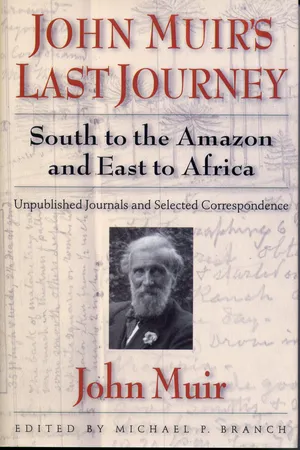
"I am now writing up some notes, but when they will be ready for publication I do not know... It will be a long time before anything is arranged in book form." These words of John Muir, written in June 1912 to a friend, proved prophetic. The journals and notes to which the great naturalist and environmental figure was referring have languished, unpublished and virtually untouched, for nearly a century. Until now. Here edited and published for the first time, John Muir's travel journals from 1911-12, along with his associated correspondence, finally allow us to read in his own words the remarkable story of John Muir's last great journey.
Leaving from Brooklyn, New York, in August 1911, John Muir, at the age of seventy-three and traveling alone, embarked on an eight-month, 40,000-mile voyage to South America and Africa. The 1911-12 journals and correspondence reproduced in this volume allow us to travel with him up the great Amazon, into the jungles of southern Brazil, to snowline in the Andes, through southern and central Africa to the headwaters of the Nile, and across six oceans and seas in order to reach the rare forests he had so long wished to study. Although this epic journey has received almost no attention from the many commentators on Muir's work, Muir himself considered it among the most important of his life and the fulfillment of a decades-long dream.
John Muir's Last Journey provides a rare glimpse of a Muir whose interests as a naturalist, traveler, and conservationist extended well beyond the mountains of California. It also helps us to see John Muir as a different kind of hero, one whose endurance and intellectual curiosity carried him into far fields of adventure even as he aged, and as a private person and family man with genuine affections, ambitions, and fears, not just an iconic representative of American wilderness.
With an introduction that sets Muir's trip in the context of his life and work, along with chapter introductions and a wealth of explanatory notes, the book adds important dimensions to our appreciation of one of America's greatest environmentalists. John Muir's Last Journey is a must reading for students and scholars of environmental history, American literature, natural history, and related fields, as well as for naturalists and armchair travelers everywhere.
eBook - ePub
John Muir's Last Journey
South To The Amazon And East To Africa: Unpublished Journals And Selected Correspondence
- English
- ePUB (mobile friendly)
- Available on iOS & Android
eBook - ePub
John Muir's Last Journey
South To The Amazon And East To Africa: Unpublished Journals And Selected Correspondence
About this book
Information
CHAPTER I

Preparing for the Last Journey: California, New York, and Boston
26 January 1911-12 August 1911
THE YEARS LEADING up to his final journey were remarkably active ones in John Muir’s life as a traveler, naturalist, activist, family man, and writer. As the twentieth century dawned, Muir was a vigorous man of sixty-one, engaged in studies of geology, glaciology, botany, and palaeontology around the American West and—between May 1903 and May 1904—tree studies around the world. Just before that travel abroad he camped with President Theodore Roosevelt in Yosemite and just after his return he worked hard to win the seventeen-year battle to have responsibility for the protection of Yosemite Valley shifted from the state of California to the federal government. In Muir’s private life during this period, the frequent illness of his teenage daughter Helen was a primary concern, but not the only one. In late June 1905 his wife, Louie, suddenly became ill with what turned out to be a lung tumor, and she died in early August of that year. Now alone, Muir wandered between the old family ranch in Martinez and various natural history studies in the field and at Stanford University and the University of California, Berkeley.
Though punctuated by periods of loneliness, the years following Louie’s death were rich and active ones for Muir, filled with happy family occasions and numerous travels with friends. In the summer of 1906 his eldest daughter, Wanda, married Thomas Rae Hanna and moved into the adobe house immediately behind Muir’s own house on the Martinez ranch. The following summer Muir made extensive trips to the Hetch Hetchy Valley with the Sierra Club and with his friend the artist William Keith. In the summer of 1908 Muir dictated his autobiography at the Pelican Bay, Oregon, lodge of his friend, the powerful railroad magnate and financier Edward H. Harriman.
In 1909 Muir, now in his seventies, continued his remarkably active schedule of travels and explorations, making a six-week trip to the Southwest and visiting the Grand Canyon with fellow literary naturalist John Burroughs. Later that year he traveled to the lower Colorado River with Harriman, to Yosemite with Burroughs, to Hetch Hetchy with the Sierra Club, and to Daggett, California, where Helen was now living in hopes the desert air would improve her health. In October he toured Yosemite with President Taft, and Hetch Hetchy with Secretary of the Interior Richard Ballinger. Muir’s family life also had its blessings. Although Helen was ill with typhoid during the spring of 1909, she recovered well and was married to Buel A. Funk in October of that year. By 1909 Wanda had already given Muir his second grandchild.
These were also remarkably productive years for Muir as a writer. Stickeen, his famous dog story, was published in 1909, and in 1910 he completed the manuscript of My First Summer in the Sierra and began work on several other book projects. Although 1910 was a year busy with travels in California and the Southwest, Muir returned four times to Los Angeles to lodge and write at the home of his wealthy friend John D. Hooker, the amateur astronomer and retired ironmaster. Muir’s friendship with the Hooker family was vitally important to him during these years. Much of his best writing from this period was accomplished not in the “scribble den” of the old Martinez ranch house, but in the garret of the Hooker’s home on West Adams Street in Los Angeles, and many of his most expressive letters from the South America and Africa journey were written to J. D. Hooker’s wife, Katharine, who was widowed several months before Muir sailed for the southern continents.
Muir’s earnest preparations for a trip to South America began in early 1911. He was then seventy-two years old and the grandfather of three: Wanda’s sons, Strentzel and John Hanna, and Helen’s infant son, Muir Funk. Nevertheless, he had decided to go east to begin his long sea voyage to the Amazon. He also hoped to use the East Coast portion of the trip to lobby representatives in Washington (and prominent men everywhere he could) on the need to preserve the endangered Hetch Hetchy Valley, and to arrange for publication of the several books he was then working on. After doing what he could on both counts, Muir reckoned, he would be free to take an Atlantic steamer south to the Amazon and beyond in order to study the great trees of the only major parts of the world he had not yet visited.
By January 1911 the outline of Muir’s plan was shaped, though the details of the trip east and journey south were as yet uncertain. Muir’s friend and Yosemite ally Robert Underwood Johnson, an editor at Century Magazine, was already soliciting from him any essays that might come out of the planned Amazonian travels. “Don’t forget that we want your impressions of South America,” reminded Johnson in a January 18 letter to Muir, to which Muir responded, in the January 26 letter included in this chapter, “[m]y impressions of South America, that you mention may be a long way off yet, but I hope to make that journey before it is too late.”
Muir’s correspondence from early 1911 is also replete with concerns about Hetch Hetchy Valley, the fate of which had already been a matter of contention for more than a decade. Requiring additional water sources to satisfy a booming population, the city of San Francisco had attempted to gain rights to the Valley since 1901 but had been energetically opposed by Muir and his Sierra Club allies, who argued that the location of Hetch Hetchy within Yosemite National Park (established in 1891) made it inviolable by urban commercial interests. The stakes in the Hetch Hetchy fight were high: if the city won and the Valley was dammed, it would assert the anthropocentric standard of the greatest good for the greatest number of people; if the Sierra Club won and the Valley was saved, it would assert the preservationist standard that national parks were sacred ground that should be protected in perpetuity.
In 1911 Muir was cautiously optimistic about efforts to preserve Hetch Hetchy from industrial incursion. In a January 27 letter to the family of Herbert Gleason, the photographer whose work illustrates the first edition of My First Summer in the Sierra, he wrote that “[a]ll continues to go well as far as I know with the Sierra Club in its work, especially with reference to the preservation of Hetch-Hetchy.” By February 15, however, Muir informed his friend the palaeontologist and natural history curator Henry Fairfield Osborn that “the Hetch-Hetchy question” remained unsettled, and he correctly guessed that a great deal of “hard fighting” was still ahead for the preservationists. Six weeks later Muir was palpably disgusted with renewed efforts to destroy Hetch Hetchy, and on March 31 he sent letters of protest to a number of high-ranking federal officials, including President Taft hims...
Table of contents
- Title Page
- Copyright Page
- Table of Contents
- Foreword
- Preface
- Introduction
- CHAPTER I - Preparing for the Last Journey: California, New York, and Boston
- CHAPTER 2 - Southbound and up the Great Amazon
- CHAPTER 3 - Coastal Brazil and up the Iguacu River into the Araucaria braziliensis Forests
- CHAPTER 4 - Southern Brazil, Uruguay, Argentina, Chile, and into the Araucaria imbricata Forests of the Andes
- CHAPTER 5 - At Sea, South Africa, the Zambezi River, and to the Baobab Trees
- CHAPTER 6 - East Africa, Lake Victoria, the Headwaters of the Nile, and Homeward Bound
- CHAPTER 7 - Home to America, California, and Writing: The Fate of John Muir and His South America and Africa Journals
- APPENDICES
- Notes to Editor’s Introductions
- Textual Notes
- Bibliography
- Acknowledgments
- Credits
- Index
Trusted by 375,005 students
Access to over 1.5 million titles for a fair monthly price.
Study more efficiently using our study tools.
Frequently asked questions
Yes, you can cancel anytime from the Subscription tab in your account settings on the Perlego website. Your subscription will stay active until the end of your current billing period. Learn how to cancel your subscription
No, books cannot be downloaded as external files, such as PDFs, for use outside of Perlego. However, you can download books within the Perlego app for offline reading on mobile or tablet. Learn how to download books offline
Perlego offers two plans: Essential and Complete
- Essential is ideal for learners and professionals who enjoy exploring a wide range of subjects. Access the Essential Library with 800,000+ trusted titles and best-sellers across business, personal growth, and the humanities. Includes unlimited reading time and Standard Read Aloud voice.
- Complete: Perfect for advanced learners and researchers needing full, unrestricted access. Unlock 1.5M+ books across hundreds of subjects, including academic and specialized titles. The Complete Plan also includes advanced features like Premium Read Aloud and Research Assistant.
We are an online textbook subscription service, where you can get access to an entire online library for less than the price of a single book per month. With over 1.5 million books across 990+ topics, we’ve got you covered! Learn about our mission
Look out for the read-aloud symbol on your next book to see if you can listen to it. The read-aloud tool reads text aloud for you, highlighting the text as it is being read. You can pause it, speed it up and slow it down. Learn more about Read Aloud
Yes! You can use the Perlego app on both iOS and Android devices to read anytime, anywhere — even offline. Perfect for commutes or when you’re on the go.
Please note we cannot support devices running on iOS 13 and Android 7 or earlier. Learn more about using the app
Please note we cannot support devices running on iOS 13 and Android 7 or earlier. Learn more about using the app
Yes, you can access John Muir's Last Journey by John Muir, Michael P. Branch in PDF and/or ePUB format, as well as other popular books in Biological Sciences & Travel. We have over 1.5 million books available in our catalogue for you to explore.