![]()
Part One
INTRODUCTION
Rafael Quijada Sierra Madre Sonora Mexico
DRUMMOND HADLEY
I go now to see my cuñada la que me repechó
She who gave me her breast when my father was killed
When my mother went to live with another man
Now my cuñada is dying she is not sick but only old
When she goes we will place her body in a sack
To bury her in the ground
A sack or the mountain wind waits for me as well
Even as I climb the steep cedar breaks
I feel calambres in my legs
Calambres are the pains when one walks
When the nerves in the legs tighten
I grow down and old like the tail of the cow
Someday I will not be able to go to find work
From the borderline as far as Pueblo Colorado
When that time comes I will need a patron
A boss who will not try only to ganar
To win all he is able from my back and my hands
I do not like the towns in the mountains the head is clear
If I could stay in a jacal a hut of bear grass near the canyon spring
I would wake in the mornings and walk to the ridgeline
To look toward those blue valleys and cradles of the Sierra Madre
There I would remember those touches of my women
The long circles the roundups the rock footed horses I’d ridden
There I would wait to drift again
With the spring wind through these mountain passes
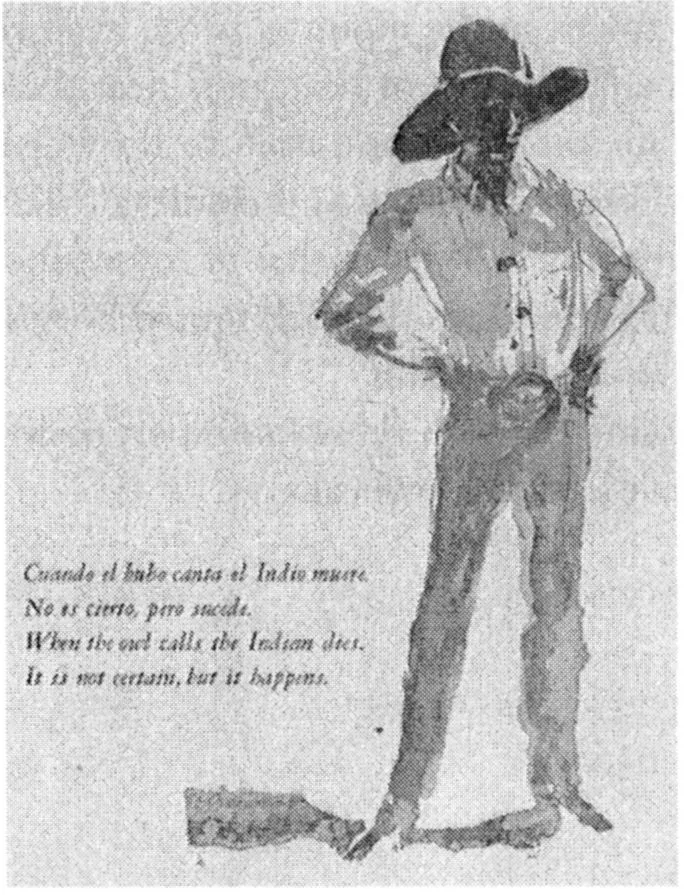
There I would wait until the owl calls
![]()
Chapter I
Ranching: An Old Way of Life in the New West
PAUL F. STARRS
For decades proposals have been floated to arrest grazing on federal lands. And today, in our interesting times, arguments are actively being made—consider one published quotation—to “remove livestock from public lands to conserve native biodiversity.”1 Although this statement invokes an epic ecological simple-mindedness that only a law professor could muster, the spirit is as undeniably and quixotically valiant as the conservation biology is primitive. In fact there is a distinguished tradition of ganging up on the livestock industry (as a structural entity), on cattle and sheep (as agents of change), on grazing (as a practice), and on livestock ranchers (as convenient and visible foils). All bear examining.
The theme isn’t close to new. The bumper sticker campaigns of the 1990s exhorted “Cattle Free by ’93,” “Out the Door by ’94,” “Boycott Public Lands Beef.” An entire catalog would take up column-feet of text. Still easily available are volumes with titles as carefully charged with inflammatory power as habanero chile bins at a Tucson farmer’s market: Sacred Cows at the Public Trough, Waste of the West, Beyond Beef. None of them (surprise!) is by an ecologist. In Elko, Nevada, a couple of years ago—a stronghold of ranching and wildlife and diverse federal lands if ever there was one—a billboard was installed at the southern end of town where it loomed, unsubtly, over every citizen’s entry and exit. “Our public lands, ground into hamburger,” it read. Studiously (and uncharacteristically), the Shovel Brigade and the Wise Users ignored it. There is nonetheless a great deal of heat generated on the theme of public lands grazing—an anger and skepticism that extends to ranching generally in the American West, whether it involves public lands or not. Vast eddies of hot rhetoric swirl about this topic, which insists on the removal of livestock, and so, tacitly, livestock ranchers, from the use of western public lands. Opening up on the subject can get you into at least a shouting match in any bar in the New West. Certainly it merits discussion.
Even more insidious today is the percolation of that benevolent pro-wilderness, antihuman sensibility steeped into those of us who grew up in the 1970s, started college in the 1980s, and graduated to become observers and students of the public domain in the 1990s. We watched, agape and eventually aghast, as the sides spread wide apart, ever intransigent, often absurd in their militancy (or militant in their absurdity?). To use or not to use: This was the polarization betwixt proponents and opponents of grazing. There are voices in between, but few. The debate, Manichean in philosophical terms, is polarized black versus white and lodged against the detents of reason. The splits are extreme: full use or none, wild or domestic, city slickers or rural rubes, federal or private, small or big, endangered species or livestock. In these terms, the hand dealt is typically all-cows or no-cows. But this doesn’t need to be so—as a number of entirely reasonable conservation and biodiversity groups have made clear by meeting ranchers and other western interest groups more than halfway. Innovations are happening in support of not just biodiversity but also working landscapes and a central terrain of shared use and purpose. The question is: How are these innovations being recorded, acknowledged, tested for results, and, if good, passed forward?
There are intriguing programs designed to use the stewardship practices of ranchers—and the actions of grazing animals, and the habitat they use, for part or all of the year—for larger aims. These aims may be personal goals, open-space goals, ecological goals, watershed goals, fuel-hazard-reduction goals, economic goals, community goals, government goals. But they flow in an atmosphere that still includes a proportion of cow haters. And change is occurring with sufficient speed on the ground—let a thousand ranchettes blossom from one historic ranch property—that this is no time to dither.
Ranching’s very practice, formation, and history make for an extraordinarily multicultural and diverse way of life that is rife with harsh compromises and yields sometimes opulent, sometimes disappointing, results. In moving away, we break clear to a suitable viewpoint; fog lifts. Gaining a sight line is, in no small degree, what this essay is about.
RANCH FITS AND STARTS
Ranching in the United States is a singular mix of the resolutely practical and time-honored as well as features that are dreamlike and elusive, feats of imagery and the fantastic and the romantic. The product is a distinctive landscape, extensive in its territory, yet often subtle, or at least remote, in its humanized features. The ranching landscape is a subject of almost infinite complexity about which much has already been written. 2 But the essence of twenty-first-century ranching—and the cowboy, and the ranch economy, and the landscape of the ranch—is complicated adaptation. And that is nothing new. It’s been so for a century and a half, maybe even five hundred years, since cattle and the elements of ranching practice were brought to the New World in Columbus’ second expedition in 1493. That’s a long tradition, in which change is about the only expected and standard rule, with challenge a close second to change as agent and force. It’s odd that a lifeway whose supporters are so given to espousing tradition is, in fact, completely dependent on tacking before countervailing political, ecological, and economic winds. Ranchers tend, pretty much of necessity, to be ultimate pragmatists. It is their supporters who wear the big hats, never having choused a cow, and it is often rancher-wannabes who prove notoriously inflexible, hidebound, and doctrinaire. Because ranching requires access to so much land and because its incomes are at best small, ranching has rarely had a strong built-in economic constituency in places of power. Instead ranchers have through the years had to make cultural converts. And they continue having to do so, with surprising and ongoing success.
The roots of ranching in the American West are stunningly ancient, extending back to practice in the Iberian Peninsula, North Africa, and the Mediterranean realm. But ranching is also the most swiftly adapting and changing land use in the West—largely because it has to be (Figure 1.1). There is little alternative. Ranch land and public lands are under unceasing pressure—in the past from farmers and homesteaders and distant elected representatives, today from environmentalists, real estate developers, politicians and planners, and sundry others. And ranchers respond to these challenges, continuing a practice of improvisation and circumstantial change that keeps ranching, in all its variations, very much among the contending forces of the New West.3
FIGURE 1.1. The ranch in the American West routinely embodies complex foreground/background relationships, evident in this 1950s view of the Bar 99 Ranch in Fish Lake Valley, Nevada. The ranch fields are in the foreground: the irrigated pastures surrounding the ranch buildings. In the middle distance are dry fields and a considerable reach of BLM land grazed as a lease. And in the distance are the White Mountains (including White Mountain Peak, 14,242 feet), where ranch cattle would graze in the early summer and nearly into the fall on Forest Service (USDA) land. The ranch is dependent on many parts, therefore, none easily controlled—“a piece of the continent, a part of the whole,” as John Donne put it. (Photograph from Bar 99 Ranch, Nevada, by Paul F. Starrs)
It does not hurt that almost everyone is in some way enchanted by the lifestyle (though there are violent contrarians). Ranching has forever involved people of varied ethnicity, race, income, and gender. To each one’s own: The newly rich flock to trophy ranches in Montana, Wyoming, Colorado, New Mexico, Nevada, and slap down conservation easements and land trusts and buffalo herds that are profoundly of the present, much akin to what the nineteenth-century “remittance men” did when they carved out their part of the frontier and put it to use. And for the middle class there remains the image of the ranch house, the ranchette, and all the colorful histories and nostalgias that time and place can build. The ranch, then, is intrinsic to the western past but intimately part of the New West’s future. Ranching embodies, still, American ambitions: dreams of community, dreams of avarice, dreams of control or compromise, dreams of family, dreams of authority, dreams of dominance, dreams of paternalistic arrogance. Not all are pleased—but that too is part of the story.
The ranch, in its varied parts and people, remains interesting to many Americans because the cowhand, the ranch, the federal grazing permit, are telling features of our time. This notion is echoed in Kinky Friedman’s timeless line—a bit of prose graven not in High Country News, not in some local penny-saver magazine, but in the op-ed pages of the venerable New York Times—which holds that “cowboys are America’s gift to the children of the world.”4 The ranch gets written off episodically, of course, just like the cowhand. The ranch merits attention precisely because it is controversial and aggressively lacking in diffidence. The ranch grows more interesting because it impinges on aspirations and clashes with visions of what we mi...