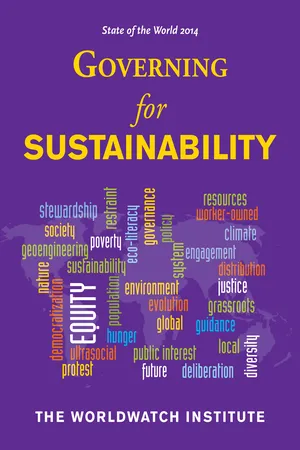
Citizens expect their governments to lead on sustainability. But from largely disappointing international conferences like Rio II to the U.S.’s failure to pass meaningful climate legislation, governments’ progress has been lackluster. That’s not to say leadership is absent; it just often comes from the bottom up rather than the top down. Action—on climate, species loss, inequity, and other sustainability crises—is being driven by local, people’s, women’s, and grassroots movements around the world, often in opposition to the agendas pursued by governments and big corporations.
These diverse efforts are the subject of the latest volume in the Worldwatch Institute’s highly regarded State of the World series. The 2014 edition, marking the Institute’s 40th anniversary, examines both barriers to responsible political and economic governance as well as gridlock-shattering new ideas. The authors analyze a variety of trends and proposals, including regional and local climate initiatives, the rise of benefit corporations and worker-owned firms, the need for energy democracy, the Internet’s impact on sustainability, and the importance of eco-literacy. A consistent thread throughout the book is that informed and engaged citizens are key to better governance.
The book is a clear-eyed yet ultimately optimistic assessment of citizens’ ability to govern for sustainability. By highlighting both obstacles and opportunities, State of the World 2014 shows how to effect change within and beyond the halls of government. This volume will be especially useful for policymakers, environmental nonprofits, students of environmental studies, sustainability, or economics—and citizens looking to jumpstart significant change around the world.
- 295 pages
- English
- ePUB (mobile friendly)
- Available on iOS & Android
eBook - ePub
About this book
Information
CHAPTER 3
Governance, Sustainability, and Evolution
John M. Gowdy
John M. Gowdy is a professor of economics and a professor of science and technology studies at Rensselaer Polytechnic Institute in Troy, New York.
How has it come to pass that humans so completely dominate Earth’s biophysical processes that we are now on the brink of a major shift in the state of the biosphere? Why, in the face of impending ecological disaster, does it seem so difficult to make the basic societal changes needed to ensure our long-term survival? The answers to both of these questions lie deep in our evolutionary history. Framing governance in terms of this history can help us solidify the successes we have achieved at the individual and community levels and, more importantly, inform us about the changes in governance that are needed if we are to gain control of our destiny as a species.1
Governance systems comprise the formal and informal ways that humans manage relationships with each other and with the natural world. In an evolutionary framework, governance can be viewed on three different levels: the individual, the community, and the global socioeconomic system. At the individual level, behavioral science has made great progress in identifying regularities in human decision making. These regularities have been used successfully to design policies to promote sustainable behavior such as recycling and the use of energy-saving appliances, as well as other efforts to “nudge” people to make better personal choices. At the community level as well, strategies for the successful management of human and natural resources have been identified and incorporated into public policy.
At the highest level in the hierarchy, however, the world socioeconomic system thus far has proved highly resistant to the fundamental changes needed to avoid system-wide collapse. Each of these governance levels and the interaction between them can be explored from the perspective of evolution. A missing piece in governance has been the failure to recognize that these levels are sometimes in conflict. The same behavior may be rational at one level but irrational at others.
Contemporary behavioral science, neuroscience, and evolutionary theory have shown that human behavior is a combination of genetic, developmental, and cultural factors. None of these can be understood in isolation, but recent advances in understanding behavior reveal how they are intertwined, giving insights into the behavioral adjustments and policy formulations needed to manage social transitions, including the transition to sustainability. Today, research efforts in a number of disciplines are beginning to coalesce into what evolutionary biologist David Sloan Wilson calls a “science of intentional change.”2
Evolutionary biology reveals a middle ground between the position that human behavior is rigidly determined and the “blank slate” tradition of the standard social science model. Our evolutionary history has instilled in the human species the ability to make rapid and complex adaptions, via culture, to special circumstances. Culture is what makes us human, and it offers the greatest hope for our species to successfully make the transition to a sustainable presence on planet Earth.
Governance and Individual Behavior
More than 25 years of research have shown that human beings are not the paragon of super-rationality that we like to think we are (and that much public policy is based upon). Policies that acknowledge this insight can be used to nudge behavior in directions that benefit individuals as well as society as a whole.3
A now-classic example is organ donation. The share of people agreeing to be organ donors varies greatly within Europe, from 4 percent in Denmark, 12 percent in Germany, and 17 percent in the United Kingdom to nearly 100 percent in Austria, France, and Poland. The difference is accounted for by the fact that, in the first three countries, people are asked on their driver’s license application to “Check the box below if you want to participate in the organ donor program.” People in the other countries are given the choice: “Check the box below if you do not want to participate in the organ donor program.” Because organ donation is a rather complicated moral decision that most people would prefer not to think about, the fall-back, do-nothing choice is appealing.4
Public policy in this case is merely changing the wording of the question. In effect, the person who designed the questions is really the one who made the choice about organ donations. Other public policy experiments have shown that knowing that one is being observed can positively affect decision making. In an experiment with a public utility program designed to prevent blackouts, participation in the program tripled when participants knew that their behavior was being observed. Observation was four times more effective than offering a monetary incentive.5
In another experiment, in California, door hangers were left on customers’ houses indicating how much electricity they used compared to their neighbors. These customers reduced their energy consumption by 10 percent compared to customers given door hangers that offered only energy-saving tips. Residents who used less energy than the average actually increased their consumption, however—a “boomerang effect” that disappeared when smiley faces were added to the door tags.6
Other, more long-term interventions have used insights from behavioral psychology to design educational curricula and course content. An example is the Good Behavior Game, which begins by having students themselves establish norms of good behavior. After these norms are set, groups of students compete to be good. Controlled experiments have shown that the positive effects of the game last until adulthood even when the game is played only in the first two years of school.7
A promising area of research is the role of evolved behavior in people’s consumption decisions. Consumption behavior is motivated by two desires: to meet basic wants and to gain status. Basic wants can be satisfied, but wants that are driven by status considerations are essentially insatiable. As a result, growth in industrialized economies, with their large populations of middle-class consumers, has become a zero-sum game, contributing little to individual well-being and perhaps even undermining it. Reducing material consumption is thus a necessary component of governance for sustainability, and understanding the evolutionary dynamics behind human behavior may help us design polices to channel behaviors such as status-seeking onto more socially and environmentally benign paths.8
Some progress is being made in this area. Neuroscience and behavioral economics, for instance, have all but demolished the rational-actor model of standard economic theory. Economists no longer rely solely on the price system as a policy tool. And although the focus of most research is still on individual behavior, neuroscience research has confirmed the existence of the social brain. The human brain evolved to allow us to function together in social groups: a growing body of evidence indicates that humans are unique among mammals in their degree of sociality. Our ability to solve resource management problems collectively is a manifestation of our uniqueness, and it offers another ray of hope that our species may achieve a sustainable way of living.9
Governance at the Community Level
For most of our existence, humans have lived in small groups within the confines of local ecosystems. Cooperation evolved because those groups that worked together survived, while those that did not perished. Institutional rules for cooperation and living within biophysical limits emerged early in pre-agricultural human societies and ensured the viability of these small groups. The rules of the game changed with the widespread adoption of agriculture some 10,000 years ago as we broke out of the confines of small communities and local ecosystems, but our evolutionary history still leads us to cooperative behavior.
The obsessive focus of economic theory on “self-regarding behavior” led economists to deny the possibility of cooperation except in cases where it was directly and immediately beneficial to both parties. Because of the free-rider problem (when someone receives a benefit without paying his or her share of its cost), economists assumed that the only options for successfully managing common-property resources were rigid, top-down control or the complete assignment of private property rights to individuals. But recent work has shown that cooperation is widespread in the natural world, including among humans, and all successful human groups have a variety of rules to punish free riders and encourage altruism. This is part of community governance, and it is accomplished by social pressure as well as formal sanctions.10

Members of several families of San people (Bushmen) at their settlement in Namibia.
Elinor Ostrom, co-recipient of the 2009 Nobel Prize in economics, drew on her experience in small-scale societies around the world to identify eight principles for the successful management of common-property resources: (1) a strong group identity, (2) fairness in distributing costs and benefits, (3) consensus decision making, (4) effective monitoring of effort and rewards, (5) graduated sanctions, (6) rapid and fair conflict resolution, (7) sufficient autonomy when the group is part of a larger system, and (8) appropriate coordination between groups. Ostrom and her colleagues identified these principles from meticulous studies of the effectiveness of different systems of common-property management. When the principles are in place, local communities do a remarkable job of protecting their resource bases even under intense outside pressure.11
Sustainable human communities existed for some 2 million years (counting Homo erectus as human), so it is not as if we cannot do it. Sustainable indigenous human cultures still exist, although they are being eliminated at an alarming rate. Sustainable communities are also appearing within the world capitalist system, as subcultures are being “re-engineered” as eco- communities built around the needs of humans and ecosystems, not markets. The success of movements for sustainable local agriculture and local currencies, and the continuing resistance of native peoples to assimilation into the market economy, attest to our ability to confront the global system.12
Can the human propensity for cooperation and community building be harnessed sufficiently to scale up and challenge a global system built on competition and accumulation? Perhaps, but we need to be realistic about what we are up against. (See Box 3–1.) In small communities, the “good of the group” corresponds to the “good of individuals within the group.” This is not necessarily true for very large groups. The positive benefits of cooperation are undeniable, and numerous recent books have touted our cooperative nature. But the optimism of those on the cooperation bandwagon is often pushed too far. For example, evolutionary biologist Mark Pagel writes:
Modern societies differ vastly from the small tribes that once competed to occupy Earth. But the old psychology plays out well in our globalized, multicultural world. Our species’ history is the progressive triumph of cooperation over conflict as people recognized that cooperation could return greater rewards than endless cycles of betrayal and revenge.13
There are reasons to temper this optimism. First, hunter-gatherer societies did not practice the kind of intergroup warfare that characterizes agricultural and industrial societies: within-group conflicts were significant, but warfare with other groups was largely absent. Human history is not a simple story of progress from savagery to civilization. Secondly, Pagel and others equate the impersonal interconnections involved in producing and consuming world economic output with cooperation. But coordination in producing economic surplus is not the same as cooperating for the common good.14
Stressing the virtues of cooperation can be a more nuanced approach to human nature than the “selfish gene”/“economic man” worldview, but the dark side to human cooperation must be understood if we are to realistically assess our present circumstances. The leap to agriculture and state societies some 8,000 years ago represented a rare but highly successful evolutionary transition to “ultrasociality,” a type of social organization seen in only a handful of species, including ants and termites. Ultrasociality is characterized by a full-time division of labor, specialists who do not aid in food production, sharing of information, collective defense, and complex city-states. The profound social and environmental consequences of such complexity have resulted in what biologist E. O. Wilson calls “the social conquest of Earth.” The ultrasocial human economy is the uppermost level in the governance hierarchy, and it is the most problematic.15
The Emergence of Human Ultrasociality
With the appearance of agriculture came a basic change in the economic organization of human societies: the switch from producing for livelihood to producing for surplus. Natural selection among competing groups of early agriculturalists favored those societies that were the most efficient in producing economic surplus, and those that could take advantage of increasing returns to larger size. This led to (1) human domination of ecosystems, (2) explosive population growth, and (3) highly hierarchical societies. The population increase after agriculture was unprecedented in the prior 200,000-year history of Homo sapiens, exploding from about 4 million to over 200 million in a few thousand years. A second population explosion, from under 1 billion in 1800 to over 7 billion today, came when fossil fuels and the Industrial Revolution ushered in the Anthropocene—the Age of Humans. (See Chapter 6.)16
Box 3–1. Can Networked ...
Table of contents
- Cover
- Praise for this Title
- About Island Press
- Title Page
- Copyright Page
- Dedication
- Acknowledgements
- Contents
- Foreword
- Introduction
- Political Governance
- Economic Governance
- Conclusion
- Notes
- Index
Trusted by 375,005 students
Access to over 1.5 million titles for a fair monthly price.
Study more efficiently using our study tools.
Frequently asked questions
Yes, you can cancel anytime from the Subscription tab in your account settings on the Perlego website. Your subscription will stay active until the end of your current billing period. Learn how to cancel your subscription
No, books cannot be downloaded as external files, such as PDFs, for use outside of Perlego. However, you can download books within the Perlego app for offline reading on mobile or tablet. Learn how to download books offline
Perlego offers two plans: Essential and Complete
- Essential is ideal for learners and professionals who enjoy exploring a wide range of subjects. Access the Essential Library with 800,000+ trusted titles and best-sellers across business, personal growth, and the humanities. Includes unlimited reading time and Standard Read Aloud voice.
- Complete: Perfect for advanced learners and researchers needing full, unrestricted access. Unlock 1.5M+ books across hundreds of subjects, including academic and specialized titles. The Complete Plan also includes advanced features like Premium Read Aloud and Research Assistant.
We are an online textbook subscription service, where you can get access to an entire online library for less than the price of a single book per month. With over 1.5 million books across 990+ topics, we’ve got you covered! Learn about our mission
Look out for the read-aloud symbol on your next book to see if you can listen to it. The read-aloud tool reads text aloud for you, highlighting the text as it is being read. You can pause it, speed it up and slow it down. Learn more about Read Aloud
Yes! You can use the Perlego app on both iOS and Android devices to read anytime, anywhere — even offline. Perfect for commutes or when you’re on the go.
Please note we cannot support devices running on iOS 13 and Android 7 or earlier. Learn more about using the app
Please note we cannot support devices running on iOS 13 and Android 7 or earlier. Learn more about using the app
Yes, you can access State of the World 2014 by The Worldwatch Institute in PDF and/or ePUB format, as well as other popular books in Biological Sciences & Environment & Energy Policy. We have over 1.5 million books available in our catalogue for you to explore.