"Intrepid conservation detective story." —Nature
"A lucid, informed, and gripping account...a must-read." —Science
"Passionate...a heartfelt and alarming tale." —Publishers Weekly
"Gripping...a well-told and moving tale of environmentalism and conservation." —Kirkus
"Compelling." —Library Journal
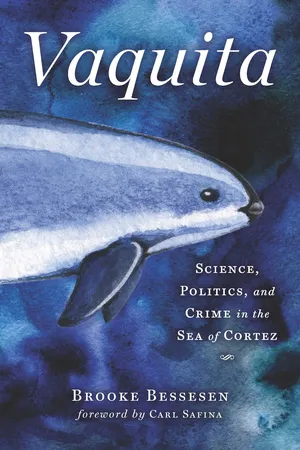
In 2006, vaquita, a diminutive porpoise making its home in the Upper Gulf of California, inherited the dubious title of world’s most endangered marine mammal. Nicknamed “panda of the sea” for their small size and beguiling facial markings, vaquitas have been in decline for decades, dying by the hundreds in gillnets intended for commercially valuable fish, as well as for an endangered fish called totoaba. When international crime cartels discovered a lucrative trade in the swim bladders of totoaba, illegal gillnetting went rampant, and now the lives of the few remaining vaquitas hang in the balance.
Author Brooke Bessesen takes us on a journey to Mexico’s Upper Gulf region to uncover the story. She interviewed townspeople, fishermen, scientists, and activists, teasing apart a complex story filled with villains and heroes, a story whose outcome is unclear. When diplomatic and political efforts to save the little porpoise failed, Bessesen followed a team of veterinary experts in a binational effort to capture the last remaining vaquitas and breed them in captivity—the best hope for their survival. In this fast-paced, soul-searing tale, she learned that there are no easy answers when extinction is profitable.
Whether the rescue attempt succeeds or fails, the world must ask itself hard questions. When vaquita and the totoaba are gone, the black market will turn to the next vulnerable species. What will we do then?
- 293 pages
- English
- ePUB (mobile friendly)
- Available on iOS & Android
eBook - ePub
About this book
CHAPTER 1
The Dead Girl
DON’T BE NERVOUS. IT’S SAFE,” Gustavo offered preemptively as we pulled into a dirt lot facing the dark entrance of a brown concrete building. The structure had the angular foreboding of an abandoned prison, with open, rusty-barred windows jutting evenly along the front. Not one to worry, I hadn’t been a bit nervous until Gustavo made this statement, which now had me attentive to deep shadows cast by the cool evening light. Still, I followed him inside.
Eyes adjusting, I scanned a panorama of dilapidated brick and tile stalls. Se renta o vende read sloppy strokes of graffiti. For rent or sale. As Gustavo’s stocky silhouette sidestepped piles of rubble, his flip-flops echoed down spoked halls, which stretched into the building’s blackest recesses.
I had met Gustavo Cárdenas Hinojosa, a thirty-something scientist with INECC (pronounced EE-nek), Mexico’s National Institute of Ecology and Climate Change, just twenty minutes earlier, at five o’clock at the Hotel Los Angeles as planned. We had fumbled through our initial greeting, each trying on a language we hadn’t worn in a while—my Spanish, his English. His English fit better, so we stuck with that.
I’d made my first ever trip from Arizona to San Felipe, Mexico—a six-hour drive—to ask a single question: why was the world’s most critically endangered marine mammal still dying in gillnets when gillnets were supposedly outlawed? Gustavo, field coordinator for INECC’s vaquita acoustics study, had generously driven over from Ensenada to introduce me to some people who might offer insight, starting with a well-known fisherman named Javier Valverde.
Gustavo and I quickly checked into the hotel, a new kelly-green monolith at the edge of town. After dumping our bags in two convenient first-floor rooms, we hopped into his red truck, a Ford Ranger that looked to be a multitour veteran of fieldwork. Five minutes later, I was being ushered down this dusty corridor.
A right. A left. Twenty paces forward.
Like the warm glow of a farmhouse on a dark night, we came upon a single, brightly lit window. In such a gloomy edifice it was strange to find a satellite office for CONANP, Mexico’s National Commission of Natural Protected Areas. It was a respite of pale yellow walls and encouraging environmental posters. As Gustavo directed me through the door, a middle-aged man wearing a viva la vaquita T-shirt stepped forward to say hello. Paco Valverde is a biologist and administrator for CONANP and is Javier’s son.
Paco offered me a friendly smile, but his features were lined with stress, and after shaking my hand, he turned to Gustavo and delivered some piece of terrible news in such rapid-fire Spanish that I was left struggling to interpret their anxious expressions. Several minutes passed before I could even begin to grasp the situation, and it wasn’t until Paco clicked through gruesome images on his computer screen that the issue became clear.
A vaquita had washed up on the beach—dead—just that morning. It was March 15, 2016. Gustavo’s arms folded across his body as if holding something fragile together. It was the second vaquita corpse in eleven days; a male had been found floating offshore on March 4.
The vaquita, scientifically named Phocoena sinus, is the world’s tiniest cetacean, a stout, glossy-skinned porpoise whose entire frame, rostrum to fluke, spans a mere five feet and tips the scale at just ninety-five pounds. On the whole planet, there is but one population of vaquitas, and that population, living in the Upper Gulf of California, has endured continual decline since the early 1940s. A prestigious group of scientists conducted a population survey in the fall of 2015. Six months later, they would announce their unfavorable findings: fewer than sixty vaquitas were left on the planet.
Chris Snyder, a Flagstaff, Arizona, transplant, had discovered the dead vaquita during her morning walk. Chris lives in an expat community called El Dorado Ranch, seven miles north of San Felipe. The porpoise was on the beach “in front of EDR golf course,” she wrote in a 10:37 a.m. Facebook post along with a photo of the body—bruised and bloated skin beginning to tear, empty eye sockets fixed and vacant. Her husband, Tom Gorman, deciding that more images were needed, had hurried back down to the body and loaded several more shots to Facebook. One showed a hungry turkey vulture lurching like a Western movie character over purple flesh.
It was the Snyder-Gorman Facebook photos that first alerted authorities to the dead cetacean and set off the firestorm of official calls, texts, photos, and reports. Paco showed Gustavo video he had taken of the corpse being loaded onto the bed of a truck for transport to Mexicali. I fretfully snatched at any Spanish words I could recognize and pieced together the basics. Despite significant decomposition, they identified the victim as a female, 1.3 meters long (about fifty-one inches). Every loss bodes poorly for the survival of the species. But with so few vaquitas remaining, I knew the forfeiture of a female’s breeding potential was a sharp twist of the knife.
As Paco spoke, Gustavo texted wildly on his cell phone, and I stood by, trying to follow the narrative. I asked a few questions, but it was obvious that these men had no attention for my inquiries. Neither seemed to possess the mind power for a second language at such an upsetting time, and I felt foolish that my crash course in refresher Spanish had failed to take. The stress was palpable, so I slipped into an adjoining room to give them some space. My heart ached for Gustavo and Paco, but I could not console them. It was like I’d accidentally stumbled into the private funeral of someone famous but whom I did not personally know. I was an interloper, an observer, a distraction.
It wouldn’t be until a couple weeks later, in a moment of deep personal contemplation, that the image of that dead vaquita would flood back to my mind. With my heart wide open, I saw her, really saw her, not as one of a disappearing population but as a single, distinct individual—a daughter, a sister perhaps—who lived freely and died tragically. I imagined her final moments: the terrified thrashing, the tangle of rope, holding her breath against the murky midnight water for countless frantic seconds until at last her burning lungs insisted on one final inhale.
In my mind, her little frame cast out on that isolated beach transformed into the body of a young girl dumped by the side of the road outside a rural town.
She’d been murdered. And everybody knew who’d done it.
There are always clues at a crime scene. In this case, there were eight totoaba carcasses strewn about on the sand.

Totoaba is a fish. It also is endemic to the Gulf of California and is also listed as critically endangered. Totoaba macdonaldi is the largest member of the Sciaenidae family. Sciaenids are commonly called drum fish, or croakers, because they can produce a thrumming sound by vibrating special muscles against an internal gas-filled organ—the swim bladder—which regulates buoyancy and helps the fish go up and down in the water column.
Totoaba (pronounced toe-TWA-buh) are now being heavily poached for their swim bladders, called buches in Spanish.
And what are those buches used for? For soup.
The swim bladder, called fish maw in Asia, is boiled into a Chinese soup that is coveted for purported curative powers, including improved skin complexion and circulation. Although such remedial properties remain unsubstantiated, the feeding frenzy continues. Since 2012, hundreds upon hundreds of buches have been smuggled and sold in what has become a multi-billion-dollar international black market for wildlife products.
China’s main source of fish maw—the Chinese bahaba, another drum fish—has all but disappeared. Bahaba taipingensis once resided in great numbers along the coast of the China Sea, from Shanghai south to Hong Kong. With the bahaba completely fished out and nearing extinction, however, the cost of a bahaba swim bladder rocketed to astronomical heights, so Chinese marketeers redirected their interests to extract Mexican totoaba from the northern half of the Gulf of California. Both are large and long-lived sciaenids, and their life cycles and bladders are very similar.
It is not the first time China has promoted poaching. The country is notorious for trafficking wildlife parts, and its unrelenting appetite for endangered species poses a catastrophic threat to many beloved animals on the threshold of extinction.
Rhino horn, tiger bone, pangolin scales, totoaba bladder. Each attracts its own cast of assassins.
For the right price, local poachers are always willing to take a risk, especially in countries like Mexico where penalties are rare. (Totoaba poaching has not been a felony, and arrested parties are typically freed within a couple of days.) Of course, fishermen who poach buches, known as bucheros, are not selling directly to China. Chinese and Mexican mafias are said to have joined forces to traffic the “aquatic cocaine”; with similar pound-for-pound profits, bladders really are as lucrative as drugs.
Unlike powdery and flowery drugs that are measured only by weight, buches are also valued by size. Size matters, a lot. The larger, thinner-walled bladder of the male totoaba is particularly valued. And the older the fish, the bigger the buche. The more perceived strength and vitality, the higher the price.
As the black market booms, fishermen rush to the water like gold miners, tossing gillnets to collect their claim. Some bucheros even “clone” their pangas, or skiffs, painting the same number on both hulls to secretly run two boats under one permit. In the dark of night—or worse, under the guise of catching legal species—local fishermen capture football-player-sized totoaba and quickly carve out their buches. Those buches are then dried for transport.
A well-connected cartel syndicate is said to smuggle the contraband across international borders and distribute it in China or to Chinese restaurants in the United States. As China’s economy grows stronger, there are more wealthy people who can afford gastronomic luxuries, and dried swim bladders are said to be standard fare at Hong Kong markets and openly auctioned in China. The illegal commodity is even sold through online sources like Alibaba.
Mexico blames China for not coming down hard enough on the sale of totoaba parts. China blames Mexico for allowing fishermen to poach the animals in the first place. They’re both right. It’s a bit like drugs. Countries that produce the merchandise must be held accountable, but countries that consume the imports are also culpable. Government leaders, fishermen, smugglers, bosses, buyers, restaurateurs, diners, and, of course, corrupt law enforcement officers are all part of the organized criminal chain.

A dried totoaba swim bladder, buche in Spanish; with long tubes of attached tissue, it looks something like a Mesoamerican drawstring sack. (US Fish and Wildlife Service)
To date, China doesn’t seem fully committed to destroying a profitable business model, and Mexico doesn’t seem fully committed to abolishing loopholes for poaching. Meanwhile, the illegal industry gains traction.
Unfortunately, totoaba is not the only critically endangered animal to be caught up in this international scandal. In death, vaquita is totoaba’s mammalian twin. Both large, lovely, silvery imperiled species fall victim to the same bucheros. The gillnets deployed to capture totoaba, left adrift in the water column, are either indistinguishable or confusing to vaquitas’ sensitive sonar. When the tiny porpoises accidentally hit the nets and catch a fin or fluke, they panic and roll themselves into inescapable knots. As air-breathing mammals like us, they cannot survive indefinitely beneath the sea surface and soon succumb to asphyxiation.
Gillnets—locally called chinchorros or redes de enmalle—have been the mainstay of fishing in the Upper Gulf since the 1940s. The contraption is simple: two ropes with netting strung between. Buoys tethered to the upper rope act as floats and markers, and lead weights attached to the bottom rope stretch and shape the net. Once deployed, the apparatus may remain unattended for many hours, sometimes days, anchored to the bottom or adrift in the current. Although gillnets are designed to snag the gills of particular species—the mesh size is selected to fit the target fish’s head—they inevitably capture nontarget species as well.
It’s called bycatch.
Bycatch is the incidental capture of nontarget species, and some researchers estimate that bycatch of nets, longlines, and trawls accounts for up to 40 percent of total global catch. In other words, for every one hundred pounds of targeted fish hauled in and sold at market worldwide, forty pounds of nontarget animals—rays, sharks, seahorses, marine birds, corals, crabs, octopus, sea turtles, seals, and cetaceans—may be dumped, dead or dying, back into the sea. That adds up to sixty-three billion pounds per year.
Collateral damage is a pitiful part of the food industry that most of us don’t want to look at. Bycatch is a sobering problem in every ocean around the world. Vaquitas, however, fall victim in just a single location, the only place the species has ever existed: a pinpoint spot on the map of Mexico.
Baja California is Earth’s second-longest peninsula behind the Malay Peninsula of Southeast Asia. This skinny strip of land, like an old man’s finger pointing toward Argentina, hugs a bio-rich aquatic environment against the continental mainland. Many geographically challenged people are confused by the different names given to the seven-hundred-mile-long embayment. Americans typically call it the Gulf of California; Spaniards call it the Sea of Cortés. Its original moniker—the Vermilion Sea—dates to 1539. Some historic references dub it the Red Sea. Perhaps Jacques Cousteau was the most insightful when he branded it “the aquarium of the wo...
Table of contents
- Cover
- Title Page
- Copyright
- Dedication
- Contents
- Foreword
- “Goodbye Baiji”
- Prologue
- Chapter 1. The Dead Girl
- Chapter 2. Resource Extraction
- Chapter 3. Chasing a Myth
- Chapter 4. Tangled Agendas
- Chapter 5. Death, Drugs, and Accountability
- Chapter 6. Pirates on Patrol
- Chapter 7. Searching for Vaquita
- Chapter 8. Hearing Is Believing
- Chapter 9. Science in the Sea
- Chapter 10. Witnessing Extinction
- Chapter 11. Saving Bigfoot
- Chapter 12. Sending Out an SOS
- Chapter 13. Meet the Totoaba
- Chapter 14. Last-Ditch Effort
- Chapter 15. Hope Is a Life Raft (with a Persistent Leak)
- Epilogue
- Author’s Note
- Guide to Acronyms
- Acknowledgments
- Notes
- Selected Bibliography
- Index
Trusted by 375,005 students
Access to over 1.5 million titles for a fair monthly price.
Study more efficiently using our study tools.
Information
Publisher
Island PressYear
2018Topic
Biological SciencesPrint ISBN
9781610919319
Subtopic
Marine BiologyeBook ISBN
9781610919326
Index
Biological SciencesFrequently asked questions
Yes, you can cancel anytime from the Subscription tab in your account settings on the Perlego website. Your subscription will stay active until the end of your current billing period. Learn how to cancel your subscription
No, books cannot be downloaded as external files, such as PDFs, for use outside of Perlego. However, you can download books within the Perlego app for offline reading on mobile or tablet. Learn how to download books offline
Perlego offers two plans: Essential and Complete
- Essential is ideal for learners and professionals who enjoy exploring a wide range of subjects. Access the Essential Library with 800,000+ trusted titles and best-sellers across business, personal growth, and the humanities. Includes unlimited reading time and Standard Read Aloud voice.
- Complete: Perfect for advanced learners and researchers needing full, unrestricted access. Unlock 1.5M+ books across hundreds of subjects, including academic and specialized titles. The Complete Plan also includes advanced features like Premium Read Aloud and Research Assistant.
We are an online textbook subscription service, where you can get access to an entire online library for less than the price of a single book per month. With over 1.5 million books across 990+ topics, we’ve got you covered! Learn about our mission
Look out for the read-aloud symbol on your next book to see if you can listen to it. The read-aloud tool reads text aloud for you, highlighting the text as it is being read. You can pause it, speed it up and slow it down. Learn more about Read Aloud
Yes! You can use the Perlego app on both iOS and Android devices to read anytime, anywhere — even offline. Perfect for commutes or when you’re on the go.
Please note we cannot support devices running on iOS 13 and Android 7 or earlier. Learn more about using the app
Yes, you can access Vaquita by Brooke Bessesen in PDF and/or ePUB format, as well as other popular books in Biological Sciences & Marine Biology. We have over 1.5 million books available in our catalogue for you to explore.