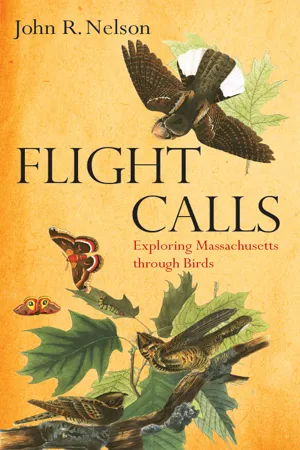
The paths of different birds look like double helixes, flowing strands of hair, and migrating serpents, and they beckon with calls that have definite meanings. These mysterious creatures inspire growing numbers of birders in their passionate pursuit of new species, and writer John R. Nelson is no exception. In Flight Calls, he takes readers on explorations to watch, hear, and know Massachusetts's hummingbirds, hawks, and herons along the coasts and in the woodlands, meadows, and marshes of Cape Ann, Cape Cod, the Great Marsh, Mount Auburn Cemetery, the Quabbin wilderness, Mount Wachusett, and elsewhere.
With style, humor, and a sense of wonder, Nelson blends his field adventures with a history of the birding community; natural and cultural history; bird stories from authors such as Henry David Thoreau, Emily Dickinson, and Mary Oliver; current scientific research; and observations about the fascinating habits of birds and their admirers. These essays are capped off with a plea for bird conservation, in Massachusetts and beyond.
I’d seen this bird before, many times, but not like this. Naked eye, I could detect the diagnostic field marks: bluish overall, white wing bars, lime patch on the back, yellow throat above a smeared black and rufous breastband, white eye arcs. Binoculars brought me so close I could barely focus. The bird’s eyes darted, its whole being quivered as it sang—a fast, thin, ascending buzz.
Loud, girly voices were coming our way. Clomp-clomp shook the boardwalk. A young woman appeared: platform shoes, shorts matching the bird’s lime, a bare midriff, puffy white blouse, eyes startled by cosmetics, hair titmouse tufted. This wasn’t one of the usual birdwatching suspects at Plum Island. She saw me and stopped. “What you looking at?”
“A bird. A Northern Parula.” I pointed. “It’s just over your head.”
She looked up. “Oh, right there close! So pretty. What did you say it was?”
“A parula. It’s a type of warbler.”
“A wobbla,” she echoed. You’d think that after half a century I’d be used to the local accents. How far back were people around here talking this way? On his midnight ride, did Paul Revere announce himself as Pall Ravea?
She watched the parula flit about. I held out my binoculars. “Here, take a look.”
“Gee, thanks.” She dimpled when she smiled.
I showed her how to work the focus knob. “Don’t try to search with the binoculars. Find the bird first, keep your eyes on it, then raise the binoculars to your eyes.” I pantomimed the technique.
“Gotcha.” She was a quick study. She got on the parula and steadied the binoculars. “Jeez, you can see everything! It’s got like a necklace but all smudgy.” She looked behind her. “Tina! Get over here. Check out this wobbla.”
Clomping approached. The young woman scanned the nearby trees. “Hey, you got any more of these wobblas around?”
“Sure. There’s a redstart just over there. And I hear a Chestnut-Sided singing. That’s a beautiful warbler.”
“Well, guy, what are we waiting for? They might fly away, right?”
Anybody can become a birder. If this young woman seemed an unlikely candidate, it’s because my imagination can be biased and shortsighted. Demographics support a profile—more white than brown or black, more old than not, more prosperous than poor, about equally male and female—but demographics aren’t destiny. I know butcher and baker birders, cops, nurses, Muslims, Young Republicans, sopranos, farmers, ship captains, metalheads, ministers, great-grandmothers, fourth-graders, Namibians, alcoholics, and astrophysicists. Some birders can’t see, hear, or walk. Some, like me, came late to the game. Others seem born to bird, as people are born for music or math. In Peru our group was helped by a young local, with threadbare pants and crappy binoculars, who was still learning conversational English but could call out the exact English name of every bird he spotted. And he spotted every bird around. Birds had called to him. Our guide put him in touch with Birders’ Exchange, a program that collects donated optical equipment and distributes it to young guides, conservationists, and educators in Latin America and the Caribbean. The birds are here for everyone.
Raised in a suburb of Chicago, I wasn’t nurtured to direct attention to nature. I can’t remember anyone from my childhood who cared about birds. My first love was sports. I liked running after balls and catching them. I was born to fetch. I wanted to be Cubs shortstop Ernie Banks, not Henry David Thoreau. When I outed myself as a birder at a high school reunion, one old chum asked, “Are you or are you not gay?” He eyed me as if I’d just offered proof of, if not gayness, then midlife crisis, declining virility, or incipient senility. How else to explain why I’d joined the nerdy ranks of Mr. Peepers and Miss Jane Hathaway from the Beverly Hillbillies? Better not, I thought, share my excitement over the Brown Creeper I’d just seen in the yard where I grew up or the Yellow-Bellied Sapsucker lakeside in Chicago. During the reunion I discovered that any mention of birds was a surefire conversation killer. Birders are sometimes accused, with some truth, of not wanting to talk about anything but birds. Some classmates asked: “Do you keep a list?” I was tempted to respond: “Of course I keep a list. I’m not the Rain Man. How else will I remember which birds I’ve seen?” Instead I smiled and said “yes” and, if prompted, listed my lists and explained why I keep them—to remember but also to educate myself about the ranges and distributions of birds, document breeding birds in my neighborhood, and target new birds in my searches.
I turned to birding only after a midlife run of orthopedic insults ended my amateur careers in basketball, touch football, and tennis. At Monteverde in Costa Rica, just after my first hip replacement, my wife, Mary, and I saw some tourists with bird books and whimsically decided to try a bird walk. We were aghast when told we’d have to meet the guide at six in the morning and stay out till noon, but we showed up. Our guide, a soft-voiced, quiet-stepping young Costa Rican, told us he usually led groups of experienced birders, not beginners like us, but three weeks earlier he’d lost his nephew, his protégé, twelve years old, and he wanted to go easy on his first day back. His eyes held sadness the whole morning in the cloud forest, but he was an encouraging teacher and terrific birdsong mimic. We felt his love for birds. I remember just a few species he showed us, hummingbirds, motmots, loud, clumsy-looking guans, and long-tailed, iridescent green and red Resplendent Quetzals. In a Mayan myth, the quetzals’ breasts turn bloodred when they drop into battlefields to mourn fallen soldiers. Only later did I grasp how lucky we were to see these birds.
Back home I started cycling for exercise—a sorry substitute for competitive sports—and brought along my cheap binoculars in case I came across something. Mostly I stopped for big, startling birds—Little Blue Herons,
Glossy Ibises—but I also noticed bold, busy little swallows and phoebes. Lots of large white birds hang out around Cape Ann, where we live, and I was embarrassed to realize they either weren’t all seagulls or were various kinds of gulls. One day I rode by a wetland, more puddle than pond, and there, lined up like pageant contestants, were a Green Heron, Glossy Ibis, Great Blue Heron, and Black-Crowned Night-Heron. I watched them for a while—surely a sight unprecedented—and then pedaled home as fast as I could to tell Mary. The birds were still there when she drove us back to the wetland. Mary looked at the birds, then at me, and said, “You’re a goner now.”
My birding career has followed a typical trajectory. I wanted to see new birds, any new birds. Then I wanted to see more new birds—lovely, strange, subtle, or plain—and see them better. Friendly trip leaders from the Brookline Bird Club took me to places where I could find them and helped me know what I was looking at. To find birds on my own and know what they were, I studied bird books and listened to birdsong tapes.
Meanwhile, something was happening to me. So intent was I on not missing a bird, I’d slipped into the habit of absorption. The amorphous world had grown more precise. Ornithologist Richard Prum says in The Evolution of Beauty (2017) that “bird-watching might be among the very first functions of mind,” since, like face recognition, it trains our brains to “transform a stream of natural history perceptions into encounters with identifiable individuals.” In pre–birding days trips with Mary, birds had sometimes caught our attention: White Storks commanding a Spanish bell tower, a dizzy Bananaquit sampling liquors at a Caribbean beachside bar, a shearwater of some sort skimming the waves and keeping time with our catamaran between Crete and Santorini. But I couldn’t remember a single bird from our treks along the Inca Trail or the Cliffs of Moher. What the hell had we been looking at? What weren’t we hearing? Now I was alert to signifying movements all around, attuned to sounds, an Eastern Towhee’s leaf-shuffling, a chipmunk’s chip, an Eastern Wood-Pewee’s distant pee-o-wee, a Red-Tailed Hawk’s scream from the sky. I was growing closer to earth, water, and sky. I’d check a bird’s field marks to identify it, then I’d stand back and try to take in the bird, its purposeful movements, its attitude toward other birds, its routine. “If a sparrow comes before my window,” wrote John Keats in a letter to his friend Benjamin Bailey, “I take part in its existence and pick about the gravel.” I’d become as concentrated as a still-hunting Green Heron. In Speak, Memory (1966) Vladimir Nabokov describes his passion for butterflies: “And the highest enjoyment of timelessness—in a landscape selected at random—is when I stand among rare butterflies and their food plants. This is ecstasy, and behind the ecstasy is something else, which is hard to explain. It is like a momentary vacuum into which rushes all that I love.”
Nabokov calls his butterfly hunting “an ardent and arduous quest.” I am, I suppose, on my own quest, though the word sounds too epic for an activity that won’t accomplish much beyond personal gratification. But there’s no denying the ardor. In search of birds I’ve gone further and further afield, first to birdy spots around Massachusetts—Mount Auburn Cemetery for spring warblers, South Beach for shorebirds and terns, Mount Wachusett for migrating raptors—next cross-country to the Rio Grande and saguaro deserts, then beyond to whole new families of birds in Belize, Brazil, Botswana, Bhutan, and Borneo.
Mary and I are lucky to have the means to travel with good optical equipment, and I’m lucky to have an adventurous wife willing to go on birding vacations. She’s more photographer than birder, but like many “non-birding partners” she’s a fine spotter who, annoyingly, has gotten great looks at some wonderful species I’ve missed. Together we’ve watched remarkable birds—the Secretarybird, quilled, leggy, snake-stomping, striding across the Serengeti like a mythical cross between stork and eagle, or the impossible Grayish Miner, a rock-colored little creature that somehow finds food and drink in the Atacama Desert, a land without rainfall, even a sprig of vegetation, or any visible bugs or other birds, nothing but rock. The miner seemed to live in a realm of its own, but other birds were connecting the world to home. The Peregrine Falcons soaring in Greek mountains and the Australian outback are the same species that winter at the city hall towers in Gloucester. The thrushes and warblers we found in Central America might be the migrant birds feeding in our yard. They’ll return to Massachusetts each spring only if they find places to thrive during winters in tropical America. Bird conservation knows no boundaries.
Certain birds seemed so at home in their habitats that they came to embody the lands where they live. Visions of the forests of Tikal are inseparable from Orange-Breasted Falcons, totemlike at their nest atop a steep pyramid we’d climbed to see them as the sun set lavender over Mayan temples. My memories of the Rio Negro in Amazonia come with a soundtrack of shrieks from Screaming Pihas—sheer volume as an agent of sexual selection. In Massachusetts a woodland without Ovenbird song would seem profoundly wrong, while a freshwater marsh would sound off-kilter, an orchestra missing its woodwinds, without the trills of Marsh Wrens. Birds ranging from Secretarybirds to Ovenbirds rouse curiosity about the evolutionary history of all birds and their great migratory journeys across the earth.
Birding travel teaches that exoticism—applied to birds, places, or people—is all about perspective. In Thailand I showed up one morning in a shirt featuring a Sulphur-Bellied Flycatcher, a streaky, cardinal-sized bird from the deserts of Mexico and Arizona. Our guide stared at me for some time before he asked, “How can this bird be a flycatcher?” I might’ve asked the same question about his Verditer Flycatcher, a stunning copper-sulfate songbird, from an entirely different family, common in Asia and hardly more exotic to its human neighbors than Thai people find themselves exotic. Baltimore Orioles and Northern Cardinals seem fabulously foreign to visitors who’ve never seen any birds from their families, but they’re our backyard neighbors in Massachusetts. The birds themselves are just going about their business. And it’s been at home that I’ve become engrossed by bird business, not just glimpsed bird beauty.
Evolutionary biologist Ernst Mayr once said that of all sciences, ornithology most readily allows amateurs to contribute through patient observation, scrupulous record-keeping, and “imaginative posing of problems.” A turning point for me was the second Massachusetts Breeding Bird Atlas, a five-year project (2007 through 2011) directed by Joan Walsh from Mass Audubon to determine which species were breeding across our state. By foot and bicycle I surveyed two atlas blocks—my neighborhood in West Gloucester and another sector in Danvers, Middleton, and Topsfield—and I came to know the ways of birds I’d often taken for granted. Finding proof of breeding was a new kind of quest, rewarded by an intent Great Crested Flycatcher gathering nesting material in our yard or a food-bearing Downy Woodpecker disappearing into a cavity. One day I heard a whistling above me, familiar but feeble, and found a Broad-Winged Hawk family. Two adults watched keenly as their single offspring tested its wings in short, wobbly flights, calling repeatedly and glancing toward its parents, like a child on a first bike ride without training wheels. These birds were placing me, deepening roots. I’m a merely competent birder, more avid than skilled, but I know my bird neighbors.
The more time I spend with birds, the more they’ve become sources of stimulation, not just visual treats or searches rewarded. They’ve catalyzed the childlike curiosity, one of the great blessings of being human, that becomes dormant in so many of us. Thoreau, in his journals, wondered at the strange harmony between birdsong and the human ear that harkens to it. Birds are just one of many possible entrees into nature’s wonders. For Nabokov it was butterflies; for Edward O. Wilson, ants; for Rachel Carson, the life of the New England seashore; for Thoreau, the whole natural history of our state. In his journal in 1820, Ralph Waldo Emerson marveled at the “occult relation” between humans and our fellow inhabitants of the world: “I feel the centipede in me—cayman, carp, eagle, fox. I am moved by strange sympathies.” Each realm of nature is a world onto itself: the more you explore, the more intricate, intriguing, and boundless it becomes. Each realm leads to all the others.
The questions I ask when I’m birding aren’t original; they’re questions that were pondered by Aesop and Plutarch and people long before them. What made that siskin choose that branch in that pine as a nesting site? How are birds’ territorial fights related to humans’ territorial wars? What can birds teach us? Some questions may be unanswerable. Some have been answered only to raise other challenging questions. Studies of Snowball, a YouTube sensation dancing cockatoo (and Backstreet Boys fan), have enabled scientists to link the capacity for vocal imitation to the rare-in-animals ability to keep time to music, but they’re still figuring out what this link reveals about the development of avian brain systems for learning song as well as the evolution of human language. Prum’s The Evolution of Beauty, a study of the elaborate mating displays of tropical birds like manakins, suggests that birds, and perhaps people as well, choose beauty in mates for its own sake, not just because it signifies good genes.
Beyond birds themselves, I’m fascinated by what people make of birds—the ways various species have been envied, spiritualized, imitated, and reviled in human myths and literature and painstakingly studied by both professionals and amateurs. The explorations in this book are not mine alone but those of many others who’ve been captivated by birds in Massachusetts over centuries: Native Americans, explorers like Samuel Champlain and John Smith, poets from Emily Dickinson to Mary Oliver, pioneering ornithologists like Edward Howe Forbush, and friends like Chris Leahy and Wayne Petersen from Mass Audubon who have carried on a long, distinguished state tradition of bird study and conservation. These companions in my explorations have helped me to locate birds within our state’s natural and cultural history.
I often bird alone, but birding can be a social activity, whether on local field trips or international guided tours. Like anyone else, birders can be greedy, dense, or drudging, but by and large they’re welcoming folks, good spirited, hardy, receptive to whatever they come across—bird, weasel, dragonfly—and generous in sharing their knowledge and enthusiasm. Since birders come together mainly to find birds, friendships can be casual and intermittent, but I’ve become good friends with some bird comrades, connected by inquisitiveness, a love of wild beauty, and concern over how to preserve what’s left of the natural world. Birds summon feelings for all those I love, whether they care much about birds or not.
Collectively, birders constitute a loose community that encompasses anyone, anywhere, who pays regular attention to birds. Modern birders in clubs, and in organizations like Mass Audubon and the Trustees of Reservations, continue a heritage that’s been crucial for conservation, scientific understanding of bird populations, and nurturing in people a sense of belonging in and caring for the natural world. Our birding community must spread nature-mindfulness as widely as possible to the next generations. We need to reach out where we haven’t reached out. Anybody can be touched by birds, but “anybody can become a birder” is true only to the extent that children and adults, in cities and suburbs, in North America and beyond, have mentors and models to show them that looking at birds outside of zoos is a plausible, pleasurable, and perfectly natural thing to do. Our hope lies in human curiosity.
Since people bird for pleasure, birding is more suited to comedy than tragedy, and some stories in this book were written mostly for laughs. A civilian told me that birders’ humor tends to be tame and nerdy, and there’s truth in that, since in-group humor is often self-reflexive and repetitious, as in calling non-birders “civilians.” If, on a tour abroad, you come across a Paltry Tyrannulet or Drab Hemispingus, I guarantee you that someone in your group—perhaps you—will pity the bird for its unfortunate naming. If you’re w...
Table of contents
Cover
Copyright Page
Dedication
Contents
Acknowledgments
1. Flight Calls
2. Birding a Patch
3. Whip-poor-will Synchronicity
4. Birds of the Promised Land
5. Watching Gulls with Emerson on Cape Tragabigzanda
6. Birding on Two Wheels
7. On a Street with No Name
8. The Birding John Nelsons
9. Twitcher’s Temptation
10. Rarity Envy
11. Sympathy
12. For Birds and People
13. Mr. Forbush and Mr. White
14. The Great Marsh
15. Sauntering through a Graveyard Garden
16. Death and the Rose-Breasted Grosbeak
17. Cape Cod
18. Ravens’ Home
19. Convalescence
20. Further Adventures in Four-Legged Birding
21. Geezer Birding
22. Our Birds
23. Territories
24. The Birds after Us
References
Recommended Reading List
Index
Trusted by 375,005 students
Access to over 1.5 million titles for a fair monthly price.
Study more efficiently using our study tools.
Frequently asked questions
Yes, you can cancel anytime from the Subscription tab in your account settings on the Perlego website. Your subscription will stay active until the end of your current billing period. Learn how to cancel your subscription
No, books cannot be downloaded as external files, such as PDFs, for use outside of Perlego. However, you can download books within the Perlego app for offline reading on mobile or tablet. Learn how to download books offline
Perlego offers two plans: Essential and Complete
Essential is ideal for learners and professionals who enjoy exploring a wide range of subjects. Access the Essential Library with 800,000+ trusted titles and best-sellers across business, personal growth, and the humanities. Includes unlimited reading time and Standard Read Aloud voice.
Complete: Perfect for advanced learners and researchers needing full, unrestricted access. Unlock 1.5M+ books across hundreds of subjects, including academic and specialized titles. The Complete Plan also includes advanced features like Premium Read Aloud and Research Assistant.
Both plans are available with monthly, semester, or annual billing cycles.
We are an online textbook subscription service, where you can get access to an entire online library for less than the price of a single book per month. With over 1.5 million books across 990+ topics, we’ve got you covered! Learn about our mission
Look out for the read-aloud symbol on your next book to see if you can listen to it. The read-aloud tool reads text aloud for you, highlighting the text as it is being read. You can pause it, speed it up and slow it down. Learn more about Read Aloud
Yes! You can use the Perlego app on both iOS and Android devices to read anytime, anywhere — even offline. Perfect for commutes or when you’re on the go. Please note we cannot support devices running on iOS 13 and Android 7 or earlier. Learn more about using the app
Yes, you can access Flight Calls by John R. Nelson in PDF and/or ePUB format, as well as other popular books in Histoire & Histoire de l'Amérique du Nord. We have over 1.5 million books available in our catalogue for you to explore.