In the 1960s and early 1970s, countercultural rebels decided that, rather than confront the system, they would create the world they wanted. The natural foods movement grew out of this contrarian spirit. Through a politics of principled shopping, eating, and entrepreneurship, food revolutionaries dissented from corporate capitalism and mainstream America.
In Food for Dissent, Maria McGrath traces the growth of the natural foods movement from its countercultural fringe beginning to its twenty-first-century "food revolution" ascendance, focusing on popular natural foods touchstones—vegetarian cookbooks, food co-ops, and health advocates. Guided by an ideology of ethical consumption, these institutions and actors spread the movement's oppositionality and transformed America's foodscape, at least for some. Yet this strategy proved an uncertain instrument for the advancement of social justice, environmental defense, and anti-corporatism. The case studies explored in Food for Dissent indicate the limits of using conscientious eating, shopping, and selling as tools for civic activism.
eBook - ePub
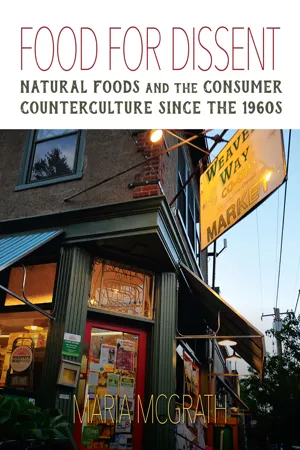
Food for Dissent
Natural Foods and the Consumer Counterculture since the 1960s
- English
- ePUB (mobile friendly)
- Available on iOS & Android
eBook - ePub
About this book
Information
Publisher
University of Massachusetts PressYear
2019Print ISBN
9781625344229
9781625344212
eBook ISBN
9781613766712
Chapter 1
“More Than Just Cheap Cheese”
Community, Class, and Consumerism in Countercultural Food Co-ops
The sixties counterculture, by many accounts, was rife with childlike indolence and hedonism. Sex, drugs, and rock ’n’ roll were its vocation and avocation. While this sweeping characterization minimizes the breadth of hippie ingenuity in the 1960s, it completely falls short when considering countercultural activities in the 1970s. In fact, in the years following the well-publicized events of the 1960s, cultural nonconformists across the country decided that rather than waiting for America to wake up, they would create the markets, services, and societies that matched their dreams for a better world. In their often collective associations, insurgent doctors, lawyers, and concerned citizens funneled their skills into the pursuit of “right livelihood.”1
Because of their open indulgence in nudity and drugs, of all collective experiments, rural communes received the most national notice in the 1960s and 1970s. But countercultural collectivity took many more sober forms. Radical feminists, such as the Bloodroot Collective discussed in chapter 2, would never self-describe as hippies, but they adopted communalism in their vegetarian restaurant and bookstore in Bridgeport, Connecticut, as did the coffeehouses, bars, record companies, magazines, and other lesbian spaces constructed in the 1970s and 1980s.2 Nonprofit operations, such as free clinics, free schools, and free legal services, formed collectively to counteract the bureaucratic impersonality of mainstream institutions. As Anthony P. Sager explained in his 1979 profile of Boston legal collectives, radical legal organizations identified as “communes” or “collectives” to indicate their “difference from establishment law firms” and to communicate membership in a “nationwide movement for social change.”3 Food co-ops played prominently in this era’s institutional experimentalism, growing from approximately five thousand to ten thousand between 1969 and 1979.4
Laura Wilson’s route to food co-op membership typifies the seventies food collectivist’s course. A “Swarthmore-educated” civil rights and antiwar activist, Students for a Democratic Society (SDS) community organizer, and radical teacher, in the early 1970s Wilson and her husband “gave up city life and politics” to move to a group-owned farm in Vermont. That arrangement quickly collapsed, but Laura continued her communal quest, eventually helping rehabilitate an ailing local co-op.5 Brimming with utopian zeal, “New Wave” co-ops, like the one Wilson joined, believed that their original business structure, their healthful natural merchandise, and their commitment to community uplift offered a persuasive substitution to the profit-driven, suburban supermarket.
For food co-op founders, America’s postwar supermarkets represented the unpleasant result of the nation’s economic nationalization and corporate consolidation. Although chain grocery stores had made inroads in the 1920s and 1930s, overtaking many independent shops, Depression-era Americans still bought most of their food in small corner stores from a trusted local grocer, butcher, or baker.6 In the 1950s, this all changed, with supermarket sales increasing from 35 percent of total U.S. food retail to 70 percent. By 1956, the corner grocer was, according to Harvey Levenstein, “a relic of the past.”7
Built in the rambling openness of the new suburbs, supermarkets had distinct advantages over the retailers that they eventually drove out of business. With generous square footage, they could warehouse goods they bought in bulk, cutting consumer cost by 8–15 percent below the neighborhood food store. Abundant shelf space allowed supermarkets to take risks with the unprecedented variety of new processed foodstuff, making them a major purveyor of factory-made goods and marketing. By 1960, the average supermarket carried 5,600 different products.8
Supermarkets embodied modern convenience, offering one-stop shopping for meat, produce, dry goods, and nonfood products. Their large parking lots, necessary in the automobile-dependent suburbs, accommodated the river of families flowing out of America’s cities in the 1950s. Supermarkets’ wide aisles, shopping carts, bright fluorescent lighting, and self-service setup cut out the middleman, making food shopping a “one-on-one [interaction] . . . between the processor and the housewife.”9
In the Cold War context, supermarkets were spun as proof positive of the greatness of democracy and the United States. In the legendary “kitchen table” debates between Vice President Nixon and Soviet Premier Nikita Khrushchev, Nixon preened over the supermarket cornucopia at American homemakers’ fingertips.10 For its critics, on the other hand, the supermarket signified consumer capitalism’s unchecked excesses and civic irresponsibility. Disturbed that a necessity of life had been captured by a system that always put profit over people, nature, and quality, ambitious progressives established food collectives as a socially forward and healthful outlet from the industrial-food Goliath. Like natural foods cookbooks and other components of the nascent natural foods movement, seventies food co-ops were instrumental in spreading a critical nutritional mindset and creating alternatives to mainstream eating and shopping.
The New Wave Mission(s)
New Wave co-ops (as opposed to Old Wave, Depression-era co-ops) shared a similar look and structure. Their bare-bones operations and dingy aisles, infested with fruit flies and pantry moths, announced aesthetic dissent from corporate grocery chain glitz. The member-ownership structure and obedience to the Rochdale Principles of cooperative business demonstrated their departure from conventional business arrangements. Beyond these common attributes, countercultural co-ops and cooperators accommodated many different progressive and practical aspirations.
The People’s Food Co-op (PFC) in Ann Arbor marshaled University of Michigan graduates’ and students’ collective energy to “supply itself with an economical source of natural and organic foods.” In the early 1970s, these specialized commodities were almost impossible to find in this midwestern college town.11 Co-op member Allan Sirotkin recollected his first encounter with the PFC on “a typical frigid Michigan day in January 1971.” Sirotkin, on a search for brown rice, “stumbled upon a small food stand” selling the elusive rice as well as bags of grain, seeds, and natural peanut butter. From that point forward, he was a devoted and active PFC member.12
In its 1968 statement of purpose, the Mifflin Street Community Co-op, in a student neighborhood in Madison, Wisconsin, envisioned a sweeping social aim of “embody[ing] a belief in community self-determination in opposition to the dominant trends in all communities in which control is increasingly concentrated outside the community and operated for profits which are not used for the betterment of the community.” In the words of one of the early founders, Bill Winfield, Mifflin Co-op was to be, first, a “community center and political hub” and, second, a “corner store.”13
On the East Coast in 1973, residents of Mount Airy, a middle-class, leftist, family neighborhood in Philadelphia created Weavers Way Co-op—named after a nineteenth-century food cooperative of British flannel weavers. Pragmatic from the start, Weavers stated charge was to increase “purchasing savings for a wide spectrum of members through cooperative buying.” At an early 1970s co-op meeting, founder Jules Timerman expressed what he believed to be the ideological underpinnings of Weavers’ simple mission statement: “An individual who works alone in our economy often experiences difficulty in obtaining a fair exchange for his or her efforts for the necessity of life.” Instead, Timerman proposed, “real security comes from being part of a community.”14 In those early years, Timerman put endless hours and muscle into the formation of an enterprise that nurtured community affiliation and served his neighbors’ needs.
Weavers Way distinguished itself from its cooperative brothers and sisters in its modest mission statement. The Mount Airy residents who built Weavers were not college students activated by New Left–counterculture currents. As slightly older leftists, they drew from the political well of the labor movement, New Deal liberalism, and civil rights activism. At the same time, as citizens committed to America’s betterment, they quickly came under the influence of the sixties “movement” spirit. Their co-op acted as a magnet to younger Philadelphians, who brought with them the high expectations and political absolutism typical in other New Wave co-ops. Weavers’ very existence attests to collectivity’s widespread allure in the 1970s and also to the influence of countercultural concepts and institutions on Americans of all generations and types.
In the 1970s, two overarching and competing objectives began to vie for prominence in the New Wave cooperative movement. The first vision, shaped by New Left community organization practices, imagined co-ops as grassroots conduits of social justice delivering cheap food to America’s needy, particularly minorities. Co-op members subscribing to this vision saw their establishments as revolutionary exemplars—directly rectifying economic inequities in black and brown city neighborhoods, while presenting an antiprofit retail challenge to the status quo economy. This faction’s motto was “Food for People, Not for Profit.”
Cooperators following this calling generally did not impose natural foods rules on their customers, although some did. In 1979 in Frederick, Maryland, Common Market Coop’s business coordinator explained his store’s uneasy reconciliation of some member’s health food desires with the preferences of working-class shoppers: “Unhealthy products . . . must be carried both as a service to the neighborhood and to keep the coop alive economically.”15 Inexpensive, accessible goods were the Common Market’s bottom line. Bill Coughlin, chair of Boston’s Food Co-op, directly expressed his food justice commitments in an early seventies debate over whether only healthy foods should sit on his co-op’s shelves. “Don’t give me any of this purist shit,” he scolded. “Feed the people.”16
The second vision, informed by countercultural and environmental longings, imagined co-ops as centers for cultural interconnection and ecologically conscientious merchandise. Shoppers and producers derived moral sustenance and tangible belonging in co-op interactions and in the natural foods community at large. According to this model, the business upstart would undermine the corporate Goliath, pushing conventional agriculture and food processing to meet consumer want. Organic technique would replace America’s chemical farming. Whole foods production would overtake processed production. And a decentralized, local economic system, fostering consumer-producer intimacy and control, would replace multinational corporate alienation. It would be a market revolution sparking social transformation.
Over time, the co-op and natural foods movements leaned more determinedly toward a principled consumer-producer network over socioeconomic intervention. This is not to say natural foods sponsors and co-op entrepreneurs forgot their obligation to the needy. But increasingly, as nutritional dogmatism and environmentalism became a foremost middle- and upper-class concern, natural foods participants’ community involvement centered on solidifying local and healthful food consumption systems. Somehow—never altogether explained or practically theorized—these righteous systems would serve the less well-off. But just “feeding the people,” if that meant satisfying their junk food habits, could not stand.
Critical commentators have argued that their interpretation of shopping and fellowship as activism signaled the retirement of the post-sixties Left into hip consumerism and lifestyle narcissism.17 But rather than a retreat, the sixties movement and the seventies counterculture totalized the political. As a Minneapolis co-op member stated in 1974, “Everything is political—what you eat, what you wear, who you sleep with . . . Limiting the word ‘politics’ to elector politics or to protest politics leaves out consumer politics and lifestyle/sexual/cultural politics which seem to be ultimately at least as crucial as the exercise of power as electoral or protest activity.”18 This wouldn’t simply be one-issue consumer boycotting; it would be consumption as persuasion, consumption as ethics, consumption as community.
From Old Wave to New: Defining the Postwar Cooperative
In general, all seventies co-ops classified themselves and their movement as dissimilar not only to supermarket America but also to Old Wave co-ops that came out of the New Deal 1930s. William Ronco explored the essential dissimilarities between New and Old Wave co-ops in his 1974 user’s guide and propagandist monograph, Food Co-ops: An Alternative to Shopping in Supermarkets. According to Ronco, Old Wave co-ops—many of which were still around in the 1970s for New Wavers’ examination—acted and looked like supermarkets. New Wave co-ops, he argued, could easily be distinguished from both supermarkets and the Old Wave. Self-financed, the New Wave rejected federal “start-up” funds on which Old Wave co-ops depended. Housed in unconventional buildings, modestly sized, with loose bookkeeping methods, “the tone of business [was] friendlier, warmer, looser,” according to Ronco.19 Most important, seventies cooperators believed that their stores provided sanctuary for unorthodox and revolutionary folks. As a member of Fields of Plenty in Washington, D.C., explained in the late 1970s, “Selling food isn’t our goal. It’s just a pretext for building living and breathing models of revolutionary change.”20 Not all seventies co-ops agreed with this sweeping proposition. Yet they would concede that co-ops “were not just about selling cheap cheese,” as longtime Weavers Way member Vince Pieri was known to say about his co-op.21 Despite the New Wave’s anticapitalist and radical self-perception, the history of one of the largest Old Wave cooperatives, the Consumers Cooperative of Berkeley (CCB), suggests that from the 1930s onward, consumerism tied one wave to the other.
Rochdale to Berkeley: American Cooperation
Until the twentieth century, America’s cooperative enterprises developed through two influential nineteenth-century associations—labor unions and agrarian clubs. The strategy of workers’ collectivity began in England and spread throughout Europe in the early nineteenth century as class defense against industrial de-skilling and company store price gouging. A group of striking flannel weavers in Rochdale who pooled their waning resources to set up a cooperative grocery store in 1844 became the most famous developers of Great Britain’s worker collectivity. Their co-op lasted sixty years and their alliance, the Equitable Pioneers of Rochdale, England, established what came to be known as the Rochdale Principles. The Rochdale Principles—democratic control, open and voluntary membership, limited interest on shares, return of surplus to members—became the cooperative movement’s foundation on both sides of the Atlantic.22
Through two waves of nineteenth-century emigration, European migrants introduced the Rochdale system into American culture and politics via urban labor unions and New England and Midwest agrarian collectives such as the Grange (in the 1860s and 1870s) and the Farmers Alliance (in the 1880s and 1890s). Although cooperatives always held a more prominent place in Europe than in the United States, American collective institutions surged in the nineteenth century. By the end of the century, a mix of structural transformations—challenges to working-class cohesion, the rise of the credit system, and consumer protection regulations—und...
Table of contents
- Cover
- Title Page
- Copyright Page
- Dedication
- Contents
- Preface
- Acknowledgments
- Introduction
- Chapter 1
- Chapter 2
- Chapter 3
- Chapter 4
- Chapter 5
- Conclusion
- Notes
- Index
Trusted by 375,005 students
Access to over 1.5 million titles for a fair monthly price.
Study more efficiently using our study tools.
Frequently asked questions
Yes, you can cancel anytime from the Subscription tab in your account settings on the Perlego website. Your subscription will stay active until the end of your current billing period. Learn how to cancel your subscription
No, books cannot be downloaded as external files, such as PDFs, for use outside of Perlego. However, you can download books within the Perlego app for offline reading on mobile or tablet. Learn how to download books offline
Perlego offers two plans: Essential and Complete
- Essential is ideal for learners and professionals who enjoy exploring a wide range of subjects. Access the Essential Library with 800,000+ trusted titles and best-sellers across business, personal growth, and the humanities. Includes unlimited reading time and Standard Read Aloud voice.
- Complete: Perfect for advanced learners and researchers needing full, unrestricted access. Unlock 1.5M+ books across hundreds of subjects, including academic and specialized titles. The Complete Plan also includes advanced features like Premium Read Aloud and Research Assistant.
We are an online textbook subscription service, where you can get access to an entire online library for less than the price of a single book per month. With over 1.5 million books across 990+ topics, we’ve got you covered! Learn about our mission
Look out for the read-aloud symbol on your next book to see if you can listen to it. The read-aloud tool reads text aloud for you, highlighting the text as it is being read. You can pause it, speed it up and slow it down. Learn more about Read Aloud
Yes! You can use the Perlego app on both iOS and Android devices to read anytime, anywhere — even offline. Perfect for commutes or when you’re on the go.
Please note we cannot support devices running on iOS 13 and Android 7 or earlier. Learn more about using the app
Please note we cannot support devices running on iOS 13 and Android 7 or earlier. Learn more about using the app
Yes, you can access Food for Dissent by Maria McGrath in PDF and/or ePUB format, as well as other popular books in History & North American History. We have over 1.5 million books available in our catalogue for you to explore.