If you take Boston's Blue Line to its northern end, you'll reach the Wonderland stop. Few realize that a twenty-three-acre amusement park once sat nearby—the largest in New England, and grander than any of the Coney Island parks that inspired it. Opened in Revere on Memorial Day in 1906 to great fanfare, Wonderland offered hundreds of thousands of visitors recreation by the sea, just a short distance from downtown Boston.
The story of the park's creation and wild, but brief, success is full of larger-than-life characters who hoped to thrill attendees and rake in profits. Stephen R. Wilk describes the planning and history of the park, which featured early roller coasters, a scenic railway, a central lagoon in which a Shoot-the-Chutes boat plunged, an aerial swing, a funhouse, and more. Performances ran throughout the day, including a daring Fires and Flames show; a Wild West show; a children's theater; and numerous circus acts. While nothing remains of what was once called "Boston's Regal Home of Pleasure" and the park would close in 1910, this book resurrects Wonderland by transporting readers through its magical gates.
eBook - ePub
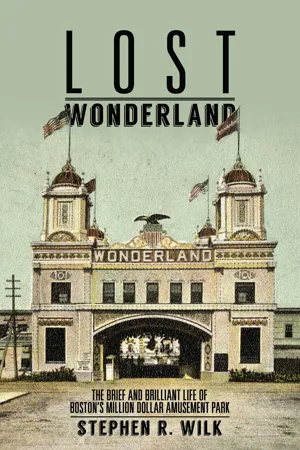
Lost Wonderland
The Brief and Brilliant Life of Boston's Million Dollar Amusement Park
- English
- ePUB (mobile friendly)
- Available on iOS & Android
eBook - ePub
Lost Wonderland
The Brief and Brilliant Life of Boston's Million Dollar Amusement Park
About this book
Information
Topic
HistoriaSubtopic
Historia de NorteaméricaChapter 1
Opening Day and Background
It was the anticipated event of the summer of 1906. The newspapers had run advertisements promising the appeal and attraction of a new and huge amusement park near Crescent Beach in Revere, Massachusetts, for months. There were rides and attractions aplenty along Revere Beach, but there was nothing on the area known as the North Shore of Massachusetts to match this—an enclosed park filled with rides and attractions, all in one place. White City Park outside Worcester and Paragon Park in Hull had opened the previous year in the commonwealth, but Wonderland boasted more attractions, and it was much closer to downtown Boston.
On May 31, 1906, Memorial Day, the crowds gathered in anticipation at the main entrance on Walnut Avenue in Revere, facing south. The entrance building had four towers—two on the outside, two on the inside—each bearing a flagpole. There were two staffs at the front; one bore a U.S. flag, the other had the word “Wonderland” embroidered on it. Above the main entry was written WONDERLAND in white block letters, surmounted by an American shield with an eagle atop, wings spread majestically. It looked like the entrance to a castle, a resemblance heightened by the bridge that crossed the Boston & Maine (B&M) Railroad, as if it were the drawbridge over a castle moat, before you reached the gate.
The official opening was scheduled for noon, but the crowds had come earlier and were larger than anticipated. They could see not only the main entrance but also, to the left, a half-timbered building, like something out of Shakespeare, except that it had the non-Elizabethan words INFANT INCUBATORS in large white letters on its roof. To the right of the entrance, a metal framework tower protruded, as did four pink minaret towers in a row. The newspaper stories leading up to this day had given brief descriptions of the attractions within, but it wasn’t clear which ones these fragmentary sights were associated with.
Seeing how large the crowd was, the management opened the gates early, and the people surged in. Inside, they found a boardwalk, freshly watered. Directly ahead was a huge artificial lagoon, its long east-west axis perpendicular to the entranceway, placed in the center of the boardwalk. To the left was a ramp sloping down from a tower, the launching point for the Shoot the Chutes ride that ended in the lagoon. Surrounding the lagoon on each side were canals that joined on the side opposite the ramp. In the canals were Venetian gondolas and a Mississippi River–style steamboat. Bridges allowed visitors to cross the canals, and another long bridge straddled the lagoon just at the end of the chute, so visitors could stand there and watch the boats plummet down the ramp into the lagoon and skip across it like a stone thrown into a pond. Lines strung across the lagoon from the towers of the Administration Building to towers on buildings on the other side were filled with gaily colored flags and pennants, flapping in the breeze. A series of concession booths was located underneath the tower of the Shoot the Chutes, and to one side was the Flying Horses carousel.
From all around came the shouts of the barkers, directed through large megaphones, touting the glories of each attraction: “Princess Fatima here, a full-blooded princess from the storied city of Nineveh, will dance the mystic anaconda dance, exactly as danced by Hypatia in Holy Write.” “Don’t miss the Fatal Wedding! Sixty laughs to the minute!” “Foolish House—cra-a-a-azy house—only a dime, ten cents, the tenth part of a dollar!” “The Foolish House, the Crazy House, the Daffy House, the Third Degree.”1
On the other side of the lagoon was a large octagonal building with the ominous sign HELL GATE written on it in red letters. The top was crenelated like a fortress, and a broad set of stairs led up to the arched entrance. To the right of this was the ballroom and restaurant together in an elegant porticoed building. Beside that was an odd building with four minarets thrusting to the sky, each slightly different, but all of them colored with alternating pink and white horizontal bands. Between the two center minarets was a keystone-like detail, flanked by two blue “onion” domes. Lettering on the front read BEAUTIFUL ORIENT and ORIENTAL EXHIBITS and TURKISH THEATER and A CONGRESS OF STRANGE ORIENTAL PEOPLE. Written above the central portal was BAZAAR.
To the right of this was the LaMarcus A. Thompson Scenic Railway. The Thompson Scenic Railway was one of the most popular rides in America, and examples of it abounded around the country. There was, in fact, already a “Scenic Railway” nearby on Revere Beach, manufactured by a Johnny-come-lately competitor. But this one was a genuine LaMarcus A. Thompson Scenic Railway, and it promised a much longer track. The elevated, undulating surface could be seen progressing behind the Beautiful Orient, the ballroom and restaurant, and the Hell Gate off into the northwest corner of the park, where it entered another building, then returned.
Turning to the right from the main entrance, one passed a nursery for small children, a penny arcade, then the Children’s Theater. Beyond that was a three-peaked building with the perplexing title THE FATAL WEDDING. Next to this was a building with a peaked top containing Hale’s Tours. On the opposite side, between this and the railway was a round building housing Love’s Journey.
Proceeding along, one reached the Japanese Village, complete with a sixty-foot-tall scale model of Mount Fuji, covered with “snow.” Entrance to the village was through a traditional Japanese Shinto gate, a torii, which had ADMISSION FREE written across the crossbar in a very non-Japanese way. A steep-sided Moon Bridge—“The Royal Arch”—spanned the stream through the village.
Next was a building adorned with a huge human hand, the palmist’s building, which also had an astrologer. This was followed by a building decorated with a huge relief carving of a ridiculous, bulbous-headed, goggle-eyed figure in a top hat. The souvenir program and the newspaper stories called this the “House of Momus” or the “House of Mirth” or, later, “The Third Degree,” but the building actually originally bore the title “The Foolish House.” It was the funhouse of Wonderland.
Opposite the Foolish House was that tall, pyramidal framework tower that could be seen from outside the park. It has a set of six arms that projected at an upward angle set equidistant around the perimeter near the top, from which cables descended, holding gondolas for passengers. After people got in, the top would rotate, sending the cars going in a circle that rose higher the faster it went. This was the Circle Swing.
Beyond the Foolish House was the tent housing Princess Trixie the Educated Horse, its entranceway in the shape of a horseshoe. Princess Trixie was famous in her day, and everyone know about this educated animal that could count and add and knew her letters. She had performed before the royal family in London, and now she was here at Revere Beach. Next to Princess Trixie’s tent was a booth and photographer’s studio, where you could have your visit memorialized.
Beyond was Ferari’s Wild Animal Show in its own huge tent. Ferari’s was famous from international exhibitions for its collection of wild cats and hybrids. Past Ferari’s was another park entrance, which came in directly from Revere Beach along Beaver Street and over the B&M tracks on its own bridge. A ticket booth lay between Ferari’s and the entrance.
Opposite that entrance was one of Wonderland’s biggest and most extravagant attractions, Fighting the Flames. From the boardwalk, you could see an exterior filled with game and concession booths that gave little of the interior away, but beyond that facade was a reconstructed city block and a grandstand to hold an audience of two thousand to watch the show. Nevertheless, the show was swamped on opening day, unable to accommodate everyone who wished to see it.
Between the Fighting the Flames grandstand and the Thompson Scenic Railway was a shooting gallery. Between the scenic railway and the lagoon was the Arcus Ring, a circus-style ring home to spectacular free performances throughout the day. Across the park, barkers extolled the glories of the attractions within in stentorian voices.
In the southeast corner were the Indian Congress and Wild West show and the vertical tower of the Whirl the Whirl ride. Throughout the day there were parades featuring a marching band, which also played in a band pavilion near the lagoon.2
At night, the park was illuminated by over 150,000 electric lights that edged the major buildings and both the main gate and the Beaver Street beach entrances.3 The bridges were lit up, and bright lights illuminated the minarets of the Beautiful Orient and the U.S. shield on the main gate, while searchlights pierced the sky and drew attention to the park.
Over 100,000 people attended that first day and were ready to return again to explore parts they had not had the opportunity to see, and to revisit their favorite parts.4 Over the course of the summer, over 2 million people visited the park. Wonderland was off to a promising start.
* * *
Revere Beach is a relatively placid stretch of sandy beach next to Broad Sound, within a couple of miles of Boston. Embraced by the peninsulas of Winthrop and Nahant, Broad Sound has little surf unless storms are present. The combination of shallow water and relative stillness were a great draw when urban workers began retreating to the beaches in hot summers, both for the ocean breezes and for the opportunity for a quick dip in the water. The ease of access provided by the railroads and ferries combined to make this site a natural one for recreation and one where modern beach culture was born. It calls itself America’s First Public Beach.
Like many beaches along the Atlantic Coast, Revere Beach is located on a barrier island with an inland waterway behind it. In the case of Revere Beach, however, the area behind is not open water but a salty wetland called Rumney Marsh. A glacial drumlin extends out to Roughans Point, just below Crescent Beach, and at one time terminated in Cherry Orchard Island, named after the fruit trees that grew there in colonial days. The island disappeared gradually throughout the nineteenth century and now only a shallow sandbar remains. Two piers were built on this bar at different times in the past, and today it supports a jetty. Sand swept away from the island was redeposited northward along the beach, all the way up to the rhombohedral spit of Point of Pines at the northern end, at the mouth of the Saugus River. There, as the name implies, a pine forest once existed, anchoring the sand. Revere Beach is thus bracketed by geographical features named after the predominant plant life. Nearby is another—a short distance south of Point of Pines is the region called Oak Island, a name that seems odd, as there is no break in the gently curving beach and no sign of any island in Broad Sound. But the island was in the other direction—inward into the marsh, where it distinguished itself as a solid patch of ground with its own ecology and species, until creeping urbanism led to landfill solidifying the surrounding marshland.5 Now Oak Island exists only as a street name. All three of these plant spots served, at one time or another, as retreats and amusement areas. It is only because of changing styles, some minor disasters, and quirks in human history that none of them today sports an amusement park.
The area, along with much of the surrounding land, was occupied in precolonial days by the Rumney Marsh Pawtucket Indians, who hunted and fished here. When the English began to colonize, present-day Revere Beach was largely unoccupied. Cut off by rivers and the marshes, it was difficult to access except by sea. The nearby Saugus River held the first long-term ironworks in the Americas, but it didn’t turn a sufficient profit and closed after about a quarter of a century, only operating from 1646 to about 1670. Despite its proximity to the city of Boston, the area, lacking easy access to the city, was given over to farming and harvesting of saltgrass. It constituted the northern part of the community of Winnisemmet, later called Chelsea. In the nineteenth century, the peninsula of Pullyn Point separated from North Chelsea to become the town of Winthrop, and the Rumney Marsh area of North Chelsea declared itself a distinct town as well.
While today widely recognized, Paul Revere, the silversmith and patriot, was neither highly regarded nor particularly well known outside his political and business circles in the decades after his death. His resurrection to a place among the patriots of the American Revolution began with Henry Wadsworth Longfellow’s 1861 poem “Paul Revere’s Ride,” which later formed a section of Longfellow’s larger Tales of a Wayside Inn. Longfellow saw this work as part of his cycle of American legends, and he knew of the historical inaccuracies in the poem, which he nonetheless hoped would foster patriotic sentiments at the start of the Civil War. Ten years after the poem’s publication, Rumney Marsh adopted Revere as the name for the new town, even though Paul Revere had neither set foot in it nor had anything to do with it.
The end of the nineteenth century saw much improved access to the area, both from the mainland and by sea. A large pier extending out from near where Cherry Island had existed was erected in 1881. It was 1,700 feet long and originally named the Broad Sound Pier. It came to be called the Great Ocean Pier and was intended as a resort with its own restaurant and attractions, as well as to provide an easy way to Revere. It lasted until 1893, when it was dismantled.
Around the same time, a complex series of railways and trolleys began to snake up from Boston through the North Shore, changing hands and ownerships in a dizzying array. The first line was laid out by the Boston, Revere Beach, and Lynn Railroad in 1875. It connected in Chelsea to a ferry that came across from Boston, and it opened the beach area for the first time to easy access from Boston. Because of the three-foot spacing between tracks, the line became better known throughout its life as the “Narrow Gauge.” Another railroad, the Eastern Junction, Broad Sound Pier, and Point Shirley Railroad, opened in 1882; it was run by the Boston, Winthrop and Shore Railroad in 1884 and 1885, at which point operation of the line by that company ceased. The tracks and right of way were purchased by the B&M Railroad to extend the Chelsea line southward. Another track that separated from that line and curved eastward toward the shore, running between the B&M and the Narrow Gauge was acquired from the Boston Winthrop and Shore by the Chelsea Beach Railroad, who ran it until 1897. It was acquired by the B&M, who used it mainly to store unused rolling stock. The effect of this curl of track was to isolate a section of Revere from direct access and development.6
The trains opened the area to people and commerce. The Point of Pines became the resort of choice, at the end of the Narrow Gauge (until a bridge was built across the Saugus River taking the line into Lynn). A huge hotel and restaurant went up there, catering to city dwellers as a getaway, catching the sea breezes, and offering a respite from city life. A few amusements and attractions went in as well, eventually extending down as far south as Oak Island. But Revere Beach developed a reputation for rowdiness, and both sides of the Narrow Gauge’s track along the spine of the barrier island were lined with cheap shanties.
That all changed in 1896, when Charles Eliot, one of the proteges of famed park designer Frederick Law Olmsted, proposed making Revere Beach into a park. The city of Revere agreed to his plans, and as a result the Narrow Gauge was moved downhill and away from the highest point. Its place was taken by a broad boulevard with pavilions where people could sit and look out onto the beach. The shanties and houses along the beach were pulled down to provide an unbroken vista of Broad Sound. A traffic circle near where the Great Ocean Pier had been was named Eliot Circle.
The great hope was probably that this new park would provide a getaway for people of even modest means, where they could escape the hustle and bustle and heat of the city and perambulate in the serenity and tranquility of the beach, lulled by the rhythm of the small breaking waves. The fear was that Revere Beach rowdyism, drunkenness, and gambling would come to the fore and spoil this paradise. The reality was somewhere between these extremes. Eliot’s parkland did not long remain a park. Although nothing could be built on the beach side of the boulevard, things could be built on the other side. In spite of the steep falloff to the west of the boulevard, buildings were constructed with upper stories level with the boulevard containing restaurants and attractions to tempt the wanderer in. Revere Beach began to acquire its honky-tonk atmosphere by the first years of the twentieth century.
* * *
Arguably, the amusement park craze all started with an enthusiastic, self-promoting Renaissance man named Paul Boyton. There are others who could stake a claim to the idea and practice of the modern amusement park, but Boyton has a better title than most. He was born on June 29, 1848, in the town of Rathangan in County Kildaire, Ireland, but his parents soon m...
Table of contents
- Cover
- Title Page
- Copyright Page
- Dedication
- Contents
- Preface
- Acknowledgments
- Chapter 1
- Chapter 2
- Chapter 3
- Chapter 4
- Chapter 5
- Chapter 6
- Chapter 7
- Chapter 8
- Chapter 9
- Chapter 10
- Notes
- Selected Bibliography
- Index
Trusted by 375,005 students
Access to over 1.5 million titles for a fair monthly price.
Study more efficiently using our study tools.
Frequently asked questions
Yes, you can cancel anytime from the Subscription tab in your account settings on the Perlego website. Your subscription will stay active until the end of your current billing period. Learn how to cancel your subscription
No, books cannot be downloaded as external files, such as PDFs, for use outside of Perlego. However, you can download books within the Perlego app for offline reading on mobile or tablet. Learn how to download books offline
Perlego offers two plans: Essential and Complete
- Essential is ideal for learners and professionals who enjoy exploring a wide range of subjects. Access the Essential Library with 800,000+ trusted titles and best-sellers across business, personal growth, and the humanities. Includes unlimited reading time and Standard Read Aloud voice.
- Complete: Perfect for advanced learners and researchers needing full, unrestricted access. Unlock 1.5M+ books across hundreds of subjects, including academic and specialized titles. The Complete Plan also includes advanced features like Premium Read Aloud and Research Assistant.
We are an online textbook subscription service, where you can get access to an entire online library for less than the price of a single book per month. With over 1.5 million books across 990+ topics, we’ve got you covered! Learn about our mission
Look out for the read-aloud symbol on your next book to see if you can listen to it. The read-aloud tool reads text aloud for you, highlighting the text as it is being read. You can pause it, speed it up and slow it down. Learn more about Read Aloud
Yes! You can use the Perlego app on both iOS and Android devices to read anytime, anywhere — even offline. Perfect for commutes or when you’re on the go.
Please note we cannot support devices running on iOS 13 and Android 7 or earlier. Learn more about using the app
Please note we cannot support devices running on iOS 13 and Android 7 or earlier. Learn more about using the app
Yes, you can access Lost Wonderland by Stephen R. Wilk in PDF and/or ePUB format, as well as other popular books in Historia & Historia de Norteamérica. We have over 1.5 million books available in our catalogue for you to explore.