Playwright, biographer, screenwriter, and critic S. N. Behrman (1893–1973) characterized the years he spent writing for The New Yorker as a time defined by "feverish contact with great theatre stars, rich people and social people at posh hotels, at parties, in mansions and great estates." While he hobnobbed with the likes of Mary McCarthy, Elia Kazan, and Greta Garbo and was one of Broadway's leading luminaries, Behrman would later admit that the friendships he built with the magazine's legendary editors Harold Ross, William Shawn, and Katharine S. White were the "one unalloyed felicity" of his life.
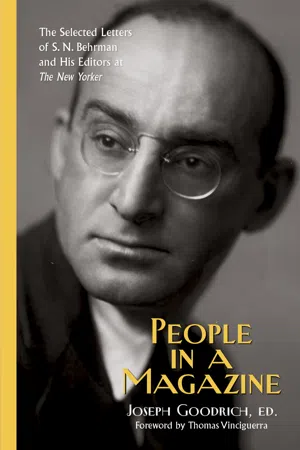
People in a Magazine collects Behrman's correspondence with his editors along with telegrams, interoffice memos, and editorial notes drawn from the magazine's archives—offering an unparalleled view of mid-twentieth-century literary life and the formative years of The New Yorker, from the time of Behrman's first contributions to the magazine in 1929 until his death.
eBook - ePub
People in a Magazine
The Selected Letters of S. N. Behrman and His Editors at "The New Yorker"
- English
- ePUB (mobile friendly)
- Available on iOS & Android
eBook - ePub
People in a Magazine
The Selected Letters of S. N. Behrman and His Editors at "The New Yorker"
About this book
Information
Chapter 1
Life in Profile
1929–1943
When I got out of college, I tried for years to make my living as a prose writer. I contributed to various magazines—especially to The Smart Set, edited by H. L. Mencken and George Jean Nathan. But there was no living in it. One day, in a moment of despair, I dramatized a short story of mine that had appeared in The Smart Set. The play opened and was a success.
—S. N. Behrman, “Harold Ross: A Recollection”
After a lengthy apprenticeship as a litterateur, Behrman achieved Broadway success in April 1927 with The Second Man, though the journey from script to production was longer and more difficult than the description in the epigraph suggests. There were dreary passages of waiting and disappointment. The Theatre Guild passed on the play, then optioned it, then let the option lapse, and then optioned it again, thanks to Behrman’s agent, the indefatigable Harold Freedman.
The Second Man concerned a mediocre (if charming) writer forced to choose between his desire for comfort and his heart. The play marked the beginning of Behrman’s friendship with Alfred Lunt and Lynne Fontanne, who would appear in four more of his plays. Inveterate tinkerers with scripts, forever rehearsing, blithely self-obsessed, the Lunts were exasperating but worth putting up with; their appearance in a play guaranteed a Broadway run and a lengthy tour. The travails of working with the Lunts figure in several of Behrman’s letters from the 1940s.
The Second Man lifted Behrman out of penury, rescuing him from economic dependence on his brothers Morris and Hiram, accountants with a thriving business in Manhattan. It also freed him from his job as a publicist for the saturnine and malevolent producer Jed Harris. Loved by some, hated by many, fascinating to all, Harris was a dark comet in the theatrical firmament of the 1920s and 1930s, producing one hit after another. He was also an egomaniacal sadist who delighted in tormenting his underlings. Behrman longed to leave Harris’s employ, and the Theatre Guild’s production of The Second Man made escape possible.
His life changed: “I found myself in a millstream of sociability in New York and London. I was in feverish contact with great theatre stars, rich people and social people at posh hotels, at parties, in mansions and great estates. It was exciting; it was flattering; it was dizzying.”
But it hadn’t changed entirely: “I never shook off the plaintive counterpoint of my origins—the memory of my parents and their poverty. You acquire a new identity and a public label with a hit play. It’s wise to remember that this label is only pasted on. It doesn’t obliterate what you are and have always been, nor does it erase the stigmata of temperament. The privations and fears of Providence Street were never far away.”
The anxious poor boy lived on in the playwright who dressed in “beautifully tailored Sulka suits,” in the words of his stepdaughter, Barbara Gelb—though the suits were often covered with cigarette ash. Gelb believed that Behrman viewed himself “as a faintly Americanized Noel Coward.” The two playwrights knew and admired each other. Coward appeared in the West End production of The Second Man and directed the English premiere of Biography. Both came from nowhere, though Coward’s childhood in the London suburb of Teddington was more shabby-genteel than impoverished. Behrman lacked Coward’s fearsome aplomb and surety in any situation—who doesn’t? Whatever his inner misgivings, it must have been sweet indeed for Behrman to finally be recognized, to move among the writers he’d admired from afar, to have money.
Serena Blandish and Meteor (both produced in 1929) followed The Second Man but were mildly received. Not sure if he’d have another hit in the theater, Behrman took advantage of offers to work in Hollywood. He enjoyed his time in the Dream Factory, which provided him with pleasant, well-paid work and the company of old friends from New York and new ones from the West Coast. He knew the difference between the work he did in Hollywood and the work he did for himself. “The physical limitations of playwriting,” he observed, “the agonizing technical difficulties imposed by the very compactness of the medium, the impossibility of leaving a room, force you to a disciplinary freedom, to concentration and fluency. The great freedom of pictures, the fact that you can go anywhere, is boring and harassing, like a perpetual picnic.” But he also recognized the cinema’s potential: “There is no reason someone shouldn’t come along who might use this extraordinary medium with a Shakespearean fullness.”
The vagaries of the motion picture industry provided him with a number of anecdotes he recounted for the rest of his life. The producer Sol Wurtzel was a source for many of Behrman’s tales of Hollywood:
I had achieved with Sol a kind of badgering intimacy. We seemed to be in a contest in which he tried to discredit me on points of knowledge, as if I were a savant traveling under false pretenses. He made me go with him to outlying towns—Riverside and Fresno—to previews of Fox pictures. You couldn’t really have a conversation with Sol. Remarks erupted from him without preamble or contextual balance; they were islands in a stertorous silence. Once, driving to Riverside, passing a huge clock advertisement—set, as they all were, at three o’clock—he suddenly barked at me, “Do you know why all these clocks are set for three o’clock?” I said I had no idea. I could tell that this confession of ignorance pleased him. “There’s a hell of a lot of things you don’t know—I suppose you know that?” “Yes, I do,” I said. “Why are they set for three o’clock?” “It’s the hour Lincoln died,” he said, and that closed that field of inquiry.
The historical record shows that Lincoln died at 7:22 on the morning of April 15, 1865, but one suspects Sol Wurtzel would have dismissed the facts as a load of East Coast guff.
Behrman’s view of Hollywood was tolerant, amused; his affection for producers such as Wurtzel and MGM’s Irving Thalberg was genuine. The earnest young man who’d once haunted the Worcester Public Library was now adapting works by the Baroness Orczy (The Scarlet Pimpernel), Jack London (The Sea Wolf), Charles Dickens (A Tale of Two Cities) and Leo Tolstoy (Anna Karenina).
Karenina was a vehicle for Greta Garbo, and so was Queen Christina. “I became, in some sort,a Garbo specialist, as I had the reputation of being, in some sort, a Lunt specialist,” Behrman wrote years later. The filming of Queen Christina provided him with one of his favorite Hollywood stories:
It was to be directed by Rouben Mamoulian, who was unhappy with the script he had and wanted it completely redone. He’d already begun filming; the set, the Queen’s palace in Stockholm, was up; the snow had been piled around it. I was to keep a day ahead of shooting. There had been a great to-do about the casting of the leading man. . . . It was decided finally to take a chance on John Gilbert. Miss Garbo had had a romantic attachment to him when she first came to Hollywood. This, from the executives’ point of view, was all to the good. Gilbert was signed up. . . . [But he] would periodically disappear—he drank. This stopped everything. The delays were tremendously costly. In those days Garbo and Salka Viertel, her friend and adviser, used to drop in for a cup of tea in my rented house in Beverly Hills. One day when Garbo couldn’t work because the leading man had not shown up, my guests were in a state. I complained to Garbo: “How could you have ever got mixed up with a fellow like that?” It was a rhetorical question; I expected no answer. Garbo meditated; it was a considered reply, as if she were making an effort to explain it to herself. Very slowly, in her cello voice, she said: “I was lonely—and I couldn’t speak English.”
The 1930s were also Behrman’s most productive years in the theater. The sparkling comedienne Ina Claire was a particular favorite of Behrman’s; she appeared in Biography (1932) and End of Summer (1936), both hits. (Her third—and last—Behrman play was the 1941 failure The Talley Method.) Other plays produced in this decade were Brief Moment (1931), Rain from Heaven (1934), Amphitryon 38 (1937), Wine of Choice (1938), and No Time For Comedy (1939). Behrman loved stars—the Lunts, Katharine Cornell, Laurence Olivier, Ruth Gordon—and wrote well for them.
Though Behrman was a well-known and much-produced dramatist from the late 1920s through the early 1960s, most of his plays linger in theatrical purgatory. Gelb cites a lack of suitable performers as the main reason for the general eclipse of his stage work: “There are no longer theater stars who possess the subtle timing, the lightness of touch required to whisk his sort of gossamer dialogue into a froth.” Other factors have affected the continued life of the plays. The critic and academic Mark Fearnow notes that Behrman’s Depression-era, “thoroughly serious comedies” were part of a culture “especially hungry for an ambivalent, difficult kind of aesthetic experience” and goes on to say that the plays “do not provide the conventional rewards one expects from comedies successful in the American theatre.”
They are relentlessly hard and intellectual; they consistently avoid the kind of sentimental closure that would leave a popular audience feeling that all was right with the world. . . . His plays brought together and set against one another, in the form of character “types,” the dominant intellectual and moral forces of the decade. His serious comedies were dramatic paradigms for the cultural dilemmas of the 1930s.
Behrman’s ability to capture the historical moment, Fearnow claims, consigned his plays to oblivion once that moment had passed. Given that theater is the most time-bound of the arts, one could argue that a succes...
Table of contents
- Cover
- Title Page
- Copyright Page
- Dedication
- Contents
- Foreword
- Acknowledgments
- Introduction
- Main Correspondents at The New Yorker
- Chapter 1. Life in Profile
- Chapter 2. Life Suspended
- Chapter 3. Life at Home and Abroad
- Chapter 4. Life Remembered
- Epilogue
- Dramatis Personae: The People in People in a Magazine
- Notes
- Index
Trusted by 375,005 students
Access to over 1.5 million titles for a fair monthly price.
Study more efficiently using our study tools.
Frequently asked questions
Yes, you can cancel anytime from the Subscription tab in your account settings on the Perlego website. Your subscription will stay active until the end of your current billing period. Learn how to cancel your subscription
No, books cannot be downloaded as external files, such as PDFs, for use outside of Perlego. However, you can download books within the Perlego app for offline reading on mobile or tablet. Learn how to download books offline
Perlego offers two plans: Essential and Complete
- Essential is ideal for learners and professionals who enjoy exploring a wide range of subjects. Access the Essential Library with 800,000+ trusted titles and best-sellers across business, personal growth, and the humanities. Includes unlimited reading time and Standard Read Aloud voice.
- Complete: Perfect for advanced learners and researchers needing full, unrestricted access. Unlock 1.5M+ books across hundreds of subjects, including academic and specialized titles. The Complete Plan also includes advanced features like Premium Read Aloud and Research Assistant.
We are an online textbook subscription service, where you can get access to an entire online library for less than the price of a single book per month. With over 1.5 million books across 990+ topics, we’ve got you covered! Learn about our mission
Look out for the read-aloud symbol on your next book to see if you can listen to it. The read-aloud tool reads text aloud for you, highlighting the text as it is being read. You can pause it, speed it up and slow it down. Learn more about Read Aloud
Yes! You can use the Perlego app on both iOS and Android devices to read anytime, anywhere — even offline. Perfect for commutes or when you’re on the go.
Please note we cannot support devices running on iOS 13 and Android 7 or earlier. Learn more about using the app
Please note we cannot support devices running on iOS 13 and Android 7 or earlier. Learn more about using the app
Yes, you can access People in a Magazine by Joseph Goodrich in PDF and/or ePUB format, as well as other popular books in Literature & Literary Collections. We have over 1.5 million books available in our catalogue for you to explore.