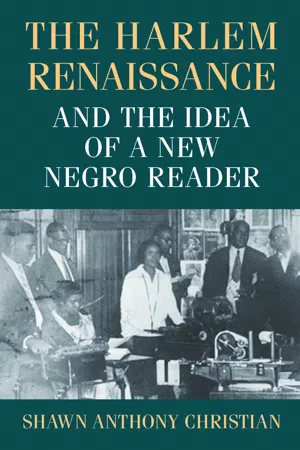
Many scholars have written about the white readers and patrons of the Harlem Renaissance, but during the period many black writers, publishers, and editors worked to foster a cadre of African American readers, or in the poet Sterling Brown's words, a "reading folk." Black newspapers featured columns that reviewed the latest African American fiction. Magazines held writing contests to urge black readers to participate in the literary culture. Through newspapers, journals, and anthologies, writers such as James Weldon Johnson, Jessie Fauset, and Gwendolyn Bennett spoke directly to their fellow African Americans to cultivate interest in literature and the intellectual tools for reading it.
In The Harlem Renaissance and the Idea of a New Negro Reader, Shawn Anthony Christian argues that print-based addresses to African Americans are a defining but understudied component of the Harlem Renaissance. Especially between 1919 and 1930, these writers promoted diverse racial representation as a characteristic of "good literature" both to exhibit black literacy and to foster black readership. Drawing on research from print culture studies, histories of racial uplift, and studies of modernism, Christian demonstrates the importance of this focus on the African American reader in influential periodicals such as The Crisis and celebrated anthologies such as The New Negro. Christian illustrates that the drive to develop and support black readers was central in the poetry, fiction, and drama of the era.
- English
- ePUB (mobile friendly)
- Available on iOS & Android
eBook - ePub
The Harlem Renaissance and the Idea of a New Negro Reader
About this book
Information
Publisher
University of Massachusetts PressYear
2017Print ISBN
9781625342010
9781625342003
eBook ISBN
9781613764473
1
Creating Critical Frameworks
Three Models for the New Negro Reader
* * *
To introduce a new feature of his monthly column “From the Dark Tower,” poet and critic Countee Cullen declared to Opportunity magazine readers that “what is being read at the Harlem library is a fair index of what books are most in demand by Negroes.”1 With this assertion, Cullen began reporting on the reserve lists for the 135th Street branch, the Harlem branch, of the New York Public Library. The titles making up the first list that Cullen compiled—Theodore Dreiser’s American Tragedy, Jessie Fauset’s There Is Confusion, P. C. Wren’s Beau Geste, Walter White’s Flight, George Dorsey’s Why We Behave Like Human Beings, and Alain Locke’s The New Negro—suggest that patrons of the Harlem branch read broadly and, just like their white contemporaries, targeted both what was popular and what critics deemed worthy.2 Though published only from December 1926 until July 1927, the reserve list feature furthered public discussion of the value of reading in African America with a necessary focus on what African Americans, in this case patrons of the Harlem branch library, were actually reading. It was in this respect an important step in developing the idea of a New Negro reader, and one that several writers promoted throughout the Harlem Renaissance.
In the January 1927 installment of his column, Cullen signaled a specific interest of Harlem branch patrons when he noted, “We have been having an exciting time of it reading John W. Vandercook’s Tom-Tom.” An account of Vandercook’s experiences among the people of Suriname, it was the only book on the branch’s reserve lists that Cullen also reviewed in his column. Tom-Tom’s draw was, Cullen contended, its “provocation to thought.” The book’s preface especially “touches us to the quick,” he argued, issuing “a protest or two toward our personal interest.” Through a collective voice, Cullen interpreted Vandercook’s comparative assertion about the development of the United States—“ ‘Slavery lasted too long and ended too suddenly for the whites to forget and forgive enough to allow the black people into our sancta’ ”—as “leaving the Negro no share in this gigantic project.”3 In this period of complex juxtapositions of racial pride and patriotism among African Americans, Cullen was attentive to Vandercook’s seeming misstep.
The remainder of Cullen’s review of Tom-Tom anticipated potential responses from Opportunity’s black readers who might have questioned why Cullen went on to review a work that so explicitly denied the contributions of African Americans to their own country. Cullen exhibited flexibility, however, in deriving “genuine pleasure” from Tom-Tom precisely because Vandercook displayed “thorough sympathy for the inhabitants of Suriname” and gave readers of his work “a picture of persons far more subtle, intelligent, and proud than we have been wont to deem these people whom we have known only by hearsay, not by actual contact on which this author [Vandercook] has based his observations.” Here Cullen contrasted approaches to race relations that emerged from bias and stereotype with those that arose from actual interaction. He applauded the latter as the method that produced Tom-Tom. According to Cullen, the book’s viability also registered through its “language which is an ambush of amuses and covert pricks at both white and colored people in our varying civilization.”4 Cullen qualified his initial objection to Tom-Tom with attention to the larger and arguably more important cultural work that it performed, ultimately offering Opportunity’s readers a review that engaged in close critical reading aimed at resisting hasty reactions to seemingly disaffirming representations of African Americans. In isolating Tom-Tom’s racial representation, Cullen’s review modeled and argued reading practices that were culturally informed and rigorous but flexible. Several writers would name similar characteristics in writing to and through their iterations of a New Negro reader.
In this chapter I illustrate the related but different ways that Harlem Renaissance writers promote and document such reading practices. I specifically consider instances of literary reading that James Weldon Johnson, Jessie Fauset, and Sterling Brown posit throughout the period. Johnson’s efforts to establish critical frameworks for engaging African America’s arts complemented his influence as a novelist, poet, musician, and NAACP secretary. The thematic range of Johnson’s commentary and the venues in which it was published afforded him numerous opportunities to address black and white America as a dual, even rhetorically integrated audience. Similarly, reflecting her training and her own creative work, including the foundational There Is Confusion, Jessie Fauset furthered recognition of African America’s literary tradition and its potential for critical reading practices. Fauset’s efforts made her one of the most influential yet judicious readers of other, usually emergent African American writers. As a seminal folk poet and professor of literature, Sterling Brown tutored the period’s reading publics as well, especially as he read and wrote literature to document the artistry in African American life among “the folk.” Although he objected to the Harlem Renaissance as a misnomer, Brown displayed equal commitment throughout the period to African American writers and their works and to speaking truthfully to and for African Americans in general.
As influential readers and writers, in their commentary on Harlem Renaissance literature, especially their reviews, these authors often summarized a work, placed it in both literary and historical context, identified its aesthetic qualities, and ultimately articulated to readers whether the work under consideration was worthy of reading or not. Their commentary also defined literature in terms of genre and operated as instances of how to read and assess a contribution to it. Significantly, Johnson’s, Fauset’s, and Brown’s reviews engaged a range of African American readers, from those more experienced with judging literature themselves to those who read literary commentary in newspapers and journals in order to receive and ideally adopt evaluative readings of literary form and its mastery in terms of racial depiction. Their own ways of reading and models for how to read the period’s literature, then, projected and called for a New Negro reader attuned to racial representation and able to read for it closely and appropriately, especially the use of dialect and depictions of African America in terms of class.
Among a number of Harlem Renaissance writers, the use of dialect, the linguistic mode of racial representation that Paul Laurence Dunbar famously made into a literary art, was frequently debated as a viable approach. While some commentators staked positions in the middle, the debate persisted largely between those advancing one of two opposing perspectives. There were writers and critics who saw the drive to cultivate African Americans’ literary abilities through versifying the speech and depicting the experiences of lower-income and working-class urban or rural American blacks as in some ways as constraining as the racial stereotypes that representations of that speech often provoked. In contrast, others saw the use of dialect or the vernacular in poetry as essential to demonstrating African American artistry, especially African American folk arts. For his part, Johnson read the singular reliance on dialect as limiting, while Fauset recognized its contemporaneous resurgence but saw it as too racially charged, too incompatible with the literary forms that she sought to master. By contrast, Brown employed dialect and argued that it was essential to the production of authentic representations of African American life. As I illustrate in this chapter, the debate that ensued had a particular manifestation in the relationship between Brown and Johnson during the Harlem Renaissance.
Another related idea that informed Johnson’s, Fauset’s, and Brown’s close readings of the period’s literature concerned the question of whose experiences best exemplified, if not the fact, then the promise of African American life—its rural and urban masses or its smaller but increasingly influential middle classes. The dynamics of this debate amplified a set of tensions that had earlier been made palpable in the development of postbellum African American literature. As Andreá Williams has noted: “On one hand African Americans who promoted racial uplift questioned whether class antipathies among them might compromise their collective protests for political rights. On the other, African Americans emphasized class differentiation to show that their race could produce representative middle and upper classes distinguished from the uncultured figures who stood for black people in most Americans’ imaginations. Both these stances aimed to refute racial prejudice.”5 Echoes of these stances reverberated throughout Harlem Renaissance literature in general and the ways it was read in particular.
For example, Johnson did not value representations of middle-class African American life to the exclusion of those of the folk. Rather, he read any portrayal of African American life as in need of refinement before it could be celebrated as art. Because Fauset viewed depictions of middle-class black life as essential to the work of racial uplift, she conceived of her own novels as counters to entrenched racial stereotypes, which tended to highlight and exploit the experiences of less educated and lower-income rural and urban African Americans. In his creative work and criticism, Brown took issue with the overrepresentation of middle-class experiences and the promotion of so-called refinement; his treatment of Fauset’s work in Negro Caravan is particularly instructive in this regard. Instead, Brown demonstrated that, meritorious on its own, the real art of and in black life was to be found among the folk. Across a number of venues, the ways of reading that Johnson, Fauset, and Brown practiced and advocated, even when at odds with one another, propelled this literary production as evidence for the assertion that “without great audiences [we cannot] have great literature.”6
Reading Closely and Comparatively
Johnson’s, Fauset’s, Brown’s, and other Harlem Renaissance writers’ orientations toward reading for racial representation offer rich proof of Angelyn Mitchell’s later claim that the Harlem Renaissance was “the inaugurating era of African American literary criticism.”7 Forging this inaugural literary criticism established several Harlem Renaissance writers as modern New Negro readers and signal arbiters of how to read (and ultimately write) the works of the period. William Stanley Braithwaite was one such reader of American poetry. As James Smethurst has argued, Braithwaite’s work as critic at the Transcript and later as editor of many anthologies, especially the annual Anthology of Magazine Verse beginning in 1914, allowed Braithwaite to “champion the ‘poetry renaissance’ ” and promote the careers of several writers, including Georgia Douglas Johnson, Robert Frost, Amy Lowell, and Claude McKay.8 The criticism that Braithwaite and several of his contemporaries fashioned through their reviews grew out of the belief that American literature had achieved a key position in solidifying racial discourse through a host of complex characterizations and depictions.
Because of this history, many Harlem Renaissance writers crafted their poem, novel, or play to convey as much about its genre as about the people and the experiences that the given work’s language imaged. This dual focus necessitated engaged, especially close readings of the literature, which writers often modeled on and elicited from their peers as well as from their larger reading public. Indeed, close reading for Harlem Renaissance writers was much more a combination of “attention to words on the page” and to “the context which produced and surrounded them” than was the practice of those typically associated with the proponents of close reading in America at the time. In the case of Johnson, Fauset, and Brown, such close reading amounted to an effort—similar to what Mark Jancovich argued of southern New Critics—to contemplate, critique, and even redress the “condition of culture and society within twentieth-century America.”9 As the record of a critical and culturally aware reader, James Weldon Johnson’s Book of American Negro Poetry, which I also discuss in subsequent chapters, was an early attempt to counter the notion that African America was not capable of artistry.
Along with the newspapers and journals that influenced them, literary anthologies advanced discussions about African American literature and cultivated readers for it. Beginning as early as 1920, commentary and publication announcements in yearly “reviews of books” suggested that the anthology was gaining status as the Harlem Renaissance’s most influential book genre.10 Whether gathering their letters and reminiscences, political commentary, photographs, or poems, anthologies reflected African Americans’ increasing literacy and gestured toward the viability of their social and cultural history. In The Book of American Negro Poetry, Johnson noted that his preface had
gone far beyond what I had in mind when I started. It was my intention to gather the best verses I could find by Negro poets and present them with a bare word of introduction. It was not my plan to make this collection inclusive nor to make the book in any sense a book of criticism. I planned to present only verses by contemporary writers; but, perhaps, because this is the first collection of its kind, I realized the absence of a starting-point and was led to provide one and to fill in with historical data what I felt to be a gap.11
Characteristic of a rhetorical style that Johnson often employed in his writing, this aside was more than a direct address to his readers and a deliberate prefatory framing of The Book of American Negro Poetry. It also articulated a useful metaphor that conveyed Johnson’s understanding of and relationship to his literary audiences.
Indeed, Johnson’s literary criticism can well be described as a series of intentional efforts to “fill gaps” between the American reading public that was his focus in the preface and the body of African American literature that his seminal anthology helped celebrate. As he declared to his readers, both black and white, especially those who were unaware of “American Negro poets”:
I make here what may appear to be a more startling statement by saying that the Negro has already proved the possession of [creative] powers by being the creator of the only things artistic that have yet sprung from American soil and been universally acknowledged as distinctive American products. These creations by the American Negro may be summed up under four heads. The first two are the Uncle Remus stories, which were collected by Joel Chandler Harris, and the “spirituals” or slave songs, to which the Fisk Jubilee Singers made the public and the musicians of both the United States and Europe listen. . . . The other two creations are the cakewalk and ragtime. (10)
In describing these “four heads” as creative genres, Johnson not only referenced the increasing appeal of these “distinctive American products” but also framed them for his readers as the confluence of an artistic tradition.
Even if his readers accepted his claim about tradition, Johnson foresaw the potential for lingering questions. One in particular—What made the spiritual or a Cullen poem art?—appears to have influenced how he discussed these genres. His commentary about the “genuine Ragtime song” was instructive in this regard, especially as an important display of the reading practices that united his creative work and social commentary. In quoting “the words of two [songs] that were popular” and through direct address to his readers, Johnson revealed a bit of what had drawn his attention to the song as he read (and listened). After quoting five lines from the song “Po’ Boy,” Johnson wrote: “These lines are crude, but they contain something of real poetry, of that elusive thing which nobody can define and that you can only tell is there when you feel it. You cannot read these lines without becoming reflective and fee...
Table of contents
- Cover
- Title Page
- Copyright Page
- Dedication
- Contents
- Acknowledgments
- Introduction:
- 1. Creating Critical Frameworks:
- 2. In Search of Black Writers (and Readers):
- 3. Beyond The New Negro:
- 4. Pedagogy for Critical Readership:
- Epilogue:
- Notes
- Index
Trusted by 375,005 students
Access to over 1.5 million titles for a fair monthly price.
Study more efficiently using our study tools.
Frequently asked questions
Yes, you can cancel anytime from the Subscription tab in your account settings on the Perlego website. Your subscription will stay active until the end of your current billing period. Learn how to cancel your subscription
No, books cannot be downloaded as external files, such as PDFs, for use outside of Perlego. However, you can download books within the Perlego app for offline reading on mobile or tablet. Learn how to download books offline
Perlego offers two plans: Essential and Complete
- Essential is ideal for learners and professionals who enjoy exploring a wide range of subjects. Access the Essential Library with 800,000+ trusted titles and best-sellers across business, personal growth, and the humanities. Includes unlimited reading time and Standard Read Aloud voice.
- Complete: Perfect for advanced learners and researchers needing full, unrestricted access. Unlock 1.5M+ books across hundreds of subjects, including academic and specialized titles. The Complete Plan also includes advanced features like Premium Read Aloud and Research Assistant.
We are an online textbook subscription service, where you can get access to an entire online library for less than the price of a single book per month. With over 1.5 million books across 990+ topics, we’ve got you covered! Learn about our mission
Look out for the read-aloud symbol on your next book to see if you can listen to it. The read-aloud tool reads text aloud for you, highlighting the text as it is being read. You can pause it, speed it up and slow it down. Learn more about Read Aloud
Yes! You can use the Perlego app on both iOS and Android devices to read anytime, anywhere — even offline. Perfect for commutes or when you’re on the go.
Please note we cannot support devices running on iOS 13 and Android 7 or earlier. Learn more about using the app
Please note we cannot support devices running on iOS 13 and Android 7 or earlier. Learn more about using the app
Yes, you can access The Harlem Renaissance and the Idea of a New Negro Reader by Shawn Anthony Christian in PDF and/or ePUB format, as well as other popular books in Literature & Literary Criticism. We have over 1.5 million books available in our catalogue for you to explore.