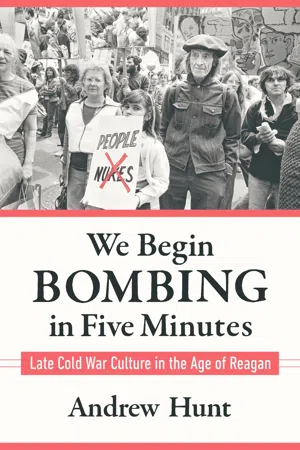
In the moments before his weekly radio address hit the airwaves in 1984, Ronald Reagan made an off-the-record joke: "I've signed legislation that will outlaw Russia forever. We begin bombing in five minutes." As reports of the stunt leaked to the press, many Americans did not find themselves laughing along with the president. Long a fervent warrior against what he termed the "Evil Empire," by the mid-1980s, Reagan confronted growing domestic opposition to his revival of the Cold War. While numerous histories of the era have glorified the "Decade of Greed," historian Andrew Hunt instead explores the period's robust political and cultural dissent.
We Begin Bombing in Five Minutes focuses on a striking array of protest movements that took up issues such as the nuclear arms race, U.S. intervention in Central America, and American investments in South Africa. Hunt's new history of the eighties investigates how film, television, and other facets of popular culture critiqued Washington's Cold War policies and reveals that activists and cultural rebels alike posed a more meaningful challenge to the Cold War's excesses than their predecessors in the McCarthy era.
- English
- ePUB (mobile friendly)
- Available on iOS & Android
eBook - ePub
About this book
Trusted by 375,005 students
Access to over 1.5 million titles for a fair monthly price.
Study more efficiently using our study tools.
Information
Publisher
University of Massachusetts PressYear
2021Print ISBN
9781625345769
9781625345776
eBook ISBN
9781613768334
Chapter 1
Setting the Stage
So thoroughly entrenched is the End of the Cold War, that it has generated an offspring, which is called Bringing Back the Cold War.
—William F. Buckley, Detroit Free Press, November 9, 1979
Hawks tell us to go back and do it right. But we did it right the first time. Full nuclear development and total ideological suspicion—you can hardly top that for a proper Cold War performance. We made things worse because we performed so well. The moral is not to be a better wife to King Henry VIII, but to give up marrying him altogether.
—Garry Wills, Hartford Courant, January 16, 1980
Cold War II
At some point in the late 1970s, it became fashionable to declare that the Cold War was on its way back. “As 1975 draws to an end, détente is dead,” wrote William Safire, syndicated columnist and former Nixon speechwriter, in the New York Times. “The Second Cold War is under way.”1 When Safire’s column appeared in the venerable paper of record, it was hard to imagine the Cold War returning to dominate American politics. The once mighty Cold War consensus now seemed unsalvageable in the aftermath of defeat in Vietnam and détente. Televised images of Nixon meeting with Mao Zedong in 1972, as well as the American evacuation of Saigon in April 1975, had left an indelible impression on the public, and few had the stomach to revisit the Cold War conflicts of yesteryear.
Hence, Safire’s position was not widely shared when his column ran. Ronald Reagan was one of the few high-profile political figures that publicly concurred with him. In the Republican primaries of 1976, Reagan hammered President Ford from the right, insisting the commander in chief lacked resolve on defense matters. At a campaign stop in Peoria, Illinois, in March 1976, Ford struck back, warning that “returning to a collision course in a thermonuclear age can lead to disaster.” Without naming Reagan, the president said the nation had “an obligation not to go back to the Cold War.”2
Before long, others would come around to Safire’s way of thinking. Political commentator Kevin Phillips predicted in March 1978 that a “neo–Cold War period, a new anticommunist era, is indeed about to begin.”3 Bespectacled and soft-spoken, Phillips had an authoritative air about him. People on all parts of the political spectrum listened to him and took him seriously. Nine years earlier, Phillips’s prescient book, The Emerging Republican Majority (1969), had identified political trends favoring a sharp rightward turn in American politics. He popularized the concept of a “southern strategy” in that book, which saw the Republican Party building a powerful conservative coalition in the so-called Sunbelt states—that vast region along America’s southern tier, from California to Florida—and abandoning the efforts of moderate Republicans to appeal to more liberal northeastern voters.4 The Emerging Republican Majority became an important go-to book for both political scientists and Republican strategists in the 1970s, and Phillips gained a nationwide pulpit as a syndicated columnist of some renown. Thus, when he forecast the return of the Cold War, his opinion carried weight. “If I had to estimate,” he wrote in 1978, “I’d guess that sometime within the next year or two or three, the U.S. will move into another strong anticommunist cycle.”5
As Phillips wrote these words, worsening regional conflicts in parts of Africa, Latin America, Asia, and the Middle East prompted warnings elsewhere of a resurgent Cold War. “What is required, and what is difficult for this administration to provide, is an offensive strategy for fighting the second Cold War with the Soviet Union,” wrote syndicated conservative columnist and former Nixon speechwriter Patrick Buchanan in April 1979.6 Alarm bells sounded outside of the United States, as well. “U.S. imperialism is obviously embarking on the path of a new Cold War and creating a situation threatening universal peace and security,” warned Soviet president Leonid Brezhnev in 1980.7 “The enemies of peace have been stepping up their counterattacks against relaxation of tension. In their mass media, the West is longing for a second Cold War,” said Erich Honecker, the East German head of state.8 “I do believe,” wrote Canadian radio host and newspaper columnist Ron Collister in the pages of the Edmonton Journal on Valentine’s Day 1980, “that the Cold War, with all its horrendous dangers, is back with a bang.” Around the same time, on the other side of the Atlantic, Denzil Peiris, the Sri Lankan–born coeditor of the London-based Guardian Third World Review, despairingly observed, “With the Soviet move into Afghanistan, the second Cold War is on.”9
Talk of a “Second Cold War”—or Cold War II, as William Safire called it—suggested that experts in the 1970s thought the Cold War had ended at some point or at least dramatically subsided. But the Cold War never completely vanished from American life. It remained ever present in politics, even in times of improved U.S.-Soviet relations. The arms control treaties signed by Presidents Nixon, Ford, and Carter and their Soviet counterparts did not spell an end to the conflict. Rather, those painstakingly formulated agreements represented attempts to manage tensions and move the superpowers away from the brink of nuclear war arrived at under Kennedy and Khrushchev in 1962. Dividing the Cold War into “first” and “second” phases, as well as using terms such as “Second Cold War” and “Cold War II,” offered a useful way of understanding the lull that separated periods of heightened conflict. It also enabled pundits, scholars, and officials to break down complex issues into a more easily digestible narrative for op-ed page readers who did not have the luxury of exploring the Cold War’s finer nuances on their own.
The goodwill that characterized détente had evaporated in the second half of the 1970s. The resumption of mutual hostilities between the United States and the Soviet Union was, by decade’s end, widely seen as a return to the global ideological contest that had profoundly shaped world affairs since 1945. By the late 1970s and early 1980s, international relations (IR) specialists and diplomatic historians studying recent superpower tensions arrived at a similar conclusion: the Cold War, once on its way to the dustbin of history, was back. For example, renowned IR scholar Fred Halliday, from the London School of Economics, titled his landmark 1983 book on the era The Making of the Second Cold War.10
Whatever terminology one used, by 1980 there was no question that the Cold War had returned to dominate American foreign policy, as it did prior to détente.11 Events overseas in the late 1970s drove gloomy predictions of the Cold War’s return. In particular, conflicts in three key global hot spots—an Islamic revolution in Iran and subsequent hostage crisis, the Soviet invasion of Afghanistan, and the Sandinista Revolution that ousted pro-U.S. strongman Anastasio Somoza in the summer of 1979—alarmed American policymakers and coincided with an escalating arms race at home under President Jimmy Carter.
Events in Iran, Afghanistan, and Nicaragua pushed Carter to embrace a more hawkish Cold War approach and to move away from the values of human rights he championed early in his presidency. These were trying times for the thirty-ninth president. At home, a faltering economy left him demoralized. Runaway stagflation, slow job growth, and long lines at gas stations owing to a Mideast “oil shock” combined to whittle Carter’s base of support. Unable to repair the ailing economy, Carter set his sights abroad. His heavily publicized success at brokering a peace agreement between Israel’s Menachem Begin and Egypt’s Anwar Sadat in 1978 did little to stall his downward-sliding reputation. Moreover, his support of a treaty to return the Panama Canal to Panama by 1999 infuriated the right.12 Some of Carter’s critics spoke of a failed presidency. Indeed, the economy’s lackluster performance went hand in hand with conservatives accusing Carter of being inconsistent on foreign policy and “soft on communism,” a charge that had dogged Democrats in the Oval Office since the days of Harry Truman.13
In his transformation to Cold Warrior, Carter relied increasingly on the counsel of his national security advisor, Zbigniew Brzezinski, a former professor of international relations at Columbia University and a hard-line anticommunist. Brzezinski, son of a pre–World War II Polish diplomat, had moved to Canada as a young boy, where his father was posted, and eventually attended Harvard with Henry Kissinger.14 His disdain for the Kremlin and its policies led him to advise President Carter to take a tough stand against what he believed to be a systematic pattern of ruthless Soviet expansionism.15
As a result of the Soviet invasion of Afghanistan, Carter, who had been drifting toward Brzezinski’s way of thinking for some time, assumed a firmer Cold War position. He oversaw a huge military buildup in the Persian Gulf and presided over the deployment of SS-20s to Europe, the construction of new cruise missiles, and the preparation of conventional forces for intervention in the Third World.16 Carter also backed the development of the LGM-118 Peacekeeper, popularly known as the MX Missile (MX stood for “Missile Experimental”), a controversial new missile system. The president gave his blessing for the construction of a hopelessly complex $34 billion network of underground launching facilities, storage shelters, and “racetracks” over which the missiles would be transported, all in an effort to conceal the approximately two hundred Peacekeepers from Soviet tracking systems. Originally, Air Force planners supervising MX missile system construction intended to build it in remote areas of New Mexico, Utah, and Nevada, but they encountered sustained opposition in those states, which led to the program being scrapped.17
The MX fiasco discouraged Carter but did not slow his conversion to Cold Warrior. As the Cold War intensified in 1980, the president further firmed up his position by refusing to sell grain to the USSR until it withdrew troops from Afghanistan and by boycotting the 1980 Moscow Summer Olympics. Pravda, the official organ of the Soviet Communist Party, lashed out at Carter’s tough line, saying his actions were “drawing the world into an atmosphere of Cold War.”18 Carter insisted such tough measures were necessary, and most congressional Democrats backed his new approach. Those on the left wishing to see a more dovish Democratic Party were disappointed. “For the first time since the Cold War era of communist containment,” wrote Princeton international law scholar Dr. Richard Falk, “congressional doves are flocking with their more hawkish brethren in unified support of greater U.S. military spending and a return to interventionism.”19
In the aftermath of Watergate and defeat in Vietnam, the Cold War’s comeback left few surprised. Policymakers from both parties, along with a sizable segment of the American population, shared the view that America had lost its prestige on the world stage. In this souring climate, Republicans took advantage of Carter’s perceived weaknesses on foreign policy. When Ronald Reagan began campaigning for the presidency in 1980, he effectively channeled a mix of buoyant optimism, American exceptionalism, and hawkish jingoism. His choreographed speeches, which typically placed him next to large American flags, electrified crowds. On July 17, Reagan delivered his acceptance address at the Republican National Convention in Detroit, warning his audience about the Soviet threat. “America’s defense strength is at its lowest ebb in a generation,” he told a cheering crowd, “while the Soviet Union is vastly outspending us in both strategic and conventional arms.”20
Reagan preferred strong language when describing the communist world, especially the Soviets. Since his failed 1976 bid for the presidency, he had routinely borrowed from pre-détente language, using words like “appeasement,” “criminal,” and “totalitarian.” His general outlook dovetailed with the findings of the nonpartisan Committee on the Present Danger, an anticommunist watchdog organization run by a board of luminaries that included former secretary of state Dean Rusk, ex-navy secretary Paul Nitze, and onetime U.S. Army chief of staff General Matthew Ridgway. In January 1980, the committee issued a detailed report, timed to coincide with Carter’s State of the Union address. “As the Soviet Union has moved forward, exploiting its growing sea power and airlift capacity, the United States has continued to retreat,” the report concluded.21
For most ordinary Americans living outside the Capital Beltway, the committee’s dire warning held little sway. Most voters—as polls demonstrated—were more concerned with pocketbook issues in 1980 than with foreign policy, and a growing number felt Carter was not managing the economy well. Reinforcing those doubts were the sharply contrasting personalities of the two presidential candidates. On the campaign trail, Reagan appeared confident at every step, yet Carter came across as sullen and pessimistic. The introspective Carter spoke of a national malaise and a crisis of confidence, yet peppy Reagan boasted that it was a good thing to be patriotic again, that free markets would usher in a new era of prosperity, that a strong defense was key to restoring the nation’s prestige, and that America could emerge from Watergate and Vietnam a mighty world power. At a campaign stop in Florida, Reagan stood on a high school auditorium stage, waving to cheering crowds while a band played “Stars and Stripes Forever,” exuding the same optimism as his onetime hero, Franklin D. Roosevelt. Shadowing Reagan, Elizabeth Drew wrote dispatches for the New Yorker marveling at his appropriation of patriotic symbols. “His rallies are draped in red-white-and-blue bunting,” Drew noted. “Reagan’s supporters wear straw hats with red-white-and-blue bands that say ‘Reagan.’ His posters are red-white-and-blue, and this year’s shows Reagan smiling his crinkly-eyed smile over a picture of the White House. The slogan is ‘Let’s Make America Great Again.’”22 Carey McWilliams, editor of the leftist Nation magazine, observed Reagan on the campaign trail with a sense of grudging respect. In June 1980, one month before he passed away, McWilliams wrote: “The former governor of California is a bright, if not original, thinker. He radiates traditional American values. He is not a ha...
Table of contents
- Cover
- Title Page
- Copyright Page
- Dedication
- Contents
- Acknowledgments
- Introduction
- Chapter 1: Setting the Stage
- Chapter 2: Nostalgia Wars
- Chapter 3: In the Shadow of Vietnam
- Chapter 4: Seeing Reds
- Chapter 5: No Nukes
- Chapter 6: The Wars for Central America
- Chapter 7: The End of the Line
- Conclusion
- Notes
- Index
- Photo Gallery
Frequently asked questions
Yes, you can cancel anytime from the Subscription tab in your account settings on the Perlego website. Your subscription will stay active until the end of your current billing period. Learn how to cancel your subscription
No, books cannot be downloaded as external files, such as PDFs, for use outside of Perlego. However, you can download books within the Perlego app for offline reading on mobile or tablet. Learn how to download books offline
Perlego offers two plans: Essential and Complete
- Essential is ideal for learners and professionals who enjoy exploring a wide range of subjects. Access the Essential Library with 800,000+ trusted titles and best-sellers across business, personal growth, and the humanities. Includes unlimited reading time and Standard Read Aloud voice.
- Complete: Perfect for advanced learners and researchers needing full, unrestricted access. Unlock 1.5M+ books across hundreds of subjects, including academic and specialized titles. The Complete Plan also includes advanced features like Premium Read Aloud and Research Assistant.
We are an online textbook subscription service, where you can get access to an entire online library for less than the price of a single book per month. With over 1.5 million books across 990+ topics, we’ve got you covered! Learn about our mission
Look out for the read-aloud symbol on your next book to see if you can listen to it. The read-aloud tool reads text aloud for you, highlighting the text as it is being read. You can pause it, speed it up and slow it down. Learn more about Read Aloud
Yes! You can use the Perlego app on both iOS and Android devices to read anytime, anywhere — even offline. Perfect for commutes or when you’re on the go.
Please note we cannot support devices running on iOS 13 and Android 7 or earlier. Learn more about using the app
Please note we cannot support devices running on iOS 13 and Android 7 or earlier. Learn more about using the app
Yes, you can access We Begin Bombing in Five Minutes by Andrew Hunt in PDF and/or ePUB format, as well as other popular books in Politics & International Relations & Military & Maritime History. We have over 1.5 million books available in our catalogue for you to explore.