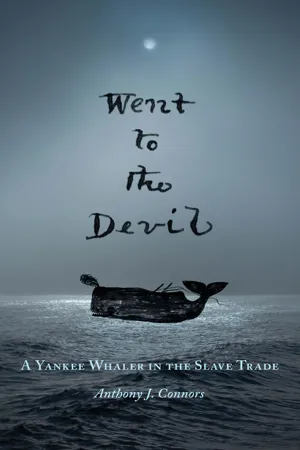
Edward Davoll was a respected New Bedford whaling captain in an industry at its peak in the 1850s. But mid-career, disillusioned with whaling, desperately lonely at sea, and experiencing financial problems, he turned to the slave trade, with disastrous results. Why would a man of good reputation, in a city known for its racial tolerance and Quaker-inspired abolitionism, risk engagement with this morally repugnant industry?
In this riveting biography, Anthony J. Connors explores this question by detailing not only the troubled, adventurous life of this man but also the turbulent times in which he lived. Set in an era of social and political fragmentation and impending civil war, when changes in maritime law and the economics of whaling emboldened slaving agents to target captains and their vessels for the illicit trade, Davoll's story reveals the deadly combination of greed and racial antipathy that encouraged otherwise principled Americans to participate in the African slave trade.
Our story begins in the rural maritime town of Westport, Massachusetts, where Edward S. Davoll was born on September 21, 1822. Westport was a young town then, having separated from Dartmouth only thirty-five years previously. But two of the Dartmouth villages that became part of Westport were well developed by 1700. One was a peninsula at the confluence of the Acoaxet and Noquochoke Rivers,1 called Peckacheque Point (later renamed Westport Point), where the maritime docks were situated just inside the entrance to a sheltered harbor leading to the Atlantic Ocean. The wharves at the Point would be an important place in Edward’s early career as a whaleman. The other village was an industrial and commercial settlement known as the Head of Westport River, or simply “the Head.” That’s where the Davoll family lived, a mile or so south of the town landing where whaling and merchant ships were built.
Edward was the first of five children of Jeremiah and Barbara (Allen) Davoll, who made a respectable living growing corn and oats and raising sheep on their sixty acres of farmland.2 The younger children were George (born 1826), Mary (1828), and William (1830). A daughter, Hannah, was born in 1835, but died two years later. We have little personal information about the family except for Edward’s cousin Ruby Devol Finch (1804–66). A painter relatively unknown outside of Westport, Ruby Devol (later Finch) is now considered “one of the most uniquely creative female American folk artists of her time.” She recorded the major events in the lives of friends and neighbors in vividly drawn watercolor paintings. Unrecognized in her lifetime, her paintings are now valuable, not only for their artistic merit but as documentation of the clothing, social customs, furniture, and architecture of Westport in the early nineteenth century.3
The Davoll family had deep roots in southeastern Mass-achusetts, and as Ruby Devol’s name indicates, there were various spellings of the family name: Devol, Devoll, Davol, Davoll, DeVol. Even official documents often misspelled Edward’s name.
Little is known about Edward’s schooling. There were nineteen school districts across this geographically large rural town, and the school at the Head was within easy walking distance of the Davoll home. Westport’s schools had once offered a classical education, including Greek and Latin, but by the time Edward started the town had switched to a more practical curriculum better suited to the kinds of work available in this agricultural and maritime area and emphasized basic writing and math skills.4
We don’t know how many years Edward attended school. There was no high school in town until 1868, so his education probably ended after eighth grade. We can, however, infer something about the quality of his education. Edward’s letters indicate a very good grasp of grammar, a solid vocabulary, and reasonably correct and consistent spelling. He also had the math skills to become an expert navigator. If the purpose of his schooling was to train him for the profession of master mariner, it was a success.
There is no record of what Edward did between the time he finished school and began his maritime career. As the eldest son of a farmer, he probably helped out on the family farm, but it is also likely that he gained some experience on the water, living close by the river and, as most local boys did, spending time in boats. Perhaps he ventured downstream to the Point, and even a bit farther, to the harbor mouth and the Atlantic Ocean.
At seventeen it was time to get a job that could lead to a career, and there were many choices for an intelligent young man in Westport in 1840. If farming didn’t interest him, there was fishing, one of the dominant businesses in town. There was shipbuilding at the Town Landing, and there were several gristmills and a sawmill along the streams just north of the Head. If he wanted factory work, Fall River was just ten miles to the northwest: there were jobs available at the many cotton mills or the Fall River Iron Works. About the same distance to the east was New Bedford—later to become an industrial giant, but in 1840 doing well in fishing and maritime trade along the Eastern Seaboard or with the West Indies. More important, by 1840 New Bedford was just overtaking Nantucket as the nation’s whaling capital. It was a fast-growing town that in a few years would become a city—the richest per capita in America.
Whaling was the third-largest industry in Massachusetts at this time, behind only cotton textiles and shoes. Whales were sought for their oil and their “bone.” This whalebone was actually baleen, the long, flexible strips of keratin that hang from the mouths of many whales (notably not toothed varieties such as the sperm whale) and are used to strain their food supply (krill) from the ocean. Because of its strength and flexibility, baleen was useful in the manufacture of products like corset stays, buggy whips, skirt hoops, and umbrella ribs—a nineteenth-century plastic. Ordinary whale oil came from the blubber of a variety of whales, such as right whales, bowheads, and humpbacks. This was not the most prized oil but had commercial value for lighting and industrial lubrication. If better whales could not be taken, as the saying went, “brown oil is better than no oil.”5
Well known to us thanks to Melville’s Moby-Dick, the sperm whale could reach sixty feet in length and weigh sixty tons. Sperm whale oil had superior lubricating qualities, and when used in oil lamps it burned brightly and without odor. It sold for about double the price of oil from other whales. Even more valuable was spermaceti, the waxy substance in their heads (called “head matter”), which produced bright, clean-burning, odorless—and expensive—candles. The sperm whale was the primary target of New England whalers.
If New Bedford was the leviathan of the whaling industry, Westport was a small fish. Yet judged by number of whaling voyages, Westport ranked eighth in the United States, a respectable showing for a small port.6 The town’s first connection with whaling was industrial, based on the sawmills, iron forge, and bog iron deposits just north of the Head of Westport, where local men built ships and forged iron products for the New Bedford whaling business. But with the harbor at Westport Point opening to the Atlantic, the town developed a whaling industry of its own. The first recorded Westport whaling voyage was in 1775, but the American Revolution delayed further cruises. There were a few in the 1790s, but it was not until 1803 that whaling took off. Despite its tricky harbor entrance, narrow and shallow channel, and tight wharf area, Westport Point was an active whaling port until 1879—a span of more than seventy-five years.
While Westport was part of the New Bedford Customs District, it had its local owners, agents, captains, shipyards, outfitting store, sailmakers, coopers—everything (except insurance companies) to manage, equip, and conduct whaling voyages. The agents directed the voyages and were usually part-owners. The major Westport agents all had impressive homes, most in the latest Greek Revival style, along Main Road, near the town docks. Andrew Hicks was on a level with many New Bedford agents: he built eight vessels and had an interest in eleven ships that made a total of seventy-eight voyages. Alexander Cory and Gideon Davis owned the chandlery (the maritime supply store) close to the docks. There were also several cooper shops nearby that provided the large number of barrels and casks required for fresh water and whale oil. With all these resources, Westport was a self-sustaining whaling port, and it was from this harbor that young Davoll began his career as a whaleman.
Edward Davoll went to sea for the first time in 1840, at the age of seventeen, on the brig Elizabeth of Westport Point. He was described as five feet eight with light skin and brown hair. An indication that he might have had some previous maritime experience is his listing as an ordinary seaman rather than a “greenhand.” His portion of the proceeds, or “lay,” is another indication: one-sixtieth, quite high for a first voyage. The crew consisted of the captain, two officers (mates), and twelve men, and in one respect it was unusual: the captain was Pardon Cook, one of the few black whaling captains, and the crew of the Elizabeth was a “checkerboard” mix of black and white mariners. The two mates, Asa and Rodney Wainer, were of black and Indian heritage. Given Edward Davoll’s later activities, it is tempting to speculate on the effect of this first voyage under a black captain and officers, but there is simply no evidence to go on.7
A brig was a sailing vessel with two masts, both square rigged. The Elizabeth was rather small for a whaler: at 130 tons, it was the smallest of the seven whaling vessels that sailed out of Westport that year (the average was 171 tons, compared to more than 300 tons for New Bedford whalers).8 A whaling vessel was a sailor’s cramped rat- and cockroach-infested home for months to years. The worst quarters were in the forecastle, in the forward part of the ship, “before the mast.” This is where the ordinary seamen and greenhands slept. As one whaleman described it, “The forecastle was black and slimy with filth, very small and hot as an oven. It was filled with a compound of foul air, smoke, sea-chests, soap-kegs, greasy pans, tainted meat, Portuguese ruffians, and sea-sick Americans.”9 Whether the Elizabeth fit this description or not, it certainly was unpleasant.
The most disagreeable duties fell to the foremast hands, especially those who had no experience. As Richard Henry Dana Jr. remarked in Two Years before the Mast, “There is not so helpless and pitiable object in the world as a landsman beginning a sailor’s life.”10 The foremast men climbed the rigging and handled the sails as the mate ordered and stood watches (usually four hours). From the masthead they scanned the ocean for whales and sang out when they spotted one. In Moby-Dick, Herman Melville describes the precarious post high above the deck: “Your most usual point of perch is the head of the t’ gallant-mast, where you stand upon two thin parallel sticks (almost peculiar to whalemen) called the t’ gallant crosstrees. Here, tossed about by the sea, the beginner feels about as cosy as he would standing on a bull’s horns.” To Ishmael this is a place for contemplation of nature, but, he warns, “move your foot or hand an inch; slip your hold at all; and your identity comes back in horror. Over Descartian vortices you hover. And perhaps, at midday, in the fairest weather, with one half-throttled shriek you drop through that transparent air into the summer sea, no more to rise for ever. Heed it well, ye Pantheists!”11
Just as terrifying was the job of manning the whaleboat, rowing miles from the ship to get uncomfortably close to creatures twice the length of the whaleboat. Once captured and brought back to the ship, the whale was processed by stripping off the blubber, cutting it into pieces, and boiling it in the tryworks to render it into oil. There were also long, boring stretches when no whales were seen. A captain usually kept the men busy at all times, to maintain discipline. If the crew was lucky, Sunday was a day off. A whaleship has been described as a military unit, a hospital, a prison, an insane asylum, an industrial enterprise, a family—all under the unconditional control of a potentially tyrannical leader. It was at times all of these.12
Davoll’s first voyage was what was known as a “plum-pudding” cruise—a short trip that would typically cross the Atlantic Ocean to the Azores, then south to the Cape Verde Islands, back across the ocean to the Brazil Banks, up through the West Indies, and back home in six months or so.13 And this 1840 voyage of the Elizabeth was typical: out from June 24 to November 1 (just over four months), in the Atlantic. Two weeks out, Davoll encountered his first whale, but they were unable to capture it. It was a full two months before a whale was successfully brought in, a large sperm whale that yielded 90 barrels of oil.14 They returned with 150 barrels of sperm oil, about one-third less than the previous voyage of the Elizabeth. While probably not a losing voyage, it is unlikely that the owners made much of a profit, nor would there have been much for the crew to share. The first-time whaleman probably earned no more than thirty dollars.15
Six months after returning from his first whaling voyage, young Davoll signed up for another. He must have been employed during his time at home (having earned little on the Elizabeth) but chose to continue as a whaleman. Again he would sail out of Westport Point, but on a different vessel, the Mexico, commanded by Gideon H. Smith, a veteran of three voyages as master. Davoll’s shipping papers specified that no “distilled spirituous liquors” could be brought on board. Also prohibited was “the introduction of any woman or women into the ship for licentious purposes.” Sailors who disobeyed these rules would forfeit their entire share in the voyage. Curiously, Davoll signed on as a greenhand, a lower rank—and lower lay—than on his previous voyage. His one-ninetieth lay was, in fact, the lowest of the entire crew except for the steward.16
The Mexico was a 137-ton brig with a deck length of seventy feet, built in 1826 in Newport, Rhode Island, just a bit over ten miles by water from Westport Point. Only slightly bigger than the Elizabeth, it was used for Atlantic cruises, sometimes as far as the Cape Verde Islands off the coast of Africa. It was seaworthy—“tight in her bottom,” the captain said—but the forecastle (or fo’c’sle) leaked badly all during the voyage due to poor caulking of the deck. Unfortunately for Davoll and the other seamen, the dark, soggy fo’c’sle was their home.
The records don’t indicate much about the first part of the voyage, which began August 31, 1842. Sometime in early winter they reached the coast of Africa, where Davoll experienced his first death at sea when crew member Antonin Cooper “departed this life of malignant fever.”17 Edward saw other drawbacks of whaling life as well. When they stopped at the island of Dominica for fresh fruit, a crew member deserted. They also had a problem with the cook—“the worst dispositioned man . . . I ever sailed with,” in the captain’s opinion—who had been confined in irons.
By February 1 they were at Puerto Rico, with only 30 barrels of sperm oil. “It has been 5 mo 7 d[ays] since we have seen the spout of a sp[erm] whale,” the captain lamented, “and the Lord only nows [sic] when we shall again.” A month later they reached Grand Cayman, with no additional oil. But whaling improved in the Gulf of Mexico: the captain reported 200 barrels at the end of May. The ship returned to W...
Table of contents
Cover
Copyright Page
Contents
A Note on the Transatlantic Slave Trade
Acknowledgments
Introduction
1. A Whaling Career
2. Captain
3. The Parting
4. “Keep a High Toe Nail & a Stiff Upper Lip”
5. The Wreck of the Iris
6. Recovery
7. “What’s in the Wind?”
8. Evasion
9. The Case against Captain Davoll
10. The Sham Whalers of New Bedford
11. Slave Traders and Abolitionists
12. The Curious Case of the Ship B_____
13. Captain Edward S. Davoll (1822–1863)
14. Consequences
Notes
Index
Trusted by 375,005 students
Access to over 1.5 million titles for a fair monthly price.
Study more efficiently using our study tools.
Frequently asked questions
Yes, you can cancel anytime from the Subscription tab in your account settings on the Perlego website. Your subscription will stay active until the end of your current billing period. Learn how to cancel your subscription
No, books cannot be downloaded as external files, such as PDFs, for use outside of Perlego. However, you can download books within the Perlego app for offline reading on mobile or tablet. Learn how to download books offline
Perlego offers two plans: Essential and Complete
Essential is ideal for learners and professionals who enjoy exploring a wide range of subjects. Access the Essential Library with 800,000+ trusted titles and best-sellers across business, personal growth, and the humanities. Includes unlimited reading time and Standard Read Aloud voice.
Complete: Perfect for advanced learners and researchers needing full, unrestricted access. Unlock 1.5M+ books across hundreds of subjects, including academic and specialized titles. The Complete Plan also includes advanced features like Premium Read Aloud and Research Assistant.
Both plans are available with monthly, semester, or annual billing cycles.
We are an online textbook subscription service, where you can get access to an entire online library for less than the price of a single book per month. With over 1.5 million books across 990+ topics, we’ve got you covered! Learn about our mission
Look out for the read-aloud symbol on your next book to see if you can listen to it. The read-aloud tool reads text aloud for you, highlighting the text as it is being read. You can pause it, speed it up and slow it down. Learn more about Read Aloud
Yes! You can use the Perlego app on both iOS and Android devices to read anytime, anywhere — even offline. Perfect for commutes or when you’re on the go. Please note we cannot support devices running on iOS 13 and Android 7 or earlier. Learn more about using the app
Yes, you can access Went to the Devil by Anthony J. Connors in PDF and/or ePUB format, as well as other popular books in History & Historical Biographies. We have over 1.5 million books available in our catalogue for you to explore.