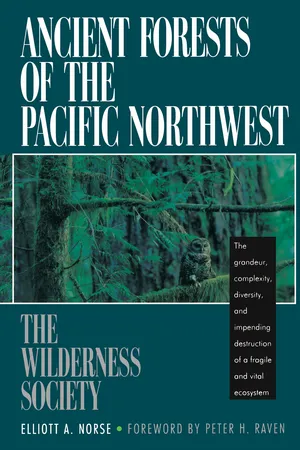
Ancient Forests of the Pacific Northwest provides a global context for what is happening in the Pacific Northwest, analyzing the remaining ancient forest and the threats to it from atmospheric changes and logging. It shows how human tampering affects an ecosystem, and how the Pacific Northwest could become a model for sustainable forestry worldwide.
- English
- ePUB (mobile friendly)
- Available on iOS & Android
eBook - ePub
Ancient Forests of the Pacific Northwest
About this book
Information
IV
The Biological values of Ancient Forests, Part 1
Biological Diversity
The diversity of life forms, so numerous that we have yet to identify most of them, is the greatest wonder of this planet.
(Edward O. Wilson, ed., Biodiversity [1988])
In the 1970s, paleontologists in Texas discovered fossil bones of the largest aerial animal ever known, a flying reptile called Quetzalcoatlus northropi. This pterosaur, whose wings spanned perhaps 40 feet, was the king of the skies in the Cretaceous era. Fascinated by this huge creature, in 1980 a talented team of aeronautical engineers decided to create a working half-size scale model, with a grant for $500,000 and sponsorship from the Smithsonian Institution’s Air and Space Museum. In May 1986, near Washington, D.C., they demonstrated to the media and a crowd of 300,000 what they had achieved. Seconds after the model was released from the tow line, it crashed to the ground and broke.
I do not recount this tale to mock those who boldly took up the challenge but, rather, to point out that our best minds could not match something that nature did more than 65 million years ago, something that not only flew better but also gathered its own fuel and reproduced itself.
Nature has produced an incredible diversity of such living things, from infinitesimal bacteria to trees weighing nearly as much as the combined human population of Port Orford, Florence, and Oakridge, Oregon. The diversity of life is a miracle, but one that now faces its gravest threat. The Earth is fast losing its biological diversity.
There have been inklings of this for a long time. But it has only been since 1979, when Norman Myers’s The Sinking Ark was published, that awareness about the rapid loss of species has spread beyond a handful of scientists to the general public and decision-makers.
Although the media pay far more attention to sports, movie stars, stock market swings, and military adventures, most thoughtful people realize that these phenomena are transitory. In contrast, extinction is forever. The Earth will never again know the thunderous wingbeats of a billion passenger pigeons or the fluttering wingbeats of a Xerces blue butterfly. If we do not act quickly, the hushed wingbeats of northern spotted owls will likely vanish as well. But the problem goes much farther; the world is now or will shortly be losing living things at a rate without precedent since the disaster that eliminated the dinosaurs 65 million years ago. We were not around at the last mass extinction, but as the cause of nearly all recent extinctions, we have the power to stop this one.
Why should we? In a world where terrorists, illegal drugs, AIDS, and mortgage payments dominate our concerns, why should we burden ourselves with yet another? Why does it matter whether bugs, fishes, pandas, or rainforests continue to exist?
There are really two answers. One, the ethical argument, is persuasive for many people but, regrettably, not, as yet, for most. Excellent discussions appear in David Ehrenfeld’s The Arrogance of Humanism (1978), Bryan Norton’s The Preservation of Species (1986), Ed Wilson’s Biodiversity (1988), and Bill Devall and George Sessions’s Deep Ecology (1985).
The second answer, however, is utilitarian, based solely on our self-interest. The living things of this Earth are our resources and life-support systems. Every bite of food you eat comes from living things. Every sip of water you drink has been cleansed by living things. The oxygen in your every breath comes from living things. Humankind is utterly dependent on biological diversity.
And it is not just individual organisms and species that we depend on; it is whole ecosystems. The organized study of the interactions of living things and their environment—the science of ecology—was born about the same time that Euro-Americans settled the Westside and came into its own only in this century. The vast majority of relationships among the living things are as yet unexplored. But everywhere we look, ecologists see miraculously intricate interactions that affect humans. Every ecologist has favorite examples. The following is one of mine.
Some years ago, the University of Wisconsin’s Stanley Temple (1977) noted that Calvaria major, an endemic tree that had once covered the island of Mauritius in the Indian Ocean, was almost extinct, with only thirteen remaining. Further, although the Calvarias bore fruit, all were 300-400 years old. Of course, many trees valued for timber have been decimated. But why was there no young Calvaria?
Until the age of European exploration, Mauritius had no native people but was home to a gigantic (more than turkey-sized) flightless pigeon, the dodo, whose name has become synonymous for both stupidity and extinction. Dodos, having evolved without mammalian predators, seemed stupid because they neither fought nor ran away when Portuguese and Dutch sailors first encountered them in the 1500s. By all accounts, dodos were nearly inedible, but the sailors made great sport of clubbing them to death. The last dodo was gone by 1680.
Temple noted that this date coincided with the age of the Calvaria trees. On a hunch, he took Calvaria seeds and, lacking a dodo, force-fed them to the next best thing: a turkey The seeds passed through the turkey’s gizzard, and, when planted, germinated, the first Calvaria seedlings in more than three centuries! The great trees had all but disappeared because the dispersal agent needed to abrade their seed coats had been exterminated. Living things are connected in ways that we have scarcely begun to understand.
Biological diversity is the diversity of life. It is useful to envision three levels, the most familiar being the middle one, species diversity, the wealth of species.
Until 1982, systematic biologists had described and catalogued some 1.5 million species of plants, animals, and microorganisms, but they knew that twice, perhaps even six times, as many had not yet been discovered. Then Terry Erwin (1984) of the Smithsonian Institution used an innovative technique to study an almost unexplored realm: the canopies of tropical forests. He found so many undiscovered arthropods that he estimated an astounding total of at least 30 million species. Although people are most familiar with large species-redwoods and wrens, whales and wildflowers-most living things are actually small invertebrates. It took until the 1980s for science to realize the wealth of life on Earth.
Scientific knowledge is incomplete in Westside forests as well. We haven’t a clue how many kinds of fungi or mites there are. This is no small shortcoming. These little-known creatures are crucial to ecological processes in their habitats and thus to our lives.
Genetic diversity and ecosystem diversity—the levels of biological diversity below and above species diversity—are even less known but no less important. Within species, individual differences in form, coloration, physiology, and behavior largely reflect differing genes.
Genes are segments of the complex molecule DNA, which codes for the production of proteins in living things. The sequence of gene locations (or loci) and the different versions (alleles) at each locus determine precisely which proteins are produced and when. For example, genes code for production of hormones that stimulate division in certain bone cells on a buck’s skull in spring, initiating the formation of antlers. Genes are passed between generations when organisms reproduce, whether sexually or asexually. Thus, they control the heritable characteristics of organisms.
Each species is made up of one or more populations of interbreeding individuals. Within each population, individuals vary genetically. Different populations can have the same collection of alleles. For example, an allele coding for early flowering might be common in some populations of Pacific rhododendrons and rare in others. Or populations can possess alleles that are absent from others. For example, one population of Port Orford cedars might have an allele that confers resistance to nickel, a toxic element in certain soils, while another population might not.
These genetic differences allow organisms to adapt to their particular environments. For example, Douglas-firs west and east of the Cascades have genetic differences that determine such crucial traits as growth rates, resistance to particular diseases and light absorbance. Indeed, they are different enough to be considered distinct subspecies. But genetic differences occur on much more local scales as well. By providing the raw material for evolution, genetic diversity allows populations to adapt to the changing conditions of our heterogeneous world. The ability to adapt becomes increasingly important as we alter the environment in unprecedented ways, with unprecedented speed.
Ecosystem diversity is a higher level of biological diversity. Our planet’s countless combinations of climatic, geological, and chemical conditions favor communities of organisms with different needs. These communities in their physical settings are called ecosystems. Ecosystems can be vast: The Westside biogeographic region is an ecosystem, as are North America and, indeed, the entire biosphere. An ecosystem can also be as small as a stream drainage, a stand of trees, or the soil beneath a single downed log.
Ecosystem diversity can be easy to see, as when coniferous forests on Cascades slopes give way to Willamette Valley croplands, grasslands, and oak woodlands. Boundaries between ecosystems can also be subtle and hard to define precisely. But whether or not people can see them, they are real. For example, the Forest Service and the BLM are in the process of designating forest patches as habitat areas for spotted owls. Unfortunately, the owls occupy some stands but ignore others that look similar to people. The owls distinguish among ecosystems using criteria that we do not yet understand.
The scarcity of severe weather, the north-south temperature and precipitation gradients, the east-west fog and precipitation gradients, the rugged topography, the complex pattern of soils, and the rich variety of disturbance regimes combine to make the Northwest a region of exceptional ecosystem diversity.
Differences among populations, species, and ecosystems are important in countless ways. Recognizing this, Congress passed laws including the Endangered Species Act (ESA) of 1973 and the National Forest Management Act (NFMA) of 1976. The ESA requires the federal government to identify populations and species that are endangered (at risk of extinction through all or part of their ranges) or threatened (likely to become endangered), to take no actions that would jeopardize their continued existence, and to act to bring about their recovery. NFMA regulations require the Forest Service to maintain viable populations of native vertebrate species, to provide for plant and animal communities, and to aid recovery of endangered species in our national forests. When agencies adhere to them, these laws provide a useful mandate for conserving biological diversity.
Nevertheless, this mandate is not always fulfilled. Part of the reason is legislative: In drafting the NFMA in 1976, Congress neglected to give the Forest Service an explicit mandate to maintain genetic diversity. But a more important reason is the Forest Service’s prevalent pro-timber bias, which has led Forest Service officials to claim that logging increases biological diversity. But as The Wilderness Society’s David Wilcove explains:
If one were to census the birds breeding within a large expanse of old-growth Douglas-fir forest in the Pacific Northwest, one would find a variety of forest-dwelling species, including Vaux’s swift, hermit warbler, and perhaps spotted owl. Absent would be most of the species associated with weedy fields, pastures, and other disturbed landscapes-such as dark-eyed junco and brown-headed cowbird. By clearing a portion of the old-growth forest, one might be able to attract some of these open-country species. On that particular tract of land, species richness would be increased. However, this increase should not be confused with an increase in biological diversity. Quite simply, there is no shortage of habitat for dark-eyed juncos and brown-headed cowbirds in the Pacific Northwest, whereas the species associated with old-growth coniferous forests are diminishing as the old-growth forests themselves are logged. (1988, p. 3)
Somehow, natural processes created a rich diversity in the Northwest long before logging began. To maintain the remaining biological diversity, forestlands must be managed with a regional, national, or global perspective. Ancient forests are exceptionally important to the biological diversity of the Northwest, the United States, and the world, as we will see.
Species Diversity
ANCIENT FORESTS AS WILDLIFE HABITAT
Nature’s stern discipline enjoins mutual help at least as often as warfare. The fittest may also be the gentlest.
(Theodosius Dobzhansky Mankind Evolving [1962])
If you ask a knowledgeable Northwesterner about the species that make old-growth forests so special, he or she might mention Douglas-firs, spotted owls, sword ferns, chinook salmon, Olympic salamanders, chanterelle mushrooms, Roosevelt elk, Pacific rhododendrons, banana slugs, cougars, or western redcedars. But the list of known old-growth species runs into the thousands, and the real number is undoubtedly a good many thousands.
Some of these species—such as grisette mushrooms and wood ducks—are widespread across North America. Others—including varied thrushes and Oregon-grapes-occur mainly in the Pacific Northwest but are common in some other ecosystems within the region. But for still others, old-growth is especially important.
Although ancient forest ecosystems are important for many reasons, the controversy about their fate has focused largely on their importance as habitat for species (particularly spotted owls) versus their importance to the timber industry. Unfortunately, scientific knowledge about old-growth as habitat has not yet influenced opinions expressed in some newspaper editorials, commercials, public hearing records, political speeches, living rooms, and barrooms. These opinions are fueled more by passion (or fear) than understanding, which greatly complicates efforts to resolve the controversy.
First, a definition: “Habitat” is where an individual, population, or species lives. It is not a synonym for community or ecosystem. Thus, we can speak of devil’s club, coho salmon, or black-tailed deer habitat but not riparian, stream, or ancient forest habitat. The boundaries of ecosystems and habitats are not necessarily the same.
For example, Westside rainbow trout occur not only in medium-sized streams but also in rivers, small streams, lakes, and coastal marine waters, although not in all of them. Natural rainbow populations vary genetically in these different ecosystems, and so rainbows vary in their habitat relations. Steelhead and kamloops rainbows, populations in the Klamaths and in the north Cascades, all differ in their habitat relations. There are also variations within populations. Adults are ecologically different from hatchlings or juveniles. Individuals occur in different places in different seasons. Finally, the size and structure of rainbow populations can vary markedly between years of usual and unusual weather.
In other words, the habitats of these fish defy simple characterization. The same is true of grand firs, goshawks, marbled murrelets, spotted owls, red tree voles, and fishers because each has unique requirements and unique ways of meeting them. Moreover, detailed investigations of species/habitat relationships have not even begun for most Westside species, so decision-makers often lack information that they need as pressures on species increase.
This does not mean that we are totally ignorant about ancient forests as habitat. There have been hundreds of person-years of studies by scientists in universities, federal and state agencies, and the timber industry. Added to knowledge from long-standing fields such as zoology, botany, mycology, ecology, wildlife biology, and fisheries biology are exciting insights about species-habitat relationships emerging from the new, synthetic disciplines of conservation biology and landscape ecology. Although no one can guarantee that spotted owls will not slip into extinction during the next century, we know enough to i...
Table of contents
- About Island Press
- About The Wilderness Society
- ELLIOTT A. NORSE
- Title Page
- Copyright Page
- Table of Contents
- Table of Contents
- Table of Figures
- Preface
- Foreword
- I - Ancient Forests: Global Resource Global Concern
- II - The Forests of the Pacific Northwest
- III - The Keys to Understanding
- IV - The Biological values of Ancient Forests, Part 1
- V - The Biological Values of Ancient Forests, Part 2
- VI - Effects of Timber Operations
- VII - External Threats to Ancient Forests
- VIII - Sustainable Forestry for the Pacific Northwest
- IX - Conclusions and Recommendations
- Glossary
- Suggested Readings
- Index
- About the Author
- Also Available from Island Press
- Island Press Board of Directors
Trusted by 375,005 students
Access to over 1.5 million titles for a fair monthly price.
Study more efficiently using our study tools.
Frequently asked questions
Yes, you can cancel anytime from the Subscription tab in your account settings on the Perlego website. Your subscription will stay active until the end of your current billing period. Learn how to cancel your subscription
No, books cannot be downloaded as external files, such as PDFs, for use outside of Perlego. However, you can download books within the Perlego app for offline reading on mobile or tablet. Learn how to download books offline
Perlego offers two plans: Essential and Complete
- Essential is ideal for learners and professionals who enjoy exploring a wide range of subjects. Access the Essential Library with 800,000+ trusted titles and best-sellers across business, personal growth, and the humanities. Includes unlimited reading time and Standard Read Aloud voice.
- Complete: Perfect for advanced learners and researchers needing full, unrestricted access. Unlock 1.5M+ books across hundreds of subjects, including academic and specialized titles. The Complete Plan also includes advanced features like Premium Read Aloud and Research Assistant.
We are an online textbook subscription service, where you can get access to an entire online library for less than the price of a single book per month. With over 1.5 million books across 990+ topics, we’ve got you covered! Learn about our mission
Look out for the read-aloud symbol on your next book to see if you can listen to it. The read-aloud tool reads text aloud for you, highlighting the text as it is being read. You can pause it, speed it up and slow it down. Learn more about Read Aloud
Yes! You can use the Perlego app on both iOS and Android devices to read anytime, anywhere — even offline. Perfect for commutes or when you’re on the go.
Please note we cannot support devices running on iOS 13 and Android 7 or earlier. Learn more about using the app
Please note we cannot support devices running on iOS 13 and Android 7 or earlier. Learn more about using the app
Yes, you can access Ancient Forests of the Pacific Northwest by Elliott A. Norse,The Wilderness Society in PDF and/or ePUB format, as well as other popular books in Biological Sciences & Forestry. We have over 1.5 million books available in our catalogue for you to explore.