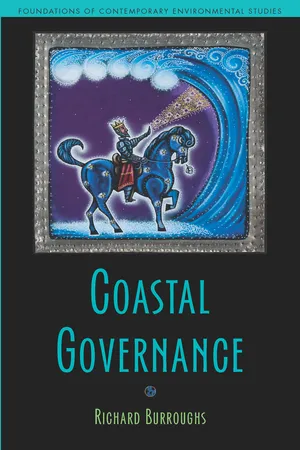
Coastal Governance provides a clear overview of how U.S. coasts are currently managed and explores new approaches that could make our shores healthier. Drawing on recent national assessments, Professor Richard Burroughs explains why traditional management techniques have ultimately proved inadequate, leading to polluted waters, declining fisheries, and damaged habitat. He then introduces students to governance frameworks that seek to address these shortcomings by considering natural and human systems holistically.
The book considers the ability of sector-based management, spatial management, and ecosystem-based management to solve critical environmental problems. Evaluating governance successes and failures, Burroughs covers topics including sewage disposal, dredging, wetlands, watersheds, and fisheries. He shows that at times sector-based management, which focuses on separate, individual uses of the coasts, has been implemented effectively. But he also illustrates examples of conflict, such as the incompatibility of waste disposal and fishing in the same waters. Burroughs assesses spatial and ecosystem-based management’s potential to address these conflicts.
The book familiarizes students not only with current management techniques but with the policy process. By focusing on policy development, Coastal Governance prepares readers with the knowledge to participate effectively in a governance system that is constantly evolving. This understanding will be critical as students become managers, policymakers, and citizens who shape the future of the coasts.
- 242 pages
- English
- ePUB (mobile friendly)
- Available on iOS & Android
eBook - ePub
Coastal Governance
About this book
Information
1
Coastal Challenges
For many of us, the coast represents warm summer days at a welcoming beach—swimming, sea birds, and sandcastles. Yet that ideal does not reflect the full reality. Instead, water pollution, beach erosion, habitat destruction, and other forces are currently threatening coastal areas all along the United States.
These problems arise from the various, often conflicting, ways we make use of the coasts. They are not simply beautiful natural areas or family recreation spots. We also use them as a place to dispose of waste, transport goods, build houses, expand industry, and much else besides.
For example, the Gulf of Mexico spill from the Deepwater Horizon oil drilling unit highlighted the conflict between energy supply and the environment. In San Francisco Bay, the Great Lakes, and elsewhere, shipping and economic activity both depend on and collide with aquatic environments. As harbors are dredged to accommodate larger ships, contaminated sediment is unearthed at an environmental cost to the site of removal as well as to the final resting place for the dredged material. Although intertidal wetlands are valued habitats, they remain under siege because developments encroach on their area and function.
These and many other problems demand responses. Our decisions about how to address them—and how to balance conflicting coastal uses—are reflected in management practices. Conflict arises when expectations and realities diverge. The conflict exposes the extent to which we as a society understand the coast and the multiple values we bring to managing it. Ultimately the choices we make as a society, expressed through government policies, will determine the future of the coasts. This book explains those choices, how we have made them in the past, and how we can improve them for the future.
A stepping-off point for this discussion is whether our current approach is adequate. When we add up all the individual policies created to improve the coasts, can they collectively lead to success? One way to answer this question is to consider the policies’ aggregate impact on ecological health. Another is to examine the policies themselves and the degree to which we apply consistent and coordinated approaches to manage coastal lands and waters. We'll do both in this chapter.
State of the coasts
The most basic measure of policy success or failure is the current state of the coasts, reflected by factors such as water quality. Unfortunately coastal waters throughout the contiguous United States are deemed fair to poor (EPA, 2008a). In figure 1.1, the overall score for each region is based largely on water and habitat quality. Waters that are murky due to solids, are low in oxygen, or have high levels of decomposing organic matter score poorly in national classifications. Sewage discharge and excess nutrients from agriculture and other sources lead to algae growth and decay, which ultimately cause water quality problems. Similarly, if sediments or organisms are contaminated and the numbers of organisms present at the ocean floor are different from what might be found there naturally, then the water body ranks poorly.
In addition to water quality, there are several other comprehensive indicators of the status of coastal environments, including the health of fisheries and the condition of wetlands and other habitats. More than 20,000 acres of coastal habitat disappear each year (Pew Oceans Commission, 2003, vi), and many fisheries have declined. For example, in 2008 twenty percent of the fish stocks assessed by the government were deemed to be subject to overfishing (NMFS, 2008).
Drivers for environmental change
Clearly, the ways we currently use the coasts are leading to environmental damage. Specifically, what human activities are responsible? Any activity that directly or indirectly causes a change in an ecosystem (Nelson et al., 2006) can be thought of as a “driver.” Drivers of coastal change include greenhouse gas emissions, invasive species, land conversion, and fertilizer for agriculture, as well as growth in human populations along the coast. Table 1.1 presents the drivers that are covered in this book. The impacts of these drivers in a given situation can be influenced by economic activity, scientific discovery, technological applications, and a variety of social factors.

All future management efforts will be shaped by two key drivers: increasing human population and rising seas. Growing numbers of people choose to live next to the coast, although sea level has continued to rise. More people and encroachment by the sea increase population density and the potential for conflict. Let's consider the specifics.
Fifty-three percent of the total population of the country inhabits coastal counties, which constitute seventeen percent of the land area of the United States, when excluding Alaska (Crossett et al., 2004). The coastal counties have an average human population density of just over 300 individuals per square mile, whereas the United States as a whole averages ninety-eight persons per square mile. If we focus on density alone, we find that the six most densely populated coastal counties range from 13,000 to 68,000 persons per square mile and that nineteen of the twenty most densely populated counties in the United States are coastal (Crossett et al., 2004). Not only are coastal counties the most densely populated, densities on average are about five times the levels in inland counties.
This trend of growing population in finite coastal areas has continued for more than a half century (figure 1.2). In the fifty-five years shown in figure 1.2, the coastal county population has increased by 80 million individuals. Each person requires a place to live, transportation, food, waste disposal, and so on. Each of these requirements places an additional burden on the environment and ultimately drives change. And the trend of increasing coastal population shows every indication of continuing.


Research suggests that population and environmental quality are tightly linked and that as the number of people in an area increases, certain aspects of environmental quality decrease. Ehrlich and Ehrlich (1990) proposed that environmental impact changes as a function of population, affluence, and technology. Although effective technology can mitigate environmental damage, greater affluence tends to worsen it. Coastal counties have by far the highest population densities in the United States and, it turns out, higher per capita income on average than inland residents. Consequently, we should expect the greatest disruption of the environment to occur at or nearby the land/sea edge.
Increasing population triggers the need for more housing units in a finite geographic area, and in most instances the housing spreads horizontally, not vertically. To meet the growing needs, more than 1,540 single-family housing permits were issued in coastal counties each day during the early years of the twenty-first century (Pew Oceans Commission, 2003). Many additional multifamily housing permits are also issued. The increasing number of units and their sprawling nature consumes coastal land at a very high rate. One assessment found that development was consuming land at five or more times the rate of population increase in many coastal areas (Pew Oceans Commission, 2003). Those figures, if nationally representative, indicate massive changes in coastal landscapes.
Furthermore, coastal land is consumed not only by construction but also by rising seas. The two combined can rapidly transform a coastal area. Global warming triggers sea level rise. As human activities release additional greenhouse gases, such as carbon dioxide, the composition of the atmosphere changes, which traps outgoing radiation and warms the atmosphere and ocean.
To assess the consequences of this change, international scientific organizations established the Intergovernmental Panel on Climate Change (IPCC), which convenes scientists from around the world. The panel has found that over the last one hundred years the globally averaged nearsurface air temperature increased 0.74 degrees Celsius. They project this metric to continue increasing at 0.2 degrees Celsius per decade for the near future (IPCC, 2007a).
Warmer air temperatures melt ice on land, which adds water to the sea. Furthermore, the seawaters themselves warm just the slightest amount and expand, which results in further sea level rise. During the twentieth century global average sea level rose at 1.7 millimeters per year, but since 1993 the rate has been 3 millimeters per year (IPCC, 2007b, 409). Projections of sea level at the end of the twenty-first century show a minimum rise of 7.1 inches (0.18 meter) and a maximum of 23.2 inches (0.59 meter), depending on what levels of greenhouse gas emissions are anticipated for the next nine decades (IPCC, 2007a, 13). These estimates do not include ice flows from continents to oceans, which will rapidly accelerate the rate of change. Furthermore, deltas and other coastal lands in certain areas are sinking due to sediment compaction and other processes that increase relative sea level rise. In sum, the IPCC projections indicate that sea level rise in the twenty-first century will at least match what has happened over the past century—a global average of 1.7 millimeters per year until 1993 and 3 millimeters per year after that. However, seas could rise at more than three times that rate and ice flows could worsen the problem further. Given the increasing rate of sea level rise in the last years of the twentieth century, the higher estimates seem more likely.
Warming and sea level rise affect coastal regions in several important ways (IPCC, 2007c). First, coastal erosion affects new areas at higher elevations along the shore. Second, wetlands are trapped and shrinking in between developed lands at their inland margins and erosion followed by inundation on the sea side. Third, the number of individuals flooded on an annual basis is expected to rise, especially in areas where the land is subsiding and tropical storms are likely. Finally, the possible increase in intense tropical storms will disrupt coastal environments and the social systems related to them.
A projected change of millimeters per year may sound inconsequential until you recognize that it could add up to sea level rise of almost two feet (0.61 meter) in the course of a century. A small vertical dimension in sea level elevation can become a very large horizontal encroachment of the sea if the coastal lands are relatively flat.
One recent report considering the United States as a whole found that flooding of roads, railways, and runways due to sea level rise and storm surge will be an increasing problem in future years (National Research Council, 2008). Another looked more specifically at the mid-Atlantic region (New York to North Carolina), where as much as ten percent of the total population lives on parcels or city blocks with at least some land less than thirty-nine inches (one meter) above monthly highest tides (Titus et al., 2009, 110). Episodes of this sort will no doubt be a warning of more sustained flooding to come. Currently in the mid-Atlantic, somewhere between three and ten percent of the population, or as many as 3.4 million people, live within or adjacent to land that is only thirty-nine inches (one meter) above the highest of the regularly occurring high tides (Titus et al., 2009, 26). Changes of just a few millimeters per year could affect millions of lives over time.
The ocean commissions
Environmental change persists along the coasts and in oceans. Its relationship to policy has not gone unnoticed (Cicin-Sain and Knecht, 2000). Recently two national commissions—one created by the nonprofit organization The Pew Charitable Trusts, the other formed by the federal government—have considered coastal problems and means for resolving them (box 1.1). Drawing on the opinions of diverse professionals, the commissions considered the objectives of coastal management and proposed more effective ways to reach them. Both identified serious deficiencies in current policies.
For example, the commissions found that although federal laws have reduced point source pollution significantly, they have been less effective at controlling nonpoint source pollution. Government regulations require that contaminants be treated before being discharged from specific sources, such as sewage or industrial plants, to rivers and estuaries. But individual pipe discharges are not the only problem. Fertilizer, manure, and other chemicals used in farming flow to the sea through groundwater and runoff after rains. Roads, parking lots, and roofs shed water faster than forests or grasslands. Consequently, suburban developments change not only the quality but the quantity of runoff. Failure to manage these and other nonpoint sources of pollution has jeopardized the gains made in controlling pipe discharges and improving coastal water quality in general. Clearly, new policies are needed. We will discuss how policy is developed, and the legal structure that orders this process, in detail in chapter 2.
Box 1.1. The National Commissions
America's Living Oceans: Charting a Course for Sea Change (Pew Oceans Commission, 2003) and An Ocean Blueprint for the 21st Century (U.S. Commission on Ocean Policy, 2004) have focused national attention on the need to improve governance of coasts and oceans. Each report assesses the national situation and provides recommendations for management. The former, commonly known as the Pew Commission Report, was overseen by eighteen commissioners, assisted by a professional staff, and supplemented by consultants who provided technical reports. The Pew Charitable Trusts financed its three-year operation ending with the publication in 2003. For the second report, the Oceans Act of 2000 established a Commission on Ocean Policy. This federally chartered effort involved sixteen commissioners, a professional staff, scientific advisors, and, like its predecessor, a series of public meetings to gather information. The final report and president's response were completed during 2004.
Together the commissions have produced hundreds of recommendations covering most areas of contemporary marine policy. The major recommendations of each group related to coastal issues overlapped in at least four areas: watershed management, water pollution discharges, creation of regional ocean councils, and fisheries management/aquaculture. Prominent action items selected by one but not both groups included coordinated management of new uses and a focus on habitat protection. To aggressively promote these actions, the commissions identified the need for enhanced science and education funding as well as coordination of coastal and ocean programs through new high-level government structures.
The completion of these reports initiated some changes in organizational structure and content for coastal management. New oversight mechanisms at the Council on Environmental Quality, a revised ocean science plan, and clarification of energy and fisheries laws arose, at least in part, from the findings of the commissions. However, the reports called for much bolder steps. Possibilities include the initiation of new coastal-ocean management entities for regions that span multiple states, ocean plans by individual states, and a federal ocean policy task force. Although it is too early to assess the overall impacts of the commissions, these accomplishments indicate the potential for substantial improvements in the future.
This story of helpful but incomplete solutions extends to biological systems as well. In many instances piecemeal control of human activities has resulted in pollution and overharvesting. Wildlife breeding populations have declined and fisheries have become less productive. Seagrass beds and wetlands are disappearing in many coastal areas. Invasive species contribute to the decline of many ecosystems. Government has acted to alleviate these biological changes, but in each case, the commissions found the need for improvement.
Taken together, the commissions’ recomme...
Table of contents
- Cover Page
- Title Page
- Copyright Page
- Dedication
- Contents
- Preface
- Chapter - 1: Coastal Challenges
- Chapter - 2: Policy Process
- Chapter - 3: Wastewater
- Chapter - 4: Oil
- Chapter - 5: Dredging
- Chapter - 6: Wetlands
- Chapter - 7: Managing Coastal and Ocean Spaces
- Chapter - 8: Ecosystem Governance
- Chapter - 9: Watersheds and Bays
- Chapter - 10: Fisheries
- Chapter - 11: Conclusion
- Questions for Discussion
- References
- Further Reading
- Glossary
- Index
- Back
Trusted by 375,005 students
Access to over 1.5 million titles for a fair monthly price.
Study more efficiently using our study tools.
Frequently asked questions
Yes, you can cancel anytime from the Subscription tab in your account settings on the Perlego website. Your subscription will stay active until the end of your current billing period. Learn how to cancel your subscription
No, books cannot be downloaded as external files, such as PDFs, for use outside of Perlego. However, you can download books within the Perlego app for offline reading on mobile or tablet. Learn how to download books offline
Perlego offers two plans: Essential and Complete
- Essential is ideal for learners and professionals who enjoy exploring a wide range of subjects. Access the Essential Library with 800,000+ trusted titles and best-sellers across business, personal growth, and the humanities. Includes unlimited reading time and Standard Read Aloud voice.
- Complete: Perfect for advanced learners and researchers needing full, unrestricted access. Unlock 1.5M+ books across hundreds of subjects, including academic and specialized titles. The Complete Plan also includes advanced features like Premium Read Aloud and Research Assistant.
We are an online textbook subscription service, where you can get access to an entire online library for less than the price of a single book per month. With over 1.5 million books across 990+ topics, we’ve got you covered! Learn about our mission
Look out for the read-aloud symbol on your next book to see if you can listen to it. The read-aloud tool reads text aloud for you, highlighting the text as it is being read. You can pause it, speed it up and slow it down. Learn more about Read Aloud
Yes! You can use the Perlego app on both iOS and Android devices to read anytime, anywhere — even offline. Perfect for commutes or when you’re on the go.
Please note we cannot support devices running on iOS 13 and Android 7 or earlier. Learn more about using the app
Please note we cannot support devices running on iOS 13 and Android 7 or earlier. Learn more about using the app
Yes, you can access Coastal Governance by Richard Burroughs in PDF and/or ePUB format, as well as other popular books in Biological Sciences & Environmental Law. We have over 1.5 million books available in our catalogue for you to explore.