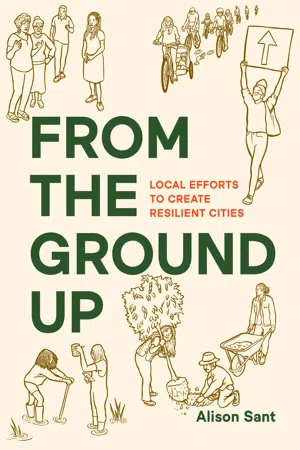
For decades, American cities have experimented with ways to remake themselves in response to climate change. These efforts, often driven by grassroots activism, offer valuable lessons for transforming the places we live. In From the Ground Up: Local Efforts to Create Resilient Cities, design expert Alison Sant focuses on the unique ways in which US cities are working to mitigate and adapt to climate change while creating equitable and livable communities. She shows how, from the ground up, we are raising the bar to make cities places in which we don’t just survive, but where all people have the opportunity to thrive.
The efforts discussed in the book demonstrate how urban experimentation and community-based development are informing long-term solutions. Sant shows how US cities are reclaiming their streets from cars, restoring watersheds, growing forests, and adapting shorelines to improve people’s lives while addressing our changing climate. The best examples of this work bring together the energy of community activists, the organization of advocacy groups, the power of city government, and the reach of federal environmental policy.
Sant presents 12 case studies, drawn from research and over 90 interviews with people who are working in these communities to make a difference. For example, advocacy groups in Washington, DC are expanding the urban tree canopy and offering job training in the growing sector of urban forestry. In New York, transit agencies are working to make streets safer for cyclists and pedestrians while shortening commutes. In San Francisco, community activists are creating shoreline parks while addressing historic environmental injustice.
From the Ground Up is a call to action. When we make the places we live more climate resilient, we need to acknowledge and address the history of social and racial injustice. Advocates, non-profit organizations, community-based groups, and government officials will find examples of how to build alliances to support and embolden this vision together. Together we can build cities that will be resilient to the challenges ahead.
- 282 pages
- English
- ePUB (mobile friendly)
- Available on iOS & Android
eBook - ePub
About this book
Information
Topic
ArchitectureSubtopic
Architecture GeneralPART 1
RECLAIM THE STREETS
“NOT TV OR ILLEGAL DRUGS BUT THE AUTOMOBILE HAS BEEN THE CHIEF DESTROYER OF AMERICAN COMMUNITIES.”1
—JANE JACOBS
In the United States, 25 to 35 percent of a city’s developed land is devoted to streets, which are dominated by the automobile.2 Many of the city’s streets are inhumane, lacking enough space for safe walking and biking, efficient public transit, or vibrant public spaces. Cars take up a lot of room in cities.3 While the private automobile carries 600 to 1,600 people an hour, two-way protected bikeways move 7,500 people, sidewalks 9,000, and on-street bus or rail transitways between 10,000 and 25,000.4
As Christof Spieler described in Trains, Buses, People: An Opinionated Atlas of U.S. Transit, the advantages of transit are “a matter of geometry.”5 Cars not only claim space while they are being driven, but also when they sit parked and idle nearly 80 percent of the time. For example, San Francisco’s 440,000 on-street parking spaces make up enough space combined to create another Golden Gate Park and still fill the floor space of 120 Transamerica Pyramids with affordable housing.6 This reality has prompted tactical interventions to reclaim parking spaces in San Francisco and permanently close entire streets in New York City (see chapters 1 and 3).
Americans pay dearly for roads whether we drive on them or not. The cost of automobile debt and ownership is often more than an average household spends on food, twice what it spends on health care, and three times what it spends on rent.7 In addition, US households pay an average of $1,100 per year in taxes to pay for the costs of driving.8 As addressed in this book’s introduction, roads cost lives as well (see introduction). Reclaiming city streets presents one of the greatest opportunities to mitigate global climate change.9 Expanding low-and zero-carbon mobility options is essential to curbing greenhouse gas emissions. It is also an opportunity to build equitable transportation systems that offer affordable fares and reasonable daily commutes, especially for those who have been pushed to live farther and farther from the center of cities due to the rising costs of housing. New York City, for example, is expanding its Select Bus Service (SBS) and creating new busways that prioritize transit on city streets and make service more reliable throughout the five boroughs.
ROADS WERE NOT MADE FOR CARS
In the 1890s, city streets were shared spaces, used mainly by people walking, biking, riding transit, and occasionally by those driving cars. The iconic San Francisco film A Trip Down Market Street characterizes what roads once felt like. It depicts a blur of trains, bikes, horse-drawn carriages, pedestrians, and cars all in a seemingly chaotic but slow dance.10 It also depicts the rhythm of the street before the crosswalk and the traffic light. People had the time and space to encounter and negotiate with each other directly.
As urban populations and traffic swelled, the rules of the road became more formalized and space more congested. As Evan Friss described in his book The Cycling City: Bicycles and Urban America in the 1890s, “The American city of the 1890s was, more than ever before or after, a cycling city.”11 In fact, bicycles were nearly as ubiquitous in cities across the United States as they are today in the best cycling cities in the world.12 Ironically, “good roads” campaigns were advanced by cyclists to replace the cobblestone streets, muddy paths, and hazardous cable-car tracks with smooth streets for speedy travel on two wheels.13 The roads were paved for bikes. However, cars soon came to dominate streets that were once shared public spaces. Pedestrians became criminalized in the 1920s as “jaywalkers” for disregarding traffic rules, and cyclists were increasingly marginalized from roadways.14
Historically, transportation investments have favored those who have access to cars. The Collier-Burns Act, passed in 1947, reoriented the state highway system from multipurpose rural roads to limited-access superhighways and extended them into the cities for the first time. Republican President Dwight Eisenhower signed the Federal Highway Act of 1956 devoting $25 billion to reorienting the American landscape to the automobile. Black neighborhoods were often gutted by new freeways (see introduction). These planning choices have left multigenerational scars that physically divide communities, promote segregation and disinvestment, and perpetuate poverty.15
Simultaneously, public transit was underfunded, often exacerbating underlying inequities as inadequate service made communities car-dependent or commuting times excruciatingly long and thus limiting access to jobs, schools, and services. As this book describes, the legacy of slavery and systemic racism has created long-term disparities legible in every aspect of the urban landscape.
“PURPLE-LINING”
During 2020 shelter-in-place orders, Oakland, California, was one of the first cities in the country to begin closing streets to traffic. These streets allowed space for physical distancing while making room for walking, rolling, jogging, and biking. They provided critical social services, room for schools, and opportunities for businesses to stay open as the pandemic wore on.16 In cities worldwide, where temporary street closures created safe space for biking during the pandemic, ridership increased by as much as 48 percent.17 Oakland prioritized routes in under-resourced neighborhoods, recognizing that many of the communities hardest hit by the pandemic were those that have the least access to parks, open spaces, and streets that are safe for walking and biking. However, these programs were criticized by urbanists for not engaging the community in the process. Many were asking, who are these streets for?
Dr. Destiny Thomas is a cultural anthropologist and planner, as well as the founder and chief executive officer of Thrivance Project, an organization focused on social justice and racial equity. She argued that because Black and Brown communities were not involved, an opportunity was missed to reverse the legacy of discrimination.18 She refers to this practice as “purple-lining,” an analog to the post–Depression era “redlining.”19 In his book The Color of Law: The Forgotten History of How Our Government Segregated America, Richard Rothstein describes how discriminatory housing policies were repeated in cities throughout the United States, effectively creating the nation’s Black ghettos.20 Redlining was a practice whereby neighborhoods predominantly occupied by people of color were considered high risk for home loans, causing banks to avoid lending in these areas for mortgages and home repairs. Insurance companies wouldn’t offer homeowner’s policies. These racist policies were followed by disinvestment in public infrastructure, including transportation, civil services, parks, and street trees, and have left an indelible mark on the landscape of US cities.
Thomas explained that her use of “purple” came from her own experiences in the Los Angeles Department of Transportation leading community engagement efforts. She described walking into meetings at which her mostly White colleagues—having left her out of conversations—would update plans, and areas of the map where Black people lived would be shaded in purple. She said, “We outlawed redlining practices. But it became so ingrained in our processes and policies that no one ever blinks an eye at the fact that the legacy of redlining is still written into everything. To me, purple-lining is a reiteration of keeping people out of the process and stripping people of self-determination.”21 For Thomas, the process of creating Slow Streets was analogous. As she explained: “I’m excited about open streets, too, but I can’t help but to acknowledge that we have undermined their value by not centering the people who we’re saying they are most beneficial to.” She continued, “We can’t lose sight of the fact that our personal experiences, and relationships to and with the built environment, don’t always match that of other people who, in this crisis, are experiencing disparities, by way of structural racism.”22
During the pandemic and beyond it, Thomas advocates for a “community planning model” in which decision-making power is shifted to residents. “I think that it’s time for something radical,” she said. “We need to think creatively about how to funnel resources directly to the people who are actual experts in the land use area, which is the people who live on the land.”23 Tamika Butler (see Butler’s essay, “Building Inclusive Cities from the Ground Up”) explained that the community must drive the process. That is true whether advocating for a Slow Street in San Francisco or a bike lane such as the Northside Greenway in Minneapolis (see chapter 2). “For so long, folks have conflated community outreach and community engagement and they think they’re the same thing,” Butler said. “Just going out and telling people what you’re going to do is not the same as actually engaging them. Because when you are engaging with somebody, you are open to the possibility that however you start that engagement might not be how you end it.”24
BLACK LIVES MATTER
In the United States, Thomas makes clear that “‘Safe streets’ are not safe for Black lives.”25 On May 25, 2020, the nation witnessed evidence of this enduring reality when George Floyd, a forty-six-year-old Black man, was murdered in South Minneapolis, Minnesota, by a White police officer. Floyd is one of many Black Americans killed by police on the nation’s streets.26 Captured on video, the footage of Floyd’s murder was instantly seen by many Americans. Street protests erupted throughout the nation (and many parts of the world), reigniting the civil rights movement, with calls voicing “Black Lives Matter” and demands to reallocate police funding. The names of Ahmaud Arbery, Michael Brown, Eric Garner, Freddie Gray, Tamir Rice, Walter Scott, Breonna Taylor, and many other Black people who were killed by White police officers were written on the signs of millions of protesters. Streets provided important sites for protest, reaffirming their fundamental place in civic life.27 As sociologist and criminologist Patrick Sharkey pointed out in his book Uneasy Peace: The Great Crime Decline, the Renewal of City Life, and the Next War on Violence: “These deaths are not independent, isolated incidents. They are only the most visible examples of a national approach to confronting violent crime, and the larger problem of urban poverty, in the nation’s poorest, most segregated neighborhoods.”28
Today, emerging community policing models empower what Sharkey described as the “new guardians” who care for their neighborhoods through a benevolent community presence.29 These approaches are explored in San Francisco’s Tenderloin neighborhood (see chapter 1). They speak to the history of the Black Panthers for Self Defense, whose “survival programs” in the mid-1960s resisted police brutality and provided food, clothing, and safe passage in Black communities.30
RECLAIMING OUR STREETS
For the benefit of humanity and the sustainability of the planet, this is a time to reclaim the streets for people. As Janette Sadik-Khan, former commissioner of the New York City Department of Transportation, described, “If cities truly want a future where more people choose to take buses or trains, to bike or walk, then cities must invest in trains and buses, bikes and better streets.”31 Congestion pricing, which requires drivers to pay a toll for entering the central business district, has been approved in New York (see chapter 3). Estimates project $1 billion in revenue from the program, part of which will go to pay for public transportation.32 A $10 billion federal pilot program was proposed to help communities tear down urban highways and invest in communities of color through the Restoring Neighborhoods and Strengthening Communities Program (also known as the “Highways to Boulevards” initiative).33 These large-scale funding approaches are necessary to create equitable public trans...
Table of contents
- Cover Page
- Title Page
- Copyright Page
- Dedication
- Contents
- Foreword
- Preface
- Acknowledgments
- List of Interviewees
- A Note on the Illustrations
- Introduction: Reimagining Our Cities
- Part 1: Reclaim the Streets
- Part 2: Tear up the Concrete
- Part 3: Plant the City
- Part 4: Adapt the Shoreline
- Conclusion: A Path Forward
- Notes
- About the Author
Trusted by 375,005 students
Access to over 1.5 million titles for a fair monthly price.
Study more efficiently using our study tools.
Frequently asked questions
Yes, you can cancel anytime from the Subscription tab in your account settings on the Perlego website. Your subscription will stay active until the end of your current billing period. Learn how to cancel your subscription
No, books cannot be downloaded as external files, such as PDFs, for use outside of Perlego. However, you can download books within the Perlego app for offline reading on mobile or tablet. Learn how to download books offline
Perlego offers two plans: Essential and Complete
- Essential is ideal for learners and professionals who enjoy exploring a wide range of subjects. Access the Essential Library with 800,000+ trusted titles and best-sellers across business, personal growth, and the humanities. Includes unlimited reading time and Standard Read Aloud voice.
- Complete: Perfect for advanced learners and researchers needing full, unrestricted access. Unlock 1.5M+ books across hundreds of subjects, including academic and specialized titles. The Complete Plan also includes advanced features like Premium Read Aloud and Research Assistant.
We are an online textbook subscription service, where you can get access to an entire online library for less than the price of a single book per month. With over 1.5 million books across 990+ topics, we’ve got you covered! Learn about our mission
Look out for the read-aloud symbol on your next book to see if you can listen to it. The read-aloud tool reads text aloud for you, highlighting the text as it is being read. You can pause it, speed it up and slow it down. Learn more about Read Aloud
Yes! You can use the Perlego app on both iOS and Android devices to read anytime, anywhere — even offline. Perfect for commutes or when you’re on the go.
Please note we cannot support devices running on iOS 13 and Android 7 or earlier. Learn more about using the app
Please note we cannot support devices running on iOS 13 and Android 7 or earlier. Learn more about using the app
Yes, you can access From the Ground Up by Alison Sant in PDF and/or ePUB format, as well as other popular books in Architecture & Architecture General. We have over 1.5 million books available in our catalogue for you to explore.