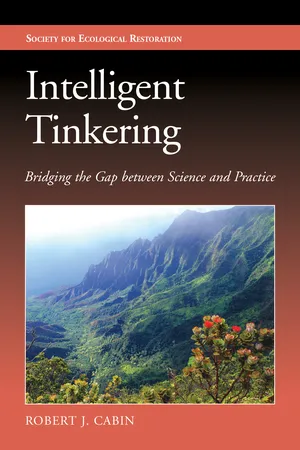
Robert J. Cabin uses the restoration of tropical dry forestland in Hawaii as an in-depth case study to investigate the scientific, practical, and philosophical issues associated with performing ecological restoration in the messy real world.
Interweaving entertaining narratives of his own on-the-ground experiences as a practicing restorationist with reflections about his scientific training and background, Cabin explores the relationship between science and practice in ecological restoration. He observes that because restoration can be complex and value-driven, its implementation often turns out to be as much interdisciplinary art as hard science. Despite the often distinct cultures and methodologies of scientists and practitioners, Cabin shows how each has a vital role in effective restoration and offers suggestions for improving working relationships.
One approach he advocates is what he calls "intelligent tinkering," after the work of Aldo Leopold. In this model, practitioners employ the same kind of careful but informal trial-and-error strategy followed by such groups as indigenous peoples and hobbyist mechanics. Cabin illustrates the power of intelligent tinkering using examples from his own work and other restoration projects.
The gap between science and practice is not unique to ecological restoration; it is a widespread problem across all fields of applied science. Written in a clear and engaging style, Intelligent Tinkering offers an insightful look at the underlying causes of the problem, along with invaluable suggestions for addressing it.
Near the end of a long midwestern winter I got a call from a Dr. Stephen Weller at the University of California, Irvine, regarding a postdoctoral fellowship in restoration ecology at the National Tropical Botanical Garden (NTBG) on the island of Kaua‘i. He explained that the original plan to fly the top three candidates to Hawai‘i to interview with him and the garden staff had fallen through, but if I was still interested, the position was mine.
I had completed my PhD in biology at the University of New Mexico the previous year and subsequently landed a one-year position as a visiting assistant professor at Kenyon College, a small liberal arts school in northeastern Ohio. Things had gone well, and Kenyon had recently offered me the option of staying on to teach another year. I was thirty years old and had just fallen in love, for the first time in many years.
I looked past my teetering stacks of ungraded papers and out the dingy window of my campus apartment. It was another gray day, and the street was full of rusty cars and dirty slush. I had never been to Hawai‘i and had virtually no knowledge of nor interest in our fiftieth state. (Before Kenyon offered to extend my appointment, I had frantically applied for this and dozens of other jobs in a desperate attempt to stave off the academic career-killing condition known as unemployment.) I had never met Dr. Weller, had no experience in restoration ecology or tropical biology, and, until this job came up, had never heard of the NTBG or even the island of Kaua‘i.
I thought for a good three seconds about staying in Ohio another year and then accepted Steve's offer.
Three days after we were married, my wife and I flew to Kaua‘i, in August 1996. Since my postdoc fellowship didn't officially start for another week, we decided to play tourist. We spent our days at the ocean, bronzing on the sand, snorkeling, and bodyboarding; we spent our nights on the lanai of our ‘ohana apartment, gawking at the surreal ocean sunsets, listening to cheesy Hawaiian music, and drinking too many mai tais. One day near the end of that week, while floating in the sun-drenched ocean, I felt a weight that I hadn't even known was there suddenly lift off my neck and shoulders. I felt light and free and happy and thought that weight was gone for good.
The next month, I met with Steve Weller and two NTBG employees, Dave Lorence and Tim Flynn, to begin mapping out a restoration plan for the Garden's Ka‘upulehu Dry Forest Preserve on the island of Hawai‘i. Steve, a full professor of ecology and evolutionary biology at UC Irvine, was a leading expert in the study of the evolutionary genetics of plant reproductive systems. Dave, the NTBG's senior research botanist, specialized in plant systematics in general and the floristics of Pacific islands in particular. Tim was the curator of the NTBG's herbarium and an expert student of both the native and alien flora of Hawai‘i.
The next day, the four of us flew from Kaua‘i to the town of Kailua-Kona on the dry, leeward side of the island of Hawai‘i. Looking out the window at the Kona landscape as we slowly taxied toward our gate, I saw a brown, tough-looking grass growing right through the cracks in the macadam runway. This grass was the only thing growing in the raw black lava flows surrounding the runway.
“What is that?” I asked Dave, pointing out the window.
He sighed, removed his glasses, and rubbed his forehead. “Pennisetum setaceum—African fountain grass,” he said with a shudder, not even bothering to look out the window.
Before moving to Hawai‘i, I had read about the great forests that once covered the dry lowland sections of the Big Island. These forests were the favorite place in all the islands of the great Hawaiian king Kamehameha I, the only Hawaiian to conquer all of the competing tribes and unite the entire island chain under his rule. In the early twentieth century, the famous English botanist Joseph Rock, author of the classic Indigenous Trees of the Hawaiian Islands, noted that there were more native tree species in these communities than anywhere else in the archipelago. Yet by the time Rock arrived in Hawai‘i, most of the islands’ original dry forests were long gone, and feral and domesticated herds of goats and cattle continued to ravage the few dry forest fragments that remained. These and other exotic animals also facilitated the subsequent invasion of these forests by noxious alien plants such as prickly pear cactus (Opuntia ficus-indica), thorny lantana shrubs (Lantana camara), and fast-growing Christmas berry trees (Schinus terebinthifolius). But although these alien species and Kona's booming tourist economy still wreak havoc on the region's remaining patches of native dry forest, today their single greatest threat is fountain grass.
If I were an alien species attempting to colonize and invade new territory, there's no place I'd rather be than the Hawaiian Islands. First, there is the islands’ justly famous mild, benevolent, and stable climate. Second, there is a lot of ecological elbow room here. Because of Hawai‘i’s extreme geographic isolation, very few species were able to disperse to these islands and establish themselves. When the Polynesian sailors first reached Hawai‘i’s shores some 1,500 years ago, the only other mammals present were the Hawaiian monk seal (Monachus schauinslandi) and two species of hoary bat (Lasiurus cinereus), and there were no reptiles or amphibians at all. And because they evolved without the intense competition and predation pressures of the more crowded and diverse mainland systems, Hawai‘i’s native species tend to be wimps relative to their alien competitors and “ice cream” to their alien predators.
Hawai‘i’s native raspberries (Rubus hawaiensis), for instance, have essentially no thorns. Until recently there were no animals around to eat them, so natural selection favored individuals that put the energy formerly spent on making thorns into something more useful, such as making more berries. In contrast, having evolved in places with intense herbivory and competition from other plants, the exotic raspberries in Hawai‘i are thorny and much more aggressive than the native species. One of these invaders, the dreaded Himalayan raspberry (Rubus ellipticus), has huge thorns that I quickly discovered can cut through flesh like concertina wire. Not surprisingly, this species has spread throughout the Hawaiian Islands like, well, a noxious weed.
Still another major advantage of landing in Hawai‘i is the golden opportunity to escape one's troubles. (An ancient Hawaiian saying, Lele au la, hokahoka wale iho, translates as “I fly away, leaving disappointment behind.”) For example, fountain grass is apparently a minor component of the savanna in its native region of North Africa. Its distribution and abundance are presumably held in check by Africa's many other grass species, its rich diversity of herbaceous insects and mammals, and a variety of pathogens and diseases. But when fountain grass began spreading across the leeward side of the Big Island, it apparently encountered only sunshine, open space, and Hawai‘i’s famous aloha spirit.
To avoid extinction, plants subjected to long periods of heavy and sustained herbivory must develop effective coping strategies. Like many other such plants, over its evolutionary history fountain grass evolved a two-tiered approach: be as unpalatable to herbivores as possible, and bounce back quickly from herbivory and other disturbances if and when they do occur. Thus, while there were (and still are) lots of cattle and goats roaming around the Big Island, clumps of mature fountain grass were about the last thing they wanted to eat. Although these animals will eat this species (especially the emerging, relatively tender new shoots) if they are hungry enough and there is nothing else around, fountain grass, like many other noxious weeds, can withstand, and even thrive under, intense levels of ungulate herbivory.
Conversely, most of Hawai‘i’s plants that evolved from mainland ancestors, such as the raspberry, eventually lost their ability to deter and withstand being eaten. Many of the plant species that evolved entirely within Hawai‘i (i.e., those whose ancestors were preexisting Hawaiian plants) simply never developed any mammalian defenses in the first place. The net result of these contrasting evolutionary histories is that the cattle, goats, and other alien animals will search through acres of thick, raunchy fountain grass to find and devour a few delicious and nutritious leaves of some forlorn and defenseless native species.
The story of fountain grass's invasion is representative of countless other deliberately introduced exotic plants within and beyond the Hawaiian Islands. At some point in the past, somebody wanted a new plant for his or her home or business that promised to be useful, valuable, pretty, or novel. Many of us do more or less the same thing today when we search for new plants to put in and around our homes. Most of the time, these botanical adventures are perfectly harmless—the new plants either do what we wanted them to do or fail to thrive and eventually fade away. However, in a small but significant number of cases, we get much more than we bargained for.
It is not hard to imagine why someone chose to bring fountain grass to Hawai‘i. When this hardy species is well watered and fertilized, it produces long, lovely clusters of bright green blades and “fountains” of spikes covered with attractive purple flowers. Even today fountain grass is often prominently featured in the manicured ornamental landscapes of Kona's expensive homes and industrial developments—the ecological equivalent of planting star thistle in Washington or kudzu in Georgia.
For many years after it was first planted on the Big Island, around the turn of the twentieth century, fountain grass apparently just sat there. Many aggressive alien species exhibit this so-called lag phase, in which they do not spread much beyond the site of their first colonization of new territory. The lag phase may last for years, decades, or in some cases even centuries. But then, for reasons that are not well understood, sometimes so slowly that no one notices, sometimes so explosively that everyone is forced to pay attention, the biological invasion begins.
Fountain grass began spreading across the leeward side of the Big Island sometime after 1915. Like many invasive plants, this species is capable of rapid and prolific reproduction and dispersal. An individual clump can produce tens of thousands of parachute-like seeds that, with the slightest breeze, are literally gone with the wind. The seeds may also be effectively dispersed by humans and our accoutrements (vehicles, equipment, clothing, etc.), water, and possibly small animals such as birds, rodents, and insects. After dispersal, fountain grass seeds may stay in a dormant but viable state for many years while they wait for favorable conditions to germinate, become established, and eventually produce thousands upon thousands more seeds. Today, fountain grass infests over 200,000 acres of arid land on the Big Island, from sea level to altitudes over 9,000 feet. Wherever it grows, this species both suppresses the establishment, growth, and regeneration of native species and greatly increases the risk of catastrophic fires.
One might assume that, given the islands’ volcanic origin, Hawai‘i’s native species would have evolved with at least occasional fires. Indeed, for millions of years, rivers of red-hot molten lava flowed down from the active volcanoes and incinerated everything in their path until finally exploding into the sea. (This phenomenon still occurs on the Big Island, which is home to the world's most active volcano.) However, before the arrival of fountain grass and other weeds, the vegetation in many native ecosystems apparently did not produce enough fuel to carry fire much beyond the edges of the lava flows themselves. Consequently, most of Hawai‘i’s native species lack the adaptations necessary to withstand fires or effectively reestablish themselves in the fires’ wake. Thus, unlike many mainland conservationists, who often use fire to control weeds and reestablish native species and ecosystem processes, in Hawai‘i we mostly fight rather than light fires.
Kona has one of the few commercial airports left in the United States in which you still walk off the plane directly into the unfiltered outside world. Kona can get away with this because it almost never rains there, and the temperature rarely drops below 75 degrees. The second Dave, Tim, Steve, and I stepped out of our plane's air-conditioned cabin, we were engulfed by intense sunshine and hot, dry air. Walking across the runway, I was secretly disappointed that, unlike the scenes in all those old movies and television shows I had watched as a kid, there did not appear to be any beautiful hula girls waiting around to greet me with a kiss and fresh lei.
We collected our bags and rental car and headed straight for the Ka‘upulehu Preserve. As we drove up and away from the coast, clumps of trees and shrubs began to appear within the seemingly endless fields of lava rock and fountain grass. I was also beginning to recognize both the planted and wild groves of Hawai‘i’s beloved (yet nonnative) food plants—bananas, breadfruit, mangoes, papaya, and coffee. (While connoisseurs argue over whether Kona coffee is truly, as advertised, the “world's best,” everyone agrees that it is the world's most expensive.) My colleagues also pointed out a cosmopolitan collection of world-class weeds that had elbowed their way into the landscape. The ecologist in me couldn't help pondering how such a bizarre “ecosystem” might work: What happens when aggressive species with radically different evolutionary and ecological backgrounds are brought out to the middle of nowhere and haphazardly mixed together?
Dave turned onto a side street and stopped next to a rough young ‘a‘
lava flow running parallel with the road. Most of this flow was completely barren; it looked like a frozen river of jagged black rocks. But off in the distance were a few scrubby trees growing improbably out of the lava like weeds on a gravel pile.
“‘Ohe makai,” Dave said, pointing to a strange-looking tree whose leaves were fluttering in the breeze.
Seeing my blank expression, Steve said, “Reynoldsia sandwicensis.” I recognized this scientific binomial from my various readings, so I knew I was looking at my first native dry forest species.
“And there's a wiliwili,” Tim said, pointing to an elfish-looking tree with reddish bark and no leaves.
“Erythrina sandwicensis,” Steve said, rescuing me again. “The only drought-deciduous tree out here.”
Having done my graduate work in the deserts of New Mexico, I was well acquainted with this clever strategy employed by many species in arid climates. Most plants acquire the carbon dioxide they need to perform photosynthesis by opening tiny pores in their leaves called stomata. However, because the concentration of water inside plants growing in dry ecosystems is usually much greater than it is outside the plant, water vapor inevitably flows out the stomata as the carbon dioxide diffuses in. As the name implies, drought-deciduous plants solve this problem by simply shedding their leaves during prolonged dry spells and thus preserving their precious water reserves. When the rains return, they quickly grow new leaves and resume photosynthesis.
“I would have thought there'd be lots of drought-deciduous species out here,” I said. But everyone just shrugged, as if to say, “This is Hawai‘i. Everything is different out here.”
Dave pulled back onto the road, and we resumed our journey through the fountain grass and patchwork quilt of alien weeds. We climbed to about 2,000 feet and headed north toward the Ka‘upulehu Preserve on the two-lane Mamalahoa Highway (Hawai‘i Belt Road). After we rounded a bend in the road to the northeast, the terrain suddenly morphed from a mostly alien forested landscape to an open grassland sprinkled with scattered clumps of trees. Dave explained that even though the preserve was just two more miles down the highway, it received on average only about a tenth as much rain as the more forested region behind us. These sharp climatic gradients are common in Hawai‘i and are partially responsible for the extreme physical and ecological diversity of these islands. For instance, within an area roughly the size of Connecticut, the Big Island alone contains ecosystems ranging from snow-covered mountains to soggy rain forests to bone-dry deserts.
At the next sharp turn, we pulled unceremoniously off the highway and onto some rough, gravelly lava. “There it is,” Steve said, pointing out the window and upslope to our right. “The NTBG's Ka‘upulehu Dry Forest Preserve.”
I knew from my previous readings that this preserve lies some 2,000 feet above the coastline in the lee of the 8,271-foot summit of Hualalai Volcano. The rocks that constitute the surface substrate of this area were formed 1,500 to 3,000 years ago, when rivers of molten lava emerged from near the summit of Hualalai and then meandered all the way down into the Kona sea. One of the many meanings of the Hawaiian word ka‘upulehu is “to burn breadfruit.” According to this interpretation, at the beginning of a large eruption 200 years ago, the people who lived in this area prayed to Pele, the Hawaiian goddess of fire, to spare their lands and villages. She apparently heard their prayers, accepted their sacrificial offerings of burned breadfruit, and at the last minute diverted her lava around this forest. Today, a broad and barren lava field laid down during that 1801 flow forms the northern boundary of the Ka‘upulehu Preserve. So far, at least, it has protected the preserve from fires originating from that direction. Although Hualalai has since been dormant, geologists say eruptions could resume at any time.
I looked out the window and saw a sparse stand of drab, pale-green trees punctuated by largely treeless patches of both barren and fountain grass-infested lava outcroppings. After we all piled out of the car, Tim walked over and opened the “gate” by untying some twine and peeling back a crude section of loose hog-wire fence that formed the lower border of the exclosure.
I scrutinized this remnant of one of the rarest and most endangered ecosystems in the world, half expecting some kind of transcendental experience or intellectual epiphany. But what I mostly felt was hot, and what I mostly saw was a diminutive forest that reminded me of the stunted scrub oak groves that commonly grow along the East Coast of the US mainland. There were no parakeets or monkeys, no coconuts or waterfalls, no flowers or even lush foliage. After I walked through the gate and stumbled my way across the loose lava and into the forest, I found that the shade cast by these trees’ sparse canopies did not provide much relief from either the intense heat or the tenacious, ankle-twisting, arm-scratching, goddamned fountain grass. I looked back across the highway and down to the turquoise sea, wondering whether there'd be time at the end of our day for a visit to one of those world-class beaches I'd noticed in the in-flight magazine on our way over from Kaua‘i that morning.
Fortunately, there was no time for me to indulge in my little daydreams because we were there to work. I was actually grateful for this because I've often found the best way to get to know new places and new people is through good, old-fashioned hard physical labor. As I soon discovered on that first day, there was always more than enough of this to go around at Ka‘upulehu, no matter how many people showed up.
Several hours later, I swung my pickax at another clump of fountain grass for the fourth and, I swore, last time. But once again the ax sliced through the fountain grass litter and glanced off the underlying sheet of lava rock, painfully twisting the handle in my already blistered hands. Throwing the ax aside in disgust, I squatted down, bear-hugged as much of the scratchy base and root crown as I could, and yanked backward. As I struggled, I saw that this clump's fibrous root network had snaked its way in, around, and through the underlying porous lava. With mounting frustration, I planted my feet even wider, bent down as low as I could, and took a long, deep breath. Using all my strength, I ripped the clump and several tightly encircled chunks of lava out of the ground and then flipped the whole wad over so it looked like an upside-down turtle. Panting, I looked at the spidery mess of torn fountain grass roots dangling from the edges of the crater I had just created. I had no idea whether those roots were capable of growing another clump of grass, but I would have bet ten to one that they could.
I stopped to drink some water, wipe the sweat and dust out of my eyes, and survey my meager progress. Like so many field projects, it had seemed like a brilliant idea during our air-conditioned, beer-driven meeting back on Kaua‘i the night before. Perhaps, we had reasoned, the only way to really control fountain grass was by ripping it out by the roots. But after t...
Table of contents
Cover Page
Title Page
Copyright Page
Dedication Page
Contents
Acknowledgments
Introduction: The Science of Restoration Ecology and the Practice of Ecological Restoration
Part 1. Restoring Paradise
Part 2. Toward a More Perfect Union
Selected Bibliography
Index
Trusted by 375,005 students
Access to over 1.5 million titles for a fair monthly price.
Study more efficiently using our study tools.
Frequently asked questions
Yes, you can cancel anytime from the Subscription tab in your account settings on the Perlego website. Your subscription will stay active until the end of your current billing period. Learn how to cancel your subscription
No, books cannot be downloaded as external files, such as PDFs, for use outside of Perlego. However, you can download books within the Perlego app for offline reading on mobile or tablet. Learn how to download books offline
Perlego offers two plans: Essential and Complete
Essential is ideal for learners and professionals who enjoy exploring a wide range of subjects. Access the Essential Library with 800,000+ trusted titles and best-sellers across business, personal growth, and the humanities. Includes unlimited reading time and Standard Read Aloud voice.
Complete: Perfect for advanced learners and researchers needing full, unrestricted access. Unlock 1.5M+ books across hundreds of subjects, including academic and specialized titles. The Complete Plan also includes advanced features like Premium Read Aloud and Research Assistant.
Both plans are available with monthly, semester, or annual billing cycles.
We are an online textbook subscription service, where you can get access to an entire online library for less than the price of a single book per month. With over 1.5 million books across 990+ topics, we’ve got you covered! Learn about our mission
Look out for the read-aloud symbol on your next book to see if you can listen to it. The read-aloud tool reads text aloud for you, highlighting the text as it is being read. You can pause it, speed it up and slow it down. Learn more about Read Aloud
Yes! You can use the Perlego app on both iOS and Android devices to read anytime, anywhere — even offline. Perfect for commutes or when you’re on the go. Please note we cannot support devices running on iOS 13 and Android 7 or earlier. Learn more about using the app
Yes, you can access Intelligent Tinkering by Robert Jonathan Cabin in PDF and/or ePUB format, as well as other popular books in Biological Sciences & Ecology. We have over 1.5 million books available in our catalogue for you to explore.