Owning and Managing Forests is both an accessible overview of the privileges, rights, and obligations that accompany forest ownership and a guidebook to help active forest owners and managers use laws to their advantage and avoid the pitfalls of expensive and exhausting litigation. The book is a revised, expanded, and updated edition of Legal Aspects of Owning and Managing Woodlands, published in 1998 by Island Press and named Best Forestry Book of the Year by the National Woodland Owners Association.
This edition provides current information on recent changes in property, environmental, and tax laws, while also discussing new directions in forest management. It offers expanded treatment of topics including private property, searching property records, easements, estate planning, timber sale contracts, working with forestry professionals, and how to pass woodlands intact to future generations. The book also describes the many different facets of trusts, changes in forestland taxation methods, and new licensing and certification options. Included, too, is a section on avoiding disputes and how to use alternative dispute resolution methods to avoid costly, troubling, and time-consuming court battles.
Owning and Managing Forests provides clear and concise descriptions of often confusing concepts and difficult subjects, and addresses issues in a competent yet conversational tone. Anyone involved with owning or managing forestland will find the book an essential guide and reference.
eBook - ePub
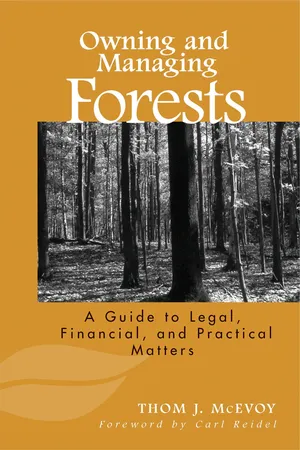
Owning and Managing Forests
A Guide to Legal, Financial, and Practical Matters
- English
- ePUB (mobile friendly)
- Available on iOS & Android
eBook - ePub
About this book
Information
Chapter 1
Forestry: Past, Present, and Future
One of the strengths of forests in the United States is the diversity of people who own them. Of the 737 million acres of woodlands in this country, 58 percent are owned by families, individuals, estates, and businesses—a very high percentage by global standards. Private ownership is a strength because different owners have dissimilar ideas about forest resource values and how best to manage lands as well as disparate management schedules and different priorities. This leads to diverse landscapes, and forest diversity promotes healthy forest ecosystems, appealing vistas, and a steady supply of such forest benefits as timber, wildlife, and recreation.
There are about 10 million private woodland owners in the United States, most of whom reside east of the Mississippi River (Birch 1994). With so many different private owners spread across 24 degrees of temperate latitude, one would expect many diverse ecosystems and many goals and needs of owners. All private forest owners have one thing in common, though: at some point during their forest ownership they will encounter legal matters directly related to owning and managing woodlands. For most of them, the encounters will be simple—a sale closing, title search, or timber sale contract. Some will experience encounters with the law that are less simple—boundary disputes, liability, and conflicts of interest. The purpose of this book is to describe the legal nature of forests, from our ideas of private property to the ethics of forestry practice and the difficulties of planning for the future of the forests that we leave to our children.
This is not a definitive guide on how to deal with the simple and not-so-simple legal aspects of owning and managing woodlands, for obvious reasons: laws and forest-use traditions vary from place to place, and the circumstances surrounding one individual almost never apply to another. Because laws help define acceptable and unacceptable behavior, it is the application of law to specific behaviors or circumstances that makes each case different. In many respects, however, laws apply broadly to the experiences encountered by forest owners irrespective of where they live, and that is the emphasis of the chapters that follow.
Owning and managing forest lands is a legal endeavor: from forest acquisition to deeds and boundaries, from timber sales to bequests, a forest owner can do little without confronting laws, rules, regulations, and traditions that define acceptable and unacceptable practices. Aside from a general notion of when legal assistance is necessary, most forest owners do not fully appreciate the extent to which laws and regulations control or influence decisions. Too often a crash course in local laws follows a disagreement, and one can only hope to be on the right side.
The following chapters describe legal matters that are among the most common requests of public agencies that field inquiries from woodland owners. At the top of the list are questions about timber sales and dealings with foresters and loggers. Although the type of information a public forester might offer in a particular instance would probably not qualify as “legal” advice—at least by standards of the legal profession—it is often guidance an owner will listen to and follow. The difference between legal advice and the advice of a public forester is the degree to which information is tailored to a client’s request. It is the wise forester who answers specific questions in general terms, with the objective of educating the owner. Specific advice—what to do and what not to do in a particular instance—is dangerous ground for a public servant.
There is no better measure of a democratic society’s evolution than the laws by which it lives. The older a society, the more complex its laws become, because legal systems are adaptive, intended to change with society. The U.S. Congress and state legislatures make new laws that, in theory, reflect society’s wishes. Decisions rendered in courts through the application of existing laws become “precedents” for subsequent decisions. The specific application of laws, precedents, and the procedures used to argue points of law in court are the main reasons we have lawyers. Not many lawyers, though, specialize in legal matters related to owning and managing woodlands.
Another reason for lawyers is that the technical language of law is Latin—a “dead” language, not in use by society, and thus not apt to change. The law is peppered with Latin words and terms because they can have only one meaning. Ironically, the very thing that assures clarity to lawyers is usually a source of confusion for the layperson. Lawyer jargon, legalese, is virtually incomprehensible unless you have studied law (or Latin). Some skeptics suggest lawyers use legalese to further society’s need for lawyers. For the purposes of this book, while it is impossible to describe legal aspects of forests without some legalese, my goal has been to keep its use to a minimum.
The chapters that follow contain descriptions of a wide range of legal issues related to forest ownership and use. Any one of the chapters could be expanded into its own book. For the reader who is well informed in any one of the subject areas, it will be easy to see that I sacrificed subject depth for breadth. Since the legal norms and traditions that affect forest ownership and management decisions are based on experiences and trends, a brief overview of forestry past, present, and future is in order. The history of forest use and society’s response to the effects of timber harvesting on the intrinsic values of forests have complicated forest ownership. Although the rules and regulations we live by today often seem excessive and unreasonable, put in the perspective of the past they make more sense.
Forestry Past
A forest is a collection of plants and animals that live in places with adequate rainfall (or nearby sources of water), sufficient soil for nutrients and anchoring, and favorable climatic conditions. More than half the land area of the United States meets the minimum environmental conditions for forests, and about one-third of U.S. soil currently supports forests. The difference between potential forests and existing forests is that potential forests are largely lands that have been cleared for agriculture and for human settlement. A broad swath of land west of the Mississippi River and east of the Rocky Mountains, however, is too dry to support forests, except along rivers and streambeds. West of that region, the presence or absence of forests is mostly related to elevation, aspect, and prior land use. Where there are mountains tall enough to force uplifting and cooling of prevailing winds, there is usually rainfall ample enough to support forests.
Forests are synonymous with trees, their most predominant and obvious inhabitant. It was land clearing for agriculture and the use and exploitation of trees for lumber and charcoal—from the eastern states to the Midwest, then on to the Far West—that led to westward expansion and settlement. With few exceptions, the history of forest use in this country is not pretty. Forests were felled as fast as prevailing technologies would allow, with little or no regard for future generations. In the early nineteenth century, forests seemed limitless, but by the beginning of the next century, almost all easily accessible forests had been harvested at least once. When the end of timber was in sight, the science of forestry was imported from northern Europe.
Modern forestry methods, with the goals of increasing harvesting efficiency and sustaining wood yields, were not widely accepted until after World War II. Government and wood-using industries played a leading role in promoting the cause of good forestry. From the late 1940s until the early 1970s, the message from a rapidly growing forestry community was: “Forests are renewable.” Trees were harvested in such a way that new forests were regenerated, or the site was replanted after harvest. The emphasis, however, was on wood yield.
In the mid-1970s, the message shifted to “multiple use,” implying forests can be easily managed for more than one resource at a time. Although “multiple purpose” might have better characterized the philosophy, managers were acknowledging competing forest values and beginning to experiment with ways to harvest timber while protecting or enhancing other forest values.
In the mid-1980s, studies of woodland owner attitudes and motivations revealed that many people were more interested in managing lands for wildlife and other intangible values than for timber. Forest owners were not opposed to harvesting timber. Rather, the motivation to harvest increased in direct proportion to the nonmonetary values of a particular action. For instance, an owner opposed to harvesting trees for the sake of income production will harvest to improve access or to create hiking and ski trails. Providing better habitat for wildlife is high on the list for many owners. Forest stewardship was the theme du jour, and for the first time managers developed forest-management plans in which timber might be subordinate to other values. Forestry was rapidly evolving from an anthropocentric view of forests to a biocentric view.
Forestry Present
Today, the principles of forest management in this country are less than four generations old—sufficient time to regrow only an insignificant fraction of the presettlement forests. And yet the United States has some of the most productive and well-managed forests in the world. Managers have learned a hard lesson from the past: forests are much more than trees. They are an enchantingly complex association of plants and animals—including humans—that can provide many different combinations of benefits, of which timber is only one.
In the early 1990s, amid a highly divisive debate about forestry’s responsibilities to threatened and endangered species, the concepts of biodiversity and ecosystem management emerged. Although the particulars of ecosystem management are discussed in greater detail in chapter 2, its emphasis is on principles and practices that mimic natural processes and thereby protect the integrity of forest ecosystems. A more appropriate term might be “ecosystem approaches to management,” since an ecosystem, by definition, is self-sustaining and does not require management or human intervention. The term management implies human use, and a fundamental agreement of all who have joined the debate is that humans are part of forest ecosystems, and our use of forests must be factored into the picture.
In just the past ten years, forestry practice has experienced a revolution, the emphasis shifting from timber production to protecting forest ecosystems. Although the cause is not clear for this radical departure from traditional forestry, with its emphasis on wood production, a heightened awareness of forest values among the general public, coupled with new science, has changed the way we operate.
Not every manager agrees. There are those who maintain a good forester always considers effects on whole ecosystems. Others charge that traditional forest-management approaches put foresters in the pockets of the wood-using industry, with little regard for nontimber values and the interests of future generations. Although the chances are slim of one side convincing the other it is wrong, both sides appear to want essentially the same thing: productive forests that provide a wide variety of benefits while protecting species and other nonmonetary values that make forests special. The most significant and important aspect of the debate is that it is happening at all. Forestry in the United States is evolving from paramilitaristic origins (possibly due in part to its Teutonic influences), in which authority is never questioned and much is accepted on faith, to a highly multidisciplinary field with few easy answers and many, many questions. A question at the heart of the current debate is: Can we sustain forestry production at current levels and still protect the productive capacity of forests, maintain or improve water quality, provide appealing landscapes and recreation, and provide adequate habitat for a diversity of forest-dwelling plants and animals? The traditionalists say, “That’s what good forestry is all about.” Others say, “Wood production is subordinate to protecting the long-term integrity and health of the forest. If we take care of the forest, wood will be available but probably not at rates thought reasonable just a few years ago.”
The concept of sustainable forestry is gradually replacing sustained yield as the primary goal of good forest management. If a practice is not sustainable—ecologically, economically, and socially—then the practice should be avoided. Wood yield by itself is no longer an adequate measure of good forestry. For some managers—even those with college textbooks from the mid-1970s—weaned on sustained yield, sustainable forestry is a radically new idea. And forestry is not a science and profession known for quickly and easily embracing new ideas.
The forest industry is changing, too. Through its Sustainable Forestry Initiative (SFI), the American Forest and Paper Association, representing many wood-using companies in the United States, is trying to encourage its members to adopt guidelines intended to protect forest ecosystems. Among the guidelines are new procurement policies aimed at keeping loggers out of the woods when forests are especially susceptible to damage, commitments to quickly regenerate harvested lands, and training programs for loggers. The goal of SFI is to shift emphasis from wood production to long-term forest management. Because many companies are publicly held and have a fiduciary responsibility to shareholders, any change that affects the bottom line is risky. For a risk-adverse industry not known for rapid change, the SFI initiative is a valid attempt to move in the direction of more sustainable forestry. But so long as short-term profitability is a motive—as it is for any company with shareholders—there are limits to which SFI principles and guidelines can be implemented. Only when there is a short-term financial advantage to practicing sustainable methods will the incentive exist to do so.
Forestry Future
Because ecosystems are nested (i.e., smaller ecosystems, such as a population of lichens on the trunk of a tree, are part of larger systems, the largest of which is the earth), protecting ecosystem values requires societal decisions that extend far beyond individual owners, local communities, state legislatures, and Congress (figure 1.1). True ecosystem approaches to forest management must transcend geographic boundaries through multilateral partnerships, requiring an unprecedented level of cooperation across many borders—political, geographical, and disciplinary. Policies to protect ecosystem values may thwart a particular owner’s management plans. Herein lies the future forestry debate: How can we protect whole ecosystems without impinging on private property rights? Who makes decisions about which ecosystem values are critical and how we protect them? Who is going to pay for ecosystem management if it costs more than traditional methods? There are no easy answers, and some people suggest that questions such as these are the Achilles’ heel of ecosystem management. Almost everyone, though, despite where they stand on the issues, agrees that ecosystem approaches to managing forests are here to stay.

Figure 1.1. An ecosystem can be defined at many different levels, from the lichens growing on the bark of a single tree, to entire landscapes, continents and—ultimately—the earth. The hierarchical effect is what makes ecosystems so complex, enchanting, and challenging.
While some people are daunted by the prospects of implementing forest ecosystem–friendly policies and practices, others see opportunity. No firm guidelines exist today on the techniques and methods of managing whole ecosystems, but innovative forestry professionals are committed to adaptive management, based on the theory that when in doubt, it is better to err on the side of inaction, knowing that practices will change as new science becomes available. Woodland owners are increasingly receptive to new practices, even if it means less immediate income and/or longer investment periods.
An emerging trend in the marketplace may make the wait worthwhile. Consumers in Europe are favoring products that are manufactured in an environmentally sensitive fashion. To give consumers credible product pedigree guarantees, the manufacturing process is monitored and certified by independent, third-party organizations. The certification process extends from raw material to the shelf by maintaining a chain-of-custody. This gives the consumer assurances a product has been manufactured without unacceptable exploitation of people or the earth. Also known as green certification, it is an attempt to inform consumers of the environmental and social consequences associated with the products they use. The idea is still relatively new in this country and there is no reliable evidence to suggest consumers in the United States would seek out or pay more for green-certified products. Some manufacturers and retailers, however, are demanding green-certified raw materials or final products, and there is a growing trend to market the earth-friendly aspects of those products. It may be only a matter of time before consumers favor green-certified products over those of unknown origin. As consumer demand for certified products increases, the demand for certified timber will grow. Forest owners who are aware of this trend, and agree to abide by the princ...
Table of contents
- About Island Press
- Title Page
- Copyright Page
- Table of Contents
- Foreword
- Preface and Acknowledgments
- Chapter 1 - Forestry: Past, Present, and Future
- Chapter 2 - Private Property
- Chapter 3 - Acquiring and Owning Forest Lands
- Chapter 4 - Surveys and Boundaries
- Chapter 5 - Managing and Using Forest Land
- Chapter 6 - Forest-Management Contracts
- Chapter 7 - Ethics in Forestry Practice
- Chapter 8 - Forest Taxation
- Chapter 9 - Planning for Woodlands in Your Estate
- Chapter 10 - Settling Disputes
- Appendix A. Extension Forestry Specialists in the United States
- Appendix B. Attorney General Offices in the United States
- Appendix C. Internet Resources
- Glossary
- References
- Index
- Board of Directors
Trusted by 375,005 students
Access to over 1.5 million titles for a fair monthly price.
Study more efficiently using our study tools.
Frequently asked questions
Yes, you can cancel anytime from the Subscription tab in your account settings on the Perlego website. Your subscription will stay active until the end of your current billing period. Learn how to cancel your subscription
No, books cannot be downloaded as external files, such as PDFs, for use outside of Perlego. However, you can download books within the Perlego app for offline reading on mobile or tablet. Learn how to download books offline
We are an online textbook subscription service, where you can get access to an entire online library for less than the price of a single book per month. With over 1.5 million books across 990+ topics, we’ve got you covered! Learn about our mission
Look out for the read-aloud symbol on your next book to see if you can listen to it. The read-aloud tool reads text aloud for you, highlighting the text as it is being read. You can pause it, speed it up and slow it down. Learn more about Read Aloud
Yes! You can use the Perlego app on both iOS and Android devices to read anytime, anywhere — even offline. Perfect for commutes or when you’re on the go.
Please note we cannot support devices running on iOS 13 and Android 7 or earlier. Learn more about using the app
Please note we cannot support devices running on iOS 13 and Android 7 or earlier. Learn more about using the app
Yes, you can access Owning and Managing Forests by Thomas J. McEvoy in PDF and/or ePUB format, as well as other popular books in Biological Sciences & Environmental Law. We have over 1.5 million books available in our catalogue for you to explore.