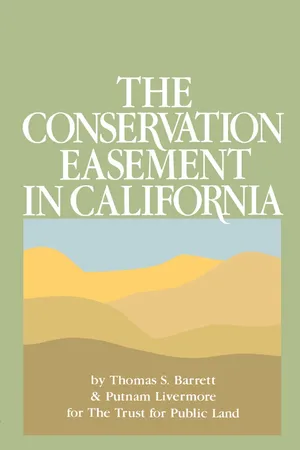
The conservation easement is an effective and flexible technique for land preservation. The Conservation Easement in California, written by California attorneys expert in conservation law for The Trust for Public Land, is an authoritative legal handbook for the use of conservation easements in California. This book puts the conservation easement in context, discusses the historical and legal background of the conservation easement in California, its state and federal tax implications and the problems involved in drafting easements. Of special importance is the book's clear exposition of the statutory distinction between conservation and open space easements, which should be especially helpful to land trusts and public agencies at all levels who want to put these innovative techniques into practise.
eBook - ePub
The Conservation Easement in California
- English
- ePUB (mobile friendly)
- Available on iOS & Android
eBook - ePub
The Conservation Easement in California
About this book
Information
CHAPTER ONE
CONSERVATION EASEMENT LEGISLATION IN CALIFORNIA
To understand the conservation easement approach to land conservation problems it is helpful to have some acquaintance with the historical evolution of open space legislation in California. In addition, it is important to be familiar with the terms of the principal statutes dealing with conservation easements—the Open-Space Easement Act and the Conservation Easements Act—and to have a sense of the relationship of those statutes to other open space legislation. This chapter outlines the history of open space legislation in California, discusses the provisions of the Open-Space Easement Act and the Conservation Easements Act in some detail and briefly summarizes the Williamson Act, the Scenic Easement Deed Act and selected other statutes that have been included here because each of them has, in varying degrees, some connection to the core conservation easement legislation.
LEGISLATIVE HISTORY
The rapid transformation of California from a predominantly agrarian to a largely urban culture has created great pressure to develop its open space and agricultural lands, particularly those lands bordering directly on burgeoning urban centers. Under conditions of rapid urban growth, speculation in open lands prime for development sends their market value up, often astronomically. This increased value alone encourages the abandonment of open space and agrarian uses of land in favor of ready profits. Historically, however, even those persons who might otherwise have resisted the temptation to sell their lands for immediate gain were confronted by a still more compelling reason to sell out in the face of urban growth. Because the new speculative value of their lands usually resulted in higher tax assessments based on the highest and best use for the land (development), farmers and other owners of open space lands were subjected, in some locations, to a property tax burden that approached or even exceeded the income they were able to derive from the most diligent management of their lands. In such cases, continued farming or other open space uses were no longer rational alternatives and the landowners were forced to sell. In this way, market value assessment—the tradition in most states and a constitutional mandate in California—came to play a central if unwitting role in the ill-advised or premature conversion of open lands to urban uses.
The first tentative steps taken by the California legislature to protect open space were aimed at abating the adverse effect of property taxes on open space. In the 1950s, Santa Clara County—historically a prime agricultural region—experienced a growth explosion. During that time, municipalities throughout the county were vying with each other for additional territory and the increased tax base that would go with it. In 1955, in an attempt to shield at least some of the region’s rich farmland from development, the legislature added Section 35009—the so-called greenbelt statute—to the Government Code.11 The greenbelt statute, limited by its terms to Santa Clara County, did not address the problem represented by the application of market value assessment techniques to open space lands, but rather sought only to prevent forced annexation from adding to the property tax burden of farmers already beset by high assessments. Section 35009 permitted farmers to choose to have their lands zoned exclusively for agriculture. If a farmer did opt for agricultural zoning, a municipality would then be required to obtain his consent prior to annexing his land. In the first few years of the program, some 50,000 acres of prime farmland were brought under the protection of greenbelt zoning.12
Section 35009 was never more than stopgap legislation. The voluntary nature of the program, the uncertain duration of the restrictive zoning, the failure to address the more critical market value assessment problem and the fact that Section 35009 was confined by its terms to Santa Clara County: all testified to the tentative nature of this first legislative step. Nevertheless, attention was at least focused on the adverse impact of property taxation on farm and open space lands, and, in 1957, the legislature began to look at the market value assessment problem itself. In that year Section 402.5 was added to the Revenue and Taxation Code, providing that land zoned and used for agriculture or recreation was to be assessed only on the basis of factors relative to that use. While market value assessment was to remain the rule, assessors were not to look to those uses for which agricultural or recreational land was naturally adaptable regardless of current use—normally fair game for valuation and assessment—but only to the highest and best use legally available for the property as zoned at the time of assessment. The zoned use standard was to be applied in those cases where “no reasonable probability” existed—as judged by zoning trends in a given jurisdiction—that the land would be rezoned in the near future for a use that would increase its value.
In practice, this test proved impossible to meet. Assessors regularly discounted the effect of zoning on market value due to its notorious impermanence, and, in any event, Section 402.5 contained a fundamental flaw. Because legislative bodies cannot restrict the future exercise of their power, there could be no assurance that rezoning would not occur, hence no basis for a finding of “no reasonable probability” under Section 402.5.13 To remove this flaw, Section 402.5 was amended in 1965 to create a rebuttable presumption that a zoning ordinance enacted pursuant to a general plan was permanent. This change shifted the burden of proving impermanence to the assessors; but, since there usually was ample evidence of the changeable nature of zoning, the burden was relatively easy to meet in most cases.14 Section 402.5 proved a weak beginning for farmland and open space protection.
In 1959, changing course somewhat, the legislature took a tentative step aimed at more actively involving local governments in open space protection. In that year, as a response to the specific need expressed by landowners in Monterey County for a ready means to protect their coastline against the threat of impending development, the Scenic Easement Deed Act was passed.15 Its purpose was to enable local governments to accept grants of “scenic easements” from landowners who wished to preserve special scenic and aesthetic values of their lands.16 The Scenic Easement Deed Act was the first such piece of legislation in the United States.17 For the first time, a legislature had recognized open space conservation as a valid public purpose, even in cases where no public access would be provided. For this reason especially, the Scenic Easement Deed Act represented a significant policy advance. However, the Act itself, as drafted, proved ineffectual.
In spite of the fact that the federal government and others had been using easements to preserve scenic landscapes since the early 1930s, the conservation easement concept was still not widely known in 1959, and the Scenic Easement Deed Act reflected this unfamiliarity. The Act was very brief. It authorized local governments to act to protect open space through the acquisition of scenic easements but provided no guidance on how to implement the authority given, outlined no planning function, established no fund for purchasing easements and extended no power of eminent domain. The Act contained no incentives to encourage participation and was silent with respect to the tax implications of an easement transfer. As experience with Section 402.5 of the Revenue and Taxation Code was demonstrating, assessors were slow to find that zoned developmental restrictions on land constituted permanent reductions in value worthy of lower assessed valuation. Without any direction from the legislature, assessors were no more likely to treat restrictions imposed by the novel scenic easement as permanent.18 In the absence of certainty that the granting of scenic easements in which they gave up valuable development rights would relieve them of paying taxes based on those rights, landowners were understandably reluctant to make use of the Act.19 In short, the Scenic Easement Deed Act, however important as a pioneering statement of public policy, was of no practical value by itself. It went unused.20
In 1962, taking yet another approach, the legislature flirted with the idea of a deferred tax program for relieving the property-tax-induced developmental pressures on agricultural lands. The idea was submitted to the electorate as Proposition 4 and was narrowly defeated. Proposition 4 would have allowed owners of farmland to defer as much of the tax on their property as was attributable to development potential until such time as they decided to sell their lands to developers. The government could then have recouped taxes for the seven years immediately preceding a sale.
Although superficially attractive, the deferred tax program had many inherent weaknesses that would have rendered it incapable of reducing speculation in farmlands close to urban areas or of preventing haphazard urban sprawl. The main flaw was that it required no long-term commitment to farming, with the result that it would have benefited both bona fide farmers and speculators indiscriminately. 21 In addition, under Proposition 4, the highest and best-use market value approach to real property assessment would have remained in place, albeit on a deferred basis. Although the legislature was groping for a way to moderate the adverse effect of the traditional market value approach to tax assessment, it remained, for the time being, too timid to attack that standard head on. The defeat of Proposition 4 undoubtedly hastened the day when it would have to do so.
In 1965, ten years after it began the search for a satisfactory method to channel development away from lands that were perceived to have a greater public value if left undeveloped, the legislature took another tack. Again the focus was on preserving agricultural lands, this time in the California Land Conservation Act of 1965, popularly known as the Williamson Act.22 In its original form, the Williamson Act was yet another attempt at an end-run around the adverse effect of full market value assessment. The Act combined governmental planning with private choice by providing a contractual method for restricting the use of agricultural lands located in governmentally designated “agricultural preserve” zones. By the terms of the Act, farmers and local governments could contract to restrict property to agricultural uses for a minimum of ten years, with provision for an automatic extension of one year at each anniversary of the contract until either party gave notice of its intent not to renew, after which the contract would be allowed to expire at the end of the time remaining in the term. Under such a system, land under contract would be protected as agricultural open space for at least ten years and potentially in perpetuity. The intent of the legislature was to provide a means of restricting land use that was sufficiently fixed, certain and binding to cause the market value of lands subject to restriction to fall. With the fall in market value, the assessed value of the land likewise would be reduced, and tax relief for farmers would result.
To make the case for tax relief even more compelling, the legislature repealed Section 402.5 of the Revenue and Taxation Code, described earlier, and adopted Section 402.1 in its place. Section 402.1 mandated that any “enforceable restriction” on land of whatever type—zoned or contractual—would have to be considered by assessors in evaluating real property for tax purposes. The rebuttable presumption of Section 402.5—that restrictions pursuant to a general plan were permanent and therefore constituted “enforceable restrictions” —was carried over into Section 402.1. Companion legislation added Section 1630 to the Revenue and Taxation Code, establishing a procedure whereby a local government could give a letter of intent to a landowner, for evidentiary purposes, stating that it did not intend to terminate the restriction on his land.
With this legislation, the legislature came as close to equating the value of property to its legally permissible use as it could without seeking to amend the California Constitution to provide an alternative to market value assessment. It was not enough. The Williamson Act received little use during its first two years on the books.23 The tax consequences of voluntary land restriction seemed too uncertain to most landowners. If open space and agricultural land preservation was to become a reality in California, assessors would have to be denied the full market value assessment technique in evaluating lands devoted to a protected purpose. Nothing short of that would be enough to encourage open space landowners and farmers to take the self-limiting step of restricting use of their lands. The financial risk was simply too great.
In 1966, the legislature finally went all the way. Article XXVIII,24 to amend the California Constitution to permit the legislature to designate certain lands as eligible for tax valuation based on their actual use rather than their market value, was proposed to the electorate as Proposition 3, won ratification and became law. Although to this point, with the exception of the moribund Scenic Easement Deed Act of 1959, the central concern had been, for all practical purposes, with agricultural lands, Article XXVIII was broadly drafted, setting forth a policy of protection for open space lands generally, on aesthetic as well as economic grounds. Article XXVIII was to be the font of open space legislation in California. The people of the state had ratified the use of preferential tax treatment to conserve open space, and the legislature now had the power to back up any open space program it might choose to institute with the property tax incentives necessary to encourage its use. The terms of Article XXVIII gave the legislature full power to define open space, to specify what constituted an enforceable restriction on open space lands and to determine the formula for assessing enforceably restricted open space lands. As a result of this profound conceptual and practical liberation from market value assessment, the state legislature, not the local assessor, held the key to protection of agricultural and open space lands. What remained was for the legislature to determine how much of that power it wished to use and the way in which it should use it.
Immediately following the passage of Article XXVIII, the legislature appointed a Joint Committee on Open Space Land whose purpose was to study existing open space legislation and make recommendations to the full body on how best to augment that legislation in light of the new authority conferred by Article XXVIII. Interim legislation was passed to provide for immediate implementation of mandatory use-related valuation for open space protection devices already available under the Williamson Act and the Scenic Easement Deed Act. Under that legislation (codified at Sections 421-425 of the Revenue and Taxation Code), a Williamson Act contract was defined as an enforceable restriction qualifying property under contract for use valuation, regardless of the effect of the contract on the market value of the property. A scenic easement deed was likewise to be considered an enforceable restriction if its terms were determined to be substantially as restrictive as a Williamson Act contract.25
With the addition of Sections 421-425, the Williamson Act, although voluntary and therefore no guarantee of comprehensive preservation, became a serious agricultural land protection tool. By 1969, twenty-three counties had made use of the program, restricting more than two million acres of land to agricultural use.26 It is estimated that at the present time more than sixteen million acres—16 percent of the state’s land area and one-third of all privately held land in the state—are protected under Williamson Act contracts.27
Of course, the true measure of success of the Williamson Act or of any differential taxation program is whether it slows down the accelerating conversion of agricultural land to urban u...
Table of contents
- Title Page
- Copyright Page
- Table of Contents
- FOREWORD
- ACKNOWLEDGMENTS
- INTRODUCTION
- CHAPTER ONE - CONSERVATION EASEMENT LEGISLATION IN CALIFORNIA
- CHAPTER TWO - TAX INCENTIVES FOR THE DONATION OF CONSERVATION EASEMENTS
- CHAPTER THREE - DRAFTING THE CONSERVATION EASEMENT
- CHAPTER FOUR - CATALOG OF OTHER REAL PROPERTY CONSERVATION TECHNIQUES
- CONCLUSION
- APPENDIX 1: LEGISLATION
- APPENDIX 2: - SAMPLE CONSERVATION EASEMENT
- NOTES
- SELECTED BIBLIOGRAPHY
- INDEX
Trusted by 375,005 students
Access to over 1.5 million titles for a fair monthly price.
Study more efficiently using our study tools.
Frequently asked questions
Yes, you can cancel anytime from the Subscription tab in your account settings on the Perlego website. Your subscription will stay active until the end of your current billing period. Learn how to cancel your subscription
No, books cannot be downloaded as external files, such as PDFs, for use outside of Perlego. However, you can download books within the Perlego app for offline reading on mobile or tablet. Learn how to download books offline
Perlego offers two plans: Essential and Complete
- Essential is ideal for learners and professionals who enjoy exploring a wide range of subjects. Access the Essential Library with 800,000+ trusted titles and best-sellers across business, personal growth, and the humanities. Includes unlimited reading time and Standard Read Aloud voice.
- Complete: Perfect for advanced learners and researchers needing full, unrestricted access. Unlock 1.5M+ books across hundreds of subjects, including academic and specialized titles. The Complete Plan also includes advanced features like Premium Read Aloud and Research Assistant.
We are an online textbook subscription service, where you can get access to an entire online library for less than the price of a single book per month. With over 1.5 million books across 990+ topics, we’ve got you covered! Learn about our mission
Look out for the read-aloud symbol on your next book to see if you can listen to it. The read-aloud tool reads text aloud for you, highlighting the text as it is being read. You can pause it, speed it up and slow it down. Learn more about Read Aloud
Yes! You can use the Perlego app on both iOS and Android devices to read anytime, anywhere — even offline. Perfect for commutes or when you’re on the go.
Please note we cannot support devices running on iOS 13 and Android 7 or earlier. Learn more about using the app
Please note we cannot support devices running on iOS 13 and Android 7 or earlier. Learn more about using the app
Yes, you can access The Conservation Easement in California by Thomas S. Barrett,Thomas S. Trust for Public Land,Putnam Livermore in PDF and/or ePUB format, as well as other popular books in Biological Sciences & Public Policy. We have over 1.5 million books available in our catalogue for you to explore.