Why did »equality« become prominent in European societies based on hierarchy during the Enlightenment? What does »equality« imply for societies, politics, or legal systems? The contributors to this volume draw on various historical case studies, from visionary practices in revolutionary France and the collection of data on the poor in 19th-century Germany, to claims raised under the minority regime of the League of Nations and the anti-discrimination politics of the UN and India. The dynamics of universalizing equality are contrasted with a concept asserting that equality must be limited to and by order. The contributions thus explore concepts of equality from the perspectives of history and law and show that practices of comparing were essential when it came to imagining others as equal, fighting discrimination, or scandalizing social inequalities.
eBook - PDF
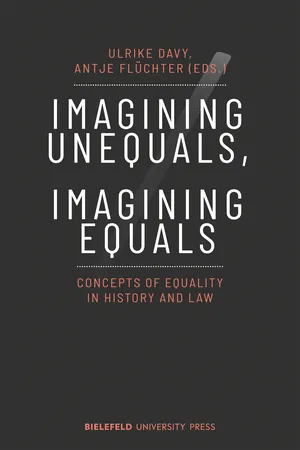
Imagining Unequals, Imagining Equals
Concepts of Equality in History and Law
- 259 pages
- English
- PDF
- Available on iOS & Android
eBook - PDF
Imagining Unequals, Imagining Equals
Concepts of Equality in History and Law
About this book
Information
Table of contents
- Cover
- Contents
- Acknowledgments
- Concepts of Equality: Why, Who, What for?
- Hierarchy as Order—Equality as Chaos?
- Envisioning Equality in the French Revolution
- “A Deep, Horizontal Comradeship?”
- Minority Protection under the League of Nations: Universal and Particular Equality
- Equality through the Lens of Racial Discrimination
- India, the UN and Caste as a Form of Racial Discrimination: Resolving the Dispute
- Equality under the Indian Constitution
- Authors and Editors
Trusted by 375,005 students
Access to over 1.5 million titles for a fair monthly price.
Study more efficiently using our study tools.
Frequently asked questions
Yes, you can cancel anytime from the Subscription tab in your account settings on the Perlego website. Your subscription will stay active until the end of your current billing period. Learn how to cancel your subscription
No, books cannot be downloaded as external files, such as PDFs, for use outside of Perlego. However, you can download books within the Perlego app for offline reading on mobile or tablet. Learn how to download books offline
Perlego offers two plans: Essential and Complete
- Essential is ideal for learners and professionals who enjoy exploring a wide range of subjects. Access the Essential Library with 800,000+ trusted titles and best-sellers across business, personal growth, and the humanities. Includes unlimited reading time and Standard Read Aloud voice.
- Complete: Perfect for advanced learners and researchers needing full, unrestricted access. Unlock 1.5M+ books across hundreds of subjects, including academic and specialized titles. The Complete Plan also includes advanced features like Premium Read Aloud and Research Assistant.
We are an online textbook subscription service, where you can get access to an entire online library for less than the price of a single book per month. With over 1.5 million books across 990+ topics, we’ve got you covered! Learn about our mission
Look out for the read-aloud symbol on your next book to see if you can listen to it. The read-aloud tool reads text aloud for you, highlighting the text as it is being read. You can pause it, speed it up and slow it down. Learn more about Read Aloud
Yes! You can use the Perlego app on both iOS and Android devices to read anytime, anywhere — even offline. Perfect for commutes or when you’re on the go.
Please note we cannot support devices running on iOS 13 and Android 7 or earlier. Learn more about using the app
Please note we cannot support devices running on iOS 13 and Android 7 or earlier. Learn more about using the app
Yes, you can access Imagining Unequals, Imagining Equals by Ulrike Davy, Antje Flüchter, Ulrike Davy,Antje Flüchter in PDF and/or ePUB format, as well as other popular books in History & Asian History. We have over 1.5 million books available in our catalogue for you to explore.