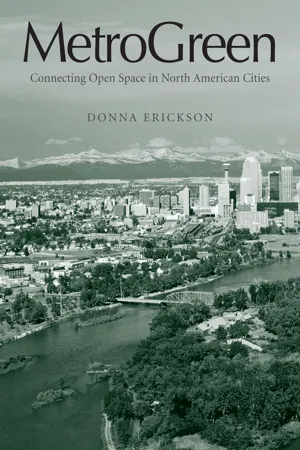
In metropolitan areas across the country, you can hear the laments over the loss of green space to new subdivisions and strip malls. But some city residents have taken unprecedented measures to protect their open land, and a growing movement seeks not only to preserve these lands but to link them in green corridors.
Many land-use and urban planning professionals, along with landscape architects and environmental advocates, have joined in efforts to preserve natural areas. MetroGreen answers their call for a deeper exploration of the latest thinking and newest practices in this growing conservation field. In ten case studies of U.S. and Canadian cities paired for comparative analysis-Toronto and Chicago, Calgary and Denver, and Vancouver and Portland among them-Erickson looks closely at the motivations and objectives for connecting open spaces across metropolitan areas. She documents how open-space networks have been successfully created and protected, while also highlighting the critical human and ecological benefits of connectivity.
MetroGreen's unique focus on several cities rather than a single urban area offers a perspective on the political, economic, cultural, and environmental conditions that affect open-space planning and the outcomes of its implementation.
- English
- ePUB (mobile friendly)
- Available on iOS & Android
eBook - ePub
About this book
Information
Topic
ArchitectureSubtopic
Architecture GeneralPart 1
Connected Open Space
1
Connected Open Space: The Metropolitan Scale
There are a lot of open spaces around us and if they’re all gobbled up, we’ve lost something big. Once it’s paved over, it’s gone forever.
—Mayor John Hieftje, Ann Arbor, Michigan1

Record numbers of voters turned out for the off-year election to weigh in on the highly controversial proposal. Local and state homebuilders’ groups were stunned. They had spent a quarter of a million dollars to defeat the proposal, arguing that the greenbelt would raise development costs, thereby further limiting affordable housing (in an environment where few affordable houses are being built to begin with). Since the election, developers have been scrambling to purchase land in the county for housing, retail complexes, and office parks. One executive for a national homebuilding corporation said, “Green space is like world peace: everyone is for it, but there can be bitter disputes on how to achieve it.”2
One of this book’s main themes is the tension between the widespread desire for open space and the complexity of and controversy over providing and protecting it. As often as not, the importance of urban open spaces is neglected in debates about land development, architectural design, and urban form. More theoretical and practical knowledge about creating greenspace is needed. Creating and protecting open-space networks across jurisdictional lines and with assorted land uses is a challenge. People have many different objectives for creating open-space networks—personal, community, and regionwide. However, using the criteria of landscape ecology and human ecology we can better understand both the motivations for and the benefits of greenspace. Landscape connectivity at a metropolitan scale can serve important human and natural functions; multiple objectives are often more effective and sustainable than one-dimensional solutions. A connected public realm is better than a fragmented one, and open-space connectivity can take many different shapes. Green infrastructure is explored as an approach that incorporates these multiple forms and functions.
Everyone Loves Open Space
Open-space protection is a topic of growing public dialog and concern. Where perhaps two decades ago planners, landscape architects, environmentalists, and park planners quietly pursued open-space planning and protection, today open space is on the front page, linked with issues of sprawl, health, lifestyle, and ecology. The smart-growth movement probably deserves the credit for this awareness. More and more people are fighting against sprawl and looking toward the promise that we can grow in more responsible, beautiful, and efficient ways. In fact, the protection of open space is a primary driver of efforts to curb sprawl.
Many people feel widespread remorse about the loss of open space in many land-use contexts and at many scales, which has generated significant funding for protecting open land.3 According to the Natural Resources Inventory for the United States, 2.2 million acres are being converted to development each year. The backlash against sprawl has, among other things, created a blitz of programming, funding, and rhetoric for open space. In reviewing the environmental impacts of sprawl, Michael Johnson found twelve main factors, many of them connected to open-space destruction, such as the loss of environmentally fragile lands and the paving of farmland.4 In particular, concern for the quality and quantity of open space at the local level has grown. Carys Swanwick and colleagues claim that worries about the declining condition of parks, growing emphasis on urban densities, priority for developing brownfield rather than greenfield land, and increased knowledge about the benefits of urban greenspace have helped fuel this concern.5 These worries have been converted to votes. In 2002 three-quarters of local and state open-space conservation ballot proposals were passed. According to the Land Trust Alliance, these measures generated $10 billion, including about $5.7 billion specifically for land acquisition and restoration.6
The provision of green, open space in urban areas may lessen the desire for residents to move farther out of cities. A study of Leuven, Belgium, showed that 50 percent of families that moved out of the city core did so because of lack of greenspace.7 “Improving the presence and quality of greenspace might help to deter commuting, so enhancing a city’s sustainability,” the study found.8 These types of studies have proliferated, generally pointing toward the importance of open space in housing preference in the United States and Europe.9 Claims from real estate research show that nearly 78 percent of all American homebuyers rated open space as essential or very important.10 Another national survey in 1994 found that among people who shopped for or bought a home, of thirty-nine features critical to their choice, consumers ranked “lots of natural open space” and plenty of “walking and biking paths” as the second- and third-highest-rated aspects affecting their choices.11 One conundrum lies in the fact that increasing development of urban areas through infill (a primary smart-growth solution) sometimes drives residents toward more roomy suburban areas. Trade-offs of one open-space type for other types seem inevitable as populations grow.
On the other hand, population growth has not been the main concern among smart-growth and open-space advocates. Alarming statistics about the ratio of developed land to population increase in various metropolitan regions demonstrate the extent of sprawl and consequent loss of open land. The amount of urbanized land in the United States increased by 47 percent from 1982 to 1997, with only a 17 percent population increase.12
In response, nearly every spatial plan for an American municipality or urban region (and in some cases, states) includes the protection of open space as a component of land-use plans or ordinances. Open-space planning and walkable neighborhoods are increasingly a part of large-scale plans for American cities. For example, Chicago’s Metropolis 2020 plan, completed by the Commercial Club of Chicago, claims, “We can build a better region. We can spend less time in traffic. We can live nearer to our jobs. We can build communities that are friendlier to walking and biking—and therefore healthier for the people who live in them. We can make economic opportunity available to more of our region’s residents.”13 Similarly, the new Envision Central Texas effort, like Metropolis 2020, developed alternative growth scenarios for the five-county Austin region, in the Texas Hill Country.14 Through extensive public participation, a preferred scenario for future growth was developed.
The planning literature is filled with studies proposing open-space plans and planning processes for various metropolitan areas around the world—Nanjing City, Warsaw, London, Phoenix, and New York.15 For example, D. A. Goode suggests five categories of open-space sites for Greater London that will encompass 20 percent of the total land area to produce a comprehensive nature-conservation strategy. These include sites of metropolitan importance, sites of borough importance, sites of local importance, wildlife corridors, and countryside conservation areas. For Warsaw, Poland, Barbara Szulczewska and Ewa Kaliszuk attempt to reconcile two main functions of open space—ecological and recreational. In addition, their greenspace plan tries to balance “green city” and “compact city” objectives through careful consideration of open-space types and objectives. Their work addresses an important tension between more dense human development (sacrificing certain types and quantities of open space in city centers in order to save it at the edges) and greening city centers (at the expense of density).
These plans are not only proliferating but taking on new characteristics. They incorporate new spatial territories, connect with new social and environmental initiatives, and involve new participants and constituents. Open-space planning has traditionally been linked to the design of new housing tracts. As subdivisions are laid out, so too are parks, nature reserves, and trails. Increasingly, though, open space is being thought of in new ways. For instance, natural areas can be incorporated into commercial landscapes, as brownfields are converted to new urban uses, and as farms, forests, prairies, and wetlands are embraced as amenities within the urban fabric. Rather than leaving open-space planning to the city parks department, other arms of municipal government are taking more active roles in open-space planning. In addition, the number of grassroots groups tackling these issues is impressive. Hundreds of citizens groups have organized across the continent in the last twenty-five years, dedicated to the protection and planning of open-space lands. They are concerned about the paving of open space, declining quality of remaining open space, diminished management budgets, universal access to open space, and lack of a strategic vision about open space in relation to new growth.
The Preliminary Blueprint for Renewal, a plan for Lower Manhattan following the September 11 tragedy, is a perfect example.16 “Open spaces,” it asserts, “are essential to the quality of life downtown, providing alternatives to steel and glass skyscrapers and, perhaps more importantly, a physical and psychological center around which the city can grow. Public open spaces stimulate and promote private and human development.”17 Although efforts are being made to preserve open space, agreeing on one definition of open space is often difficult.
What Is Open Space Anyway?
Just what is this open land that planners, designers, and citizens in hundreds of towns and cities are trying to designate and protect? Is it simply land without buildings? What is its spatial dimension? How does it function? At what scale is open space important for cultural and ecological values? Do connections between open-space sites matter? In order to protect open space, we need to know more about what we are trying to achieve. There is considerable ambiguity about the forms and functions of open space, as well as diverse approaches for incorporating these landscapes into larger land-use plans.
Each year I choreograph an exercise with my graduate-level, land-use-planning students to illustrate this point. We brainstorm and debate the meanings, settings, and purposes of open space, in order to prepare a land-use plan for open-space lands at the fringe of our city. The typology that develops usually swings widely between several perceived dichotomies—public/private ownership, functional/aesthetic purpose, urban/rural land use, natural/human-made elements, open field/tree cover, and visual/physical access. To the ecologically minded, open space implies a level of environmental integrity. To others, it is simply an aesthetic issue. Some think of neighborhood parks, and some think of productive farmland at the edge of town. Open space can comprise vast swaths of greenspace in urban areas, as in Figure 1.1, but it can also be small, seminal pieces in the center of the city, as shown in Figure 1.2. The constructs in people’s minds around the idea of open space are wide ranging and often conflicting.
Likewise, the professional literature on open-space planning is often ambiguous and confusing. Some authors have crafted definitions that help readers understand what they mean by open space in specific locations or for specific research issues. Many focus closely on recreation. For example, Karen Payne uses the recreational focus: “Open space, or green space, can be thought of as a mix of traditional parks and reserve...
Table of contents
- LAND USE PLANNING
- About Island Press
- Title Page
- Copyright Page
- Dedication
- Table of Contents
- Preface and Acknowledgments
- Part 1 - Connected Open Space
- Part 2 - Connectivity and Human Ecological Planning
- Part 3 - Synthesis: Key Ingredients, Challenges, and Strategic Trends
- Bibliography
- Notes
- Index
- Island Press Board of Directors
Trusted by 375,005 students
Access to over 1.5 million titles for a fair monthly price.
Study more efficiently using our study tools.
Frequently asked questions
Yes, you can cancel anytime from the Subscription tab in your account settings on the Perlego website. Your subscription will stay active until the end of your current billing period. Learn how to cancel your subscription
No, books cannot be downloaded as external files, such as PDFs, for use outside of Perlego. However, you can download books within the Perlego app for offline reading on mobile or tablet. Learn how to download books offline
We are an online textbook subscription service, where you can get access to an entire online library for less than the price of a single book per month. With over 1.5 million books across 990+ topics, we’ve got you covered! Learn about our mission
Look out for the read-aloud symbol on your next book to see if you can listen to it. The read-aloud tool reads text aloud for you, highlighting the text as it is being read. You can pause it, speed it up and slow it down. Learn more about Read Aloud
Yes! You can use the Perlego app on both iOS and Android devices to read anytime, anywhere — even offline. Perfect for commutes or when you’re on the go.
Please note we cannot support devices running on iOS 13 and Android 7 or earlier. Learn more about using the app
Please note we cannot support devices running on iOS 13 and Android 7 or earlier. Learn more about using the app
Yes, you can access MetroGreen by Donna Erickson in PDF and/or ePUB format, as well as other popular books in Architecture & Architecture General. We have over 1.5 million books available in our catalogue for you to explore.