In a world filled with breathtaking beauty, we have often overlooked the elusive charm and magic of certain landscapes. A cloudy river flows into a verdant Arctic wetland where sandhill cranes and muskoxen dwell. Further south, cypress branches hang low over dismal swamps. Places like these–collectively known as swamplands or peatlands–often go unnoticed for their ecological splendor. They are as globally significant as rainforests, and function as critical carbon sinks for addressing our climate crisis. Yet, because of their reputation as wastelands, they are being systematically drained and degraded to make way for oilsands, mines, farms, and electricity.
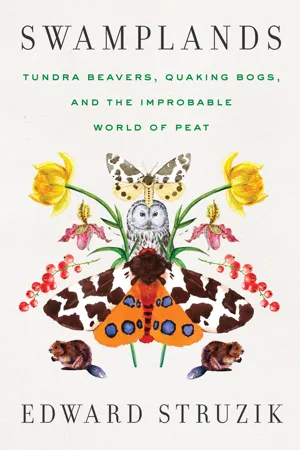
In Swamplands, journalist Edward Struzik celebrates these wild places, venturing into windswept bogs in Kauai and the last remnants of an ancient peatland in the Mojave Desert. The secrets of the swamp aren’t for the faint of heart. Ed loses a shoe to an Arctic wolf and finds himself ankle-deep in water during a lightning storm. But, the rewards are sweeter for the struggle: an enchanting Calypso orchid; an elusive yellow moth thought to be extinct; ancient animals preserved in lifelike condition down to the fur.
Swamplands highlights the unappreciated struggle being waged to save peatlands by scientists, conservationists, and landowners around the world. An ode to peaty landscapes in all their offbeat glory, the book is also a demand for awareness of the myriad threats they face. It urges us to see the beauty and importance in these least likely of places. Our planet’s survival might depend on it.
- 298 pages
- English
- ePUB (mobile friendly)
- Available on iOS & Android
eBook - ePub
About this book
Information
Print ISBN
9781642832907
9781642830804
Subtopic
Ecosystems & HabitatsChapter 1
The Great Dismal Swamp
In the dark fens of the Dismal Swamp
The hunted Negro lay;
He saw the fire of the midnight camp,
And heard at times a horse’s tramp
And a bloodhound’s distant bay.
—“The Slave in the Dismal Swamp,” Henry Wadsworth Longfellow, 1842
Along coastal Virginia where the British colonists began settling permanently in the spring of 1607, much of the land was tidal marsh, swamp, bogs, and fens filled with carnivorous plants and giant Atlantic white cedar and longleaf pine trees. It looked like paradise to those who had sailed for four and a half months across the cold, foggy ocean. “Faire meddowes and good tall trees,” observed colonist George Percy. “I was almost ravished at the first sight thereof.”1
Almost immediately, the colonists began cutting down the white cedars that dominated the overstory and draining the bogs to produce bog iron. They relied on the trees to build cabins and to produce “tryals of Pitch and Tarre” to send back home. Pitch was used to seal boat hulls. Tar was used to grease the wagon axles. Britain badly needed both because most of its pines had been felled.
The terrain was presumably less wet and spongy than it typically would have been, due to an epic seven-year drought that started a year before they arrived. (Modern dendrochronology confirms this.)2 This was known as the “starving time.” Most of the crops planted by the Jamestown colonists in those first few years shriveled up by the end of summer, not necessarily for lack of farming skills, as some historians have suggested, but because of both the drought and also frost that came often during the abnormally cool period known as the Little Ice Age. The cooling began sometime around AD 1300 and intensified in the decades before and after the colonists arrived. River water and groundwater that was already brackish would have been more so as the drought persisted.
“There were never Englishmen left in a foreign Country in such misery as we were in this new discovered Virginia,” Percy wrote in September 1607, just four months after he and 104 other people arrived with so much optimism. “We watched every three nights, lying on the bare cold ground, what weather soever came [and] warded all the next day, which brought our men to be most feeble wretches. Our food was but a small Can of Barley sod in water, to five men a day.”
When a ship with supplies and another 100 settlers finally arrived in the winter of the new year, only 38 of the original colonists were still alive. Most of the others had died from a combination of malnutrition, salt poisoning, and typhoid. Typhoid alone killed more than 6,000 settlers between 1607 and 1624.3
On a rainy-day drive along the Pocahontas Trail from Williamsburg toward the Jamestown settlement, I saw very little of that spongy peatland ecosystem still intact. What I saw instead were badly degraded, peopled landscapes such as Busch Gardens, a sprawling outdoor amusement mall with theme parks and parking lots inexplicably named after England, Italy, and other European countries; joy rides called the Loch Ness Monster, Alpengeist, and Verboten; and a Rhine River cruise boat that plies the waters of a small lake. Farther down the Trail, and along other routes, I passed shopping malls, golf courses, residential neighborhoods of one-family houses and mobile homes, William and Mary University, and the Powhatan Resort manor, which dates back to 1735.
The resort and also a creek that cuts a verdant swath through the best-preserved forested peatland of James City County were named after the home village of a powerful North American Indian chief, known to the English as Chief Powhatan, who stood as head of an Algonquian-speaking empire. The territory, called Tsenacommacah, extended from the Potomac River in northern Virginia to the Great Dismal Swamp along the North Carolina border where the Nansemond, one of 30 or so tribes of Tsenacommacah, lived along the river that passes through present-day Suffolk.
Chief Powhatan, known to his own people as Wahunsenacawh, was the father of the legendary Pocahontas. All that is left of those people is a tiny reservation an hour’s drive north of Jamestown.
I never fully appreciated the story of Pocahontas, who may or may not have saved the life of Captain John Smith, one of the leaders of the Jamestown colony. In my youth, Pocahontas was presented to us as a saccharine caricature in a Disney film. The dubious “facts” of her life were offered up in American history classes along with topics such as the establishment of the first permanent colony at Jamestown, the birth of American slavery a short time later, the networks of abolitionists such as Harriet Tubman and conductors of the Underground Railroad, and the Civil War that followed. Pocahontas was more myth than reality.
I did not see what connected Pocahontas and her people, enslaved persons, the Underground Railroad, and the Civil War until I drove from Jamestown to the Great Dismal Swamp, a vast peatland that stretches out along the border of Virginia and North Carolina. Lake Drummond, one of only two natural lakes in Virginia, sits in the middle of it.
This connection, which knits together so much history of the eastern United States, became clear as I explored the Great Dismal Swamp, both by myself and in the company of scientists who are trying to restore or sustain what’s left of its peat. Seeing the fragments of land, and talking with the people who know it well, reveals the sharply contrasting points of view of the indigenous people who lived and hunted in these bogs, fens, and swamps, the fugitive slaves and social outcasts who took refuge in them, and the colonists such as Virginia-born William Byrd, who grew up in Britain and viewed the Great Dismal, when he returned to take over his father’s estate, as a “horrible desart,” a “blot on his Majesty’s Kingdom,” and a “miserable morass where nothing can inhabit.”
“Never was rum, that cordial of life,” he wrote, “found more necessary than it was in this dirty place.”4
Eric W. Sanderson, the landscape ecologist who puzzled out what the island of Manhattan might have looked like before human settlement, once observed that people fit the environment to what best suits them rather than adapting, as animals do, by taking advantage of features of the environment which best suit them. Indigenous people like the Algonquin of the Powhatan confederacy were the exception. They made do with what peatlands like the Great Dismal Swamp offered rather than subdue the land, as the settlers tried to do in the centuries that followed.
Pocahontas was born in 1596, long before William Byrd set foot in the country. “Pocahontas” was a nickname meaning “playful one” or “ill-behaved child.” Her birth name was Amonute. More formally, she went by the name of Matoaka, which means “flowers between two streams.” She and her people lived comfortably in longhouse villages built on sandy escarpments and grassy pocosins, the Algonquian word for “swamp on a hill.” Invariably, these settlements were situated along rivers and streams like the Chickahominy and Nansemond, tributaries of the James River. Peaty forests and wetlands like the Great Dismal, as well as “smaller dismals” like the Pitch and Tar Swamp at Jamestown, were places where they and other tribes went to hunt deer, bear, beaver, wild turkey, and ducks, and to pick nuts and fruits such as persimmons, pawpaws, and blackberries. Log fern (Dryopteris Celsa), fungi, and other forested peatland plants were harvested for their medicinal properties.
Young women like Pocahontas were taught to identify these and other plants. Pawpaws and log fern, they learned, were two sisters who grew together, one—the pawpaw—above the other—the log fern. Both were found in wettish, well-drained soils bordering swamps in neighboring uplands.
Powhatans grew tobacco for pleasure and ceremonial purposes, and maize (corn), squash, and beans for food. As modern gardeners know, these are the Three Sisters in agriculture. Corn offers support for beans to climb and grow. The beans pull nitrogen from the air to the soil to benefit corn and squash. The large prickly squash leaves ward off predators and shade the soil, keeping it moist and cool. It’s important to know, because most peatland soils do not offer much in the way of nutrients for plants to take up.
The Powhatan tribes were so well adapted to what these peatlands had to offer that the first wave of British colonists often called on them to provide food during those “starving times” in exchange for tools such as hatchets and more fanciful items like the glass produced by Polish artisans, people not typically associated with that first wave of Jamestown settlers. The Poles and some Dutch people who were also brought along as skilled workers would produce not just glass, but pitch, tar, bog iron, and other materials. The Dutch, no doubt, were skilled at picking out lands that could be drained for the planting of crops.
Through trial and error, the colonists discovered what the New World had to offer. “If it not be ripe, [persimmon] will drawe a man’s mouth awrie with much torment,” noted Captain John Smith, who was charged with mutiny on that first sailing before party leaders learned upon their arrival that the Virginia Company had made him a member of the governing council. “But when it is ripe, it is delicious as an Apricocke.”
More often than not, the early colonists puzzled over insect-eating pitcher plants, thorny “devil’s walking sticks,” venomous snakes, and vicious biting flies. Flies and snakes, red wolves and panthers may have deterred them from venturing too deep into the swamplands to harvest root vegetables and muscadine grapes or shoot the very many rabbits, deer, and other animals that dwelled there.
The friendly relations turned increasingly violent when the Powhatans could not, or would not, keep up with the colonists’ incessant demands for food. The drought and cool weather were affecting yields from their crops as well. One Powhatan leader said as much when he called on Captain Smith “to pray to my [Smith’s] God for raine, for their [the Powhatans’] Gods would not send any.”5 The colonial leader didn’t believe him. He suspected that the Powhatans were simply hoarding food to pressure the colonists into leaving.
Deadly skirmishes followed as the situation escalated into an all-out war until 1613, when Captain Samuel Argall, the sailor who brought supplies to Jamestown, kidnapped Pocahontas “for the ransoming of so many Englishmen as were prisoners with Powhatan: as also to get . . . armes and tools . . . [and] some quantities of Corne, for the colonies relief.”
Chief Powhatan offered to negotiate a price for the return of his daughter, but without success. In captivity, Pocahontas converted to Christianity and married colonist John Rolfe, the first to plant tobacco as a commercial crop in America. They then sailed off to England. She died there in 1617, by then known as Lady Rebecca. Rolfe, by some accounts, loved his wife, but he also allowed that he married her to induce Chief Powhatan and his tribes to be more cooperative.
Rolfe returned to Jamestown to manage his tobacco plantation. His fortunes, and those of the other struggling colonists, took a significant turn in August 1619 when a Dutch ship arrived with cargo in tow. Rolfe was initially disappointed. “It brought not anything but twenty and odd Negroes.” Merchant Abraham Piersey and Governor George Yeardley, however, saw in these Africans a source of free labor for the planting of commercial crops such as tobacco and hemp, both of which were in high demand in Europe. They bought the Africans in exchange for “victuals”—food supplies that the Dutch captain badly needed.
These twenty enslaved people were among the first of 12.5 million Africans who were kidnapped, chained, and shipped off to America over the next two and half centuries. This forced labor allowed the colonists to drain swamps, bogs, and fens and greatly expand the planting of tobacco, hemp, rice, and eventually cotton, which, by 1803 had become America’s leading export.
There was a limit, however, to what could be done locally. Because tobacco takes up more nitrogen, phosphorus, and potassium than almost any other plant, the soils around the Jamestown region became increasingly depleted of nutrients. Planting the “Three Sisters” might have solved the problem, but second- and third-generation colonists were more interested in making money from tobacco than growing food beyond what was needed to get them through a winter. Bogs, fens, and swamps that sat on sand, soil, and peat suitable for planting new crops were systematically drained until most of them disappeared.
It was William Byrd who suggested that the future of tobacco, hemp, rice, and corn lay in the Great Dismal Swamp. The plantation owner came to that conclusion after venturing into the Great Dismal Swamp in 1728 as one of the leaders of a survey to establish a disputed boundary line between Virginia and North Carolina, a state he mockingly dismissed as “Lubberland” and whose people, he said, “devour so much Swine’s flesh that it fills them full of gross Humours.”
Most everything we know about Byrd, including a painting in which he is dressed as an aristocratic dandy in blue velvet, suggests that he didn’t have the ruggedness to survive an expedition as arduous as that one would have been. I met a few resentful Carolinians who suggested he was only there at the beginning and end of the journey. The truth is that he and other commissioners went around the perimeters of the swamp, leaving the surveyors to do most of the bushwhacking.
“A well-bred gentleman and polite companion” is how Byrd liked to describe himself. And that’s how historians portrayed him well into the twentieth century. Byrd, however, was anything but a gentleman, to judge from entries in secret diaries that were overlooked by many historians and not published until 1942.6 There was no end to the number of times he boasted about “rogering” his wife (on a billiard table, no less), often with a “flourish” following what was frequently a “little quarrel.” He bedded maids and enslaved women, sometimes against their will. He was sorrier for sometimes forgetting to say his prayers at night than for using “those women as if they belonged to me when they really do not.”
His idea of a joke would have brought the Pilgrims at Plymouth Rock to their knees in prayer. Letters to an old school friend were addressed to a “Mr. Cocke” and signed by “Mary F-x.” He also beat and whipped the people he enslaved anytime it pleased him, recording the myriad cruelties with seeming satisfaction in his diary.
Sadist and misogynist though he was, Byrd was also a serious naturalist who consulted with scientists about plants and animals and the swampy peatlands that clearly fascinated him. His descriptions of the Great Dismal Swamp were often spot-on.
“A boggy place” in which “white cedar,” is commonly mistaken for juniper,” he wrote, explaining why some called part of the Great Dismal “Juniper Swamp.”
“The reeds which grew about 12 feet high, were so thick, & so interlaced with Bamboe-Briars, that our Pioneers were forc’t to open a Passage. The Ground, if I may properly call it so, was so spungy, that the Prints of our Feet were instantly fill’d with Water.”
Byrd ate the meat of bear and venison mixed in stew and seemed to enjoy it. He saw panthers and heard red wolves howling “with the yell of a whole family of wolves, in which we could distinguish the treble, tenor, and bass, very clearly.”
Byrd, however, also crafted an image of bleakness in the Great Dismal that evoked the most macabre of medieval superstitions about swamps and bogs being sources of poisonous vapors rising from rotting vegetation. A “miasma,” as it was called in those days.
Birds, he claimed, didn’t fly over the Dismal Swamp “for fear of the noisome exhalations that rise from this vast body of dirt and nastiness. These noxious vapours infect the air round about, giving agues and other distempers to the neighbouring inhabitants.”7
The best and profitable thing to do, he advised, was to drain it. “By draining the Dismal,” he wrote, “it will make all the adjacent country much more wholesome, and consequently, preserve the lives of many of the king’s subjects: this will happen by correcting and purifying the air.
. . . After the Dismal comes to be drained, it will be the fittest soil in the world for producing hemp, the propagating of which, is with so much reason, desired and encouraged in his majesty’s plantation.”
Byrd drafted a proposal to members of the Council of Virginia calling for the formation of a company to drain the swamp. He envisioned using enslaved laborers to build roads and drainage dit...
Table of contents
- Cover Page
- Title Page
- Copyright Page
- Contents
- Preface
- Introduction
- Chapter 1: The Great Dismal Swamp
- Chapter 2: Central Park
- Chapter 3: Peat and Endangered Species
- Chapter 4: Tropical Peat
- Chapter 5: Ash Meadows, Ancient Bogs, and Desert Fens
- Chapter 6: Sasquatches of the Swamps
- Chapter 7: Peat and Reptiles
- Chapter 8: Mountain Peat
- Chapter 9: Ring of Fire: The Hudson Bay Lowlands
- Chapter 10: Pingos, Polygons, and Frozen Peat
- Chapter 11: Tundra Beavers, Saltwater Trout, and Barren-Ground Grizzly Bears
- Chapter 12: Portals to the Otherworld
- Chapter 13: “Growing Peat”
- Conclusion
- Notes
- Acknowledgments
- Index
- About the Author
Trusted by 375,005 students
Access to over 1.5 million titles for a fair monthly price.
Study more efficiently using our study tools.
Frequently asked questions
Yes, you can cancel anytime from the Subscription tab in your account settings on the Perlego website. Your subscription will stay active until the end of your current billing period. Learn how to cancel your subscription
No, books cannot be downloaded as external files, such as PDFs, for use outside of Perlego. However, you can download books within the Perlego app for offline reading on mobile or tablet. Learn how to download books offline
Perlego offers two plans: Essential and Complete
- Essential is ideal for learners and professionals who enjoy exploring a wide range of subjects. Access the Essential Library with 800,000+ trusted titles and best-sellers across business, personal growth, and the humanities. Includes unlimited reading time and Standard Read Aloud voice.
- Complete: Perfect for advanced learners and researchers needing full, unrestricted access. Unlock 1.5M+ books across hundreds of subjects, including academic and specialized titles. The Complete Plan also includes advanced features like Premium Read Aloud and Research Assistant.
We are an online textbook subscription service, where you can get access to an entire online library for less than the price of a single book per month. With over 1.5 million books across 990+ topics, we’ve got you covered! Learn about our mission
Look out for the read-aloud symbol on your next book to see if you can listen to it. The read-aloud tool reads text aloud for you, highlighting the text as it is being read. You can pause it, speed it up and slow it down. Learn more about Read Aloud
Yes! You can use the Perlego app on both iOS and Android devices to read anytime, anywhere — even offline. Perfect for commutes or when you’re on the go.
Please note we cannot support devices running on iOS 13 and Android 7 or earlier. Learn more about using the app
Please note we cannot support devices running on iOS 13 and Android 7 or earlier. Learn more about using the app
Yes, you can access Swamplands by Edward Struzik in PDF and/or ePUB format. We have over 1.5 million books available in our catalogue for you to explore.