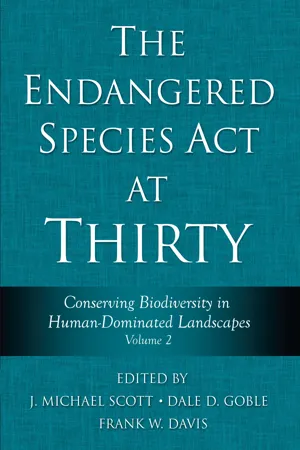
A companion volume to The Endangered Species Act at Thirty: Renewing the Conservation Promise, this book examines the key policy tools available for protecting biodiversity in the United States by revisiting some basic questions in conservation: What are we trying to protect and why? What are the limits of species-based conservation? Can we develop new conservation strategies that are more ecologically and economically viable than past approaches?
eBook - ePub
The Endangered Species Act at Thirty
Vol. 2: Conserving Biodiversity in Human-Dominated Landscapes
- English
- ePUB (mobile friendly)
- Available on iOS & Android
eBook - ePub
The Endangered Species Act at Thirty
Vol. 2: Conserving Biodiversity in Human-Dominated Landscapes
About this book
Information
Part 1
Conservation Goals
Americans value species for a variety of intrinsic and extrinsic reasons. It shows in the language of the Endangered Species Act, which declares that “fish, wildlife and plants are of esthetic, ecological, educational, recreational, and scientific value to the nation and its people.” In principle, the Endangered Species Act does not confer higher value on some species than others. For example, threatened and endangered species are listed alphabetically within a taxonomic group, suggesting that all species are equally deserving. In reality, a small subset of species receive a disproportionate share of funding and conservation attention, usually because of their symbolic value, as in the case of the bald eagle (Haliaeetus leucocephalus), their aesthetic value, as in the case of the California condor (Gymnogyps californianus), or simply because they are more familiar to us: vertebrates are disproportionately represented over invertebrates.
Confronted with scarce fiscal resources and growing need, public agencies, nongovernmental organizations, and the scientific community continue to debate conservation priorities and the appropriateness of a species-level national biodiversity conservation policy. Scientific dimensions of this issue are explored in part 2. Economic and management dimensions are considered in part 3. The chapters in this part probe the philosophical and legal historical roots of American nature conservation and of species conservation in particular, and provide a conceptual and legal foundation for the chapters that follow.
In chapter 2, Dale Goble tracks the legal record from the colonial laws of the late seventeenth century through the passage of the act in 1973 to the administrative reforms of the 1990s. In chapter 3, to help us navigate the complex history of U.S. conservation policy, Leona Svancara and colleagues provide a time line of significant twentieth-century legal actions, ending with the thirtieth anniversary of the act in 2003. In chapters 4 and 5, Baird Callicott and Bryan Norton offer contrasting philosophical perspectives on how we define and value biodiversity. Callicott examines how we assign instrumental and intrinsic value to species in the context of the Endangered Species Act and considers the role of the marketplace versus the legislature in establishing those values. Norton focuses instead on how we define and measure biodiversity and on the relationship between its biological meaning and public policy.
1
Introduction
More than thirty years after its passage, the Endangered Species Act (ESA) of 1973 continues to be a cornerstone of U.S. biodiversity policy and among our most powerful environmental laws. The ESA set the nation’s biodiversity conservation policy on a path that emphasized species-based conservation and triggered action only when a species faced imminent extinction. However, promoting recovery has proven more challenging than the original designers of the law anticipated. The number of listed species has mushroomed from 78 in 1973 to 1,267 in 2005, while in that time only 13 species have recovered sufficiently to be removed from the list (Scott et al. 2006).
As described in The Endangered Species Act at 30: Renewing the Conservation Promise, the act has proven remarkably durable in spite of nearly continuous political assaults and legal and scientific challenges (Goble et al. 2006). The contributing authors to that volume describe a variety of factors responsible for the act’s endurance. Public support for species conservation has remained strong, especially for high-visibility species such as the bald eagle (Haliaeetus leucocephalus ) and grizzly bear (Ursus arctos horribilis) but also for less-charismatic taxa. The act has been championed by environmental groups in part for its power to control development, a role supported by a majority of the American public (Czech and Krausman 1997). Reforms have also been important to the act’s continuance. In particular, implementation has evolved over the years from an absolute prohibition on take of endangered species to a more flexible permitting system, thereby defusing potentially explosive conservation conflicts on private lands. The act has also catalyzed administrative and legal reforms at all levels of government that have led to positive changes in natural resource management in rural areas and in urban open space planning.
The future viability of the Endangered Species Act, however, is uncertain. Over the next few decades the sheer magnitude of the conservation challenge will almost certainly defy species-by-species conservation (Woodwell 2002). We now live in a human-dominated world of a rapidly changing climate and increasingly biologically impoverished ecosystems (Millennium Ecosystem Assessment 2005a). As the conservation need grows, scientists have recommended putting more effort and resources toward protecting ecosystem services rather than simply preserving biodiversity for its own sake (Folke et al. 1996; Balvanera et al. 2001). This tension between investing in species for their intrinsic value versus their utility is likely to increase. The number of at-risk species in the United States is already five to ten times greater than the number of species currently protected under the ESA (Scott et al. 2006) and the gap will almost certainly continue to widen.
The cost of saving species must also be reevaluated. As our understanding of ecosystem dynamics and species requirements has improved, we see more clearly that our nature reserves are neither large enough nor represent environmental variation well enough to buffer species against continued habitat loss, degradation, or geographic displacement under climate change (Scott et al. 2001; Rosenzweig 2003a). Perhaps more to the point, many of the species at greatest risk are on private lands where political and economic costs of reserve-based species conservation are highest.
In other words, broad socioeconomic and environmental trends, combined with advances in conservation science, predict a rapidly widening gap between the goal of the Endangered Species Act, “to provide a means whereby the ecosystems upon which endangered species and threatened species depend, [and] to provide a program for the conservation of such endangered species and threatened species” (sec. 2(b)), versus what the law can actually deliver or what conservation scientists would argue is needed. For this reason, we believe an examination of the Endangered Species Act at thirty is not complete without revisiting some of the basic questions that pertain to U.S. policy for biodiversity conservation:
- What are we trying to protect and why?
- What are the limits of local species-based conservation for protecting biodiversity at multiple spatial scales and levels of organization?
- How can we conserve the biodiversity of the United States in increasingly human-dominated landscapes?
- Can we move beyond the tradition of biological reserves for rare and endangered species toward a conservation strategy that is more ecologically and economically viable?
The first volume, The Endangered Species Act at 30: Renewing the Conservation Promise, examined the implementation record, key actors and institutions, successes and failures, and opportunities to increase the act’s effectiveness. This companion volume examines the four questions posed above in more detail, offering perspectives from environmental philosophers, conservation biologists, ecologists, and economists. Together the two books present a thorough examination of America’s most powerful environmental law at a critical juncture in its history.
Chapters are organized into three parts: “Conservation Goals,” “Conservation Science,” and “Conservation Policy and Management.” Chapters in the first part examine the historical and philosophical underpinnings of nature conservation in general and species conservation in particular. In the second part, biogeographers, geneticists, ecologists, and conservation biologists consider biodiversity conservation at multiple scales and levels of organization, the effectiveness of the Endangered Species Act in protecting different kinds of biodiversity, and ways of improving the role of science in its implementation. Chapters in the third part examine prospects for conserving biodiversity in human-dominated ecosystems from economic, ecological, and social perspectives. The emphasis is on conserving biodiversity on private lands outside of nature reserves in urban and agricultural landscapes. Several chapters explore new approaches such as conservation banks and markets for species and ecosystem services.
The chapters in this volume are more technical than those in the first volume and readers may find the juxtaposition of so many disciplines thought provoking. Their scope varies widely. Some chapters are broad and conceptual while others more narrowly focus on specific aspects of conservation science or policy. The underlying theme throughout, however, is that biodiversity conservation in human-dominated landscapes requires a different mindset than the view prevailing in 1973. At the time, it was thought that single-species conservation could be achieved by “cease-and-desist” orders and nature set-asides; instead, we find ourselves in an increasingly complicated world of multispecies- and ecosystem-based conservation over large landscapes, active adaptive management of nature, and dynamic biodiversity markets.
Despite the extraordinary challenge of biodiversity conservation in the twenty-first century, however, the authors are decidedly positive and pragmatic in their outlooks. We hope that the reader will find, as we have, that the forward-looking ideas and approaches presented here create a sense of excitement and renewed hope for restoring and maintaining the diversity of nature in America.
2
Evolution of At-Risk Species Protection
Wildlife conservation has historically employed two sets of tools. The first, “hook-and-bullet” game management, relies on take restrictions such as closed seasons and bag limits to maintain huntable populations; its use can be traced back nearly a millennium (Goble and Freyfogle 2002; Bean and Rowland 1997). The second, habitat protection, is equally ancient. Both the king in Parliament and colonial American legislatures routinely restricted land uses to conserve habitat (Goble and Freyfogle 2002; Hart 1996). The tools—take prohibitions and habitat protection—authorized by the Endangered Species Act (ESA) thus are familiar, but the act’s objectives are not. Indeed, the notion that “saving all the pieces” is important is a change in perspective that remains intensely contested.
This chapter examines the evolution of wildlife conservation in the United States from game law to endangered species preservation, roughly divided into four overlapping periods. The first period lasted from the arrival of Europeans in North America to the rise of industrialism. The second was defined by the transformations produced by industrialization and the triumph of an unrestrained market. The third, from the end of the nineteenth century to the 1960s, was a reaction to the excesses of the market: conservationists sought reform by mandating scientific management of natural resources. The final period is the still-uncertain present. It began with the dramatic burst of federal legislation that transformed wildlife law—legislation that produced a corporate-fueled reaction.
The Myth of Abundance
The first stories from America were tales of exuberant bounty: Thomas Morton described a Massachusetts with “Fowles in abundance, Fish in multitude, and ... Millions of Turtledoves one the greene boughes: which sate pecking, of the full ripe pleasant grapes, that were supported by the lusty trees” (Morton 1637; Cronon 1983). Richard Whitbourne’s description of the now-extinct great auk (Alca impennis), of its ability to “multiply so infinitly,” and of God’s gift of “the innocency of so poore a creature, to become such an admirable instrument for the sustenation of man” (Whitbourne 1620), captures two of the central precepts of the period: nature was both inexhaustibly fecund and created for the use of our species, and it was a continuously replenished storehouse. The innumerable flocks of passenger pigeons (Ectopistes migratorius) and the horizon-darkening herds of buffalo (Bison bison) made a mockery of restraint, and a policy of free access was simply assumed.
Experience soon demonstrated, however, that although wildlife might be abundant, it was not infinite. Massachusetts Bay adopted a closed season on deer in 1693; by the Revolution, every colony except Georgia had similar laws (Hynning 1939; Lund 1976). Colonial and state governments also regulated land uses to protect wildlife habitat (Goble and Freyfogle 2002; Hart 1996). The most common examples involve anadromous fish because of their importance to local communities. John Hart (2004), for example, has found that “[b]y 1800, thirteen states had laws prohibiting mill dams on some or all of their rivers from obstructing the passage of fish” (292). As the Massachusetts Supreme Judicial Court noted in one early decision contesting a requirement that the dam owner install fish passage facilities, “every owner of a water-mill or dam holds it . . . under the limitation, that a sufficient and reasonable passageway shall be allowed for the fish” (Inhabitants of the Towns of Stoughton, Sharon, Canton v. Baker 1808, 528).
Industrialization brought dramatic change: the relatively static society of the early Republic with its emphasis on community (Novak 1996) was fundamentally transformed.
The Triumph of the Market
The common law allocated resources through property rules. One result was the protection of settled expectations; stability and continuity were dominant values. In colonial America, for example, access to fish was determined by long usage of fishing places (Carson v. Blazer 1810; Freary v. Cooke 1779; Pitkin v. Olmstead 1790). This understanding of “property” was swept away during the industrial transition between 1750 and 1850 (Horwitz 1977; Nelson 1975). Older communitarian restraints—t...
Table of contents
- About Island Press
- Title Page
- Copyright Page
- Table of Contents
- Preface
- Part 1 - Conservation Goals
- Part II - Conservation Science
- Part III - Conservation Policy and Management
- Contributors
- Notes
- References
- Index
- Island Press Board of Directors
Trusted by 375,005 students
Access to over 1.5 million titles for a fair monthly price.
Study more efficiently using our study tools.
Frequently asked questions
Yes, you can cancel anytime from the Subscription tab in your account settings on the Perlego website. Your subscription will stay active until the end of your current billing period. Learn how to cancel your subscription
No, books cannot be downloaded as external files, such as PDFs, for use outside of Perlego. However, you can download books within the Perlego app for offline reading on mobile or tablet. Learn how to download books offline
Perlego offers two plans: Essential and Complete
- Essential is ideal for learners and professionals who enjoy exploring a wide range of subjects. Access the Essential Library with 800,000+ trusted titles and best-sellers across business, personal growth, and the humanities. Includes unlimited reading time and Standard Read Aloud voice.
- Complete: Perfect for advanced learners and researchers needing full, unrestricted access. Unlock 1.5M+ books across hundreds of subjects, including academic and specialized titles. The Complete Plan also includes advanced features like Premium Read Aloud and Research Assistant.
We are an online textbook subscription service, where you can get access to an entire online library for less than the price of a single book per month. With over 1.5 million books across 990+ topics, we’ve got you covered! Learn about our mission
Look out for the read-aloud symbol on your next book to see if you can listen to it. The read-aloud tool reads text aloud for you, highlighting the text as it is being read. You can pause it, speed it up and slow it down. Learn more about Read Aloud
Yes! You can use the Perlego app on both iOS and Android devices to read anytime, anywhere — even offline. Perfect for commutes or when you’re on the go.
Please note we cannot support devices running on iOS 13 and Android 7 or earlier. Learn more about using the app
Please note we cannot support devices running on iOS 13 and Android 7 or earlier. Learn more about using the app
Yes, you can access The Endangered Species Act at Thirty by J. Michael Scott, Dale D. Goble, Frank W. Davis, J. Michael Scott,Dale D. Goble,Frank W. Davis in PDF and/or ePUB format, as well as other popular books in Biological Sciences & Environmental Law. We have over 1.5 million books available in our catalogue for you to explore.