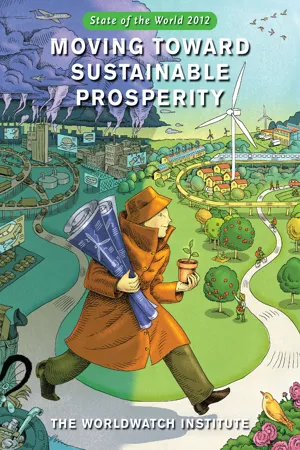
In the 2012 edition of its flagship report, Worldwatch celebrates the twentieth anniversary of the 1992 Earth Summit with a far-reaching analysis of progress toward building sustainable economies. Written in clear language with easy-to-read charts, State of the World 2012 offers a new perspective on what changes and policies will be necessary to make sustainability a permanent feature of the world's economies. The Worldwatch Institute has been named one of the top three environmental think tanks in the world by the University of Pennsylvania's Think Tanks and Civil Societies Program.
eBook - ePub
State of the World 2012
Moving Toward Sustainable Prosperity
- 243 pages
- English
- ePUB (mobile friendly)
- Available on iOS & Android
eBook - ePub
About this book
Information
CHAPTER 1
Making the Green Economy Work for Everybody
In June 2012, Rio de Janeiro will host the United Nations Conference on Sustainable Development, more commonly referred to as Rio 2012 or Rio+20. The meeting marks the twentieth anniversary of the U.N. Conference on Environment and Development in 1992, also held in Rio. That landmark gathering adopted the Framework Convention on Climate Change and opened the Convention on Biological Diversity for signature. The conference was itself a milestone in the evolution of international environmental diplomacy, taking place two decades after the 1972 Stockholm Conference on the Human Environment.
On one level Rio 2012 marks a continuity of efforts to rally governments and civil society around the ever more urgent goal of reconciling human development with the limits of Earth’s ecosystems. In 1992, the end of the cold war and rising environmental awareness seemed to open new horizons for global cooperation. The years since then have in many ways been a sobering experience, with sustainability aspirations often running headlong into discomforting political realities, orthodox economic thinking, and the staying power of materials-intensive lifestyles.
Among the obstacles to moving toward a more sustainable world order, writes Tom Bigg of the International Institute for Environment and Development (IIED), are “the interests of powerful constituencies that defend their turf and can manipulate the political system to stymie change; the hierarchy of policy and politics in almost every country which places environmental issues towards the bottom and economic growth and military security at the top; and the difficulty of achieving strong global regimes to effect change at a time when multilateralism is on the retreat.”1
Environmental governance has largely taken a backseat to the pursuit of corporate-driven economic globalization—a process that has been marked by deregulation and privatization and thus a relative weakening of national political institutions. Comprehensive intergovernmental agreement on strategies for sustainability remains elusive. Despite multiplying numbers of solemn declarations, plans, and goals, no nation is even close to evolving toward a sustainable economy. The growth model that has emerged since the start of the Industrial Revolution, rooted in structures, behaviors, and activities that are patently unsustainable, is still seen as the ticket to ensuring the “good life”—driven in no small measure by massive advertising. Western industrial countries hold fast to this model even in the face of rising consumer debt, while people elsewhere aspire to it.2
Michael Renner is a senior researcher at the Worldwatch Institute and co-director of State of the World 2012.
The Rio 2012 conference presents a much-needed opportunity to take stock of progress toward sustainability and development goals—and to create a new take on what prosperity means in the twenty-first century. Success will require not just official summitry but also imaginative initiatives to “lead from below” and qualitatively new relationships among governments, civil society, corporations, and the media.
A Complex Crisis
Humanity is confronting a severe and complex crisis. Mounting ecosystem stress and resource pressures are accompanied by growing socioeconomic problems. The global economy is struggling to get out of a severe recession that was triggered by the implosion of highly speculative financial instruments but more broadly is the result of bursting economic bubbles and unsustainable consumer credit. The economic crisis is sharpening social inequities in the form of insecure employment and growing rich-poor gaps within and among countries.
All this has led to a growing crisis of legitimacy of economic and political systems, as massive bank bailouts stand in sharp contrast to austerity and curtailment of spending for the public benefit. The de facto appeasement of a run-amok financial system has blocked the emergence of a vision of how the real economy could be both rescued and made sustainable. Growing numbers of people sense that their interests are not represented in legislative and policymaking processes whose outcomes are increasingly influenced by money. Over the years, this has led to declining voter participation in elections and to political apathy.3
On the other hand, and more recently, disenchantment with the status quo has spawned rapidly multiplying bottom-up protests now known as the “Occupy Movement.” Before Occupy Wall Street was born, the “Indignados” (or Outraged) had camped out at the Puerta del Sol square in Madrid, and protesters took over public squares in Chile and Israel. The new movement derives some inspiration from the Arab Spring in the Middle East, suggesting a commonality of concerns across economic and political systems. The movement spread like wildfire. By mid-October 2011, Occupy protests had taken place in more than 900 cities around the world; by late December, there were activities in more than 2,700 locations.4
These protests have largely focused on social and economic concerns. But on the sidelines of the 17th Conference of the Parties (COP17) to the U.N. treaty on climate change that took place in Durban, South Africa, in December 2011, protesters made a connection to the fundamental issues of environmental sustainability. Organizers of Occupy COP17 argued that “the very same people responsible for the global financial crisis are poised to seize control of our atmosphere, land, forests, mountains and waterways.” From Madrid to Manhattan to Durban, these actions are driven by deep frustration with the failure of governments and international conferences to address the fundamental problems that threaten human well-being and survival.5
In the two decades since the 1992 Earth Summit, pressures on the planet’s natural resources and ecological systems have increased markedly as the material throughput of the economy keeps expanding. Not surprisingly, the bulk of human consumption is concentrated in cities. Urban areas account for half of the world’s population but 75 percent of its energy consumption and carbon emissions.6
Ecological stress is evident in many ways—from species loss, water scarcity, carbon buildup, and nitrogen displacement to coral reef die-offs, fisheries depletion, deforestation, and wetlands losses. The planet’s capacity to absorb waste and pollutants is increasingly taxed. Some 52 percent of commercial fish stocks are fully exploited, about 20 percent are overexploited, and 8 percent are depleted. Water is becoming scarce, and the supply is expected to satisfy only 60 percent of world demand 20 years from now. Although agricultural yields have increased, this has happened at the cost of declining soil quality, land degradation, and deforestation.7
A 2009 study of “planetary boundaries” showed that nine critical environmental thresholds had been crossed or were on track to be crossed, threatening to destabilize ecological functions on which economies, societies, and indeed all life on Earth critically depend. Humanity has been acting as if fresh resources were always waiting to be discovered, as if ecological systems were irrelevant to human existence, as if an Earth 2.0 were waiting in the wings in case we finally succeed in trashing this planet. There are isolated examples in human history of civilizations that outstripped their resource base, crashed, and vanished. But never before has this happened on a planetary scale; humanity is crossing into totally uncharted territory.8
While the impacts will be felt everywhere and especially in the poorest quarters, it is the actions of a minority that have gotten us to the edge of the precipice. According to the World Bank, people in the world’s middle and upper classes more than doubled their levels of consumption between 1960 and 2004, compared with a 60 percent increase for those on the lower rungs of the income ladder. The global consumer class, about a billion people or so, mostly lives in western industrial countries, but the last two decades have witnessed the emergence of growing numbers of high consumers in countries like China, India, Brazil, South Africa, and Indonesia. Another 1–2 billion people globally aspire to the consumer life and may be able to acquire some of its trappings. But the remainder of humanity—including the “bottom of the pyramid,” the most destitute—have little hope of ever achieving such a life. The global economy is not designed for their benefit.9
Over the last decade, countries outside the Organisation for Economic Co-operation and Development (OECD) have increased their share of the world economy. From 40 percent of global gross domestic product (GDP) on a purchasing-power parity basis in 2000, their share has risen to 49 percent in 2010 and could grow to 57 percent by 2030. And economic expansion in countries like China, India, and Brazil has improved the economic lot of many people. According to OECD statistics, the number of poor people worldwide declined by 120 million in the 1990s and by nearly 300 million in the first half of the 2000s. And according to a World Bank analysis, the share of China’s population earning less than $1.25 a day (in 2005 prices) dropped from 84 percent in 1981 to 16 percent in 2005. In Brazil the figures went from 17 percent in 1981 to 8 percent in 2005, and in India, from 60 to 42 percent.10
But it would be a mistake to regard the steady expansion of the global consumption-intensive industrial economy as a surefire path toward overcoming poverty and social marginalization. The OECD notes: “The contribution of growth to poverty reduction varies tremendously from country to country, largely due to distributional differences within them. In many cases, growth has been accompanied by increased inequality.” From 1993 to 2005 Brazil reduced poverty more than India did, even though its growth was much lower (1 percent versus 5 percent annually). This is because inequality has fallen in Brazil with the assistance of welfare programs like Bolsa Familia, but it has risen in China and India.11
Globalization has gone hand in hand with increased volatility and turbulence—and with great vulnerability for those unable to compete. The economic crisis that broke into the open in 2008 caused the ranks of the unemployed to swell from 177 million in 2007 to an estimated 205 million in 2010, with “little hope for this figure to revert to pre-crisis levels in the near term,” the International Labour Organization (ILO) notes. Fears about “jobless growth” are borne out by an ILO analysis noting that the recovery of global GDP growth in 2010 was not paralleled by a comparable jobs recovery. And global emissions of carbon dioxide from fossil fuel burning rose by half a billion tons in 2010—the largest annual increase since the start of the Industrial Revolution. It is difficult to avoid the conclusion that the economy no longer works for either people or the planet.12
Even among those with a job, at least 1.5 billion persons worldwide—roughly half the workforce—are in highly vulnerable employment situations. The conditions they face—often referred to as “informality”—include inadequate or highly variable earnings, low-productivity work, temporary or insecure employment, and poor workplace conditions, especially in terms of occupational health and safety. Informal-sector workers typically earn about half as much as people in the formal sector.13
Rising numbers of people in industrial economies face precarious employment conditions as well. In the United States, wage stagnation and growing income inequality have been prominent phenomena since the late 1970s. Even though U.S. labor productivity expanded 80 percent between 1979 and 2009, average hourly compensation for workers rose just 8 percent, with most of the gains realized by the top earners. The number of Americans living below the official poverty line, about 46 million in 2010, is the highest in the 52 years since government statistics have been published on this topic. In Germany, long a high-wage country, the low-wage sector grew to more than 20 percent of all employees as of 2008. In Japan, one third of the country’s labor force is part-time and contract workers who lack job security. More than 10 million Japanese workers earn less than the official poverty line.14
There is a paradox. Wages are under pressure and employment is uncertain for many, yet consumerism remains alive and well. Materials-intensive lifestyles are financed not just by taking on additional jobs but also by going deeply into debt. The ILO explains that “in advanced economies, stagnant wages created fertile ground for debt-led spending growth—which is clearly unsustainable.” In the United States in particular, high consumption was enabled by leveraging exaggerated housing values during the years of the real estate bubble.15
Worldwide, an extremely unequal distribution of wealth has emerged, with consequences for who has an effective voice in matters of economics and politics—and thus in how countries address the fundamental issues of sustainability and equity that confront humanity. A 2008 study by the UN University’s World Institute for Development Economics Research (UNU-WIDER) offers data for the year 2000. (Data gaps and lags render a more up-to-date reckoning difficult.) The richest 1 percent of adults owned 40 percent of global assets. (See Figure 1–1.) For the top 5 percent, the share rises to 71 percent, and the top 10 percent controlled 85 percent of global wealth. By contrast, the bottom half of humanity together had barely even 1 percent of all wealth. The...
Table of contents
- Cover
- Title Page
- Copyright
- Contents
- Acknowledgments
- Foreword
- Preface
- State of the World: A Year in Review
- 1. Making the Green Economy Work for Everybody
- 2. The Path to Degrowth in Overdeveloped Countries
- 3. Planning for Inclusive and Sustainable Urban Development
- 4. Moving Toward Sustainable Transport
- 5. Information and Communications Technologies Creating Livable, Equitable, Sustainable Cities
- 6. Measuring U.S. Sustainable Urban Development
- 7. Reinventing the Corporation
- 8. A New Global Architecture for Sustainability Governance
- Policy Toolbox
- Notes
- Index
Trusted by 375,005 students
Access to over 1.5 million titles for a fair monthly price.
Study more efficiently using our study tools.
Frequently asked questions
Yes, you can cancel anytime from the Subscription tab in your account settings on the Perlego website. Your subscription will stay active until the end of your current billing period. Learn how to cancel your subscription
No, books cannot be downloaded as external files, such as PDFs, for use outside of Perlego. However, you can download books within the Perlego app for offline reading on mobile or tablet. Learn how to download books offline
Perlego offers two plans: Essential and Complete
- Essential is ideal for learners and professionals who enjoy exploring a wide range of subjects. Access the Essential Library with 800,000+ trusted titles and best-sellers across business, personal growth, and the humanities. Includes unlimited reading time and Standard Read Aloud voice.
- Complete: Perfect for advanced learners and researchers needing full, unrestricted access. Unlock 1.5M+ books across hundreds of subjects, including academic and specialized titles. The Complete Plan also includes advanced features like Premium Read Aloud and Research Assistant.
We are an online textbook subscription service, where you can get access to an entire online library for less than the price of a single book per month. With over 1.5 million books across 990+ topics, we’ve got you covered! Learn about our mission
Look out for the read-aloud symbol on your next book to see if you can listen to it. The read-aloud tool reads text aloud for you, highlighting the text as it is being read. You can pause it, speed it up and slow it down. Learn more about Read Aloud
Yes! You can use the Perlego app on both iOS and Android devices to read anytime, anywhere — even offline. Perfect for commutes or when you’re on the go.
Please note we cannot support devices running on iOS 13 and Android 7 or earlier. Learn more about using the app
Please note we cannot support devices running on iOS 13 and Android 7 or earlier. Learn more about using the app
Yes, you can access State of the World 2012 by The The Worldwatch Institute in PDF and/or ePUB format, as well as other popular books in Biological Sciences & Ecology. We have over 1.5 million books available in our catalogue for you to explore.