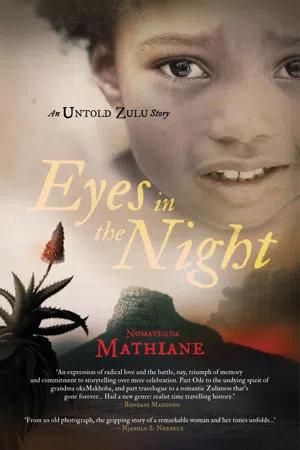
' 1879, the year in which I grew up faster than I could shout my name. That year was the one in which we experienced events and encounters that no one, particularly a child, should ever witness. It was also the year my people lost everything – their land and fields – and were reduced to being vagrants and beggars in the land of their birth. I am the daughter of Mqokotshwa Makhoba, one of King Cetshwayo's generals of the iNgobamakhosi regiment, he named me Nombhosho, which means bullet. He said I would come out of any situation fast and unscathed, like a bullet… ' Nomavenda Mathiane stumbled upon her grandmother's story well over a century after the gruelling events of the Battle of Isandlwana that formed her life. Astounded to hear how her grandmother had survived the 1879 Anglo-Zulu War between the British and Zulu nations as a young girl, Mathiane spent hours with her elder sisters reconstructing the extraordinary life of their grandmother. The result is a sweeping epic of both personal and political battles. Eyes in the Night is a young Zulu woman's story of drama, regret, guilt and, ultimately, triumph – set against the backdrop of a Zululand changed beyond recognition. A true story almost lost, but for a chance remark at a family gathering.
- English
- ePUB (mobile friendly)
- Available on iOS & Android
eBook - ePub
About this book
PART ONE

A Nation Besieged
I do not know in what year I was born but I remember that I was a young girl about to reach puberty when the war between the Zulus and the English broke out.
I mention my puberty status because in those days people’s birth dates were not recorded. Their ages were determined either by the development landmarks of their bodies, by plagues, or by some historical milestone.
I begin my narrative by recalling what happened in 1879, the year in which I grew up faster than I could shout my name. That year was the one in which we experienced events and encounters that no one, particularly a child, should ever witness. It was also the year my people lost everything – their land and fields – and were reduced to being vagrants and beggars in the land of their birth.
I am the daughter of Mqokotshwa Makhoba, one of King Cetshwayo’s generals of the iNgobamakhosi regiment, who was later elevated to the status of adviser to the king. Mqokotshwa named me Nombhosho, which means bullet. He said I would come out of any situation fast and unscathed like a bullet, and he named his second and last daughter Ndumbutshu which he said was the manner in which a bullet exits the barrel of a gun.
Although I was a young girl when the war broke out I remember as if it was yesterday the political climate of the time as well as the social conditions that engulfed us in Zululand. How can I forget the war between the English and the Zulus, and about King Cetshwayo?
At times when reading the Ilanga lase Natal I would get angry when we were told about hundreds of people who had been bombed in Italy and in England. What about our regiments who died by the thousands? Whoever cared to write about them? Whoever highlighted the plight of our nation? We were under siege the moment the strange-looking people set foot in Zululand.
*
For a moment, a picture of my granny flashed into my mind. I was about eighteen years old when she died. Although I saw her a few times when we visited her when my parents were on holiday, her picture remained etched in my mind. I have a vivid memory of the big-busted lady who seemed larger than life. The one aspect of her looks that springs to my mind whenever I think of her is how her pinafore dresses were often chafed and discoloured around her breasts due to excessive washing around that part of her body. She always looked ever so clean, as though she had just stepped out of a bath. Although she was not what one would describe as a beauty, her facial features were captivating. For a Zulu woman, she was fairly light in complexion with high cheekbones, a small nose, piercing yet kind eyes and thin lips. She could easily have passed for Khoisan.
*
My childhood home was in the Oqongweni village in the valley next to the Shiyane mountains. We lived a stone’s throw from the now world-famous Isandlwana mountain. From where we lived we could clearly see the strange-looking people who had pitched tents on the green slopes next to the mountain. There were plenty of unpalatable stories told about these strange people, whom King Shaka called abelumbi.
*
According to legend, King Shaka referred to white people as abelumbi – sorcerers – because he couldn’t fathom how their artillery could harm and kill from a distance. However, over the years, the name abelumbi was bastardised to a point where whites are now referred to as abelungu – the good or the kind ones – a word whose origins have always baffled me because while I was growing up in the 1960s there were so many stories about cruelty meted out to Africans by abelungu, stories that made me wonder if these narratives were fables or legends.
*
The arrival of abelumbi on these shores gave rise to many stories. The worst rumour which was travelling fast, far and wide, which more than illustrated the treacherous ways of the foreigners, was the tale of the abduction of young Zulu women by these people. It was alleged that a group of white men on horseback had taken advantage of the absence of Zulu men who had been summoned to the king’s palace at Ondini. The white men had wooed young women around the uMzinyathi area to work in their homes. They promised the women heaven on earth. The ones who consented to go with them were made to dispose of their isidwaba, the traditional hide skirt worn by Zulu women, and had to wear invaders’ apparel of unsightly, long flowing skirts. They also made the women shave their heads and remove the inhloko, the traditional Zulu women’s headgear, which they claimed provided a convenient habitat for lice.
When the men returned to their homes, they found their wives, lovers and sisters had gone to work for the white people. To the men who had been away meeting with the king and the nation’s leaders and elders, trying to find a solution to the impasse created by the invaders, this exodus of the women was an affront, a betrayal of the nation. The men were so angry that they went after the women. When they found them they beat them to a pulp. Others were simply killed.
Soon the rumours of an impending war became a reality as wagons were seen criss-crossing the land and tents were set up sporadically in many parts of the country. We Zulu people watched in awe as animals such as horses and oxen pulled structures that seemed like little houses with men inside them. They were wagons. When not riding on the wagons or their horses, these strange-looking people could be seen in big peaked hats and red coats strutting up and down the land as if they owned it. To add pain to humiliation and uncertainty, the British Secretary for Native Affairs, Sir Theophilus Shepstone, whom the Zulu people called Somtseu, sent an ultimatum to King Cetshwayo instructing him to disband his regiments as well as pay a fine of five hundred cattle for failing to adhere to the terms put to him when he was crowned King of the Zulus.
When the king learned of Somtseu’s demands, he fumed and swore that he would rather die than accede to them. He told his people to prepare for war.
By the end of winter a large part of the country was dotted with tents, coaches and wagons, as well as horses belonging to the invaders. It was clear to everyone that the foreigners’ intentions were to annihilate us and force us off our land. It was also clear that the enemy was prepared to go to any lengths to achieve this goal.
One day the king’s spies spotted a new settlement that had sprung up not far from our village Oqongweni.
That was the last straw for King Cetshwayo who immediately gave orders that we should move because he was getting ready to strike at the invaders. He had tolerated enough humiliation from them, particularly from Somtseu who was treating him as his subject and dictating to him how to rule his people. The king swore he was going to show Somtseu and the rest of the foreigners what the Zulu people were made of.
There were other white people who were also involved in the fracas like Sir Bartle Frere, the British High Commissioner for Southern Africa, and Sir Henry Bulwer, the Governor of Natal, to mention a few, but Somtseu was the one who was in our faces. He was the one who interacted directly with the king and his messengers, the one who imposed fines on King Cetshwayo. The rest of the foreigners were in the background.
There is no doubt that Shepstone was the most hated white man in Zululand. The Zulu people did not understand how a foreigner could lord it over their nation. Nobody knew who had bestowed on him, foreigner that he was, the right to dictate terms of governance to the king and his people. It was not the colour of his skin that the Zulus objected to; we just could not understand why he was meddling in our affairs.
Somtseu was not the first white person to interact with the Zulu people. There had been, in the past, numerous white people who had lived among the Zulus but none had displayed contempt for them in the way that Somtseu did. For instance, there was Henry Francis Fynn, a trader whom we called Findo. He had been trading in Zululand for years and had befriended King Shaka. The two men had a healthy relationship. Findo had learned the Zulu ways and spoke our language. Somtseu also spoke isiZulu and isiXhosa fluently, and was fully conversant with Zulu customs and traditions, yet he regarded the Zulu people with condescension. In response to his attitude, the Zulus saw him as an interloper.
I knew about Somtseu because my father who was then a member of the king’s advisory team had, on behalf of the king, met Somtseu on numerous occasions, such as when he had to deliver fines in the form of cattle or elephant tusks as peace offerings or when Somtseu’s emissaries delivered ultimatums to King Cetshwayo. My father was part of the delegation that received the British envoys.
The Zulu people were irked by Somtseu’s discourteous omnipresence. We did not understand why he featured so prominently in our lives and why we were on the receiving end of his wrath. We could not comprehend why he was persecuting King Cetshwayo when the king had done him no wrong. If anything, it was Somtseu and his people who were the aggressors in our land.
One of the incidents for which Somtseu penalised the king for was the vengeful behaviour of some drunken Zulus who had assaulted two white men who were working on the road. The incident had occurred at the height of hostilities between the Zulus and the foreigners. The Zulu men had seen the white men in their part of the land working on the road and had confronted them. They wanted to know who had given them permission, as foreigners, to do whatever it was they were doing. When there was no explanation forthcoming from the white men, partly because of the language barrier and partly because they did not deem it necessary to explain themselves to people they perceived as inferior, the Zulus were incensed by their arrogance and beat them up.
When Somtseu was informed of the incident, he was hopping mad and he immediately sent an envoy to King Cetshwayo, fining him five hundred cattle as compensation for the assault on the two white men.
Another matter which I was convinced was one of the main causes of the war between the Zulu people and the English was the Mehlokazulu debacle. Mehlokazulu was the son of Sihayo, one of King Cetshwayo’s most trusted and fearless warriors and generals. Though diminutive in stature, Sihayo was revered and popular all over Zululand and is rumoured to have had thirty-eight wives. He lived a stone’s throw from Isandlwana mountain. One of his wives, okaQwelebane left him to cohabit with a man who lived beyond the Zululand border, on the side of the Boers. Like his father, Mehlokazulu was brave and fearless. When he learned of his mother’s adultery and betrayal of the Zulu cause by opting to go and live with a deserter, Mehlokazulu was livid. Without his father’s knowledge or approval, he decided that he was going to kill his mother to avenge his father’s humiliation.
The only person Mehlokazulu confided in was his father’s second wife, who, when she learned of his intentions responded by saying: ‘Tell me you are joking.’
‘No, I’m not joking. I am going to smash her head with this assegai and scatter her brain all over the rocky mountain,’ was Mehlokazulu’s reply as he embarked on his deadly mission. He was accompanied by a group of friends who were as hotheaded as he was. However, the friends didn’t know that he was planning to kill his mother. They were under the impression that he intended killing his mother’s lover.
The young warriors set off on their bloodthirsty journey across the border in a carefree manner, betraying no emotion about the nature of their mission. As they didn’t want to be noticed or recognised by the villagers where okaQwelebane was now living, they casually picked their way amidst the low cliffs and dongas and arrived at the village just as the sun was setting. They selected a good vantage point behind the dongas of the establishment, where they could watch the activities taking place in and around the homestead where their prey was now living. They saw the boys herd the cattle back to the homesteads and milk the cows; they watched the girls return from the river carrying calabashes full of water while some were making fires on the floor hearth ready to prepare the evening meal.
The young warriors waited until the boys had concluded their daily chores and had locked the cattle in the pen before retiring into their respective huts. Surreptitiously, Mehlokazulu and his friends moved nearer the homestead. They hid among the bushes that were part of the hedge that surrounded the kraal and waited for okaQwelebane to make an appearance. They knew that she would at some stage have to respond to the call of nature. Indeed, when it became dark, they spotted her leaving the main hut and approaching the bushes in search of a place to relieve herself. As soon as she was done with her business, the men pounced on her and frogmarched her away from the homestead.
OkaQwelebane realised that she was being abducted by none other than her son. She knew how hard-hearted he was and that soon, as the isiZulu saying goes, ‘the vultures would be hovering over her corpse’. She began pleading for mercy, reminding her son that she was the woman who had brought him into the world and promising that she would go back home to her husband. But her lamentations and pleas fell on deaf ears. As soon as they were away from the village, Mehlokazulu grabbed her, wrung and broke her neck, dropped her lifeless body on the ground and crossed the border back home.
Somtseu must have rubbed his hands in glee when the news reached him because he now had a valid reason to attack King Cetshwayo, claiming the king had not kept his side of the bargain by not adhering to the terms of governance.
The terms stipulated by Somtseu were that the king should disband his regiments, abstain from the practice of sniffing out witches and stop the slaying of his subjects. Somtseu sent a delegation to King Cetshwayo, demanding Mehlokazulu’s head on the proverbial platter. He fined the king five hundred cattle, but not just ordinary cattle. He demanded a certain breed of cattle – the Nyonikayiphumuli breed. This was a special type of cattle that was first bred by King Shaka and from that time onwards they were bred only by royalty. To this day they are still regarded by the Zulu people as a symbol of Zulu sovereignty. They are spotless white cattle which commoners are not allowed to breed. Somtseu also demanded that the king hand over Sihayo, Mehlokazulu and his conspirators to stand trial for okaQwelebane’s murder. It didn’t matter to Somtseu that the crime had been committed outside Cetshwayo’s jurisdiction. Somtseu wanted Zululand, and Mehlokazulu had given him a good excuse to annihilate it. But the king was not about to betray his loyal subjects. He dug in his heels and flatly refused to hand over Mehlokazulu and Sihayo.
This stand-off was to result in the outbreak of the war that took the lives of thousands of Zulu people and hundreds of English soldiers. It displaced many families and was the precursor to the destruction of the Zulu nation.
*
These events took place not long after King Cetshwayo was crowned king of the Zulu people, an occasion which Somtseu not only attended, but one in which he officiated as representative of the British monarch, Queen...
Table of contents
- Cover
- Copyright
- Contents
- Map of southern Africa, circa 1879
- Map of Zululand
- Matrilineal Family Tree of the Makhoba Clan
- Prologue
- PART ONE: A Nation Besieged
- PART TWO: The Search
- PART THREE: Adrift
- PART FOUR: Another Move
- PART FIVE: The Farm
- Respite
- PART SIX: Escape to Freedom
- PART SEVEN: The Road Ahead
- Epilogue
- Historical Note
- Glossary and Guide to Zulu Words and Phrases
- Acknowledgements
Trusted by 375,005 students
Access to over 1.5 million titles for a fair monthly price.
Study more efficiently using our study tools.
Frequently asked questions
Yes, you can cancel anytime from the Subscription tab in your account settings on the Perlego website. Your subscription will stay active until the end of your current billing period. Learn how to cancel your subscription
No, books cannot be downloaded as external files, such as PDFs, for use outside of Perlego. However, you can download books within the Perlego app for offline reading on mobile or tablet. Learn how to download books offline
Perlego offers two plans: Essential and Complete
- Essential is ideal for learners and professionals who enjoy exploring a wide range of subjects. Access the Essential Library with 800,000+ trusted titles and best-sellers across business, personal growth, and the humanities. Includes unlimited reading time and Standard Read Aloud voice.
- Complete: Perfect for advanced learners and researchers needing full, unrestricted access. Unlock 1.5M+ books across hundreds of subjects, including academic and specialized titles. The Complete Plan also includes advanced features like Premium Read Aloud and Research Assistant.
We are an online textbook subscription service, where you can get access to an entire online library for less than the price of a single book per month. With over 1.5 million books across 990+ topics, we’ve got you covered! Learn about our mission
Look out for the read-aloud symbol on your next book to see if you can listen to it. The read-aloud tool reads text aloud for you, highlighting the text as it is being read. You can pause it, speed it up and slow it down. Learn more about Read Aloud
Yes! You can use the Perlego app on both iOS and Android devices to read anytime, anywhere — even offline. Perfect for commutes or when you’re on the go.
Please note we cannot support devices running on iOS 13 and Android 7 or earlier. Learn more about using the app
Please note we cannot support devices running on iOS 13 and Android 7 or earlier. Learn more about using the app
Yes, you can access Eyes in the Night by Nomavenda Mathiane in PDF and/or ePUB format, as well as other popular books in History & African History. We have over 1.5 million books available in our catalogue for you to explore.