![]()
![]()
4
Burnout isn’t just a feeling of exhaustion, being overwhelmed, and being extremely stressed and anxious. It’s not merely feeling tired all the time, not wanting to see friends and having no appetite for anything other than sugar, carbs and caffeine. It isn’t only feeling stretched in too many different and competing directions, by too many different and competing demands. It’s not simply a result of struggling to say no or failing to ask for help.
It’s all these things and more. It’s also a feeling of listlessness and ineptitude, a lack of enthusiasm and excitement, an existential emergency.
Burnout is a complex and systemic condition. Each element and aspect of burnout is connected to and influenced by every other element and aspect. The social aspects are connected to the emotional aspects, which are connected to the physical aspects, which are connected to the professional aspects and the financial aspects, and the domestic aspects, and the environmental aspects, and any other aspects you can think of.
That’s why just paying attention to the physical pieces of the puzzle isn’t enough to solve the problem. Eating more fruit and fewer chocolates is a good start, but it isn’t going to deal with the conditions that gave rise to the bad eating habits in the first place. Reducing stress levels (and, as I’ve often said, if anyone can tell me how to do that, I’d be very grateful) is a great ambition but doesn’t interrogate the underlying traits and thoughts that generate the stress.
The fact is that we’re part of a complex ecosystem and our burnout is a component of the larger whole.
Keeping our personal ecosystems healthy
Ecology is the branch of biology that studies how organisms – including people – relate to each other and their environment. There are many tiny elements in an ecosystem that are all interrelated and that all affect and are affected by each other. If one element in the ecosystem is working too hard or not hard enough, the whole system is altered. In a lake, for instance, if the delicate balance of light, water, air, sand, plants, fish, frogs and ducks is destabilised by a drought, the lack of rain leads to overcrowding in the water, which results in moss and other plant life dying and decomposing, using up precious oxygen. The lower levels of oxygen result in the suffocation of the fish, which results in the starvation of the frogs and ducks, which results in the increase in the numbers of pests like snails and slugs…
The health of any ecosystem, be it in the natural world or in our own private world, depends on all the various parts that make up the system maintaining their equilibrium. Our survival is dependent on the health and balance of the ecosystems that we’re part of. We’re affected by all the various elements that make up our own personal ecosystems, from our own innate biology and nature and what they require, to our families, our work, the communities we’re a part of, the society and country we live in, and even the world at large… We’re very much part of a greater whole.
If one element of the whole is out of balance, it has a knock-on effect on all the other elements of the system. What may start off as a small unhappiness in one life area (say, work) can soon spill over into other life areas. And, left unchecked, that unhappiness can start to affect the whole of life. Burnout results when our ecosystem gets out of balance and, rather than working together to support each other, one or more elements start to work against each other.
If we want to recover and stay recovered from burnout, we need to ensure that the health and equilibrium of our ecosystem is restored.
CUMULATIVE BURNOUT
When Grace arrived for her first coaching session with me, she was so emotionally bruised and battered that I wasn’t sure if I could help her or if I should refer her to a psychologist for depression. A very petite and extremely thin woman, she was obviously very anxious and looked as though she may spontaneously combust at any moment. As jittery as a deer walking past a lions’ den, she could barely sit still and talked nineteen to the dozen.
She was a few months into a job she hated, doing meaningless work with people she didn’t respect for an organisation that was fraught with conflict. The job also entailed a lot of travel, which meant she was away from home a couple of nights a week.
Grace was in a relationship with a man who had turned blowing hot and cold into an Olympic sport. Her mother was frail and needy, and demanded a lot of Grace’s attention and precious free time. Most of her friends were coupled up, and spending too much time with them served only to rub salt into her wounds.
She lived in a complex that attracted lots of young professionals and should have been a lovely place to live, but instead Grace felt assaulted by the loud parties her neighbours held every Friday and Saturday night and most Sundays in the daytime. Her home wasn’t the place of refuge she so desperately needed. She wasn’t sleeping enough, and she was too worn out to make sure she was eating properly or exercising well.
To add to all her stress, Grace was keenly interested in current affairs, and watched or read any source of news and commentary she could find time for. The constant stream of information about politics, corruption, crime, instability and uncertainty only added to her already unhealthy sense of doom and gloom.
Any one of those challenges would have been enough to send Grace into the burnout danger zone, but simultaneously combined, they gave her no chance of escaping unscathed. What Grace had was a perfect example of what I call ‘cumulative burnout’. At almost every level, and in almost every sphere of her life, she was experiencing exhaustion, helplessness and hopelessness. It was a perfect storm of pain, stress and unhappiness.
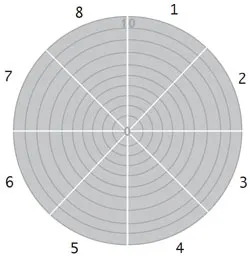
Once she’d expended enough nervous energy to calm down and be present with herself and with me, I asked her to complete a ‘wheel of life’ exercise. This is a powerful way to identify where life is good and where it needs to be improved. Grace’s wheel showed that, while she was pleased with the amount of money she earned and with her personal growth (she was studying part-time to further her qualifications), the other areas of her life were not even satisfactory, let alone making her happy.
The ‘wheel of life’ exercise helps us to quickly and easily identify where we’re out of balance so that we can take steps to regain some equilibrium in our lives. When you draw your own wheel of life, you’ll probably notice, as most people do, the interrelatedness of your satisfaction, or lack thereof, in the different areas – for instance, you may find that the good money you earn comes at the expense of doing work that’s not right for you, or that what ‘me’ time you have may be impacted by your physical or social environment.
While scoring a perfect 10 in each of the life areas would be fabulous, it’s not realistic. The aim is to get the wheel as round and balanced as possible, so that our lives feel and become more steady and stable. We’re aiming for even scores rather than high scores; and high even scores are the ultimate goal, reflective of a healthy and happy ecosystem.
Make your own wheel of life to see where your life is out of balance, and think about the changes you need to make in order to ensure the wheel is rounder and more in balance.
Draw a circle on a page. Divide the circle into eight so that it looks like a bicycle wheel. Label each of the eight sections of this wheel to represent the main areas of your life.
1. Work
2. Personal growth
3. Physical environment (micro and macro)
4. Intimate relationships
5. Relationships with family and friends
6. Money
7. ‘Me’ time
8. Health (good and bad, including sleep, eating, rest, exercise, drinking, smoking, etc.)
Allocate a score between 0 (very unhappy, at the centre of the wheel) and 10 (very happy, on the outer rim) to illustrate your current level of satisfaction in each area of your life, and mark the appropriate place on the ‘spoke’ of the wheel.
Now ask yourself:
• If this was a wheel on your car, how smooth would your ride through life be?
• Which life areas have you identified as being less than satisfactory?
• Which areas are you satisfied with?
Now identify two or three goals or resolutions for each of the life areas, either to improve things that are already working for you, or to address things that aren’t.
Take a look around you right now. How is the physical space you find yourself in reflecting how you’re feeling, and/or how may it be affecting how you’re feeling?
Is there a pile of clutter that’s making you feel anxious and out of control, or are your feelings of being overwhelmed and out of control being reflected by the mess on your desk? Is the noise in your head making you more aware of the noise around you, or is the noise in your environment negatively affecting your stress and anxiety levels? Are the flowers on the dresser making you happy, or did your happiness make you buy some flowers for your dresser?
Our inner and outer worlds are mirrors of each other. It can be hard to know what comes first.
What I do know (and I’m sure you do too) is that making a positive change to your space results in a positive change in your spirit.
Choose one thing that you can do right now to improve your space. Tidy up, throw away old magazines and burned-out candles, wash the windows, stick up a picture that makes you happy.
Even a tiny change to what you see can make a big change to how you feel.
![]()
5
I’m often asked by journalists to give advice on various articles. I get asked to comment on questions like ‘Why do women have affairs with married men?’ or ‘What makes people push themselves too hard?’ Wouldn’t it be nice if I could answer those questions! Instead, I explain that the only way to get any accurate insights would be to ask every single woman having an affair with a married man, or every single person who drives themself too hard.
Everybody is unique, and we all have unique circumstances and contexts that determine our responses to the world around us, so it’s impossible to reach an absolute understanding of the choices that all people make. It is, I believe, disrespectful to presume to know what makes ev...