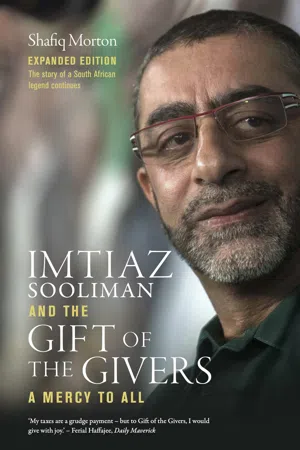
Imtiaz Sooliman, a medical doctor practising in Pietermaritzburg, South Africa, visited a Shaikh in Istanbul in 1992. The Sufi teacher gave him a message that would dramatically change the lives of countless people. 'To my absolute astonishment he told me I would help people for the rest of my life. He then instructed me to form a humanitarian organisation called the "Gift of the Givers, " and repeated the phrase "the best among people are those who benefit mankind." Almost 30 years later Gift of the Givers, Africa's largest humanitarian and disaster agency, has a reputation for speedy responses to floods, war, famine, fires, tsunamis, kidnapping, and earthquakes. Well known for their interventions in South African and international disasters, teams of volunteers have undertaken missions to places such as Bosnia, Palestine, Japan, Haiti, Indonesia, Malawi, and Mozambique. They have put up hospitals, run clinics, dug wells, drilled boreholes, built houses, offered scholarships, and provided shelter, food, and psychological succour to millions.
- 336 pages
- English
- ePUB (mobile friendly)
- Available on iOS & Android
eBook - ePub
About this book
Information
1
BEGINNINGS
YOU WILL FORM AN ORGANISATION, THE NAME WILL BE GIFT OF THE GIVERS
‘You feel the calling, you feel the need, you see the suffering of man and you want to do something. There’s a lot of prayer involved. You’ve been shown what the right way is; what to do and what not to do. And things are put very clearly in front of you.’
Dr Imtiaz Sooliman
THE SOOLIMANS came to South Africa in the early 1900s from Gujarat, an Indian coastal region bordered by Pakistan. Looking for economic opportunity, patriarch Joosab Gani Sooliman opened a shop in Potchefstroom, a town in the Tlokwe Municipality on the banks of the Mooi River in the North West province.
He was a Memon, a member of an ethnic group originating from lower Sindh in the Indus Delta. History books describe the Memons of Gujarat as the Muslim sailor merchants of India. Today, Memons are renowned for being entrepreneurial, hardworking, innovative, soft-hearted and generous.
Dr Imtiaz Sooliman (who was born in 1962) remembers his father, Ismail, and grandfather, Joosab Gani, always being kind to their customers, discreetly helping destitute families with funeral costs or allowing them to buy basic foodstuffs on tab – even when there was no guarantee of them ever being paid back.
Later, when he went to stay with his mother, Farida, in Durban (his parents separated when he was young) he discovered she was the same. Although she did not have much, he recalls her telling him that you gave charity, even if you could only afford to give one food parcel a month. He remembers walking long distances to deliver his mother’s food to the poor.
Sooliman describes himself as being ‘timid’ as a child, initially fearful of things such as cricket and soccer balls. But he did grow in confidence in Durban, where the streets were a lot tougher and more abrasive than in Potchefstroom.
‘There were many gangsters where my mother lived and they’d stab people in full view. I thought, man, this place is not for me!’
He soon lost his timidity when the neighbourhood children asked him to play soccer with them.
‘So I got a little adventurous. I started out as the reserve. My job was to fetch the ball but by the following year I was the captain.’
Despite his modest circumstances in the shadow of Durban’s leafy Berea, Sooliman matriculated from Greyville’s Sastri College in 1978 and enrolled at the University of Natal’s medical school (now the Nelson R Mandela School of Medicine) to study medicine. He qualified in 1984, completed his internship at King Edward VIII Hospital in Durban and went into private practice in Pietermaritzburg.
He also became an active member of the Islamic Medical Association, an organisation formed in the 1980s by local Muslim doctors to provide medical care to the underprivileged. In 1990 he visited Nacala Hospital in northern Mozambique with the Islamic Medical Association during a severe drought.
‘The difficulty that ordinary Mozambicans experienced in their daily lives touched my heart,’ he said.
‘I went to Mozambique because I wanted to help. I’d never done anything like that before in my life. I saw two frail and malnourished kids in a riverbed digging a half-metre-deep hole and using their tiny hands to scrape out muddy drinking water. That freaked me out. I thought how easily we watered our gardens and turned on taps without thought.’
On his return to South Africa Sooliman bought a fax machine and installed it in his home. He picked out names in the phone book, called mosques and faxed whoever would listen to him, a report of what he’d seen and what needed to be done. Within five days he’d raised R1 million – enough to dig 30 boreholes and provide much-needed relief, including airlifting malaria medication for use by Mozambican authorities.
‘That was my first major humanitarian project. The next year was the Gulf War in Iraq and we got involved there, then the Bangladesh cyclone of 1991.’
It was in the Turkish city of Istanbul that he would enjoy a fateful meeting with a Sufi teacher, Shaikh Safer Efendi, on the urging of his neighbour in Pietermaritzburg. A master in the science of Islamic mysticism, and representing an unbroken chain of Shaikhs going back to the time of Prophet Muhammad, Shaikh Safer would change Sooliman’s life forever.
Sooliman remembers every detail:
‘It was 6 August 1992; I was 30 years old and it was a Thursday in Istanbul. The Shaikh’s manner was so gentle, so soft, so accommodating … his face was engulfed in such light, his deep eyes were filled with such compassion and his presence was so magnetic – you just couldn’t help being drawn to him, falling in love with his personality.’
Sufi masters, regarded as doctors of the human soul, are believed by their followers to possess great insight. Sooliman said there is no doubt in his mind that Shaikh Safer could see his soul.
‘After a congregational religious ceremony the Shaikh just looked at me as if something was talking through him. I do not understand a word of Turkish, but I knew what he was saying. He looked at me and said: “My son I’m not asking you, I’m instructing you. You will form an organisation. The name will be the Gift of the Givers. You will serve all people of all races, of all religions, of all colours, of all classes, of all political affiliations and of any geographical location, and you will serve them unconditionally.”
‘Apart from the unconditionality of service, the Shaikh told me in no uncertain terms that I should never expect anything in return. He told me that the best I could ever expect was a kick up the backside, and if I didn’t get one, I should consider it as a bonus!
‘The Shaikh then instructed me to serve people with kindness, compassion, mercy, and remember that the dignity of man was foremost. No matter what condition there was, I always had to protect the dignity of man; and when I acted, I had to act with excellence.
‘The Shaikh told me that this was an instruction for the rest of my life. The best among people would be those who benefited mankind [a validated axiom of the Prophet Muhammad], and I had to remember that whatever was done would be done through me – and not by me. If I abided by that principle, I would help a lot of people. He warned me not to forget that.’
The other thing that struck the 30-year-old doctor was the make-up of the people gathered around the Shaikh – they were from all walks of life, from all nations, and representing all colours. As a young South African ghettoised by apartheid, Sooliman said this made a marked impression on him. Clearly, all people couldn’t be painted with the same brush.
Sooliman’s brother-in-law, Rafeek Ismail, who was with him at the time, recalls that before their interpreter could translate, the Shaikh would seem to know what was on their minds.
‘It was as if we were speaking through our silence,’ he said.
Gift of the Givers was founded in August 1992, and immediately Sooliman found himself involved in the Bosnian crisis – and remembering the Shaikh’s teaching:
‘Go out in the street without your coat some cold winter’s day, just to see how it is for those who have no coats at all! As long as your stomach is full, you will know nothing about the condition of the starving … satisfy the hungry, so that Paradise may love you.’
Inducted into the Sufi way, Sooliman was encouraged to be humble at all times. As his Shaikh had warned:
‘Become aware of the condition of all those paupers and orphans, for your own wife may become a pauper and your very own children orphans. The wheel of fate turns. None of us knows what is to be …’
His is a job driven by fate. You never know what is waiting around the corner. It’s a question of what he calls a ‘connection’.
‘You feel the calling, you feel the need, you see the suffering of man and you want to do something. There’s a lot of prayer involved. You’ve been shown what the right way is; what to do and what not to do. And things are put very clearly in front of you.’
Sooliman believes that it’s the conditions of others less fortunate than him that keeps him going. You want to help over and over when you see the pain and suffering of others. The most satisfying thing is the smile on a person’s face when they are lifted up.
To ensure that Gift of the Givers runs effectively as an NGO, Sooliman insists on quality and professionalism at every turn. The organisation is primarily funded by ordinary South Africans, people who make great sacrifices to give him money, and also corporates whose ethos demands delivery.
There are no short cuts. He runs a core staff of about 50 people in Pietermaritzburg, Durban, Johannesburg and Cape Town in South Africa, and Mogadishu (Somalia), Blantyre (Malawi), Darkoush (Syria) and Sana’a (Yemen). Volunteer doctors, paramedics and search-and-rescue teams are on standby. Sooliman and his team always render humanitarian assistance themselves, and while happy to partner in projects, Gift of the Givers hardly ever works through third parties or agencies at the point of delivery.
He learnt very quickly that to be effective in the emotionally demanding field of humanitarian work he had to have a clear mind and a cool temperament.
‘It is impossible not to feel for people, but you have to be ice-cold in this type of situation … you really cannot afford to sit down and cry. You may end up doing nothing. I consider myself to be a very gentle person, but I can be icy cold at the same time. I feel for people, but I have never got emotionally attached.’
Another lesson was that because of the urgency of a situation, you had to be straightforward. Sooliman’s blunt, off-the-record exchanges with officials are legend but – as he says – they have at all times been driven by a concern for helping others, rather than scoring points and satisfying the ego.
‘I call a spade a spade. I’ve found that in the type of work we do, it’s the only way we can really survive and help others to survive.’
Sooliman maintains that he learnt almost everything about humanitarian work in Bosnia. There, every possible obstacle was put in front of him, every possible bureaucratic hurdle was erected, and at every turn his patience was tested.
‘Each challenge makes you stronger,’ is his understated response to what was a highly taxing and troublesome time in his life.
The Bosnian conflict occurred in the former Socialist Federal Republic of Yugoslavia that had fractured along sectarian lines after the death in 1980 of its leader, Josep Broz Tito. Yugoslavia had consisted of Slovenia, Croatia, Serbia, Bosnia-Herzegovina, Montenegro and Macedonia.
An astute man who took power in 1945, Tito’s internal policy of crushing sectarian nationalist sentiment and enforcing unity between the six Yugoslav nations, saw him remaining in power until his death 35 years later.
Yugoslavia consisted of three major ethnic groups: the Catholic Croats, the Orthodox Serbs and the Bosnian Muslims. Tito had known better than most the real substance of Yugoslav nationalism, and it had taken his iron fist to keep its destructive forces at bay. However, after his death the socialist federation had started to crumble, and with the implosion of the Soviet Union, the uneasy framework of Yugoslav state unity had collapsed. Competing nationalist movements rose to the fore after the 1990 elections.
When Slovenia and Croatia declared independence in 1991, the Yugoslav armed forces – by now the blunt instrument of Serbian nationalism – prepared to ...
Table of contents
- Cover
- Copyright
- Contents
- Preface 2021
- Preface 2014
- 1. Beginnings
- 2. 1995-2003: From Food Parcels to Careline
- 3. The Early Years
- 4. Sibusiso, A Zulu Blessing
- 5. 2004: The Asian Tsunami, Sri Lanka and Somalia
- 6. 2006: Lebanon
- 7. Xenophobia
- 8. 2009: Gaza
- 9. January 2010: The Haiti Earthquake
- 10. September 2010: The Pakistan Flood
- 11. 2011: Libya
- 12. August 2011: The Somali Famine
- 13. September 2011: Rebuilding in Somalia
- 14. October 2011: The Verdwaal Four
- 15. 2013: The Syrian Story
- 16. Syria: The Ubuntu of Darkoush
- 17. January 2013: The Khayelitsha Fire
- 18. 2013: Mandela Day and the Alex Housing Scheme
- 19. 2013: Typhoon Haiyan
- 20. 2014: Yemen
- 21. 2011-2019: The Hostage Crises
- 22. 2015: Nepal
- 23. September 2018: Palu
- 24. 2015-2021: Drought
- 25. June 2017: The Knysna Disaster
- 26. 2019: From Cyclone Idai to Day Zero
- 27. 2020-2021: The COVID-19 Pandemic
- 28. 1993-2014: Dr Imtiaz Sooliman and Gift of the Givers People
- 29. If You Give, You Get
- 30. 2014-2021: Changes
- 31. 1993-2021: In Service
- Acknowledgements
- About the author
- Pictures
Trusted by 375,005 students
Access to over 1.5 million titles for a fair monthly price.
Study more efficiently using our study tools.
Frequently asked questions
Yes, you can cancel anytime from the Subscription tab in your account settings on the Perlego website. Your subscription will stay active until the end of your current billing period. Learn how to cancel your subscription
No, books cannot be downloaded as external files, such as PDFs, for use outside of Perlego. However, you can download books within the Perlego app for offline reading on mobile or tablet. Learn how to download books offline
Perlego offers two plans: Essential and Complete
- Essential is ideal for learners and professionals who enjoy exploring a wide range of subjects. Access the Essential Library with 800,000+ trusted titles and best-sellers across business, personal growth, and the humanities. Includes unlimited reading time and Standard Read Aloud voice.
- Complete: Perfect for advanced learners and researchers needing full, unrestricted access. Unlock 1.5M+ books across hundreds of subjects, including academic and specialized titles. The Complete Plan also includes advanced features like Premium Read Aloud and Research Assistant.
We are an online textbook subscription service, where you can get access to an entire online library for less than the price of a single book per month. With over 1.5 million books across 990+ topics, we’ve got you covered! Learn about our mission
Look out for the read-aloud symbol on your next book to see if you can listen to it. The read-aloud tool reads text aloud for you, highlighting the text as it is being read. You can pause it, speed it up and slow it down. Learn more about Read Aloud
Yes! You can use the Perlego app on both iOS and Android devices to read anytime, anywhere — even offline. Perfect for commutes or when you’re on the go.
Please note we cannot support devices running on iOS 13 and Android 7 or earlier. Learn more about using the app
Please note we cannot support devices running on iOS 13 and Android 7 or earlier. Learn more about using the app
Yes, you can access Imtiaz Sooliman and the Gift of the Givers by Shafiq Morton in PDF and/or ePUB format, as well as other popular books in Social Sciences & Social Work. We have over 1.5 million books available in our catalogue for you to explore.