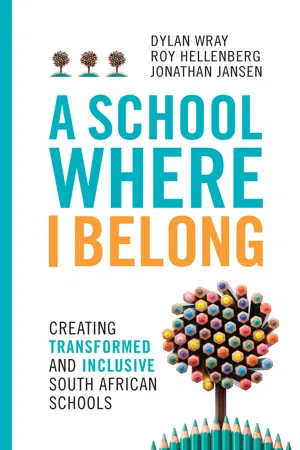
Over the past few years, it has become clear that the path of transformation in schools since 1994 has not led South Africa's education system to where we had hoped it could be. Through tweets, posts and recent protests in schools, it has become apparent that in former whites-only state schools, and private schools, children of colour and those who are 'different' don't feel they belong. Following the astonishing success of How to Fix South Africa's Schools, the authors sat down with young people who attended former Model-C and private schools, as well as principals and teachers, to reflect on transformation and belonging in South African schools. These filmed reflections, available for streaming, are honest and insightful. Drawing on the authors' experiences in supporting schools over the last twenty years, and the insight of those interviewed, A School Where I Belong outlines six areas where true transformation in South African and world classrooms and schools can begin.
eBook - ePub
A School Where I Belong
Creating Transformed and Inclusive South African Schools
- English
- ePUB (mobile friendly)
- Available on iOS & Android
eBook - ePub
A School Where I Belong
Creating Transformed and Inclusive South African Schools
About this book
Information
1
FACING
THE PAST
We need to face our past with honesty and courage. Until we face the fact that many of our schools weren’t just silent bystanders but indeed active participants in the oppression of others, we cannot see a future in which we have a responsibility to educate for all and ensure that everyone in our schools feels at home.
“We can say, ‘All right, we were a white school, come to us and fit in with what we believe in,’ or we can say, ‘We were a white school, and, while we cannot change the past, we recognise that that was an unjust system that we were part of, and in order for us to go together into a just society going forward we have to acknowledge that what was there was unjust.’”
Tony, Principal
WITH HONESTY AND COURAGE
The past does not lie quietly down to rest. Even when we hope we have tucked it in tightly, it murmurs, and as we are discovering, sometimes it stirs, wakes up and is not happy.
Through university students bringing down Rhodes and fees, and through girls tired with racially offensive policies at schools in Pretoria and Cape Town, South Africans are being forced to look back in order to simply understand today, let alone what will happen tomorrow. We are uncomfortably discovering that there is more of our past still to face, more of our history still to talk about, and more legacies still to acknowledge and respond to.
If we are to really hear the loud voices of these young people, we have to remember that our education system was built on a racially divided and unfair past. The legacy of apartheid and 300 years of colonialism reinforced a persistent message – that you could divide humanity into those who were allowed to achieve great things and those who were not. White South Africans were given better schools with better facilities and more opportunities to achieve those great things. University access was reserved for white South Africans, with higher-level thinking and deep theoretical reflection thought to be their exclusive domain.
Today, former white schools still have more resources and better facilities than poorer schools, and their success, based on a history of privilege, reinforces the message about who can achieve great things. Their well-maintained buildings and sports fields are still located in neighbourhoods that are wealthier. Most who enter and succeed in tertiary education come from these schools. As we have been reminded through the Fallist protests, access to universities remains out of reach for the majority of young South Africans.
There needs to be an understanding and acknowledgement of how these structures, formed to support a colonial and then an apartheid system, continue to exist, and how the perceptions created during this period of oppression continue to be ingrained in the cultures of many schools.
The Truth and Reconciliation Commission was a national project, but surely it was ultimately meant to become a community process where we, as South Africans, could look at all our institutions and begin to ask uncomfortable questions of ourselves? There were hopeful expectations that at some point we would turn to education and ask, “How did our schools perpetuate an unfair and discriminatory system and society? How did this school encourage it? What needs to happen next?”
Very few schools have willingly begun this difficult conversation. Few have looked back on that past and spoken about how they as an institution, or as part of a racially hierarchical education system, excluded other young South Africans from also achieving great things – and not just accepted that the law gave them no choices. Few have admitted how they might have accepted that only white South Africans could participate, and how sometimes, they chose not to be concerned that no one else was participating.
Hardly any schools have had the courage to say, “Whether we were present at the time or whether we are new to this school, this institution carries a legacy that we have to take responsibility for today.” Fewer have asked, “How do we use the privilege given to us by the past to build a school that no longer excludes those who live too far or are too poor, where everyone will feel like they belong?”
We need to face our past with honesty and courage. Until we face the fact that many of our schools weren’t just silent bystanders but indeed active participants in the oppression of others, we cannot see a future in which we have a responsibility to educate for all and ensure that everyone in our schools feels at home.
“I think it’s important for all of us to acknowledge the past and I don’t think we can escape that. The universities at present, in particular UCT, are going through a truth and reconciliation sort of process. You know, our school is part of a system that existed, an education system that existed in the past as well. We were part of a process that said, ‘You can only take white boys’ at one stage.
When our school was formed at the end of the 19th century, one of the conscious reasons for its formation was to find reconciliation between Afrikaans- and English-speaking families after the Anglo-Boer War, which was considered a real problem. There was this rift between Afrikaans-speaking people and English-speaking people, and there was a very conscious attempt at the time to bring the two communities together. I think when the possibility opened for white schools to start admitting pupils of colour, our school was a very early adopter. But I suppose what we need to do would be to really dig into the past.
It’s certainly a language that’s entered into the conversation around our vision and what’s been written into that as well. We’re very conscious of the fact that we’re a school that has mostly catered for white privileged kids and that we have a responsibility to change that.
I suppose one could rewrite the history books to make a statement of that sort. I don’t think anybody in our school system, certainly, would have any objection to owning up to the fact that we were a white elitist school at one stage. I think what’s most important to me and to the school is to change where we are right now and to be different now.”
Shaun, Principal
DUSTING IT OFF
It is hard to be an adult who grew up during the apartheid era in South Africa and not still carry some of its dust. This is South Africa, after all. We have many dirt roads and the winds of change keep returning strong, scattering dust everywhere.
Just as the past has shaped our education system and the ethos and culture of our schools, so too has history shaped the people who work in these buildings. Given that the average age of teachers in South Africa today is around 35 years, most teachers currently in schools were themselves learners in a racially divided and unequal system. Some were even teachers then. They all bring some of that history into their classrooms.
For more than 15 years we have been running the programme Facing the Past – Transforming our Future in partnership with Facing History and Ourselves in Boston, USA. Through many workshops, seminars and conferences, we have brought together hundreds of teachers from all backgrounds and ages to explore their identity, how they see each other and the impact this country’s past has had on us, how we teach and, even, where we teach. These have been unique spaces of learning where black, white, foreign national, female, male, old and young teachers faced each other, shared their history and stories, listened and, for many, heard for the first time. Crucially, teachers were given curriculum support to change their classrooms into inclusive and safe spaces where vigorous debate could be encouraged.
When we were planning for the very first Facing the Past workshop in 2003, we were concerned about how teachers would cope sitting across from each other, black and white, exploring the painful history we have lived through. We knew that the process would open doors that had been purposefully shut many years before. We knew that teachers of different races and backgrounds sitting in the same room, exploring a past that affected them each so differently, could open wounds, lend weight to guilt, and echo indifference.
We were concerned at our ability to create a space safe enough to honour and value those who would be in the room, so we went in search of help from trauma counsellors. But we didn’t get very far. Our first meeting was with Paul Haupt, who at that time was working for the Institute for Justice and Reconciliation. We had come to get his advice, and were hoping he could be in the room and manage the trauma we feared to face. It wasn’t to be. Not because he hadn’t offered his help, but rather because of what he had told us. He said (something like), “You don’t need to have trauma counsellors in the room with you. You have teachers. Teachers spend their days managing the emotions, feelings and reactions of classrooms filled with 20, 30, 50 young people”. And then he added (verbatim), “Never underestimate the power of a room full of teachers to support themselves.”
We gave up looking for trauma counsellors. We have never underestimated the supportive power of teachers. Although the past has been painful and the conversations raw, a trauma counsellor has not been needed. Of course, we have had to guide and facilitate a process and conversation. But when it came to hearing one another’s stories and reflecting on their own identity and choices, the hundreds of teachers who we have worked with were able to speak, and they stayed in the room listening, uncomfortably and cathartically. Our work was to invite them to begin the conversation. These conversations are needed now more than ever.
Much of what we have witnessed through this opportunity is echoed in what these three teachers said about the process:
“I know how indoctrinated I was, so people who are older are much more so than me. That has to influence their teaching, irrespective of what race they are. And if we’re not critically looking at how it is that who we are influences how we teach, then we’re just perpetuating either hatred, maybe indifference towards the other, whoever they are, and then how do we possibly create a new way of being?”
“I think it was difficult preparing myself for that type of lesson … because I needed to search my own heart for my own prejudices and my own thoughts and be confronted with my own inadequacies … Just thinking through where I was at the time. How the laws that I wasn’t even aware of at the time as a child impacted on me. [This] was actually harder than understanding what the law meant.”
“The stories of the ‘white’ teachers especially were significant. I think there are many generalisations that this group had no need to complain and that they all benefitted from the old system. I think there is also a stereotype that those who did suffer must just get on with it, move on. What the Facing the Past workshops have done is to give us space and acknowledgement that our stories are powerful too. This of course is mirrored in what we then do in our classrooms.”
When schools became multi-racial in 1991, very few planned for the hard work that would need to be done to recognise that teachers are people who carry their history, prejudices and ways of being into the classroom. Very few since then have proactively supported all their teachers to be more reflective of how our past has shaped them. Few, especially those with racially homogenous staffrooms, actively made the effort for staff to learn with and from teachers ve...
Table of contents
- Cover
- Copyright
- Contents
- Introduction
- What to expect from this book
- Who is featured in the book and videos
- 1 Facing the past
- 2 Deliberately including
- 3 Battling bias
- 4 Seeking difference
- 5 Leading for change
- 6 Fostering civil discourse
- 7 Where to begin
- Appendix
- Acknowledgements
- References
Trusted by 375,005 students
Access to over 1.5 million titles for a fair monthly price.
Study more efficiently using our study tools.
Frequently asked questions
Yes, you can cancel anytime from the Subscription tab in your account settings on the Perlego website. Your subscription will stay active until the end of your current billing period. Learn how to cancel your subscription
No, books cannot be downloaded as external files, such as PDFs, for use outside of Perlego. However, you can download books within the Perlego app for offline reading on mobile or tablet. Learn how to download books offline
Perlego offers two plans: Essential and Complete
- Essential is ideal for learners and professionals who enjoy exploring a wide range of subjects. Access the Essential Library with 800,000+ trusted titles and best-sellers across business, personal growth, and the humanities. Includes unlimited reading time and Standard Read Aloud voice.
- Complete: Perfect for advanced learners and researchers needing full, unrestricted access. Unlock 1.5M+ books across hundreds of subjects, including academic and specialized titles. The Complete Plan also includes advanced features like Premium Read Aloud and Research Assistant.
We are an online textbook subscription service, where you can get access to an entire online library for less than the price of a single book per month. With over 1.5 million books across 990+ topics, we’ve got you covered! Learn about our mission
Look out for the read-aloud symbol on your next book to see if you can listen to it. The read-aloud tool reads text aloud for you, highlighting the text as it is being read. You can pause it, speed it up and slow it down. Learn more about Read Aloud
Yes! You can use the Perlego app on both iOS and Android devices to read anytime, anywhere — even offline. Perfect for commutes or when you’re on the go.
Please note we cannot support devices running on iOS 13 and Android 7 or earlier. Learn more about using the app
Please note we cannot support devices running on iOS 13 and Android 7 or earlier. Learn more about using the app
Yes, you can access A School Where I Belong by Dylan Wray,Roy Hellenberg,Jonathan Jansen in PDF and/or ePUB format, as well as other popular books in Education & Inclusive Education. We have over 1.5 million books available in our catalogue for you to explore.