A detailed account of the rich history and resilience of the Bakwena ba Mogopa, one of the most important traditional communities in South Africa. This seminal and lucid work depicts the scope of social, political and economic change of the community from its earliest beginnings as the Kwena tribe migrating from East Africa to southern Africa, the birth of the tribe as a distinct and independent lineage in the 1600s, the impact of land dispossession of the Boer settlers as they advanced from the Cape Colony to the interior, the impact of Christianity, the racist and oppressive attitudes and policies of colonial governments, through to the hardships endured under the Union government and apartheid. Mountains of Spirit captures the role that the traditional leaders of the Bakwena ba Mogopa played in shaping the community and responding to challenges of the modern economy and constitutional democracy of South Africa. It is an important study of the tribal structures, the social, cultural and traditional practices, and the questions of land, minerals and mining rights of the Bakwena ba Mogopa. A story spanning migrations, wars, land dispossession and restitution, intra-tribal rivalry, unrest, cultural disintegration, forced removals, pain and suffering and reintegration, Mountains of Spirit reclaims the history of a people and evinces the fighting spirit and resilience of a resourceful community against immense odds.
eBook - ePub
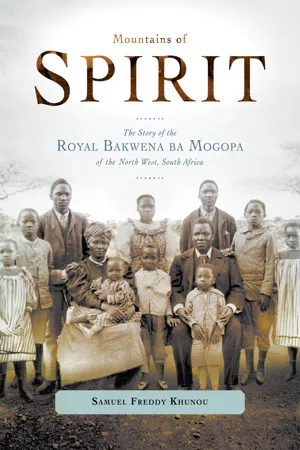
Mountains of Spirit
The Story of the Royal Bakwena ba Mogopa of the North West, South Africa
- English
- ePUB (mobile friendly)
- Available on iOS & Android
eBook - ePub
Mountains of Spirit
The Story of the Royal Bakwena ba Mogopa of the North West, South Africa
About this book
SECTION I

THE HISTORY OF THE BAKWENA BA MOGOPA
EARLY HISTORY
CHAPTER 1
Earliest beginnings
c.1000–c.1600
Like that of most African people, the early history of the Tswana people1 is shrouded in legends, folklore and traditions,2 and some information recorded by historians seems to be at variance with oral history.
There are different migratory theories about the early origins of the Tswana people. One (regarded as unrealistic) traces the Tswana ancestors back to 1350, when they inhabited the present-day area of Johannesburg in South Africa’s Gauteng province.3 In terms of this theory, the main Tswana migration4 moved westwards within South Africa, encouraged and stimulated by friction and competition for survival from others. This theory posits that the Tswana empire originated in the 18th century, and that by 1800 many related Tswana groups were already organised and settled.5
Another theory suggests that they originally came from North Africa, and were living north of the Zambezi River between the 11th and 15th centuries.6
Historical evidence indicates, however, that most Southern African black people, including the Tswana, originally came from northeast Africa.7 Reasons for their migration included the increase and spread of domesticated livestock, the drying of the Sahara Desert, and the spread of metallurgy.8
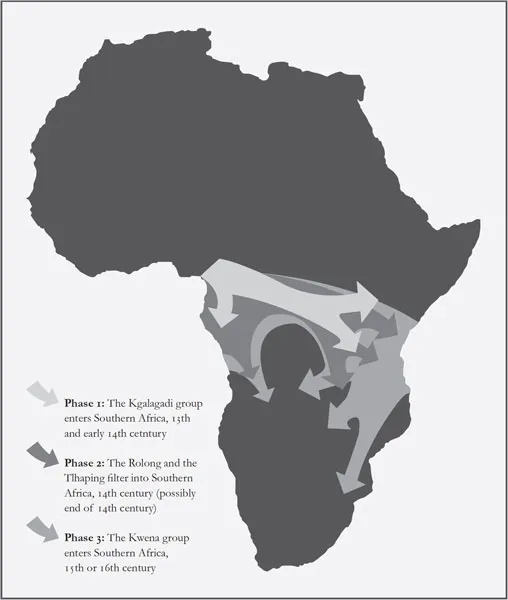
Migration routes of Tswana groups in Africa (SOURCE: www.newworldencyclopedia.org/entry/Bantu)
The Tswana separated from other black people in the vicinity of Nokadifatshe (literally, ‘The Great Lakes of Africa’), and proceeded downwards along the western section of present-day Zimbabwe, crossing the Botletli (today’s Zambezi) River9 before the 11th century.10
The Tswana filtered into Southern Africa from north of the Zambezi in three migratory waves.11 Pastoral people who travelled with their livestock entered Southern Africa along the ridges of the central Rift Valley and then moved through the tsetse-free zone12 between the Kalahari Desert and the Limpopo River valley. As hunters, herders and cultivators, the migrants found the high plains to their liking: game animals abounded, the grass was excellent for cattle, there were no serious endemic livestock diseases, and the soil was deep and easy to cultivate.
The first group to arrive in Southern Africa was the earliest Kgalagadi people, during the 13th and 14th centuries.13 The next groups of immigrants were the Rolong and the Tlhaping.14 The Rolong – who took their name from Chief Morolong, the earliest recorded chief15 – are believed to be the most ancient Tswana group, having migrated from the north, probably in the region of the Great Lakes, around 1400.16 Having reached Southern Africa, they then underwent a common Tswana process of fission, dividing into four chiefdoms: the Rratlou-Rolong, the Seleke-Rolong, the Tshidi-Rolong and the Rapulana-Rolong.17 From these descended not only various Tswana communities now found in Botswana and South Africa, but also various branches of the Barotsi nation.
After four generations, the Rolong reached the Molopo River and settled somewhere in the vicinity of present-day Mahikeng.18 They formed a powerful state in the 17th and 18th centuries in the region of the northwestern Cape and one-time south-western Transvaal.19 They reached the height of their power under Chief Tau,20 establishing a large, stone-walled capital town named Taung.
The third wave of the Tswana migration into Southern Africa was that of the Kwena, during the 15th or 16th century21 under Chief Mogale, who is regarded as the father of all the communities of the Bakwena group.22 All the larger Tswana chiefdoms, such as the Ngwaketse, Ngwato, Tawana, Bakwena ba Mogopa, Bafokeng and Baphalane, and some of the Sotho communities,23 emerged from this parent Kwena lineage.
Within Southern Africa, the Tswana settled in different regions; historians do not agree on the exact areas.24 It’s believed that the Kwena resided in the Brits-Rustenburg area from 1400, although some say that the Tswana lived in the area of the Molopo River from 1500. Other historians suggest that the Tswana first settled in an area that was free of both tsetse fly and malaria around the Magaliesberg Mountains and the watershed of the Crocodile, Vaal (Lekwa) and Molopo Rivers, the Marico region, Rustenburg and Lichtenburg districts of the one-time western Transvaal.25
THE KWENA AND ITS BREAKAWAY GROUPS
The original Kwena tribe lived at Lowe southwest of the Marico and Notwane Rivers under Chief Mogale. From there, they relocated to Rathateng on the lower reaches of the Crocodile (Odi) River. The Kwena dispersal probably started at Rathateng near what was later called the Botswana-Transvaal border.
The original Kwena tribe was ruled by Chief Mogale, who was succeeded by his son Mfete. Melore, the son of Mfete, took over the reins next. Melore’s son, Masilo (who lived in the 15th or 16th century), had two sons, Mohurutshe I and Malope. Chief Malope ruled the Kwena group.
After the death of Malope, there was a succession dispute between his daughter Mohurutshe II and her brothers, Kwena,26 Ngwato and Ngwaketse. Some objected to Mohurutshe II’s bid for the throne because she was a woman, and, as a result, during the 15th or 16th century,27 she and her followers broke away. The followers of Mohurutshe moved south as a separate group, possibly to Kaditshwene, near Zeerust, an area which later formed part of the western Transvaal. 28
Subsequent to the formation of this Bahurutshe dynasty, the Kgatla broke away from them29, taking their name from their early chief Mokgatla.30 The Kgatla lineage, which was also divided on numerous occasions,31 includes the Bakgatla ba Mmakau, Bakgatla ba Kgafela, Bakgatla ba Mosetlha, Bakgatla ba Motsha in Hammanskraal and Bakgatla ba Mmanaana in present-day Botswana.
By the early 18th century, the Bahurutshe had become one of the most powerful Tswana chiefdoms, based at Tshwenyane near present-day Zeerust32 – the district of South Africa where they are still mainly located today. The Bahurutshe were known fo...
Table of contents
- Cover
- Copyright
- Contents
- Acknowledgements
- Foreword
- Abbreviations and acronyms
- Introduction
- SECTION I: THE HISTORY OF THE BAKWENA BA MOGOPA
- SECTION II
- Glossary
- Bibliography
- Picture section
Trusted by 375,005 students
Access to over 1.5 million titles for a fair monthly price.
Study more efficiently using our study tools.
Frequently asked questions
Yes, you can cancel anytime from the Subscription tab in your account settings on the Perlego website. Your subscription will stay active until the end of your current billing period. Learn how to cancel your subscription
No, books cannot be downloaded as external files, such as PDFs, for use outside of Perlego. However, you can download books within the Perlego app for offline reading on mobile or tablet. Learn how to download books offline
Perlego offers two plans: Essential and Complete
- Essential is ideal for learners and professionals who enjoy exploring a wide range of subjects. Access the Essential Library with 800,000+ trusted titles and best-sellers across business, personal growth, and the humanities. Includes unlimited reading time and Standard Read Aloud voice.
- Complete: Perfect for advanced learners and researchers needing full, unrestricted access. Unlock 1.5M+ books across hundreds of subjects, including academic and specialized titles. The Complete Plan also includes advanced features like Premium Read Aloud and Research Assistant.
We are an online textbook subscription service, where you can get access to an entire online library for less than the price of a single book per month. With over 1.5 million books across 990+ topics, we’ve got you covered! Learn about our mission
Look out for the read-aloud symbol on your next book to see if you can listen to it. The read-aloud tool reads text aloud for you, highlighting the text as it is being read. You can pause it, speed it up and slow it down. Learn more about Read Aloud
Yes! You can use the Perlego app on both iOS and Android devices to read anytime, anywhere — even offline. Perfect for commutes or when you’re on the go.
Please note we cannot support devices running on iOS 13 and Android 7 or earlier. Learn more about using the app
Please note we cannot support devices running on iOS 13 and Android 7 or earlier. Learn more about using the app
Yes, you can access Mountains of Spirit by Freddy Khunou in PDF and/or ePUB format, as well as other popular books in History & 20th Century History. We have over 1.5 million books available in our catalogue for you to explore.