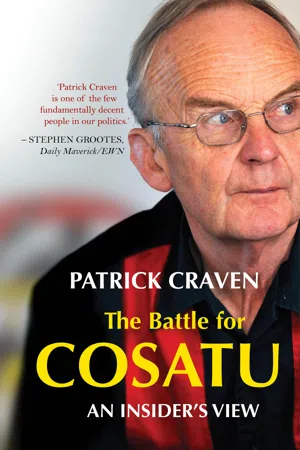
From his early start as a passionate pro-labour and anti-apartheid campaigner in Britain in the 1960s, to championing and defending the rights of workers in South Africa for the last 30 years, Patrick Craven first served as the editor of the Congress of South African Trade Union's magazine, then rose through the ranks of the Congress to become National Spokesperson. Craven has become the go-to person for labour-related commentary. In this, Craven's first book, we are given insight into one of the most tumultuous times for trade unions in post-apartheid South Africa. Beginning with the run-up to Cosatu's 11th National Congress in 2012, to the expulsion from Cosatu of both Numsa (the National Union of Metalworkers of SA) in 2014, and its own General Secretary Zwelinzima Vavi in 2015, Craven tracks events as they unfolded. Drawing strongly on personal recollections, media interpretations and official documents, Craven exposes the breakdown of the tripartite alliance – and the implications of this for South Africa's labour movement and the country as a whole.
- English
- ePUB (mobile friendly)
- Available on iOS & Android
eBook - ePub
About this book
Information
1
BACKGROUND TO THE BATTLES TO COME
Cosatu National Congress, 2012
Cosatu was launched in December 1985 after four years of unity talks between unions opposed to apartheid and committed to a non-racial, non-sexist and democratic South Africa. According to its website, www.cosatu.org.za, at its launch it represented less than half a million workers organised in 33 unions. ‘We currently have more than two million workers, of whom at least 1,8 million are paid up,’ the website states, making it among the fastest-growing trade-union movements in the world.
Cosatu’s main broad strategic objectives were to improve the material conditions of its members and of the working people as a whole, to organise the unorganised, and to ensure worker participation in the struggle for peace and democracy.
Its core principles included non-racialism; worker control in order to keep the organisation vibrant and dynamic, and to maintain close links with the shop floor; paid-up membership in a bid for self-sufficiency; international worker solidarity, ‘the lifeblood of trade unionism, particularly in the era of multinational companies’; and ‘one industry, one union; one country, one federation’.
Regarding this last, the website states, ‘In order to unite workers across sectors, we have grouped our unions into industries. Our 6th National Congress resolved to merge unions into cartels or broad sectors, such as ‘‘public sector’’ and ‘‘manufacturing’’ … At the same time, for as long as there is no single federation, we have no choice but to recruit even those workers who belong to other unions and federations.’
Tragically, however, in 2015, 15 years after I started work for Cosatu as the editor of the federation’s magazine, The Shopsteward, there was a split within this mighty workers’ movement, which led to its total paralysis. It was the conclusion of a long and bitter series of battles.
It’s vital to analyse what happened, why it happened and who was responsible, so that we may start to rebuild a strong trade-union federation and strive to prevent any similar developments in the future. I hope that the analysis in this book, by someone who was on the inside, will also help trade unions around the world so that they can learn lessons and prevent similar divisions.
There were, of course, fundamental reasons for the split; but there were also issues that arose from time to time which were not the reasons for the schism. These included numerous conspiracy theories, fake intelligence reports, ‘third force’ allegations, people in the pockets of imperialists, counter-revolutionary alliances with civil society – all invariably without any evidence. I shall mention these only to illustrate the depths to which some of the participants were prepared to go to discredit their opponents. They should never have been taken seriously then, nor should they now.
There were also allegations that were based on real and important facts, but which in my view were not central to the dispute, which broke out openly in mid-2012. The most important were the sale and purchase of the Cosatu buildings in 2011 and allegations of some unions poaching members from others; as well as issues around a sexual act between the general-secretary Zwelinzima Vavi and a Cosatu staff member, during 2013.
All these issues cropped up during the course of this story, but none was raised when the dispute first erupted; nor were any of them central to the underlying conflict, which was always a fundamental political rift, or ‘rupture’, not just between individual people or unions, but, as always in such disputes, between representatives of contending economic class forces in society as a whole.
What sets this conflict apart from other disputes in which Cosatu was involved is that capitalist employers were largely spectators. This doesn’t mean that Cosatu wasn’t in dispute with them – with the Democratic Alliance (DA), Business Unity South Africa (Busa), the Free Market Foundation and many pro-business academics and commentators – during this time, over other issues such as collective bargaining, violence during strikes, over-restrictive labour laws and ‘excessive’ wage claims. But the federation was united on all these issues against a common enemy, so these issues never featured in the internal debates.
Perhaps the oddest feature of this battle was that it was waged between people who were supposed to be on the same side – ‘comrades’ who expressed very similar answers to many questions. Both sides used Marxist-Leninist language to justify their views and quoted from the same Cosatu resolutions and statements to make their points. Both insisted that they were fighting for a united trade-union movement and a socialist South Africa, and did not want a split. Three different groups who were engaged as facilitators also shared these views, and all insisted that they wanted to reconcile the conflicting parties.
Why, then, when on the surface there appeared to be so much political consensus at such a high level within the alliance which was formed in the early 1990s between Cosatu, the ANC and the South African Communist Party (SACP)1, did the split in Cosatu nevertheless take place?
The reason, I’m convinced, is the SACP. From start to finish, there was a core of anti-Vavi and anti-Numsa hardliners within the SACP who never had any intention of compromising, and who steadfastly ignored all the facilitators’ appeals to back down.
The common feature in this group was their leadership positions in the SACP. The key players included Sidumo Dlamini, Cosatu president and member of the SACP central committee and politburo (executive committee); Fikile ‘Slovo’ Majola, former general-secretary of the National Education, Health and Allied Workers’ Union (Nehawu) and member of the SACP central committee and politburo, now in Parliament; Senzeni Zokwana, former president of NUM, SACP national chairperson and now Minister of Agriculture; and Frans Baleni, general-secretary of NUM and member of the SACP central committee.
And always behind the scenes was Blade Nzimande, the SACP general-secretary and Minister of Higher Education, who was the very first to raise the political arguments that came to dominate the dispute.
It can’t be coincidental that these SACP heavyweights were always among the initiators and intransigent advocates of the campaign to purge the federation of its ‘elephant in the room’, Zwelinzima Vavi, and what the party referred to as the ‘Numsa clique’.
Much of the SACP’s work was, I’m sure, done behind the scenes. The Mail & Guardian reported that after the February 2013 divisions in Cosatu, there were indications that the SACP was involved in caucuses with those spearheading the campaign against the 2012 congress decisions.
The role of the SACP in the split only came into the open quite late in the dispute, in an exchange of views between Vavi and Jeremy Cronin, the SACP’s first deputy secretary-general, in an article in the SACP publication Umsebenzi on 27 November 2014. Called ‘What lies behind the current turmoil within Cosatu?’ it was a response to a speech Zwelinzima Vavi had given at the 40th anniversary celebration of the South African Labour Bulletin on 21 November 2014.
Vavi’s response to Cronin, ‘An open letter to members of the SACP’, published in Umsebenzi on 17 December 2014, was, I believe, by far the most important political contribution to the entire debate, but it received negligible media coverage, perhaps because it came out as the holiday season was beginning. (Vavi’s full speech, Cronin’s response and Vavi’s reply are contained in the Annexure to this book.)
Vavi’s response not only placed the SACP in the central role in this story – as I have just done – but also explained how the behaviour of the party wasn’t an aberration but was entirely consistent with a pattern established over many years. Vavi’s article documented this pattern in meticulous detail.
In essence, the SACP had evolved a strategy of talking left while acting right. (This explains my earlier reference to Cosatu’s internal dispute reflecting the wider class struggle in society, as I hope will become clear.) The SACP, while talking about revolution and Marxism, had in effect become the main defender of the right-wing, pro-capitalist policies of the ANC Government, and were the most loyal supporters of a president who was by then firmly in the right-wing camp led by the Treasury and its advisors in global financial institutions like the International Monetary Fund (IMF) and the World Bank.
To achieve this, the SACP leaders had built up a base of support, especially among trade-union and ANC activists and the youth, for revolutionary socialist policies, using traditional Marxist-Leninist language, and tried to convince workers that they were the revolutionary vanguard of the workers’ movement, although of course none of them had ever been elected as such by any workers.
During the struggle against apartheid, up until 1994, this strategy worked well, because we were indeed in a revolutionary situation. In those circumstances, the SACP’s concept of a national democratic revolution became very popular among workers and the poor African majority. The alliance with the ANC made sense then, when apartheid was being brought to its knees and workers recognised that it wasn’t just a national struggle, but that they were being exploited threefold – as black South Africans, as workers and as women.
After the 1994 breakthrough, many SACP leaders put themselves forward as candidates for Government office, including some of the top people, like Joe Slovo. There’s nothing inherently wrong with that. Communists aren’t armchair theoreticians; they have to be prepared to get involved in public office. The crucial question is, however, on what conditions do they take office, so as to ensure that they don’t betray any of their fundamental principles?
The ANC was not, and had never claimed to be, a socialist or communist party. It was merely, as stated by Secretary-General Gwede Mantashe on 10 November 2014, ‘biased in favour of the workers and the poor’, but it had always contained a powerful pro-capitalist wing within its leadership. This inevitably led to the Government’s adoption of positions that were at odds with those of the SACP.
The big dilemma for some SACP members, therefore, was that the only way they could be elected to Government positions was as ANC candidates, bound by a mandate from the ANC, not the SACP. This led to the extremely confusing and ultimately iniquitous ‘two hats’ concept: when speaking in Parliament or as ministers, SACP members would wear their ANC hats and support ANC and Government positions; but at weekends they would wear their SACP hats and advocate SACP policies.
Occasionally, SACP members seemed to forget which hat they were wearing. When Thulas Nxesi, SACP deputy national chairperson and Minister of Public Works, was answering questions in July 2015 at a meeting of a Parliamentary subcommittee about excessive expenditure using public funds on President Zuma’s Nkandla residence, he should have been wearing his ANC hat as the minister. But he said, ‘The problem with Public Works projects like hospitals and prisons lies with outsourcing work to the private sector. Part of the problem is because a lot of qualified built-environment officials are allowed to go out with the outsourcing and minimise the [role of the] State. It’s neoliberalism; the State must focus on its core function. But that’s part of the problem – the outsourcing and the downsizing of the public service. The debate should be around reconstructing the Public Works Department and bringing back the skilled people that have left.’
These words, which doubtless were in line with SACP policy, came from the very Minister who, when wearing his ANC hat, was in charge of the Government department that had been doing all the outsourcing and downsizing of the public service – or that had, at best, totally failed to prevent it. This resulted in a politician being condemned by his alter-ego in his SACP hat.
1 When political organisations were unbanned in early 1990, the ANC, SACP and Cosatu agreed to work together. This revolutionary tripartite alliance is centred around the short-term, medium-term and long-term goals of the national democratic revolution: the establishment of a democratic and non-racial South Africa, economic transformation, and a continued process of political and economic democratisation.
2
ORIGINS OF THE CRISIS
Ready to govern? ANC National Conference, Polokwane, 2009
After 1994 Cosatu had to adapt to its new role in a constitutional democracy and face new challenges, which were to lead inexorably towards the problems of later years. Crucial was the issue of how the national democratic revolution – the central plank of the alliance that had been forged between Cosatu, the ANC and the SACP in the early 1990s – would be taken forward in the democratic era.
For Cosatu, the national democratic revolution was particularly important, as it enshrined the concept of not just a fight against apartheid but the interrelated fight against racial, class and gender oppression, to build a new, socialist society. This is why Cosatu so often quoted this passage from the ANC’s Strategy and Tactics document of the 1969 Morogoro conference, held on 25 April 1969 in Tanzania, to bring about organisational changes and a new framework and structure:
‘Our nationalism must not be confused with chauvinism or narrow nationalism of a previous epoch. It must not be confused...
Table of contents
- Cover
- Copyright
- Contents
- Introduction
- 1. Background to the battles to come
- 2. Origins of the crisis
- 3. Early signs of trouble
- 4. Marikana
- 5. The battle for the soul of Cosatu
- 6. Mangaung
- 7. Open warfare
- 8. One step forward, two steps back
- 9. In different trenches
- 10. Affiliates’ submissions
- 11. Sex in the office
- 12. The call for a Special National Congress
- 13. Creeping paralysis
- 14. The battle lines are drawn
- 15. The battle hots up
- 16. Vavi bounces back
- 17. A canyon between factions
- 18. Numsa expelled
- 19. The fallout
- 20. Another axe falls
- 21. The bigger picture
- Postscript
- Annexure A: ‘Is labour at a turning point?’
- Annexure B: ‘What lies behind the current turmoil within Cosatu?’
- Annexure C: ‘An open letter to members of the SACP’
- Glossary
Trusted by 375,005 students
Access to over 1.5 million titles for a fair monthly price.
Study more efficiently using our study tools.
Frequently asked questions
Yes, you can cancel anytime from the Subscription tab in your account settings on the Perlego website. Your subscription will stay active until the end of your current billing period. Learn how to cancel your subscription
No, books cannot be downloaded as external files, such as PDFs, for use outside of Perlego. However, you can download books within the Perlego app for offline reading on mobile or tablet. Learn how to download books offline
Perlego offers two plans: Essential and Complete
- Essential is ideal for learners and professionals who enjoy exploring a wide range of subjects. Access the Essential Library with 800,000+ trusted titles and best-sellers across business, personal growth, and the humanities. Includes unlimited reading time and Standard Read Aloud voice.
- Complete: Perfect for advanced learners and researchers needing full, unrestricted access. Unlock 1.5M+ books across hundreds of subjects, including academic and specialized titles. The Complete Plan also includes advanced features like Premium Read Aloud and Research Assistant.
We are an online textbook subscription service, where you can get access to an entire online library for less than the price of a single book per month. With over 1.5 million books across 990+ topics, we’ve got you covered! Learn about our mission
Look out for the read-aloud symbol on your next book to see if you can listen to it. The read-aloud tool reads text aloud for you, highlighting the text as it is being read. You can pause it, speed it up and slow it down. Learn more about Read Aloud
Yes! You can use the Perlego app on both iOS and Android devices to read anytime, anywhere — even offline. Perfect for commutes or when you’re on the go.
Please note we cannot support devices running on iOS 13 and Android 7 or earlier. Learn more about using the app
Please note we cannot support devices running on iOS 13 and Android 7 or earlier. Learn more about using the app
Yes, you can access The Battle for Cosatu by Patrick Craven in PDF and/or ePUB format, as well as other popular books in Politics & International Relations & Political Biographies. We have over 1.5 million books available in our catalogue for you to explore.