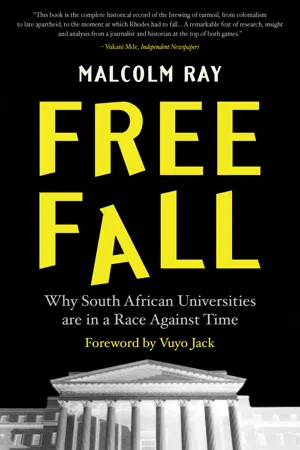
Free Fall recounts how and why the present education crisis in South Africa has become the leading cause for black university students. Probing deep beneath the surface of the crisis, the book reveals uncomfortable truths about colonial- and apartheid-era education, and traces the tangled web of connections between foreign and South African business interests, the apartheid government, and the role of universities in propping up a white elite and coopting a subservient black class to their cause. It brings to life the people and ideas that, over a century-and-a-half, have created a perfect storm for the present crisis in South African higher education. Malcolm Ray combines intellectual rigour with the intimacy of narrative non-fiction, introducing readers to the main protagonists since the end of slavery in 1834, through the rise of missionary education as an instrument of indoctrinating and subjugating black people, and into the apartheid era. Beyond apartheid, the book details how policy blunders by the democratic government since 1994 have conspired with the past to fuel South Africa's slide into increasing economic and social disarray. It is the story of the failure of South Africa's democratic government to deal with major fault lines fissuring higher education, and the circumstances that led to the #RhodesMustFall and #FeesMustFall movements in 2015. The book ends on a high note, answering the question: 'What now?' This book aims to be the beginning of the solution.
eBook - ePub
Free Fall
About this book
Information
PART I
An Imperial Prologue
1835–1902
CHAPTER 1
A polite war
THE ROLE OF MISSION SCHOOLS IN CONQUEST
THERE IS NO SEMINAL OPENING ACT FOR OUR STORY, BUT LET’S START with a solitary affair – long discarded in the currency of time – that provided a foretaste of the years that lay ahead. In what is clearly one of the least-heralded events in South African history, we find in an archived notebook of British missionary, Reverend John Campbell, scrawls of a report to London outlining the dangers of a new conflict. Upon the successful conclusion of slavery, warned Campbell, the Dutch would become a menace in southern Africa more formidable to the British Crown than any yet known. Campbell’s entry, some time in March 1832, tells of plans for a secret treaty between a Griqua interpreter named Andries Waterboer and the British governor of the Cape Colony at that stage, in which Waterboer agreed to ‘keep the peace’ in the area.16
We do not have an exact date of the treaty, but we can hazard a guess at 1835, a year after the end of slavery and the outbreak of the Third Cape Frontier War. By this time, freed slaves and indigenous communities in the Cape were resisting schooling for subordinate positions in the Cape Colony. Until the first suggestion of segregation in schooling, when the Church recommended separate schools for slaves, Dutch children shared common facilities with slaves, and endured similar subject status. Thus, from the earliest days of formal education in the Cape, the colonialists’ implementation of policy was met by slave-Dutch student resistance.
Their most effective defence, the historian, Frank Molteno, has written, was flight.17 And so, in the early 1830s, the outcast Khoikhoin were fleeing the Cape inland to the area known as Griqualand West (now the Northern Cape) via Namaqualand; so, too, were Dutch hunters and farmers at the Cape gradually moving north, some along the coastline, others spreading fanwise toward the Orange Free State and the Transvaal.
In Griqua oral testimony, related to me by one of the oldest surviving members of the community named Eddie Fortune, the presence of the Dutch in the Northern Cape became a menace by the mid-1830s. The number of Afrikaner trekboers had grown considerably, from a handful in 1832 to about 1 500 by the end of slavery in 1834, with some 700 settled on land beyond the Orange River during 1836. Some settled land occupied by the Griqua; others leased considerable tracts from the Griqua chief, Adam Kok I, known as the “‘missionary chief’ because the church had a great deal to do with his election”.18 Once occupied, they ignored the Griqua and emulated as best they could the institutions of the British colony they had recently fled.
When I met Eddie Fortune in early 2010, he told me that many Afrikaners who had crossed the Orange River remained on Kok’s land around Campbell, and later an area known as Philippolis (later Kokstad). Others asked Sotho Chief Moshoeshoe for pasturage between the open scrubby veld and mountains in the Caledon Valley. A few isolated parties under separate leaders reached the Vaal River, where they encountered Chief Mzilikazi’s mighty Ndebele; still others trekked eastwards into the land of King Tshaka’s amaZulu.
Apartheid history has, since the late 1930s, mythologised this stage in the Dutch trekboers’ journey from the Southern Cape as the Great Trek and ascribed the split between Afrikaners and English in the white power bloc to liberal policies of the British government in the latter’s relations with black people. Conceptualising the process from an alternative standpoint, the historian, Nosipho Majeke, has described how the trekboers “were in danger of being submerged” because of their small numbers, lack of military strength and complete lack of cohesion. “For the procuring of guns,” she wrote, “they were dependent on the British, whose subjects they were.”19
In this climate of conflict and betrayal, the majority of trekboers were given free rein as long as they didn’t resist Britain’s advance into the interior and northern parts of the country. Between the early and late 1930s, the budding republics the trekboers had gone on to establish in the Orange Free State and the Transvaal did pose a threat to Britain’s expansion. Subject to Afrikaner ideology, the Afrikaners now looked both back to their own culture and language, and onward to an aggressive struggle against Britain for self-determination that would span the better part of a century. The chief beneficiaries of Britain’s imperial ambitions in southern Africa, for the first time since the migration of trekboers and the Khoikhoin from the Cape, were now tribal chiefs such as Moshoeshoe in the Caledon Valley and Waterboer in Griqualand, who stood to benefit from a new capitalist economy under British rule.
By mid-1835, the threat of a land grab persuaded Adam Kok in Philippolis that Britain would have to intervene directly to avert annexation by the Boer republics. But the chronology of time leading to the treaty reveals that it was at least three months earlier, in March 1835, that Andries Waterboer met British agents to discuss the finer shadings of his role in Britain’s annexation of the area. In this treaty, Waterboer, who had gone on to usurp the chieftainship of a rival Griqua faction, had also to use his military forces against any ‘rebel’ Griqua loyal to Kok under constant supervision by a British government agent and emissary of London.
Here was Britain’s finest hour. Unfortunately for the Griqua, it was Waterboer’s darkest hour. Britain needed the vast South African interior in order to advance north from the Cape Colony, where it had ruled since the turn of the 19th century; and tribal chiefs like Andries Waterboer were its ‘jackpot’.
It could be argued that the keynote for our story was struck at just this moment, 172 years after the first school was opened in 1663 to educate the original shipment of Dutch East India Company slaves to the Cape in Christianity and the Dutch language.20 As will become evident later in this book, the manner of their banishment to a life of inferiority and despair after the end of slavery in 1834 would, going on two centuries later, foreshadow the decampment of a generation of born-frees onto a new political landscape.
The aim of this chapter is not to probe a vast speculative literature, or certain dubious histories that have edged closer towards falsification, on the role Britain came to play in the conquest, first of the Khoikhoin and then African communities in southern Africa, although this forms a significant backdrop. Rather, it is to explore how and why Britain’s principal front organisation for educational indoctrination and cultural assimilation – the London Missionary Society – and its main instrument, mission schools, came about before returning to their role in the conquest and dismemberment of the Griqua.
*
There is an image in the private collection of Gamsha Gool, who married into the Kok family in Kimberley, of Andries Waterboer wearing a suit; his necktie is fastened to a stiff, white wing collar and his greying hair is neatly combed back behind a wide forehead and pinched face that tapers into a well-groomed moustache and pointy beard. The yellowy, creased portrait cuts an incongruous figure: his elegant attire appears to cast the man in the respectable image of an English aristocrat. His apparent air of pensive concentration gives the impression of almost studious poise. Only the austerity of a threadbare jacket and rumpled shirt exclaims the real background of his minor station in British colonial society.
By the time we see Waterboer in this photograph, already in his sixties, he is very much a ‘black Englishman’, not quite his own man. He is among a few black people to have been through mission schooling and believes that Christianity is civilised and divine; the Crown Colony is its anointed emissary.
In 1935, Waterboer’s primary mission was a coup – dividing the Griqua nation and generating considerable support for Britain’s occupation of the territories of Griqualand. Until this point, Britain maintained a formal alliance with Waterboer in Griqualand West, with the nominal backing of Adam Kok in Philippolis, against Afrikaner trekboers who, we recall, had fled British rule in the Cape Colony during the mid-1830s and established two republics. This creation of ‘buffers’ in the ensuing battle between the English and Chief Mzilikazi to the north and Afrikaners on farms at Winburg across the Vaal River and Potchefstroom would be a constant theme of British imperial designs on South Africa well into the 20th century.
In 2010, when I met Gamsha Gool already sixteen years into South Africa’s democracy, I was struck by how deeply the legacy of Waterboer’s treaty had been etched in the social fabric of the Griqua. “The bones of the Griqua,” he told me, “were scattered far and wide by centuries of false promises, ideological indoctrination, co-option and division by British missionary schooling.”21 The broader current in which the education of chiefs was thus articulated ideologically, Gool seemed to be saying, was the work of liberal humanitarians in the aftermath of the Industrial Revolution in Britain. In fact, there arose a new stratum of colonialists fulfilling the role of moderate, post-feudal African governments, so important in sustaining the emerging secular ideology of 19th-century British imperialism.
Here, the wheels of history began to role, and, depending on your interpretation, ultimately shaped the alliances, boundaries and land-ownership patterns in what became modern monopoly capitalism. The role Britain came to play in the conquest, first of the Khoikhoin and then Nguni- and Sotho-speaking Africans beyond slavery, was not an ephemeral thing.
London’s r...
Table of contents
- COVER
- COPYRIGHT
- CONTENTS
- ABBREVIATIONS AND ACRONYMS
- AUTHOR’S NOTE
- ACKNOWLEDGEMENTS
- Foreword by Vuyo Jack
- Introduction: The student who got rid of Rhodes
- PART I: An Imperial Prologue: 1835–1902
- PART II: From Christian Nationalism to Bantu Education: 1902–1961
- PART III: NUSAS and the Liberal Agenda: 1959–1968
- PART IV: The Black Student Movement: 1968–1976
- PART V: The Apartheid-Skills Quandary: 1977–1993
- PART VI: From Lost Generation to Lost Opportunities: 1994–2012
- PART VII: Reform and Rebellion: 2003–2016
- Epilogue: ‘A tragic optimism’
- BIBLIOGRAPHY
- PICTURE SECTION
Trusted by 375,005 students
Access to over 1.5 million titles for a fair monthly price.
Study more efficiently using our study tools.
Frequently asked questions
Yes, you can cancel anytime from the Subscription tab in your account settings on the Perlego website. Your subscription will stay active until the end of your current billing period. Learn how to cancel your subscription
No, books cannot be downloaded as external files, such as PDFs, for use outside of Perlego. However, you can download books within the Perlego app for offline reading on mobile or tablet. Learn how to download books offline
Perlego offers two plans: Essential and Complete
- Essential is ideal for learners and professionals who enjoy exploring a wide range of subjects. Access the Essential Library with 800,000+ trusted titles and best-sellers across business, personal growth, and the humanities. Includes unlimited reading time and Standard Read Aloud voice.
- Complete: Perfect for advanced learners and researchers needing full, unrestricted access. Unlock 1.5M+ books across hundreds of subjects, including academic and specialized titles. The Complete Plan also includes advanced features like Premium Read Aloud and Research Assistant.
We are an online textbook subscription service, where you can get access to an entire online library for less than the price of a single book per month. With over 1.5 million books across 990+ topics, we’ve got you covered! Learn about our mission
Look out for the read-aloud symbol on your next book to see if you can listen to it. The read-aloud tool reads text aloud for you, highlighting the text as it is being read. You can pause it, speed it up and slow it down. Learn more about Read Aloud
Yes! You can use the Perlego app on both iOS and Android devices to read anytime, anywhere — even offline. Perfect for commutes or when you’re on the go.
Please note we cannot support devices running on iOS 13 and Android 7 or earlier. Learn more about using the app
Please note we cannot support devices running on iOS 13 and Android 7 or earlier. Learn more about using the app
Yes, you can access Free Fall by Malcolm Ray in PDF and/or ePUB format, as well as other popular books in Education & Higher Education. We have over 1.5 million books available in our catalogue for you to explore.