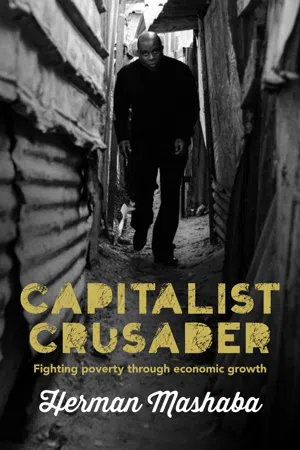
'When I had to give up my university studies 35 years ago I was so angry that I wanted to leave South Africa, get military training and an AK47 and come back to kill evil white people … I'm just as angry now as I feel my economic freedom is under threat, but I'm staying to fight for what I believe in.' When Nelson Mandela became South Africa's president in 1994, Herman Mashaba thought his struggle for personal and economic freedom was over, the battle won. Twenty-one years later, he has had to question that assumption as his freedoms are eroded and economic controls tighten. Mashaba, a selfmade entrepreneur who started his business Black Like Me in the dark days of apartheid, is committed to freeing South Africans from poverty. As a successful business person, Mashaba says he can no longer be silent on the state of the South African economy. In Capitalist Crusader he outlines his quest for economic freedom for all South Africans—through a firm commitment to capitalist principles. He describes the changes in his political affiliations and maps out the route South Africa needs to follow to escape entrenched unemployment, poverty and inequality.
- English
- ePUB (mobile friendly)
- Available on iOS & Android
eBook - ePub
About this book
CHAPTER 1

POLICY STILL HOLDS US BACK
Apartheid was a monstrous imposition, and as a start we should recognise the wide-ranging harm it did. Yet we also need to acknowledge that other kinds of policies can deliver their own varieties of harm. The National Party came to power in South Africa in 1948, and over the next four decades they enforced one Act after another that institutionalised their policy of apartheid and completely dehumanised and enslaved the black population. The following review of the National Party’s successive racist policies traces how apartheid caused untold misery to the black population.
The Population Registration Act of 1950 was the foundation upon which apartheid was constructed, namely the racial classification of the population. This single act would determine the life I was legally entitled to as a black person. It classified black people as less than—less than whites, less capable of intellectual thought, less capable of living decently, less inclined to a thorough education, less entitled to work of their choice—and it barred the black population from a human quality of life. Essentially, before I was born, the government had limited my opportunities as a black child.
I was born in 1959 in the backwater of Hammanskraal, in the very year during which Prime Minister Dr HF Verwoerd, the architect of apartheid, pushed through the Promotion of Bantu Self-government Act. It ramped up his party’s campaign to entrench rigid segregation legally by abolishing representation for black people and relegating the entire black South African population to homelands. There we were expected to develop our own political and cultural institutions—homelands being situated in non-urban areas that were isolated from commercial hubs.
However, prior to my birth, laws had already been passed that would determine the path my life could take. The Group Areas Act of 1950 confined all racial groups to their own residential and commercial areas. This Act forced thousands of non-whites out of their homes and businesses into areas that held no cultural or economic significance for them. No cognisance was taken of a black person’s right to live where it was convenient, or to work or run a business where it was financially viable. The Group Areas Act devastated the personal lives and livelihoods of hundreds of thousands of people. It was apartheid’s precedent of enslavement of the black population. A black person enjoyed absolutely no rights of citizenship—my father could not buy or rent a home near the pharmacy in central Johannesburg where he worked, and my mother could not live near us because we were economically isolated in Hammanskraal, and she could only find domestic work in Johannesburg. Black miners were accommodated in hostels near the mines purely because they had to keep the labour wheels of the mines turning, and domestic workers were tolerated in rooms in the back yards of white homes to raise white children while their mothers and fathers could work close to home and provide their children with lifestyles we black children never even dreamed of.
The Bantu Laws Amendment Act of 1952 placed severe limitations on black people who had the right to reside permanently in urban areas, and forcibly removed from urban areas anyone who did not meet these criteria. Apartheid policies such as these ensured that we were allowed to participate in the economy and reside in the urban areas only in so far as our participation would boost the South African economy.
These racist laws of separateness resulted in families being divided, and each of the successive laws that the government enacted further embedded separateness on every level: the racial divide, economic separation, and social disconnection. From the age of two, I was raised in Hammanskraal by my older sisters, our family having been successfully and irrevocably divided by apartheid’s evil policies.
The oddly named Abolition of Passes Act of 1952 had done away with the ‘pass’ that we were expected to carry, but it substituted the pass with a far more controlling national document that detailed the holder’s entire personal and job history, fingerprints, and rights of movement within the country. Every black person from the age of 16 was compelled to carry this reference book, and failure to do so meant arrest and appearing in front of the Bantu Commissioner. From 1956, anyone who was apprehended without a reference book was arrested and sentenced and was not allowed to appeal the sentence imposed by the Bantu Commissioner’s Court. The powers of this severely controlling Act were later extended, allowing police to raid dwellings to drive out undesirables. I recall being woken up several times as a child by policemen flashing their torchlight into our eyes, shouting and knocking over our personal possessions, demanding that we point out the hiding place of any person they thought we might be harbouring. These home invasions were extreme and humiliating incidents of harassment, and they were terrifying to me as a young child, since the only protection I had was from my older sisters, who were no match against the brutality of the police force. Hammanskraal residents were particularly vulnerable to this invasive onslaught because we lived close to a police training college and were considered fair game for the recruits to practise their skills of intimidation and terror. I still possess a copy of the brown reference book that I often show my children to remind them about the past. I had to apply for that reference book before I actually turned 16 because of my regular travel to Johannesburg to visit my mother. My school regularly had to sign that I was still a student.
The Bantu Education Act, passed in 1953, meant that the type of education I would receive was likewise determined before I was born. Black education fell under state control and was intentionally designed to reduce the quality of education black children received. It aligned such substandard education with what the government deemed our inferior black minds were capable of—menial and unskilled labour. This was yet another law intended to fracture the morale of black people and to enslave us to a white economic ruling class. Law after law was enacted to strengthen the National Party’s power base and cement racially exclusive policies. In essence, basic human freedoms were continually denied to black people through damning apartheid legislation.
Further maintaining the whiteness of urban areas, the Reservation of Separate Amenities Act was passed in 1953, ensuring separate amenities for different races, and the dastardly demeaning ‘whites only’ and ‘non-whites only’ signs were erected. These meant that my mother could take her young white charges to play in the local park, but she could not sit on a ‘whites only’ park bench to observe them. She could go to the butcher to buy meat for her madam, but she had to use the ‘non-whites only’ entrance to do so. My father could assist in the sorting and shelving of medicines at the back of the pharmacy, but he could not step up to the counter and serve white customers. These laws enshrining what came to be known as ‘petty apartheid’ were an ignoble separation of races, and they were so acutely entrenched that many, many years later, when my wife Connie and I stepped onto a Durban beach for the first time, we were aware that even though the law had been repealed, we were stepping where our entire black nation had been refused access for almost 40 years.
Apartheid policies were the finely tuned armour that the National Party machine used to dehumanise black people at every turn. One of the most foul laws was the Suppression of Communism Act of 1950, which was used extensively to silence anyone deemed to be a critic of the apartheid regime and racial segregation. The Act defined communism as any scheme aimed to render political, industrial, social, or economic change within the country, and it enabled the government to gag anyone deemed to be a critic of government policies, to silence anyone who advocated for civil rights, and to punish people without trial. The government defended apartheid on the basis that it sought to protect South Africa against the so-called communists. In reality the government indoctrinated the white minority so that they didn’t really see any difference between the rooi gevaar (communism) and the swart gevaar (black people), who, according to the National Party government, were both equally dangerous to national security. The Cold War between the West and the Soviet Union further complicated South Africa’s situation, and the South African government was able to convince the West to help defend the country against the communist onslaught, and by association the false danger of the black people. This particular Act meant that, by default, as a black child I was a communist, a danger, and justifiably relegated to third-class citizenship and a life of being enslaved and controlled.
I often ask myself whether the National Party had any idea of the devastating long-term effects that the apartheid legislation would have on the enduring psyche of millions of South Africans, their social disintegration, and the economic hardship that they would endure. The aim of apartheid policy was to divide the nation racially on the basis of colour and to exclude the black majority from any form of participation in the country’s politics, enslaving them only as suited their purposes. These laws and policies definitively decimated the foundations of black society and devastated both black morale and economic power, limiting us at every turn, so that we had no option but to endure the miserable conditions foisted upon us.
Living in Hammanskraal under this apartheid regime most certainly shaped my life. Apartheid policies determined my family’s dire living conditions and, to a large degree, our strategies for coping with such difficult circumstances. Without the day-to-day guidance and support of our forcibly absent parents, my sisters and I had to forge our own way in the world, and very often our strategies were constructed in reaction to our situation and environment. Like most other homelands and townships, Hammanskraal did not have access to basic amenities—water and electricity. If we needed water, we stole it from the nearby farm; we simply didn’t have money to pay for it. What else were we to do to supply life’s most basic need? If we required warmth or fuel for cooking, we stole the wood from another nearby farm. This theft was not occasioned by greed but by pure necessity.
Under such adverse circumstances, it is easy to see why so many black people resort to a lifelong pattern of theft. When you don’t have access to basic commodities, what other options do you have? After she was widowed and became the sole breadwinner, my mother’s R29-a-month salary was grossly insufficient to provide for five children, so who could blame her for stealing some sugar or flour from her employer to keep the wolf from her children’s door? Theft was such a regular topic of discussion at social events that it seemed like a natural means of survival. Stealing from white people was actually celebrated and encouraged. The irony of it was that despite our weekly thieving raids, we all went to church every Sunday. Growing up in Hammanskraal during the 1960s and ‘70s was difficult and sometimes full of hopelessness, and I have documented those daily trials in my autobiography, Black Like You, released in 2012.
During my youth I was extremely resistant to interaction with white people, believing them to be the architects of suppression and responsible for the undignified way in which many black people were forced to survive. Having listened to accounts by family and friends of their encounters with white people, I could not entertain the notion of going to work in a white family’s garden for a slice of bread, a cup of tea, and a couple of rand. In my mind, white people were evil creatures.
It was my dream to become a political scientist, and my sister Esther and my brother-in-law Nkokoto Parkies were determined to help me achieve my goal. They made every sacrifice to ensure my university fees were paid at the University of the North. In 1980 the university was temporarily closed due to the political unrest of the time. As students we were protesting and demanding the release of fellow students, and as a result of tension between the university administration and students, classes were boycotted for about two weeks. Instead of addressing the students’ grievances, the university administration opted for military intervention. That was typical of the apartheid system in operation.
When the university reopened after a month, I decided not to return and abandoned my education. I was an angry young man who wanted to help bring about a change in the government, and I was prepared to do whatever I had to do. I desperately wanted to leave the country and join Umkhonto we Sizwe, the armed branch of the struggle machinery. I wanted the Russians to give me an AK-47 and train me to use the rifle so that I could return to kill all the white people whom I regarded as evil. At the same time, I was angry, and disappointed in the West, in particular UK Prime Minister Margaret Thatcher and US President Ronald Reagan. These two world leaders represented the democratic system that I admired, but I could not reconcile myself with the rationale behind their openly defending the apartheid system that the world regarded as a crime against humanity. They resisted any resolutions by the United Nations to impose sanctions against South Africa. The liberation movements and leaders, including Nelson Mandela, were labelled as terrorists. Fortunately, the collapse of the Soviet Union in 1989 helped facilitate the collapse of the apartheid regime as well. My attempts to join Umkhonto we Sizwe were unsuccessful, and after a severe bout of depression and questioning my future and myself, I began to grasp that I needed a change in mindset.
I soon realised that if I wanted to become economically active, then I would have to reconsider my attitude towards white people, with whom I’d attempted to avoid contact for so long. If I wanted to be a productive member of society, I had to find work, and the only people who could offer me a job were whites. So I took a job at Spar in Pretoria, where I was employed as a dispatch clerk because I was fortunate to be one of the few applicants who could read and write. The effects of National Party policy of confining black labour to menial jobs only were clearly evident. The Bantu education system was a dismally inferior product, and even among the few students who managed to make it through high school, often their literacy and numeracy levels were weak.
My experience at Spar confirmed that there were indeed racist whites; however, and more importantly, it also confirmed that if I worked hard, I could engineer my own future. Within two-and-a-half years I had elevated myself from a dispatch clerk to starting my own business. There are most certainly cases of white people exploiting black workers, but the white companies did not exploit me; indeed, it was I who used them to elevate myself from the bottom rung of the employment ladder, working my way through my goals until I was able to start a business, which I believed, and later proved, was the road to personal freedom.
I started my business Black Like Me in 1985 during the height of apartheid. The entire system was stacked against a black person getting a decent job, and we were even less likely to start our own businesses. In those days only Afrikaners had job protection. At that time they enjoyed the benefit of a quota system ensuring that jobs would go to them because of the colour of their skin, and they could take advantage of having a civil servant relative who could secure them work with benefits in the local municipality. The restrictions on black people were in full force and effect in 1985 when I started out in the hair care business, but instead of kowtowing to the law and being content with being employed, I did the unthinkable. I took on a white partner, accepted a loan, and obediently opened my business in Bophuthatswana, the black homeland in which I’d grown up, adhering to the exclusive business laws of the time—exclusive in the sense that the economy was geared to the establishment of white-owned businesses.
I decided to make the system work for me. I needed the expertise of a chemist and initially thought I could employ a black man who had worked in the industry. It soon became apparent that he did not have the chemical and management skills required, and when I had to consider employing someone else, the only respected beauty industry chemist I knew who was capable of the job and who might consider throwing in his lot with me was a white man and an Afrikaner—Johan Kriel. Such an arrangement was unheard of in 1985.
By the time democracy was established in South Africa in 1994, I was already a successful capitalist. It was entirely unnecessary for me to seek out the black economic empowerment (BEE) appointments that were elevating black business people. I had sufficient money to ensure comfort for my family, and I had the business to rebuild and run after the devastating fire just before the dawn of our democracy. When Parliament started debating bringing legislation to enact black economic empowerment, I realised that with or without me, BEE was going to be a reality in the country’s economic landscape. We all thought the process would be short-lived and smooth. At about the same time, my white business colleagues were knocking at my door daily asking that I invest in their businesses. This resulted in the establishment of my investment company in 2002 to focus on such opportunities. I was able to hand over the reins of Black Like Me in 2004 to my wife. During the first 10 years of our democracy I supported the African National Congress. It was encouraging to see that housing, electrification, and provision of water were priorities for the government and that jobs previously the preserve of white people were now being taken up by qualified black applicants. But gradually I began to have doubts about the focus of the ANC. It seemed as though the ANC itself was the main priority, that party leadership instead of national leadership seemed to have taken over, and that personal agendas instead of national priorities were prevalent.
Various incidents began triggering alarm bells for me, such as Thabo Mbeki’s open support (quiet diplomacy) for land grabbing by the Zimbabwe African National Union–Patriotic Front, resulting in Zimbabweans suffering massive human rights violations; the emergence in South Africa of crony capitalism by cadres close to power; corruption in the civil service happening almost with impunity; and failure to provide appropriate education to poor people. South African blacks and some whites had fought for freedom, and yet instead of our leaders supporting and imposing law...
Table of contents
- Cover
- Copyright
- Contents
- Abbreviations
- Foreword by Yuri N Maltsev
- Introduction
- 1. Policy Still Holds Us Back
- 2. The Power of Our Votes
- 3. Considering Socialism
- 4. Paying for the Safety Net
- 5. Jobs, Rights and Laws
- 6. Discontent and Protests
- 7. Corruption and Civic Responsibility
- 8. Labour Laws Are Key
- 9. Unions in a Free Economy
- 10. An Open Opportunity Society
- 11. Getting Education Right
- 12. How Citizens Build a Nation
- 13. Supporting One Another
- 14. Transparency Sustains Democracy
- Notes
- References
Trusted by 375,005 students
Access to over 1.5 million titles for a fair monthly price.
Study more efficiently using our study tools.
Frequently asked questions
Yes, you can cancel anytime from the Subscription tab in your account settings on the Perlego website. Your subscription will stay active until the end of your current billing period. Learn how to cancel your subscription
No, books cannot be downloaded as external files, such as PDFs, for use outside of Perlego. However, you can download books within the Perlego app for offline reading on mobile or tablet. Learn how to download books offline
Perlego offers two plans: Essential and Complete
- Essential is ideal for learners and professionals who enjoy exploring a wide range of subjects. Access the Essential Library with 800,000+ trusted titles and best-sellers across business, personal growth, and the humanities. Includes unlimited reading time and Standard Read Aloud voice.
- Complete: Perfect for advanced learners and researchers needing full, unrestricted access. Unlock 1.5M+ books across hundreds of subjects, including academic and specialized titles. The Complete Plan also includes advanced features like Premium Read Aloud and Research Assistant.
We are an online textbook subscription service, where you can get access to an entire online library for less than the price of a single book per month. With over 1.5 million books across 990+ topics, we’ve got you covered! Learn about our mission
Look out for the read-aloud symbol on your next book to see if you can listen to it. The read-aloud tool reads text aloud for you, highlighting the text as it is being read. You can pause it, speed it up and slow it down. Learn more about Read Aloud
Yes! You can use the Perlego app on both iOS and Android devices to read anytime, anywhere — even offline. Perfect for commutes or when you’re on the go.
Please note we cannot support devices running on iOS 13 and Android 7 or earlier. Learn more about using the app
Please note we cannot support devices running on iOS 13 and Android 7 or earlier. Learn more about using the app
Yes, you can access Capitalist Crusader by Herman Mashaba in PDF and/or ePUB format, as well as other popular books in Business & Business General. We have over 1.5 million books available in our catalogue for you to explore.