South Africa has an education crisis, despite the fact that the government spends the biggest slice of its budget on education, more than any other African country. And yet the crisis persists. Jansen and Blank looked at South African schools that work, in spite of adverse conditions -- schools in poor communities, schools with overcrowded classrooms, schools in both rural and urban environments -- and have drawn out the practical strategies that make them successful. 19 short films (included on DVD or available for streaming or download in digital editions) let you visit these schools and understand in the words of their principals, teachers and learners what makes them succeed. Then take look at the 10 key strategies identified and see how to implement them in other schools to effect transformation. As we have come to expect from Jansen, there are no complicated theories, not difficult to implement solutions -- just lots of common sense!

eBook - ePub
How to Fix South Africa's Schools
Lessons from Schools that Work
- 200 pages
- English
- ePUB (mobile friendly)
- Available on iOS & Android
eBook - ePub
About this book
Information
10 KEY STRATEGIES
THAT CAN CHANGE OUR SCHOOLS
| 1 | Schools establish and maintain firm routines |
| 2 | Schools extend the time for learning |
| 3 | Teachers teach every day and in every class |
| 4 | Students are confronted with high expectations |
| 5 | Students are provided with love and discipline |
| 6 | Parents are involved in the life of the school |
| 7 | Principals are visible in their leadership |
| 8 | Principals (and some teachers) are social entrepreneurs |
| 9 | Principals act on (manage) the external environment |
| 10 | Students are offered a life beyond the school |
“What COSAT does is to DO THE BASICS PROPERLY. We have the kids in class when they’re supposed to be in class, we have the teachers in class when they’re supposed to be in class, and during that time TEACHING AND LEARNING IS HAPPENING. I think that is the most important thing.”
Phadiela Cooper, Principal, Centre of Science and Technology (COSAT), Western Cape
STRATEGY #1
Schools establish and maintain firm routines
You know a well-functioning school even before you reach the gate. There are no children drifting outside between classes or youngsters under a tree catching a smoke. You will not find a teacher leaning lazily against the side of the classroom door to catch some sun while engaging in banter with a colleague next door. The playground is spotless and often the security guard at the gate welcomes you warmly with a clipboard. If you approach between periods, you will find neat rows of children walking behind and alongside each other, sometimes in gendered lines, towards the next class period. In a well-organised school with enough classrooms, teachers have their own classrooms, which they can fill with subject-related materials and posters. In other schools, the teachers move between classes and find well-prepared learners waiting for them.
Then as you come closer you hear noise. It is the voice of a spirited teacher rising above the class to pose a question or make a didactic point or remind learners about homework or, occasionally, to crack a joke to break the tension of long periods of concentration. This is good noise, not the more common disruptive or bored noise.
Routines are remarkably similar. The timetable is ready on day one of the school year. The two days before the children arrive are occupied by a demanding schedule involving planning, discussion and review. Parents know what to expect, and that communication between school and home is clear and in advance. Admission decisions are made early.
Teachers teach. Parents govern. The school’s senior team leads. Students learn. The sports teachers have a plan for the term, as does the debate teacher, the Arts and Culture teacher and the teacher arranging the Mathematics Olympiads. Roles are clearly defined, and the school leaders keep the team together to form a well-oiled machine of operations.
Homework is a well-established routine. Teachers assign homework regularly, and provide feedback consistently. Homework enriches and extends classroom knowledge, and advances learner outcomes.
Routine is critical to the way that Principal Verna Jeremiah runs Heatherdale Secondary School. Her staff meetings always end at 7.45 am and students and teachers immediately go to class. Once the bell rings, Jeremiah walks around urging students to get to class quickly so that lessons can begin on time. Teachers stand outside their classrooms, showing students they are ready for teaching and getting learners to walk into classes quietly and immediately take out their books. At COSAT, Mondale and Louis Botha, where teachers also each have their own classrooms, students line up outside the class before going in.
Every morning at Batswana Commercial Secondary School, students gather for an assembly outside. The assembly motivates and encourages learners, then the principal rings the bell and students move to class. COSAT has a strong focus on values, including punctuality, respect and academic commitment. They have a system to deal with latecomers, students are taught to respect themselves, their classmates and the school space and incomplete homework is not tolerated. Students know it is a significant thing if they are late for school or class when coming from break. Finally, Mbongeni Mtshali, principal at Velabahleke, firmly believes in organisation and discipline, from his arrival at 5 am to organise the school to his mandatory early-morning classes, to morning assembly and creating firm expectations with teachers and learners of when they are to be in class.


Batswana Commercial Secondary School, North West

COSAT, Western Cape
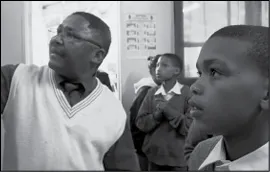
Heatherdale Secondary School, Free State
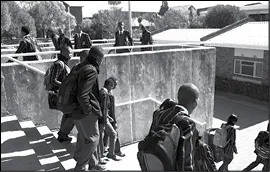
Louis Botha Technical High School, Free State
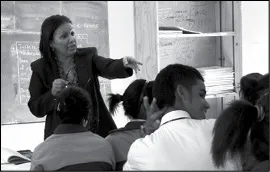
Mondale High School, Western Cape

Velabahleke Seco...
Table of contents
- Title page
- Copyright page
- Contents
- Schools That Work videos
- What to expect from this manual
- 3 resources you can use to change a school
- The state of education – 9 facts
- What will happen to South Africa if we fail to fix our schools? – 7 consequences
- What are we doing wrong? – 8 mistakes
- What do we know from research and experience? – 7 good practice lessons
- How we chose our Schools that Work
- 5 reflections on visiting Schools that Work
- 10 key strategies that can change our schools
- Using the videos for change
- Tools for running a school improvement workshop – 5 templates
- Acknowledgements
Trusted by 375,005 students
Access to over 1.5 million titles for a fair monthly price.
Study more efficiently using our study tools.
Frequently asked questions
Yes, you can cancel anytime from the Subscription tab in your account settings on the Perlego website. Your subscription will stay active until the end of your current billing period. Learn how to cancel your subscription
No, books cannot be downloaded as external files, such as PDFs, for use outside of Perlego. However, you can download books within the Perlego app for offline reading on mobile or tablet. Learn how to download books offline
Perlego offers two plans: Essential and Complete
- Essential is ideal for learners and professionals who enjoy exploring a wide range of subjects. Access the Essential Library with 800,000+ trusted titles and best-sellers across business, personal growth, and the humanities. Includes unlimited reading time and Standard Read Aloud voice.
- Complete: Perfect for advanced learners and researchers needing full, unrestricted access. Unlock 1.5M+ books across hundreds of subjects, including academic and specialized titles. The Complete Plan also includes advanced features like Premium Read Aloud and Research Assistant.
We are an online textbook subscription service, where you can get access to an entire online library for less than the price of a single book per month. With over 1.5 million books across 990+ topics, we’ve got you covered! Learn about our mission
Look out for the read-aloud symbol on your next book to see if you can listen to it. The read-aloud tool reads text aloud for you, highlighting the text as it is being read. You can pause it, speed it up and slow it down. Learn more about Read Aloud
Yes! You can use the Perlego app on both iOS and Android devices to read anytime, anywhere — even offline. Perfect for commutes or when you’re on the go.
Please note we cannot support devices running on iOS 13 and Android 7 or earlier. Learn more about using the app
Please note we cannot support devices running on iOS 13 and Android 7 or earlier. Learn more about using the app
Yes, you can access How to Fix South Africa's Schools by Jonathan Jansen,Molly Blank in PDF and/or ePUB format, as well as other popular books in Education & Education General. We have over 1.5 million books available in our catalogue for you to explore.