The secret to getting ahead is getting started. It is important to create general habits that will keep you on track all semester. The habits you put in place on day one are key. Think about how you want to feel at the end of the semester. Prepared? Confident? Knowledgeable? Organized? Chances are no one wants to face a final exam with a handful of messy notes, or worse, no notes at all
Taking Notes in Class - Be on time. Get yourself settled, organized, and ready to take notes
- Silence your phone. Turn off any other notification functions on electronic devices
- Use a different notebook for each subject. If you have a large notebook or binder with dividers, use a different section for each subject
- Take handwritten notes during class; studies suggest that handwritten notes stimulate the brain more than typed notes
- Typing notes can encourage word-for-word transcription, which is not necessary
- Typing implies that you have your laptop or tablet in front of you, which means you have the Internet and are liable to get distracted
- Lecturers often provide information in class that is not included in the textbooks or reading material. Listen for new information or ideas
- Record the lecture title and date for each set of notes. Start each day’s notes on a new piece of paper
- Imagine that you are taking notes for a friend. Make sure the notes are legible and coherent
- Use abbreviations to save space. Don’t worry about spelling
- Have a place in your notes to record any questions that come up as you listen. Make a point to ask a friend or the teacher about these later
- Color code your notes, if possible. For example, write main ideas in one color and supporting ideas in another. When you review your notes, this will engage your visual memory and may contribute to memory storage
- Write down important information that is presented even if you already know it. It may be helpful to later reflect on why this information was part of the lecture
- Write down anything the teacher writes on the board. This is often important information that may appear on a test
- Find a note-taking outline format that works for you
- Be brief. Do not write lines word for word
- Complete sentences are usually a waste of time
- The method you choose should be appropriate for the subject area and style of the lecturer as well as your writing speed and understanding of the class
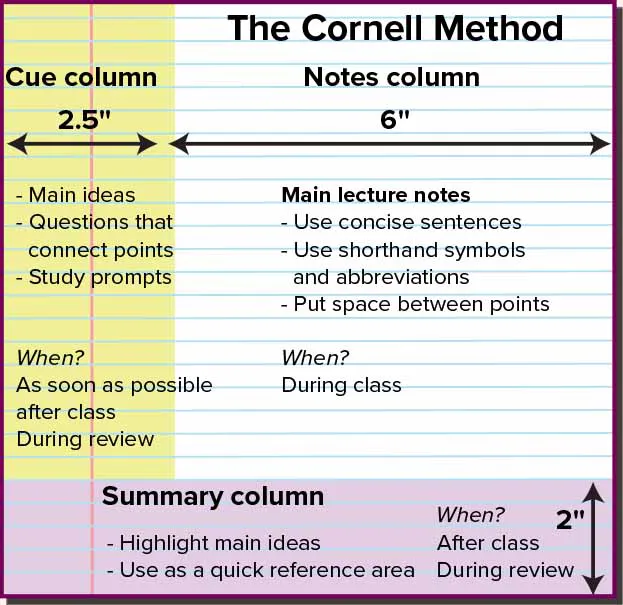
- Create two columns
- In one column, record concise lecture notes
- In the other column, write questions you have about the material. Do this during or immediately after class. This helps you clarify your understanding of the meaning of class content, how content is related, etc. These questions also help you prepare yourself when you’re reviewing your notes later
- To review, cover the notes column or fold the paper over. Ask yourself the questions aloud. Try to answer using your own words
- Reflect on the material by quizzing yourself. Answer overarching questions, such as: “What’s meaningful about this information? Are there underlying principles? How does this content relate to my background knowledge? What deeper understanding might this lead me to?”
- Use the bottom margin
- In the bottom margin of your page, summarize the day’s notes after class. What are your takeaways?
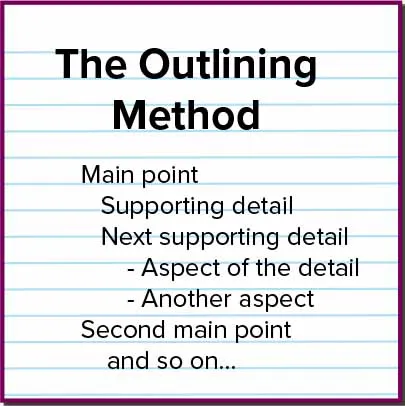
A popular method that organizes information using space indentation
- Most general information begins at the left. As details or specific information is added, lines are indented with spaces to the right. As even more specific information is added, it can be indented with a dash
- This method is helpful when the lecture is also presented in an outlined form
- Advantage: It is simple to record and visually easy to follow
- Disadvantage: It requires organization during note taking. This method may not be useful if the lecture is delivered quickly and you do not have time to organize general information from detailed information as you write
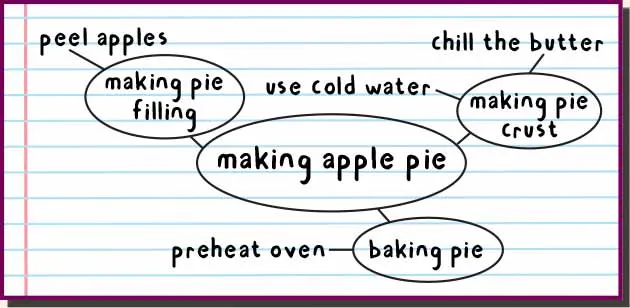
A method that uses graphic representations to organize lecture content. It shows the relationships between facts or ideas
- Advantage: It is visually easy to see relationships with this method
- Disadvantage: Requires the identification and organization of major ideas and related facts as you write notes
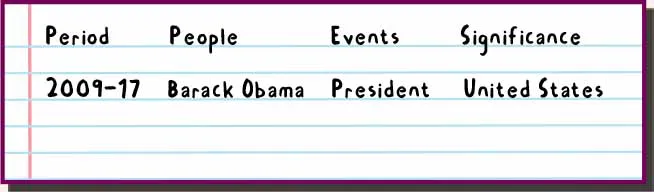
A method that uses clearly marked categories and headings in a tablelike format
- This method is especially helpful if you know how information will be delivered and you can set up your paper ahead of time by creating columns for each category
- During the lecture, fill in the columns with corresponding information (e.g., key words, quotes, dates, and concepts)
- Advantage: Once the columns are in place, you can record information quickly. The organized table-like format makes it easy to review information later
- Disadvantage: Must be preceded by a basic understanding of how the information presented in class will be organized (e.g., major headings and categories)
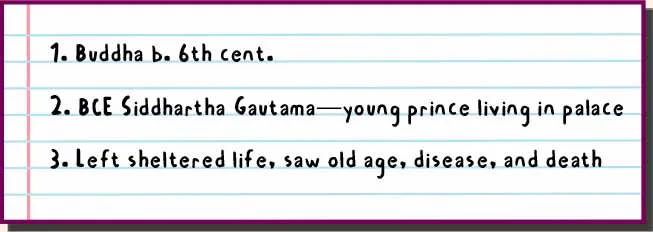
If all of the above methods seem to require too much preorganization, you may want to try the sentence method. This method results in notes that are similar to a paragraph, but concise and with abbreviations
- Write each piece of important new information on a separate line
- Number the lines to clearly separate information
- You do not need to use complete sentences