| 1943 | - Casablanca Conference: President Franklin Roosevelt and Churchill require unconditional surrender of Axis powers; Charles de Gaulle and Free French leader Henri Giraud are also present
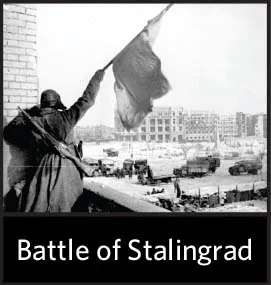
- Germans suffer defeat at the hands of the Soviets in the Battle of Stalingrad; in July 1942, Germans launch a massive offensive to capture the city while supported by Luftwaffe strikes; despite capturing 90 percent of the city, some partisans hold out, and the offensive gets bogged down with the onset of winter; Soviet troops attack and isolate the German 6th Army, and by February 1943, the 6th Army is destroyed; the estimate of combined military and civilian casualties is as high as 2 million
- In May, Afrika Korps surrender in Tunisia; Rommel escapes, but 275,000 prisoners are taken
- Allied invasion of Italy
- Invasion of Sicily; Patton captures the capital Palermo and the port city Messina
- As the Allies begin bombing Rome, King Victor Emmanuel III dismisses Mussolini and replaces him with Marshal Pietro Badoglio; Mussolini is arrested and imprisoned, and Badoglio dissolves the Fascist Party; while maintaining the appearance of an alliance with the Nazis, Badoglio seeks an armistice with the Allies; Badoglio and the king flee Rome and declare war against Germany from Malta; fighting continues to drive out the Germans
- Hitler sends German troops into Italy and frees Mussolini; Hitler sets up a puppet Social Republic with Mussolini as ruler
- Resistance Movements: Virtually every country occupied by the Nazis, including Germany, maintains active resistance movements; among them:
- Maquis: Many French men and women serve in the French underground, some to escape conscription for forced labor by the German or Vichy government; organized into local cells; aid the Allies after the invasion of Normandy
- Italian: Communists, socialists, and monarchists form Italian resistance and work with the Allies to end German presence in Italy
- Belgian: Leopold III surrenders and is imprisoned; his cabinet flees to England and maintains a government in exile; Belgian resistance sabotages Nazi installations and assists Allied troops, often hiding downed airmen
- Norwegian: Initial resistance allows King Haakon and the government to escape the capitol; resistance movements such as Milorg and Company Ligne carry out armed resistance against the Nazi occupation; in addition, numerous acts of civil disobedience such as the distribution of illegal newspapers and a resistance to speaking German keep the spirit alive
- Dutch: Independent cells grow into larger organizations such as the National Organization for Help to People in Hiding and the Council of Resistance; these organizations commit assassinations and acts of sabotage and hide resistance fighters
- Polish: Largest partisan army in occupied Europe; sabotages supply lines to the eastern front, provides counterintelligence to the Allies
- Greek: A number of armed and unarmed resistance groups sabotage Nazi and Bulgarian occupation
- German: Operation Valkyrie is the code name for a plot to assassinate Adolf Hitler in July of 1940
- After several earlier attempts fail, a group of German army officers headed by Lieutenant Colonel Claus von Stauffenberg coordinate a complex plan to assassinate Hitler by means of planted explosives at his Wolfsschanze (Wolf’s Lair) headquarters in East Prussia
- The plan calls for the mobilization of the Reserve Army, the implementation of a new government, and a peace initiative with the Allies to prevent a Soviet invasion of Germany
- On July 20, 1944, von Stauffenberg plants a briefcase filled with explosives on a table where Hitler and several officers have gathered; at the last minute, the briefcase is moved
- The explosion destroys the meeting room, three officers and a stenographer are killed, and several officers are injured, but Hitler survives
- In the chaos that follows, Hitler and the Nazi high command regain control and begin reprisals; some of the conspirators commit suicide, and those closely involved with the plot, including von Stauffenberg, are executed immediately
- As weeks go on, thousands of people are arrested; the Gestapo claims some 7,000 arrests; many who are not connected with the actual plot are brutally executed; Hitler, who believes his survival to be a “divine moment in history,” orders that those convicted be “hanged like cattle” by means of wire and has home movies taken of the executions
- Hitler also has commemorative “Wound Badges” embossed in silver or gold designed and awarded to survivors
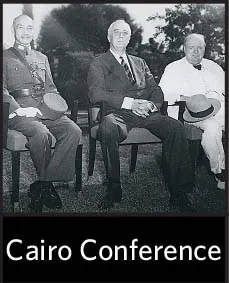
- From November 22–26, Franklin Roosevelt, Winston Churchill, and Chiang Kai-shek meet at the Cairo Conference and promise continued military action until Japan surrenders unconditionally; Stalin refuses to attend in protest of Kai-shek’s presence
- Three clauses of the Cairo Declaration, signed on November 27, 1943, state:
- Japan will be stripped of all the islands in the Pacific that it has seized or occupied since the beginning of World War I in 1914
- All the territories Japan has stolen from the Chinese will be restored to the Republic of China
- In due course, Korea will become free and independent
- From November 28–December 1, Stalin, Churchill, and Roosevelt (“The Big Three”) meet at the Teheran Conference, the first conference between all three leaders; the three agree to an allied invasion of Normandy and southern France in 1944, organization of the United Nations, Soviet support for the war against Japan once the war in Europe is over, support for Yugoslavian partisans, and the postwar borders of Poland
|
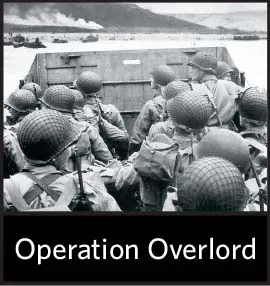
| 1944 | - Operation Overlord: The code name for the planned invasion of German-occupied Western Europe, consisting of U.S., British, and Canadian forces
- Allies lead Germans to believe that an invasion will occur at Calais; they create a fake First U.S. Army Group and use fake intelligence and tanks to support the ruse
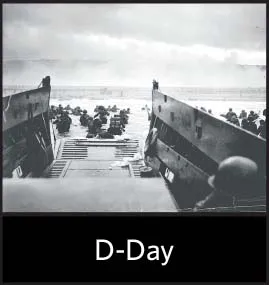
- The invasion occurs at 6:30 a.m. on June 6, D-Day; General Dwight D. Eisenhower has written a personal message to each member of the invasion force; he has also written a message accepting full responsibility in case the invasion fails; the operation involves 12,000 planes, 7,000 vessels, and nearly 160,000 troops; by the end of August, 3 million troops are in France
- The assault hits Gold Beach, Utah Beach, Omaha Beach, Sword Beach, Juno Beach, and Point du Hoc; casualties number around 10,000, about half of what had been feared
- Operation Cobra: U.S. General Omar Bradley directs Allied forces to break beyond the beaches; the Battle of Falaise Gap traps German forces;...
|