Little is known about how language teacher educators become, and also develop professionally as, teachers of teachers. One avenue for teacher education professional development is that of teacher research, whereby teacher educators can not only improve their practices in their immediate context but also help develop transformative pedagogies in wider contexts by sharing their research. This volume aims to understand how language teacher educators around the world continue developing professionally by examining their own teaching practices. It seeks to understand the professional gains teacher educators see in conducting research with their own students/future teachers; to promote knowledge democratisation by including teacher educators from under-represented contexts such as Latin America and Africa; to examine language teacher educators' motivations to write for publication; and to reduce the gap between educational research and educational practice in BA and MA programmes in language teaching.
eBook - ePub
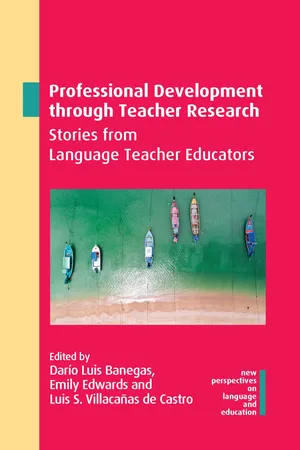
Professional Development through Teacher Research
Stories from Language Teacher Educators
- 232 pages
- English
- ePUB (mobile friendly)
- Available on iOS & Android
eBook - ePub
Professional Development through Teacher Research
Stories from Language Teacher Educators
About this book
Information
Topic
EducationSubtopic
Professional Development1Introduction
Darío Luis Banegas, Emily Edwards and Luis S. Villacañas de Castro
Initial Approximations
This volume is about how language teacher educators develop professionally by carrying our research on their own practice. In the paragraphs that follow, we unpack the preceding sentence.
Who are language teacher educators? In this volume, the term language teacher educator is used to refer to any professional who formally prepares future teachers for the teaching profession, in particular, language. Although teacher education also takes place through internships and practicum placements (for example, when student-teachers are supervised by school teachers acting as mentors), the teacher educators we have in mind are those working in institutions of higher education, such as teacher colleges or universities. Depending on contextual and institutional circumstances, they may be called teacher trainers, tutors, instructors, lecturers or professors, but we would like to focus on who they teach – teachers. Regardless of the modules they teach or support (e.g. linguistics, phonology, professional practice, practicum/placement), the common denominator is scaffolding professional learning. Teacher educators may also be called teachers of teachers as they are teachers who, through different trajectories, have assumed the role (and challenge!) of preparing new generations of teachers. In this volume, those studying to become teachers are referred to as ‘student-teachers’, ‘pre-service teachers’, ‘teacher learners’ or simply ‘students’.
We must acknowledge that not all teacher educators are teachers themselves in a formal and restrictive sense of the term. There is a multiplicity of scenarios in this sense. For example, there are teacher educators who do not hold a teaching degree, or do not have a teaching degree in the discipline. There may be teacher educators who have a degree in the discipline in which language teaching is inscribed (e.g. linguistics, literature) or a degree in another discipline (e.g. psychology). There may also be teacher educators who have teaching experience in the levels for which future teachers are being prepared. There may be others who have limited or no teaching experience. Despite these different backgrounds which shape their professional identity, they share the goal of enabling future teachers to become critical and informed professionals who can navigate heterogeneous socioeducational settings.
As the title of this volume suggests, the contributor chapters explore the impact of research on teacher educators’ professional development through the voice of teacher educators themselves. The focus falls on three interrelated concepts – teacher professional development, teacher education and teacher research – that this Introduction must clarify before it can illustrate the volume’s scope and the nature of the questions it wishes to address.
To this aim, John Dewey’s philosophy of education is a better resource than many. His work articulated growth, education and scientific inquiry in a similar way to how teacher professional development, teacher education and teacher research (and their relationship) can now be understood. As read in Dewey’s (2015 [1938]) Experience and Education, the meaning of growth orbited around the different ways in which individuals might interact with their environment in order to make it amenable to further transformation and richer, ongoing experiences. While every instance of individual-environment interaction implied growth, not every form reaped the same amount, degree or quality. As a result, education emerged as the exercise of systematic analysis and manipulation of interactional situations to maximise growth for the individuals who took part in them. Educators, that is, had to make sure that any ‘person, young or old, gets out of his present experience all that there is in it for him at the time he has it’ (Dewey, 2015 [1938]: 49), precisely by designing and providing learners with situations that allowed them to refine and energise those dispositions and habits that would ‘contribute to building experiences that are worthwhile’ (Dewey, 2015 [1938]: 40). These were the same habits that, in due course, would allow students to take this process into their own hands and become educators of their own lives. Finally, inquiry – scientific inquiry, particularly – was the privileged means (alongside art) that Dewey identified to bend the environment to richer forms of growth and experience. Both were represented in school curricula.
Cannot the relationship between growth, education and scientific inquiry help us picture how teacher professional development, teacher education and teacher research connect with one another? By pushing this parallelism forward, we could define teacher professional development as teachers’ ability to transform school environments in ways that guarantee not only that they will showcase and display their best teaching qualities – which mean nothing if they do not trigger, in turn, dynamics of student learning and growth – but also that this spiralling process will be sustained, expanded and projected into the future. To do so, teachers would have to read into themselves (into their own funds of knowledge and identities) and also into their surroundings in order to draw on whatever material, immaterial and human resources they might have at hand to aptly intervene in the variables that constitute school contexts: namely, curricular subject matter, methods of instruction, facilities of the school building and its whereabouts, and students’ accumulated habits and past experiences (Dewey, 2015 [1938]: 28). Likewise, teacher education could then be understood as the series of interconnected experiences that teacher educators (who are the focus of this volume) design to provide student-teachers with a theoretical and practical knowledge of the preconditions for, and accelerators of, student growth and teacher professional development. This understanding, of course, cannot be conceived without the corresponding dynamics of growth experienced by the student-teachers – the expectation being that, by the end of their teacher education, they would be ready to secure their professional development without external supervision, and grant fulfilling experiences to their own future students in turn. Finally, if teacher education were to fulfil these aims, scientific outlooks into the profession – as represented by different traditions of educational research – would have to form part of the curriculum and also play a pivotal role in teacher educators’ course designs and experiences.
Dewey’s nuanced discussion of general as opposed to scientific forms of inquiry must be introduced at this point to shed light on the nature and scope of the contributions in this volume. For Dewey, science was simply ‘the most rational, technical, and thus transformative manifestation (since it employed the most developed sets of signs and tools) of human inquiry understood as a way of being in the world’ (Villacañas de Castro & Banegas, 2020: 4). Like any living organism, human beings existed by changing and being changed by their environment in a reciprocal give and take whose outcomes and relations science had just started to systematise and, hence, control. Yet even scientific forms of inquiry were inscribed in life itself and could not be disentangled from this vital substratum. Like all the other manifestations of the life creature, science was respondent to human aims, needs and purposes. It was not an abstract endeavour but one rooted in different occupations or social practices (Dewey also called them occupations), each of which represented a specific scheme of individual-environment interaction, guided by its own aims and means. In line with practitioner and action research versions of scientific inquiry, educational research had to remain anchored in the purposes and values of education, which – as has been explained – necessarily referred back to generating more opportunities for student growth and teacher professional development.
This series of interconnected concepts sets the grounds for some of the questions that the volume will potentially raise and hopefully answer. How do teacher educators conceive of, and resort to, research? Do teacher educators’ research projects intersect in any way with their professional development, understood as their ability to organise sophisticated contexts that cater for student-teacher growth? What role does educational research play in teacher education programmes and curricula, and in student-teachers’ formative experiences? Do teacher educators often include student-teachers in their own scientific inquiries, and do they encourage student-teachers to embark on them? If so, are student-teachers inducted into research initiatives that give them the chance to experience positively the interrelated nature of educational research, student growth and their own professional development? Does teacher education successfully lead to the creation of sustainable research networks or partnerships that accompany student-teachers as they transition into becoming in-service teachers? All of these questions have been addressed previously in the literature (Avalos, 2011; Borko et al., 2010; Darling-Hammond et al., 2017; He & Lin, 2018). The following chapters relate to them in new ways which bear witness to their lingering presence at the heart of teacher education and teacher professional development.
On Teacher Educators
Teacher educators are, to a certain extent, at the top of the pyramid in the formal preparation and development of (future) teachers. In systems with explicitly delineated political-educational policy (Brennan, 2011), teacher educators are expected to align their practices and informed decisions with the curricula implemented in the educational sphere. As recognised in the literature (e.g. Freeman et al., 2019), they have the responsibility (and the power) to determine what counts as knowledge in language teaching and how additional languages should be taught. Teacher educators have the possibility to create context-responsive pedagogies and learning opportunities through the design of syllabi and experiences that allow future teachers to create learning environments considering learners’ needs, motivations and agency. To achieve this multifaceted goal, Johnson and Golombek (2020) suggest the enactment of language teacher education pedagogy which is:
•theoretically informed: dialectical thinking around the issue of how future teachers learn to teach;
•located: opportunities, affordances, resources and practices locally situated;
•person situated: experiences that recognise student-teachers’ cognition, emotions and learning biographies;
•goal directed: explicitly formulated goals that contribute to the externalisation and discussion of processes to achieve them;
•self-inquiry driven: practitioner inquiry carried out by teacher educators.
If language teacher education pedagogy is expected to be oriented towards these features, it is imperative that teacher educators deploy a wide range of semiotic resources that position them as professionals who engage in reflective practice and concomitant teacher research. In so doing, they may be extending their agentive professionalism as well as becoming models of teacher-researchers to their own student-teachers. In this regard, doing teacher research will not be seen as mere discourse or something that others do; it will be seen as performative, something that situates teacher educators as good examples of congruent practice. As Yuan (2018) has demonstrated, teacher educators often wish to identify themselves and be identified as educators whose modelling practice may encourage student-teachers to follow and improve their professional strategies.
Recent studies have investigated teacher educators’ experiences (e.g. Yuan & Yang, 2020), motivations (e.g. Banegas & del Pozo Beamud, forthcoming) and qualities (e.g. Yuan & Hu, 2018). These studies agree that teacher educators exhibit a tendency to engage in the preparation of teachers guided by an interest in contributing to the common good in the contexts in which they are inserted. In addition, they are driven by an interest in contributing to the language teaching pr...
Table of contents
- Cover-Page
- Half-Title
- Series
- Title
- Copyright
- Contents
- Tables and Figures
- Abbreviations
- Contributors
- 1. Introduction
- 2. Promoting Pre-service Teachers’ Collaborative Reflective Practice: Voices from a TESOL Teacher Education Programme in Vietnam
- 3. Ghosts in the Machine? Exploratory Teaching on a Distance Learning Development Project
- 4. Developing Languages Pre-service Teachers’ Epistemic Agency in Using Technology in Languages Teaching
- 5. Student-Teachers’ Beliefs and Emotions about an EFL Teaching Practicum: A Proposal to Support their Development Processes
- 6. Exploring the Ways in which Modern Languages Student-Teachers Conceptualise Practitioner Enquiry in Scotland
- 7. Engaging Students in Learning through Teacher Research
- 8. Narrative Pedagogies in Argentinean University English Language Teacher Education
- 9. Scaffolding Conscientisation and Praxis in Critical Language Teacher Education
- 10. Supervising Student-Teachers’ Research: Between Reinforcing our Supervisor-Researcher Identities and Enabling Novice Teacher-Researchers
- 11. Mapping Transformations in Teacher Education: Colombian Teachers’ Enactments through Mentoring
- 12. Teaching Oral Skills to Student-Teachers: A Visually Impaired Teacher Educator’s Experiences
- 13. Conclusion
- Index
Trusted by 375,005 students
Access to over 1.5 million titles for a fair monthly price.
Study more efficiently using our study tools.
Frequently asked questions
Yes, you can cancel anytime from the Subscription tab in your account settings on the Perlego website. Your subscription will stay active until the end of your current billing period. Learn how to cancel your subscription
No, books cannot be downloaded as external files, such as PDFs, for use outside of Perlego. However, you can download books within the Perlego app for offline reading on mobile or tablet. Learn how to download books offline
We are an online textbook subscription service, where you can get access to an entire online library for less than the price of a single book per month. With over 1.5 million books across 990+ topics, we’ve got you covered! Learn about our mission
Look out for the read-aloud symbol on your next book to see if you can listen to it. The read-aloud tool reads text aloud for you, highlighting the text as it is being read. You can pause it, speed it up and slow it down. Learn more about Read Aloud
Yes! You can use the Perlego app on both iOS and Android devices to read anytime, anywhere — even offline. Perfect for commutes or when you’re on the go.
Please note we cannot support devices running on iOS 13 and Android 7 or earlier. Learn more about using the app
Please note we cannot support devices running on iOS 13 and Android 7 or earlier. Learn more about using the app
Yes, you can access Professional Development through Teacher Research by Darío Luis Banegas, Emily Edwards, Luis S. Villacañas de Castro, Darío Luis Banegas,Emily Edwards,Luis S. Villacañas de Castro in PDF and/or ePUB format, as well as other popular books in Education & Professional Development. We have over 1.5 million books available in our catalogue for you to explore.