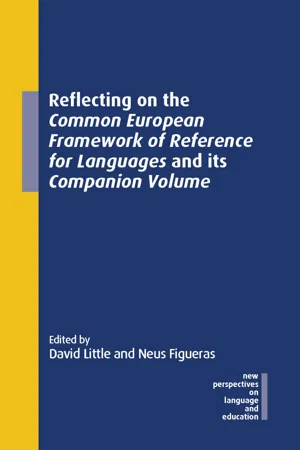
The Common European Framework of Reference for Languages (CEFR) and its Companion Volume have established themselves as an indispensable reference point for all aspects of second and foreign language education. This book discusses the impact of the CEFR on curricula, teaching/learning and assessment in a wide range of educational contexts, identifies challenges posed by the Companion Volume and sheds light on areas that require further research and development. Particular attention is paid to three features of the two documents: their action-oriented approach, their focus on plurilingualism, and the potential of their scales and descriptors to support the alignment of curricula, teaching/learning and assessment. The book suggests a way forward for future engagement with the CEFR, taking account of new developments in applied linguistics and related disciplines.
eBook - ePub
Reflecting on the Common European Framework of Reference for Languages and its Companion Volume
- English
- ePUB (mobile friendly)
- Available on iOS & Android
eBook - ePub
Reflecting on the Common European Framework of Reference for Languages and its Companion Volume
About this book
Information
Topic
Lingue e linguisticaSubtopic
Didattica generalePart 1: The Common European Framework of Reference for Languages: Past, Present and Future
Introduction to Part 1
David Little
The publication of the Common European Framework of Reference for Languages 20 years ago (CEFR; Council of Europe, 2001a) marked the culmination of three decades of work on foreign language teaching and learning by a succession of Council of Europe projects. To begin with, the work was carried out under the aegis of the Committee for Out-of-School Education and focused on the needs of adult learners. Traditionally, language learning had been conceived as a years-long progress from ‘zero beginner’ to (rarely attained) ‘native-like’ proficiency; the learner’s progress was measured with reference to the target language system (Trim, 1984: 11). Against this tradition, the first Council of Europe modern languages project sought ways of developing programmes of limited duration that would enable learners to meet clearly defined communicative objectives. This entailed a shift of focus from language system to learner needs, from lexicogrammatical features to communicative purposes. The project’s earliest products were proposals for a European unit/credit scheme of adult language learning (Trim, 1978) and The Threshold Level (van Ek, 1975), which specified the repertoire needed to cross the threshold into temporary membership of the target language community. The unit/credit scheme turned out to be shortlived, but The Threshold Level’s functional approach had a profound impact on the development of communicative approaches to language teaching and laid the foundations on which, in due course, the CEFR was built.
From the beginning, the Council of Europe’s modern languages projects were informed by the organization’s core values: human rights, democratic governance and the rule of law. The projects aimed to facilitate the free movement of people and ideas, to make the language learning process more democratic, and to provide a framework for international cooperation (Trim, 1984: 9). The CEFR was developed with the same goals in mind. In 1991 the Rüschlikon Symposium, ‘Transparency and Coherence in Language Learning in Europe’, hosted by the federal Swiss authorities, recommended that the Council of Europe should establish ‘a comprehensive, coherent and transparent framework for the description of language proficiency’ (Council of
Europe, 1992: 39). This task was undertaken by the project ‘Language Learning for European Citizenship’. At an intergovernmental conference held in Strasbourg in 1997, the second draft of the CEFR (Council of Europe, 1996) was launched for dissemination, discussion and feedback, and over the next three years further work resulted in the version of the CEFR that was published in English and French in 2001 (Council of Europe, 2001a, 2001b).
Those who are unfamiliar with the CEFR often assume that it consists entirely of proficiency ‘standards’ expressed in scales of ‘can do’ descriptors. But to focus on the scales without engaging with their immediate and broader context is to miss a large part of their point. The CEFR’s illustrative scales are embedded in detailed taxonomic descriptions of communicative language activities (CEFR, Chapter 4) and the language user/learner’s competences (Chapter 5). These central chapters are preceded by a summary of the political and educational context in which the CEFR was developed (Chapter 1), an explanation of its action-oriented approach to the description of proficiency (Chapter 2) and an overview of the common reference levels on which the illustrative scales are based (Chapter 3). Chapter 6 discusses the processes of language learning and the methodological options available for language teaching, Chapter 7 considers the role of tasks in language learning and teaching, Chapter 8 explores the implications of linguistic diversification for curriculum design, and Chapter 9 focuses on the purposes and types of assessment.
In keeping with the CEFR’s underlying ethos, the second half of its title puts learning before teaching and teaching before assessment. Nevertheless, over the past 20 years the CEFR’s impact has been most obvious in the area of language testing. Its proficiency levels were quickly adopted by major testing agencies across Europe; in some countries, so-called reference level descriptions were developed as a way of putting language-specific flesh on the CEFR’s language-neutral skeleton;1 and the Council of Europe developed manuals for linking language tests to the CEFR (Council of Europe, 2009) and developing new language tests in conformity with the CEFR (Council of Europe, 2011a). In addition, there has been a large number of alignment projects, and additional descriptors have been developed by language-testing and other agencies in many countries in Europe and around the world.
Projects linking curricula to the CEFR’s proficiency levels in a systematic and detailed way have been undertaken especially by organizations in the private and semi-state sectors; one thinks, for example, of the Core Inventory for English developed by EAQUALS and the British Council2 and, on a more limited scale, Integrate Ireland Language and Training’s English Language Proficiency Benchmarks, based on the first three proficiency levels (A1, A2, B1) of the CEFR (Integrate Ireland Language and Training, 2003a, 2003b) and used to support the educational inclusion of pupils and students from immigrant families. As regards foreign language learning in the school sector, it was widely assumed that A1 and A2 applied to lower secondary, B1 and B2 to upper secondary and C1 and C2 to tertiary education. This may help to explain why, soon after publication of the CEFR, ministries of education began to attach CEFR proficiency levels to the learning outcomes proposed in their curricula without following systematic linking procedures (see Part 4). The First European Survey on Language Competences (European Commission, 2012), based on the CEFR, showed that in many cases actual learning outcomes fell a long way short of the levels specified in curricula.
As for teaching and learning, the Rüschlikon Symposium recommended that ‘once the Common Framework has been elaborated, there should be devised, at the European level, a common instrument allowing individuals who so desire to maintain a record of their language learning achievement and experience, formal or informal’ (Council of Europe, 1992: 39). Instead of developing this common instrument, destined to become the European Language Portfolio (ELP), the Council of Europe issued Principles and Guidelines that described the ELP’s structure and purposes (Council of Europe, 2011b). The ELP was to have three obligatory components: a language passport that would summarize the owner’s experience of foreign language learning and use; a language biography that would provide a reflective accompaniment to learning; and a dossier in which the owner would keep evidence of learning achievement. The pedagogical function of the ELP was to promote learner autonomy, plurilingualism and intercultural awareness and competence. It was linked to the CEFR by checklists of ‘I can’ descriptors derived from the illustrative scales and used for the purposes of goal-setting and self-assessment.
From 1998 to 2000 versions of the ELP were developed and piloted in 15 member states of the Council of Europe, in private language schools under the auspices of EAQUALS, and in universities in various countries under the auspices of CercleS (Confédération Européenne des Centres de Langues de l’Education Supérieure) and the European Language Council (Little et al., 2011: 8–10). Thereafter it was left to interested agencies and institutions to develop their own ELPs and submit them to the ELP Validation Committee in Strasbourg for validation and accreditation. By the end of 2010, when validation was replaced by registration, the committee had accredited 118 ELPs from 32 Council of Europe member states and 8 INGOs/international consortia (Little et al., 2011: 10).3 Between 2001 and 2009 some eight European seminars were organized to support ELP development and implementation.4
To begin with, there was a widespread expectation that the ELP would effect a transformation of language teaching and learning across Europe. Ministries of education funded projects to develop, pilot and disseminate ELPs, and the European Centre for Modern Languages in Graz funded a succession of projects designed to support ELP development and use.5 But pilot projects came to an end, continuation funding was scarce, and several years before validation came to an end it was already difficult to find evidence of widespread ELP use. By now, the ELP is mostly history, though in some countries there are echoes of its influence in the self-assessment component of language coursebooks.
There are multiple and complex reasons for the ELP’s failure to take root in Europe’s education systems (Little, 2019a). Chief among them perhaps is the fact that the ELP was rarely part of an integrated and coherent reform of curricula, teaching/learning and assessment. As a consequence, in most contexts it was extraneous to established classroom practice and its checklists of ‘I can’ descriptors bore little discernible relation to curriculum goals. The idea of learners setting their own learning targets and assessing their own progress was alien to most education systems, the concept of interculturality was poorly understood, and the plurilingual approach to language education advocated by the CEFR (Council of Europe, 2001a: 4–5; see Part 3) was mostly overlooked. The ELP’s early demise is a fair measure of the extent to which the CEFR has failed to make its mark on language education in schools, colleges and universities across Europe. It is also a measure of the need for a renewed effort following the publication of the CEFR’s Companion Volume (CEFR-CV), first in a provisional and then in its definitive version (Council of Europe, 2018, 2020).
Since the provisional version was released in 2018, the CEFR-CV has been received with a great deal of interest, especially by associations of language education professionals. Inevitably there is a risk that existing users will discard and new users will ignore the CEFR in favour of the CEFR-CV. In doing so they will easily lose sight of the human rights basis of Council of Europe language education policy, and they will deprive themselves of the detailed taxonomic description of communicative language activities and the language user/learner’s competences contained in Chapters 4 and 5 of the CEFR. If the CEFR-CV is to make a lasting impact on language curricula, teaching/learning and assessment, we must explore critically the relevance and utility of its illustrative scales – especially in relation to mediation and plurilingual/pluricultural competences – in conjunction with the CEFR’s taxonomy of language use in different contexts. It has always been the Council of Europe’s intention that the CEFR should be used selectively, taking account of local priorities and issues. The large number of new scales and descriptors included in the CEFR-CV means that the need for a disciplined approach to selection and localization is more urgent than ever.
Outside Europe the impact of the CEFR has nowhere been greater than in Japan, which developed its own version, CEFR-J, to guide the teaching and learning of English in Japanese schools and colleges. Chapter 1, by Masashi Negishi, provides a detailed summary of this work. As in Europe so in Japan: most interest seems to centre around levels and can-do descriptors; much less attention is paid to key concepts like the action-oriented approach, the social agency of language user/learners, plurilingualism and pluriculturalism, and mediation. In Negishi’s view more time is needed for these concepts to filter through to language learning, teaching, and assessment. At the same time, he argues that principled localization of the CEFR as exemplified in the work inspired by CEFR-J has the potential to strengthen the original framework by reflecting back local contexts and needs.
In the US the ACTFL Proficiency Guidelines perform much the same function as the CEFR does in Europe (for a detailed comparison of the two systems, see Little, 2019b). In Chapter 2, Margaret E. Malone reports on the progress of a transatlantic initiative to explore the feasibility of creating a ‘crosswalk’ between the ACTFL Proficiency Guidelines and the CEFR and considers possible next steps in light of the publication of the CEFR-CV and the growing importance of plurilingualism. Drawing on her experience with the ACTFL Proficiency Guidelines, Malone argues that the success of the CEFR-CV is likely to depend on a sustained effort of public education. It will be necessary, for example, to find ways of communicating the complexity of its content in relatively straightforward terms and persuading the general public that language learning is a challenging process that takes a long time.
Chapter 3, by Brian North, provides an essential point of reference for the remainder of the book. As one of the authors of the 2001 CEFR and coordinator of the project that developed the CEFR-CV, Brian North is ideally placed to outline the CEFR-CV’s aims, summarize its content, explain its conceptualization of mediation, and detail the conceptual and technical achievements on which it rests.
Notes
(1) For details see the Council of Europe’s CEFR website: https://www.coe.int/en/web/common-european-framework-reference-languages/reference-level-descriptions-rlds-developed-so-far (accessed 20 August 2020).
(2) Available at https://www.eaquals.org/resources/the-core-inventory-for-general-english/ (accessed 24 August 2020).
(3) Full details of accredited and registered ELPs are provided on the Council of Europe’s ELP website: https://www.coe.int/en/web/portfolio/accredited-and-registered-elp (accessed21 August 2020).
(4) The reports on the ELP seminars are available on the Council of Europe’s ELP website: https://www.coe.int/en/web/portfolio/reports (accessed 21 August 2020).
(5) Details of these projects will be found on the ECML website: https://www.ecml.at.
References
Council of Europe (1992) Transparency and Coherence in Language Learning in Europe: Objectives, Evaluation, Certification. Report on the Rüschlikon Symposium. Strasbourg: Council of Europe.
Council of Europe (1996) Modern Languages: Learning, Teaching, Assessment. A Common European Framework of Reference. Draft 2 of a Framework proposal. Strasbourg: Council of Europe.
Council of Europe (2001a) Common European Framework of Reference for Languages: Learning, Teaching, Assessment. Cambridge: Cambridge University Press. https://rm.coe.int/1680459f97 (accessed 20 August 2020).
Council of Europe (2001b) Cadre européen commun de référence pour les langues: Apprendre, enseigner, évaluer. Paris: Didier. https://rm.coe.int/16802fc3a8 (accessed 17 December 2020).
Council of Europe (2009) Relating Language Examinations to the Common European Framework of Reference for Languages: Learning, Teaching, Assessment (CEFR): A Manual. Strasbourg: Council of Europe. https://rm.coe.int/CoERMPublicCommonSearchServices/DisplayDCTMContent?documentId=0900001680667a2d (accessed 20 August 2020).
Council of Europe (2011a) Manual for Language Test Development and Examining. For Use with the CEFR. Produced by ALTE on behalf of the Language Policy Division of the Council of Europe. Strasbourg: Council of Europe. Available at https://rm.coe.int/CoERMPublicCommonSearchServices/DisplayDCTMContent?documentId=0900001680667a2b (accessed 20 August 2020).
Council of Europe (2011b) European Language Portfolio (ELP) Principles and Guidelines, with added explanatory notes. Strasbourg: Council of Europe. Available at https://rm.coe.int/CoERMPublicCommonSearchServices/DisplayDCTMContent?documentId=09000016804586ba (accessed 21 August 2020).
Council of Europe (2018) Common European Framework of Reference for Languages: Learning, Teaching, Assessment. Companion Volume with New Descriptors. Strasbourg: Council of Europe. https://rm.coe.int/cefr-companion-volume-with-new-descriptors-2018/1680787989 (accessed 17 December 2020).
Council of Europe (2020) Common European Framework of Reference for Languages: Learning, Teaching, Assessment. Companion Volume. Strasbourg: Council of Europe. Available at https://rm.coe.int/common-european-framework-of-reference-for-languages-learning-teaching/16809ea0d4 (accessed 21 August 2020).
European Commission (2012) First European Survey on Language Competences. Brussels: European Union. Available at https://op.europa.eu/en/publication-detail/-/publication/42ea89dc-373a-4d4f-aa27-9903852cd2e4/language-en/format-PDF/source-119658026 (accessed 21 August 2020).
Integrate Ireland Language and Training (2003a) English Language Proficiency Benchmarks for non-English-speaking Pupils at Primary Level. Dublin: Integrate Ireland Language and Training. Available at https://ncca.ie/media/2064/english_language_proficiency_benchmarks.pdf (accessed 24 August 2020).
Integrate Ireland Language and Training (2003b) English Language Proficiency Benchmarks for non-English-speaking Students at Post-primary Level. Dublin: Integrate Ireland Lan...
Table of contents
- Frontcover
- Title Page
- Copyright Page
- Contents
- Acknowledgements
- Contributors
- Introduction David Little and Neus Figueras
- Part 1: The Common European Framework of Reference for Languages: Past, Present and Future
- 1 The Impact of the CEFR in Japan Masashi Negishi
- 2 ACTFL and CEFR: Relationships, Influences and Looking Forward Margaret E. Malone
- 3 The CEFR Companion Volume Project: What Has Been Achieved Brian North
- Part 2: The Action-oriented Approach: A Change of Paradigm?
- 4 The Action-oriented Approach and Language Testing: A Critical View John H.A.L. de Jong
- 5 The Action-oriented Approach in the CEFR and the CEFR Companion Volume: A Change of Paradigm(s)? A Case Study from Spain Mark Levy and Neus Figueras
- 6 Action-oriented Plurilingual Mediation: A Search for Fluid Foundations Constant Leung
- Part 3: Plurilingualism, Plurilingual Education and Mediation
- 7 A Data-driven Curriculum with Mediation Descriptors for Plurilingual Education Bessie Dendrinos
- 8 Some Thoughts about the Testing of Mediation Peter Lenz
- 9 Implementing Plurilingual Education: The Experience of an Irish Primary School Déirdre Kirwan and David Little
- Part 4: Descriptors, Scales and Constructive Alignment
- 10 Refining the Vertical Axis of the CEFR for Classroom Purposes: Local Reference Points Armin Berger
- 11 Commonality versus Localization in Curricula Elaine Boyd
- 12 The CEFR Companion Volume and Mediation: An Assessment Perspective Elif Kantarcıoğlu
- Part 5: Afterword
- 13 Making the CEFR Work: Considerations for a Future Roadmap Barry O’Sullivan
Trusted by 375,005 students
Access to over 1.5 million titles for a fair monthly price.
Study more efficiently using our study tools.
Frequently asked questions
Yes, you can cancel anytime from the Subscription tab in your account settings on the Perlego website. Your subscription will stay active until the end of your current billing period. Learn how to cancel your subscription
No, books cannot be downloaded as external files, such as PDFs, for use outside of Perlego. However, you can download books within the Perlego app for offline reading on mobile or tablet. Learn how to download books offline
Perlego offers two plans: Essential and Complete
- Essential is ideal for learners and professionals who enjoy exploring a wide range of subjects. Access the Essential Library with 800,000+ trusted titles and best-sellers across business, personal growth, and the humanities. Includes unlimited reading time and Standard Read Aloud voice.
- Complete: Perfect for advanced learners and researchers needing full, unrestricted access. Unlock 1.5M+ books across hundreds of subjects, including academic and specialized titles. The Complete Plan also includes advanced features like Premium Read Aloud and Research Assistant.
We are an online textbook subscription service, where you can get access to an entire online library for less than the price of a single book per month. With over 1.5 million books across 990+ topics, we’ve got you covered! Learn about our mission
Look out for the read-aloud symbol on your next book to see if you can listen to it. The read-aloud tool reads text aloud for you, highlighting the text as it is being read. You can pause it, speed it up and slow it down. Learn more about Read Aloud
Yes! You can use the Perlego app on both iOS and Android devices to read anytime, anywhere — even offline. Perfect for commutes or when you’re on the go.
Please note we cannot support devices running on iOS 13 and Android 7 or earlier. Learn more about using the app
Please note we cannot support devices running on iOS 13 and Android 7 or earlier. Learn more about using the app
Yes, you can access Reflecting on the Common European Framework of Reference for Languages and its Companion Volume by David Little, Neus Figueras, David Little,Neus Figueras,Prof. David Little in PDF and/or ePUB format, as well as other popular books in Lingue e linguistica & Didattica generale. We have over 1.5 million books available in our catalogue for you to explore.