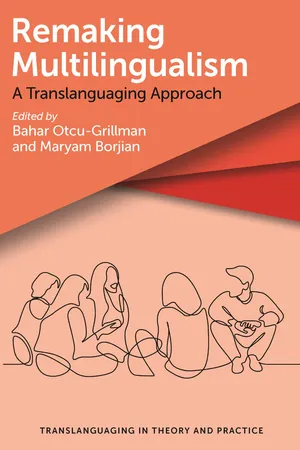
This book is both a collection of cutting-edge research in the areas of multilingualism, translanguaging and bilingual education by leading scholars in these fields, and a tribute to the research and influence of Ofelia García. The chapters use a variety of methodological approaches and research designs to address topics across language policy, sociology of language and bilingual education, representing the full breadth of Ofelia García's scholarship. Combined with the empirical chapters are more personal chapters which testify to the contributions Ofelia has made as a mentor, colleague and friend. The book recognizes Ofelia García's place at the centre of a movement to remake multilingualism in the service of linguistic equality, justice, pluralism, diversity and inclusion in schools and societies worldwide.
- English
- ePUB (mobile friendly)
- Available on iOS & Android
eBook - ePub
About this book
Information
Introduction (Part One): The Local Roots and Global Reach of Ofelia García’s Multilingualism
Maryam Borjian1
De donde crece la palma.
[I am] from the land where the palm grows.
José Martí (1853−1895)
The Cuban royal palm is an elegant and majestically tall tree with roots deeply seated in the Cuban soil, but with an outward-looking gaze that gives passers-by the impression that the tree is in search of all the many things standing before it, in the distant horizon, way beyond the local landscapes and perhaps even overseas. Native to Central America, this tree has inspired generations of poets, singers and artists across territorial borders of Central American nation states. In Cuba, where the splendor of this tree brought it the title of ‘royal’, it has been a source of inspiration to many, including to José Martí, the 19th century Cuban poet, whose verse adorns the opening of this introduction. This centuries-old tree with its locally grounded roots and globally directed outlook is used here as one of two metaphors (the other will follow shortly) to cast light on the extraordinary life and fruitful academic track record of Ofelia García, a leading intellectual, writer, scholar, sociolinguist, language activist and educator of our time, in whose honor this book is written.
Born in Cuba, García spent a blissful childhood, as she reflected on it many years later (García, 2017), under the cool shade and the wondrous gaze of royal palms. Was it there, as she was developing her roots alongside those of the royal palm, that the tree inspired her to keep her gaze always towards the distant horizon? At the time, the term ‘globalization’ as we know and talk about it today was not widely known. Yet, the royal palm must have left its imprint on García’s mind, for many years later, when she became a professor and scholar, concepts like the locality of roots and the globality of thoughts became central themes of her sociolinguistic investigations. In spite of her close bond with the royal palm, her alliance with her beloved tree came to an abrupt end, when at the age of eleven, she and her family had to leave home to take permanent refuge in the United States due to the radical sociopolitical changes that were taking place in the country.
In America, New York City was their chosen destination. Where could possibly be a better destination than the Big Apple for a girl who was aware of her roots but passionate enough to grow beyond them and learn about the many new things that were awaiting in her new surroundings? This mega metropolis was globalized way before the birth of contemporary globalization. To her, this city must have resembled a magnificent patchwork of hybrid peoples, ethnicities, languages, cultures, customs and traditions that were all like colorful threads that had long before been interwoven into the fabric of a cosmopolitan way of life. Was it then that she felt that she was going to like this city? She was, of course, too young then to make anything out of the city, but gradually its enormous hybridity and diversity must have impressed her greatly for she has stayed ever since and become a New Yorker. Of her many books, The Multilingual Apple (García & Fishman, 1997), may best capture García’s appreciation of the city’s expansive multilingualism.
New York had a lot to offer García, but not the royal palm tree of her yesteryears’ childhood. This tree was utterly foreign to the city’s cold climate. Instead, New York offered her its finest and most inspirational tree, the linden − known for its tall stature, abundant leaves and beautiful flowers with refreshing fragrances floating into the air every spring. Rooted in Greek mythology as the symbol of love and friendship, the linden has inspired generations of European poets and writers over centuries: from England’s William Shakespeare (1564−1616) to the German Wilhelm Müller (1794−1827).
Although the linden tree is cherished for inspiring feelings of protection, love and friendship − all the very good qualities of García’s inner self − the tree has also shown her another face of New York City: its towering resilience and strength. Often heaving and cracking through the pavement of the city’s wide sidewalks, the spreading roots of linden are there in the walkways to remind the urban passers-by that nature exists and defies our limiting, if not fully selfish, way of life − a way of life through which we have long been marginalizing nature as we push it out of our towns, cities and countries throughout the world. Disregarding such a selfish wish, the linden trees of New York City continue breaking through the pavement as a means of claiming more space for themselves and their roots than the limited space given to them by us or by the city’s authorities.
Before New York City could notice the presence of this newcomer young girl on its soil, García was already developing her roots alongside those of the lindens in the city’s sidewalks. Are García’s enormous strength, resilience and loving and sheltering character the fruits of her alliance with the linden tree? Was it the linden who inspired her to see, question, problematize and challenge another aspect of humans’ limiting way of life − the one constructed socially, often by visible or invisible forces (or voices) of authorities as a means of categorizing people to favor some but exclude some others? This I do not know. Yet, as said by Alastair Pennycook (2012), critical resistance requires critical writing. Critical resistance to those forms of authority whose decisions (or unjust policies) limit humans’ fluid ways of life (whether social, cultural or linguistic) is another characteristic of García’s writings.
Regardless of her enormous passion for learning about all the new things that enclosed her in her adapted home, García’s immigrant/refugee status placed her within a vertical chart of sociocultural and linguistic hierarchies, to which she was not accustomed. She first encountered such a categorization in schools, where she was told that her English was not good, because of which she had to be placed in remedial English classes. As for her first language, Spanish, that was regarded as inappropriate or simply irrelevant. All that mattered back then, and perhaps still today, was English − the yardstick used to assess the intellectual abilities of minoritized students in standardized tests in American schools. Thus, at a very early age, she learned, not from books but from her first-hand experiences, what it meant to be an immigrant, a minority or a foreign other, with a foreign language, accent, culture and perhaps, imagination, hopes and dreams, on which she once remarked:
In making sense of the experiences of others and caring for them, I make sense of myself. I care because I know what it feels like to be told I am stupid because I didn’t speak English, to be placed in remedial language arts classes where language use was solely mechanical, to score low in standardized assessments that did not measure what I knew, to be told that my Spanish was not ‘good’ because it showed the signs of English, to be told to teach in English only when my students only spoke Spanish. My sense of language in the world did not come solely from books, but more from experience. (García, 2017: xiii)
Many years later in the 1980s when she obtained her PhD in Spanish Literature from the Graduate Center of the City University of New York, she knew in her heart that it was language that she wanted to pursue. Although literature never left her and has left its imprints on her poetic style of writing, it was language that drove a heartfelt quest that emerged from within. She wanted to step into the very field that had once categorized her as the foreign other, the inferior other. Determined to make a difference in the lives of minoritized students in schools and their marginalized ethnolinguistically diverse families in the wider society, she began her advocacy for bilingualism, multilingualism and bilingual education; an advocacy for linguistic themes that barely existed at the time, or if they existed they were not the established concepts we know and talk about today. She was determined, nonetheless.
‘Where there is a will, there is a way’, as the saying goes, and will is what García has had in abundance. Her heartfelt quest soon led her to Joshua Fishman (1926−2015), her life-time mentor, colleague and friend. The two together became a greater whole, using a macro sociolinguistic lens, known as the Sociology of Language, in their sociolinguistic and educational linguistic investigations. Although García always emphasizes (García & Schiffman, 2006) whatever she knows about language, she learned in ‘Joshua Fishman 101’,2 she must have awed him too.
Once García began teaching, lecturing and writing, it all poured out so naturally and organically from within. What she had inside her was a vast treasury of lived experiences that were rich, insightful, intellectually of superb quality, but most importantly, honest and truthful. They were the real experiences of real peoples with fluid language practices, patchwork cultures and fragmented identities. They were the lived experiences of real people who lived not in an imaginary world of books but in the real world, the physical and social world that surrounds us all. Who could read about such experiences and still try to deny, toss them out, or label them as irrelevant data?
When García began her academic journey some four decades ago or so, little did she know how she would awe and inspire generations of scholars with her enormous gift of intellectuality. Little did she know of the extensive contributions that she would make to the vast realm of language studies across academic disciplines: from bilingualism and multilingualism to the sociology of language, from language policies and ideologies to language inequalities, injustice and linguistic human rights, from language and globalization to the glocality of knowledge and ideas and from educational linguistics to translanguaging and language teacher training, to name but a few. She has been able to do all this because she has lived the languages about which she writes. She has lived the cultures on which she reflects. And most importantly, she has lived with the people whose lives, languages, cultures and identities alongside their other existential issues and challenges have been voiced in her writings.
Hence, García’s story with language is not that of a sociolinguist or of an educator solely but rather that of a soul who has thrown herself into a field, a current or an academic discipline as a means of casting light on the lives of others; not those from the centers or the cores of our towns, cities or countries, but those from the margins, the peripheries, the in-between spaces that exist everywhere and anywhere throughout the world but yet are often forgotten. She uses her gift of intellectuality and knowledge to give voice to the voiceless and power to the powerless people of the margins. Seeing marginality as a source of strength but not a weakness, García stands in the periphery and from there she looks, thinks and writes about the marginalized and minoritized people. This action, in turn, disturbs both the flow and the framework of knowledge, whose boundaries have long been decided by the will of the authorities at the centers, the cores or the metropoles throughout the world. This is, indeed, an act of decolonization on García’s part − a decolonization of the field of education and language studies (Thiong’o, 2012).
Like the linden trees of her beloved New York City, through her research García tells us how to challenge various forms of authority, including those of the western intellectuals and their narrow perceptions of language in education and in the wider society. Labeling such a perception a ‘monoglossic ideology’, rooted in centuries-old monoglossic practices of the western societies, García offers us a fresh lens; a lens constructed by her to remind us of what Jacques Derrida (1974) calls ‘différance’. It is a plea to go beyond the Eurocentric and other forms of authority-driven approaches to be able to see the surrounding world and assign meanings to what we see through a ‘heteroglossic’ or ‘transglossic’ lens, which will, in turn, allow us to see multilingualism, linguistic diversity, pluralism and inclusion as realities of human lives (whether monolingual, bilingual or multilingual citizens) from throughout the world (García, 2009).
Although native to Cuba and other Central American nation states, the royal palm has transcended the locality of space. Planted as an ornamental tree in many other parts of the world, today the royal palm is no longer territorialized. What makes García’s research boundless with enduring legacies is precisely the way her ideas and ideals have gone global, way beyond the geopolitical and territorial borders of nation states. The reason is clear. García’s research gives us a vision that goes beyond named languages and beyond nation states to center on the speakers themselves. It is a vison of people, of each and every one of us, languaging here and there throughout the world, while using our entire linguistic repertoire and resources to speak, live, work, dream, love and care for one another (García, 2009).
It would be remiss of us not to mention other individuals who have left their imprints on García’s mind and life. One such notable individual is Ricardo Otheguy, an eminent linguist and prolific scholar from the Graduate Center of the City University of New York. About him, she once remarked:
And how can I talk about a husband and colleague? […] Ricardo has been a most patient listener, and he has given me room to disagree, to hold different views. He has never complained about the attention I pay to my students and my work, even though sometimes it takes away from things that we both hold dear. I have learned more from him than from any other, about language, but also about history, politics, and life in general. (García, 2009: xiv)
Along with them happened a happy Cuban-American family. Their three children − Eric, Raquel and Emma − not only made them happy with endless love, but also inspired them with their translanguaging. As proud parents, they watched, talked and listened to their children, and all this languaging germinated the seeds of some of García’s scholarship.
Ofelia García’s enormous gifts of intellectuality, brilliance of thought coupled with her profound love for humanity are not the only characteristics of her academic endeavors that have awed and inspired many over the past several decades. Her immeasurable humility, warmth of character, abundant love and her sheltering personality have made her a true mentor, colleague and friend to many. Together, we join in this collective volume to honor Ofelia García’s enduring commitment to the cause of linguistic pluralism, diversity, justice and inclusion in schools, communities, societies and the nation states of the world − both those of the global North and those of the global South.
Notes
(1) I am grateful to the following individuals who read an earlier draft of this essay and offered me their invaluable suggestions, including Professor Mary Curran (Rutgers University), Professor Nancy Hornberger (University of Pennsylvania), my co-editor of this volume Professor Bahar Otcu-Grillman (Mercy College) and my life-time colleague, spouse and friend Dr Habib Borjian (Columbia University before and Rutgers University now).
(2) 101 stands for an introductory course on any topic for beginners in American universities.
References
Derrida, J. (1974) Of Grammatology. Baltimore and London: John Hopkins University.
García, O. (2009) Bilingual Education in the 21st Century: A Global Perspective. Malden: Wiley-Blackwell.
García, O. (2017) Why we care: Language in a globalized world. In M. Borjian (ed.) Language and Globalization: An Autoethnographic Approach (pp. xiii−xvi). London and New York: Routledge.
García, O. and Fishman, J.A. (eds) (1997) The Multilingual Apple: Languages in New York (1st edn). Berlin: Mouton de Gruyter.
García, O. and Schiffman, H. (2006) Fishmanian sociolinguistics. In O. García , R. Peltz and H.F. Schiffman (eds) Language Loyalty, Continuity and Change (pp. 3−68). Clevedon: Multilingual Matters.
Pennycook, A. (2012) Language and Mobility: Unexpected Places. Bristol: Multilingual Matters.
Thiong’o, N. (2012) The challenge – ndaraca ya thiomi: Languages as bridges. In V. Rapatahana and P. Bunce (eds) English Language as Hydra: Its Impacts on Non-English Language Cultures (pp. 11–17). Bristol: Multilingual Matters.
Introduction (Part Two): A Tribute to Ofelia García: A Translanguaging Approach
Bahar Otcu-Grillman
Spanish runs through my heart, but English rules my veins.(Study participant, 2016)
Bilingual education in the United States has gone through a lot of turmoil for centuries. It came a long way from the early 18th century, when it was permitted as an essential part of the education system, to the days it became restricted between the mid-19th and mid-20th centuries, then to 1950s, when it gained more opportunities because of national security laws allowing education in foreign languages (García et al., 2013). Today, in the 21st century, still easily manipulated by political tendencies and biased views towards a multilingual and multicultural society, bilingual education and how it is implemented in schools continue to be controversial topics debated by politicians, sociolinguists and educators. For 40 years, Ofelia García has been a leading ‘sociolinguist who has specialized in the education of bilinguals’,1 advocating for bilingualism, multilingualism and true bilingual education not only for language minorities but for all, and not only in the United States, but throughout the world.
Ofelia García, who has recently been elected to the National Academy of Education (2018) and been the recipient of countless awards for her scholarship, teaching and mentoring, started her outstanding academic career as a Bilingual and ESL (English as a Second Language) teacher in New York City. Since then, having brought her expertise in teaching bilingual students into her academic career, she has taught, researched and written extensively about bilingual education and multilingualism (see a list for her publications from Multilingual Matters in the Appendix of this book). She visited diverse ethnolinguistic communities in the United States and multiple countries of the world and raised awareness about the teaching of languages other than English, as already depicted in detail by several contributors of this book (see Borjia...
Table of contents
- Frontcover
- Title Page
- Copyright Page
- Contents
- Contributors
- Foreword A Note on Ofelia García
- Preface The Genesis of this Book
- Introduction Part One: The Local Roots and Global Reach of Ofelia García’s Multilingualism
- Part Two: A Tribute to Ofelia García: A Translanguaging Approach
- Part 1: Remaking Multilingualism
- 1 Imagining Multilingualism with Ofelia: Translanguaging and the Continua of Biliteracy
- 2 A Mentor from Afar
- 3 Ofelia García’s Global Classroom
- 4 A Letter for Ofelia García
- Part 2: Bilingual Pedagogies and Teacher Education
- 5 Emergent Bilinguals and Trans-Semiotic Practices in the New Media Age
- 6 Using ‘Transfeaturing’ to Explore Differentiation in the Pursuit of Translanguaging Pedagogical Goals
- 7 Translanguaging in an Urban Social Justice Teacher Education Program
- 8 Where the Banyan Tree Grows: Nurturing Teachers’ Translanguaging Pedagogy through A Study Group
- 9 Bilingual Teachers Engage: Poetic Inquiry as a Site for Languaging Dilemmas
- Part 3: Bilingual Community Education
- 10 Parental Voices in Bilingual Education
- 11 Translanguaging in Bilingual Community Education
- 12 Bilingual Education: Making a U-Turn with Parents and Communities
- Part 4: Language Policy and Language Ideologies
- 13 Translanguaging: An Ideological Perspective
- 14 Multiple Actors and Interactions Are at Work: English Language Policies in Post-Revolutionary Iran
- 15 Reimagining Language Policy through the Lived Realities of Bilingual Youth
- 16 American Jewish Summer Camps as Translanguaging Thirdspaces
- Part 5: Epilogue
- Afterword A Brief History of Work and Play with Ofelia García
- Appendix Ofelia García’s Publications with Multilingual Matters
Trusted by 375,005 students
Access to over 1.5 million titles for a fair monthly price.
Study more efficiently using our study tools.
Frequently asked questions
Yes, you can cancel anytime from the Subscription tab in your account settings on the Perlego website. Your subscription will stay active until the end of your current billing period. Learn how to cancel your subscription
No, books cannot be downloaded as external files, such as PDFs, for use outside of Perlego. However, you can download books within the Perlego app for offline reading on mobile or tablet. Learn how to download books offline
Perlego offers two plans: Essential and Complete
- Essential is ideal for learners and professionals who enjoy exploring a wide range of subjects. Access the Essential Library with 800,000+ trusted titles and best-sellers across business, personal growth, and the humanities. Includes unlimited reading time and Standard Read Aloud voice.
- Complete: Perfect for advanced learners and researchers needing full, unrestricted access. Unlock 1.5M+ books across hundreds of subjects, including academic and specialized titles. The Complete Plan also includes advanced features like Premium Read Aloud and Research Assistant.
We are an online textbook subscription service, where you can get access to an entire online library for less than the price of a single book per month. With over 1.5 million books across 990+ topics, we’ve got you covered! Learn about our mission
Look out for the read-aloud symbol on your next book to see if you can listen to it. The read-aloud tool reads text aloud for you, highlighting the text as it is being read. You can pause it, speed it up and slow it down. Learn more about Read Aloud
Yes! You can use the Perlego app on both iOS and Android devices to read anytime, anywhere — even offline. Perfect for commutes or when you’re on the go.
Please note we cannot support devices running on iOS 13 and Android 7 or earlier. Learn more about using the app
Please note we cannot support devices running on iOS 13 and Android 7 or earlier. Learn more about using the app
Yes, you can access Remaking Multilingualism by Bahar Otcu-Grillman,Maryam Borjian in PDF and/or ePUB format, as well as other popular books in Languages & Linguistics & Inclusive Education. We have over 1.5 million books available in our catalogue for you to explore.