- 323 pages
- English
- ePUB (mobile friendly)
- Available on iOS & Android
eBook - ePub
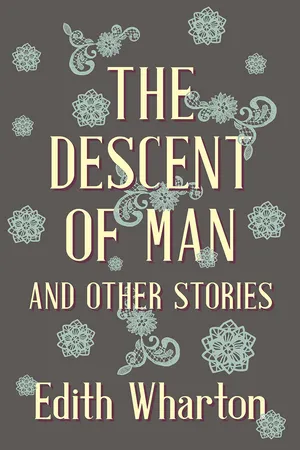
The Descent of Man and Other Stories
About this book
"The Descent Of Man And Other Stories" was the third collection of short stories by Edith Wharton, first published in 1904. The tales deal with a variety of subjects including friendship, marriage, love and even ghosts. This volume is highly recommended for lovers of the short story form, and it is not to be missed by fans and collectors of Wharton's seminal work. The stories include: "The Descent of Man", "The Other Two", "Expiation", "The Lady's Maid's Bell", "The Mission of Jane", "The Reckoning", "The Letter", "The Dilettante", "The Quicksand", and "A Venetian Night's Entertainment". Edith Wharton (January 24, 1862 - August 11, 1937) was an American novelist, writer of short stories, and designer. She won the Pulitzer Prize for literature in won the 1921 for her novel "The Age of Innocence" (1920) and was nominated for the Nobel prize in 1927, 1928 and 1930. Wharton was famous for her novels, within which she married her person experience of life in America's privileged classes with brilliant wit and mastery of language. Many vintage books such as this are becoming increasingly scarce and expensive. We are republishing this volume now in an affordable, modern, high-quality edition complete with a specially commissioned new biography of the author.
Information
Print ISBN
9781444651317
9781444652215
Subtopic
ClassicsEXPIATION
I.
"I CAN never," said Mrs. Fetherel, "hear the bell ring without a shudder."
Her unruffled aspect—she was the kind of woman whose emotions never communicate themselves to her clothes—and the conventional background of the New York drawing-room, with its pervading implication of an imminent tea-tray and of an atmosphere in which the social functions have become purely reflex, lent to her declaration a relief not lost on her cousin Mrs. Clinch, who, from the other side of the fireplace, agreed with a glance at the clock, that it was the hour for bores.
"Bores!" cried Mrs. Fetherel impatiently. "If I shuddered at them, I should have a chronic ague!"
She leaned forward and laid a sparkling finger on her cousin's shabby black knee. "I mean the newspaper clippings," she whispered.
Mrs. Clinch returned a glance of intelligence. "They've begun already?"
"Not yet; but they're sure to now, at any minute, my publisher tells me."
Mrs. Fetherel's look of apprehension sat oddly on her small features, which had an air of neat symmetry somehow suggestive of being set in order every morning by the housemaid. Some one (there were rumors that it was her cousin) had once said that Paula Fetherel would have been very pretty if she hadn't looked so like a moral axiom in a copy-book hand.
Mrs. Clinch received her confidence with a smile. "Well," she said, "I suppose you were prepared for the consequences of authorship?"
Mrs. Fetherel blushed brightly. "It isn't their coming," she owned—"it's their coming now."
"Now?"
"The Bishop's in town."
Mrs. Clinch leaned back and shaped her lips to a whistle which deflected in a laugh. "Well!" she said.
"You see!" Mrs. Fetherel triumphed.
"Well—weren't you prepared for the Bishop?"
"Not now—at least, I hadn't thought of his seeing the clippings."
"And why should he see them?"
"Bella—won't you understand? It's John."
"John?"
"Who has taken the most unexpected tone—one might almost say out of perversity."
"Oh, perversity—" Mrs. Clinch murmured, observing her cousin between lids wrinkled by amusement. "What tone has John taken?"
Mrs. Fetherel threw out her answer with the desperate gesture of a woman who lays bare the traces of a marital fist. "The tone of being proud of my book."
The measure of Mrs. Clinch's enjoyment overflowed in laughter.
"Oh, you may laugh," Mrs. Fetherel insisted, "but it's no joke to me. In the first place, John's liking the book is so—so—such a false note—it puts me in such a ridiculous position; and then it has set him watching for the reviews—who would ever have suspected John of knowing that books were reviewed? Why, he's actually found out about the Clipping Bureau, and whenever the postman rings I hear John rush out of the library to see if there are any yellow envelopes. Of course, when they do come he'll bring them into the drawing-room and read them aloud to everybody who happens to be here—and the Bishop is sure to happen to be here!"
Mrs. Clinch repressed her amusement. "The picture you draw is a lurid one," she conceded, "but your modesty strikes me as abnormal, especially in an author. The chances are that some of the clippings will be rather pleasant reading. The critics are not all union men."
Mrs. Fetherel stared. "Union men?"
"Well, I mean they don't all belong to the well-known Society-for-the-Persecution-of-Rising-Authors. Some of them have even been known to defy its regulations and say a good word for a new writer."
"Oh, I dare say," said Mrs. Fetherel, with the laugh her cousin's epigram exacted. "But you don't quite see my point. I'm not at all nervous about the success of my book—my publisher tells me I have no need to be—but I am afraid of its being a succes de scandale."
"Mercy!" said Mrs. Clinch, sitting up.
The butler and footman at this moment appeared with the tea-tray, and when they had withdrawn, Mrs. Fetherel, bending her brightly rippled head above the kettle, continued in a murmur of avowal, "The title, even, is a kind of challenge."
"'Fast and Loose,'" Mrs. Clinch mused. "Yes, it ought to take."
"I didn't choose it for that reason!" the author protested. "I should have preferred something quieter—less pronounced; but I was determined not to shirk the responsibility of what I had written. I want people to know beforehand exactly what kind of book they are buying."
"Well," said Mrs. Clinch, "that's a degree of conscientiousness that I've never met with before. So few books fulfil the promise of their titles that experienced readers never expect the fare to come up to the menu."
"'Fast and Loose' will be no disappointment on that score," her cousin significantly returned. "I've handled the subject without gloves. I've called a spade a spade."
"You simply make my mouth water! And to think I haven't been able to read it yet because every spare minute of my time has been given to correcting the proofs of 'How the Birds Keep Christmas'! There's an instance of the hardships of an author's life!"
Mrs. Fetherel's eye clouded. "Don't joke, Bella, please. I suppose to experienced authors there's always something absurd in the nervousness of a new writer, but in my case so much is at stake; I've put so much of myself into this book and I'm so afraid of being misunderstood...of being, as it were, in advance of my time... like poor Flaubert....I knowyou'll think me ridiculous... and if only my own reputation were at stake, I should never give it a thought...but the idea of dragging John's name through the mire..."
Mrs. Clinch, who had risen and gathered her cloak about her, stood surveying from her genial height her cousin's agitated countenance.
"Why did you use John's name, then?"
"That's another of my difficulties! I had to. There would have been no merit in publishing such a book under an assumed name; it would have been an act of moral cowardice. 'Fast and Loose' is not an ordinary novel. A writer who dares to show up the hollowness of social conventions must have the courage of her convictions and be willing to accept the consequences of defying society. Can you imagine Ibsen or Tolstoy writing under a false name?" Mrs. Fetherel lifted a tragic eye to her cousin. "You don't know, Bella, how often I've envied you since I began to write. I used to wonder sometimes—you won't mind my saying so?—why, with all your cleverness, you hadn't taken up some more exciting subject than natural history; but I see now how wise you were. Whatever happens, you will never be denounced by the press!"
"Is that what you're afraid of?" asked Mrs. Clinch, as she grasped the bulging umbrella which rested against her chair. "My dear, if I had ever had the good luck to be denounced by the press, my brougham would be waiting at the door for me at this very moment, and I shouldn't have to ruin this umbrella by using it in the rain. Why, you innocent, if I'd ever felt the slightest aptitude for showing up social conventions, do you suppose I should waste my time writing 'Nests Ajar' and 'How to Smell the Flowers'? There's a fairly steady demand for pseudo-science and colloquial ornithology, but it's nothing, simply nothing, to the ravenous call for attacks on social institutions—especially by those inside the ins...
Table of contents
- Edith Wharton
- THE DESCENT OF MAN
- THE OTHER TWO
- EXPIATION
- THE LADY'S MAID'S BELL
- THE MISSION OF JANE
- THE RECKONING
- THE LETTER
- THE DILETTANTE
- THE QUICKSAND
- A VENETIAN NIGHT'S ENTERTAINMENT
Trusted by 375,005 students
Access to over 1.5 million titles for a fair monthly price.
Study more efficiently using our study tools.
Frequently asked questions
Yes, you can cancel anytime from the Subscription tab in your account settings on the Perlego website. Your subscription will stay active until the end of your current billing period. Learn how to cancel your subscription
No, books cannot be downloaded as external files, such as PDFs, for use outside of Perlego. However, you can download books within the Perlego app for offline reading on mobile or tablet. Learn how to download books offline
Perlego offers two plans: Essential and Complete
- Essential is ideal for learners and professionals who enjoy exploring a wide range of subjects. Access the Essential Library with 800,000+ trusted titles and best-sellers across business, personal growth, and the humanities. Includes unlimited reading time and Standard Read Aloud voice.
- Complete: Perfect for advanced learners and researchers needing full, unrestricted access. Unlock 1.5M+ books across hundreds of subjects, including academic and specialized titles. The Complete Plan also includes advanced features like Premium Read Aloud and Research Assistant.
We are an online textbook subscription service, where you can get access to an entire online library for less than the price of a single book per month. With over 1.5 million books across 990+ topics, we’ve got you covered! Learn about our mission
Look out for the read-aloud symbol on your next book to see if you can listen to it. The read-aloud tool reads text aloud for you, highlighting the text as it is being read. You can pause it, speed it up and slow it down. Learn more about Read Aloud
Yes! You can use the Perlego app on both iOS and Android devices to read anytime, anywhere — even offline. Perfect for commutes or when you’re on the go.
Please note we cannot support devices running on iOS 13 and Android 7 or earlier. Learn more about using the app
Please note we cannot support devices running on iOS 13 and Android 7 or earlier. Learn more about using the app
Yes, you can access The Descent of Man and Other Stories by Edith Wharton in PDF and/or ePUB format. We have over 1.5 million books available in our catalogue for you to explore.